
How Gemini Omni Actually Works Under the Hood
Gemini Omni is Google's first natively multimodal foundation model: a single transformer that ingests text, images, audio, and video in the same forward pass and emits video, audio, and stills back, without the model ever leaving its own latent space to swap modalities.
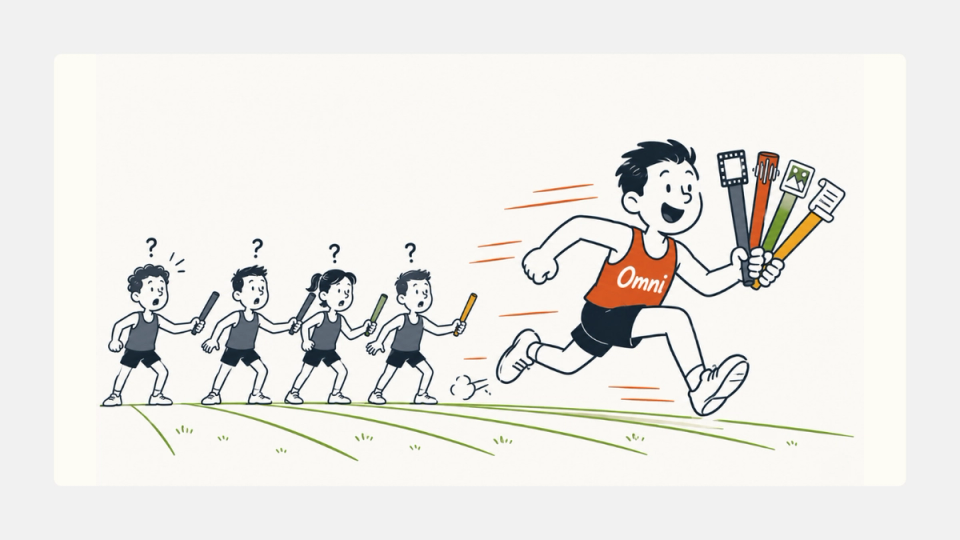
That description is doing more work than it looks. For two years, every "multimodal" model on the market, including prior Gemini versions, GPT-4o, and Claude, was secretly a pipeline. Vision encoder feeds a language model. Language model writes a description. Description feeds a separate diffusion model. The pipeline produced impressive demos and brittle products. Omni is the first frontier model that ships without the relay race.
This piece is the version you send to a teammate who has read four "Google launches Omni" recaps and still cannot explain what changed at the architecture level. The thesis is simple: the relay race is what made conversational multimedia broken, and dissolving it is what makes Omni the first model that lets you talk to video the way you talk to a chatbot.
The Quick Answer
What is Gemini Omni?
Google's first natively multimodal world model. One transformer ingests and generates across text, images, audio, and video without modality-switching pipelines, served on Google's new TPU 8t and TPU 8i silicon. (blog.google)
Why does it matter?
Every prior "multimodal" model was a chain of specialist models stitched together. Omni replaces the chain with a single forward pass, which changes what you can ship on top of it.
The non-obvious truth: The headline capability is not better video. It is conversational continuity across modalities. You can edit a clip by talking to it across twelve turns, and the model remembers what it rendered on turn three. No prior architecture could do that without a custom orchestration layer.
The Foundations (the part everyone explains)
The basics first, fast, because you have read these elsewhere.
At Google I/O 2026 on May 19, Google announced Gemini Omni and shipped the first member of the family, Gemini Omni Flash, into the Gemini app, Google Flow, and YouTube Shorts. The Flash variant generates 10-second video clips with synchronized audio from a single multimodal prompt and lets you edit those clips through chat. (blog.google)
Omni is positioned as a "world model" in DeepMind's framing. Google's three official capability promises are: edit any video step by step in chat, generate scenes grounded in real-world physics and knowledge, and accept any combination of inputs to drive any combination of outputs. (DeepMind)
The infrastructure underneath is the eighth-generation Tensor Processing Unit, split for the first time into specialized training silicon (TPU 8t) and inference silicon (TPU 8i). The 8t is built for cross-data-center training across more than one million TPUs via Pathways and JAX. The 8i clocks at 1,500 tokens per second on the Flash tier, with on-chip SRAM and HBM sized to hold full KV caches without spilling to off-chip memory. (CNBC)
Omni fuses the reasoning of the main Gemini model with three previously separate Google generative systems: Veo for video synthesis, Nano Banana for image editing, and Project Genie for interactive world simulation. (VentureBeat)
So far, so press release. Everything below this is where surface coverage stops.
Where the Surface Explanations Break
What does "native multimodal" actually mean at the architecture level?
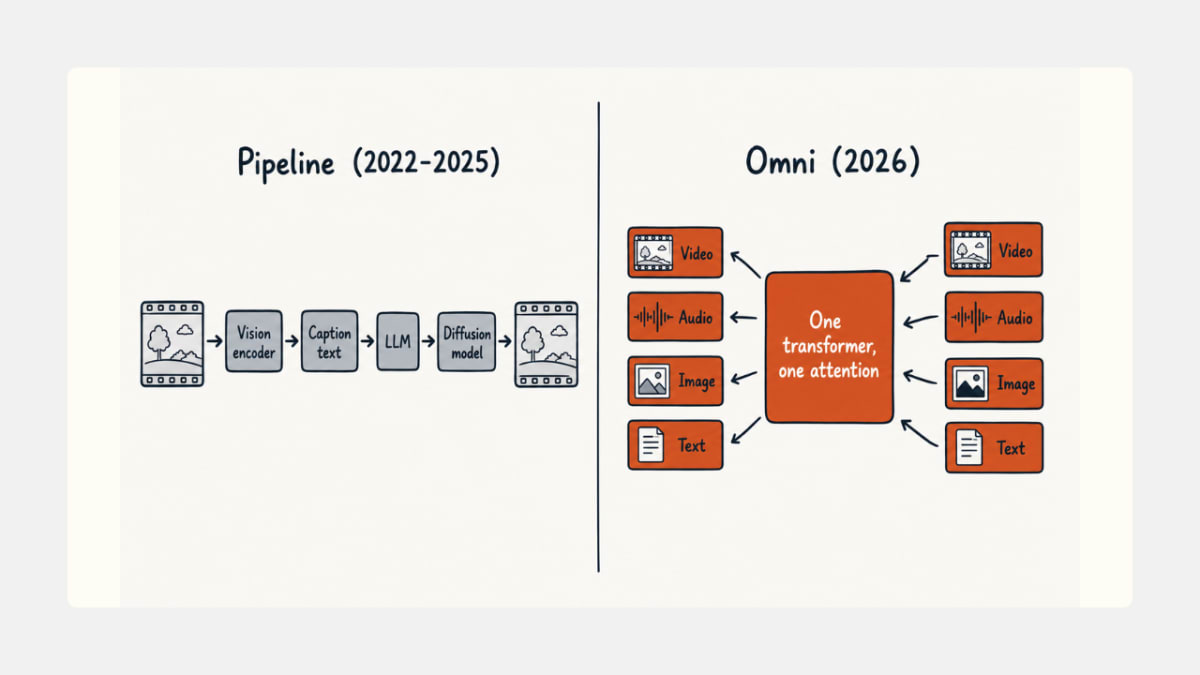
It means the model has one tokenizer, one transformer stack, and one set of attention weights operating on every modality at once. Inputs are projected into a shared embedding space at ingestion, not after a separate captioning step, and outputs flow out of the same stack that did the reasoning.
In a pipeline model, a video clip travels like this: video frames go to a vision encoder, the encoder emits embeddings, those embeddings get either passed as opaque tokens or, more commonly, summarized as a text caption that the language model then reasons about. By the time the LLM "sees" the clip, the clip has been compressed into something the LLM was trained on, namely text.
In Omni, the same transformer attends to raw video tokens, raw audio tokens, raw image tokens, and raw text tokens in the same self-attention block. There is no caption step. The model is reasoning about the actual video, not about a sentence that approximates the video. This is the same architectural shift that Meta argued for when it shipped Muse Spark, whose real superpower turned out to be seeing rather than reasoning. Omni takes that pattern and applies it to the generation half too.
The practical consequence: prompt fidelity goes up because the model is no longer answering a question about a caption of a video, it is answering a question about the video itself.
Why does conversational editing only work in this architecture?
Because state lives inside the model's attention, not in a session controller pasting prior frames back into a fresh generation. The KV cache carries every previous turn forward, so Omni can refine the same scene across many edits without losing what it rendered three turns earlier or what the user clarified on turn five.
In a pipeline product like Runway, Pika, or pre-Omni Veo, every edit is effectively a fresh generation. The product layer tries to fake continuity by passing the prior frame, the prior prompt, and some lock-region masks back to the diffusion model on each turn. The model itself has no memory of turn one when it runs turn five.
Omni keeps the KV cache live across turns. The TPU 8i is built specifically to host that cache on-chip, which is why Google bothered to mention the SRAM and HBM sizing in the hardware section of the launch. (Efficiently Connected) When you say "now change the butterfly to a bee, but keep everything else," the model is not regenerating from scratch and trying to match. It is continuing a sequence it has been attending to the whole time.
That is the same architectural move that powered OpenAI's GPT-Realtime-2 when it collapsed the voice stack two weeks earlier. The pattern is now clear across both vendors: when you replace the pipeline with one model holding state, conversational behavior emerges as a side effect of the architecture, not as a feature shipped on top.

What does "world model" mean here, beyond marketing?
A world model is one trained to predict the consequences of actions in a simulated environment, not just to predict the next token in a sequence of text. DeepMind's claim is that Omni was trained on enough video data with physics-grounded annotations to internalize how gravity, fluid dynamics, kinetic energy, and material properties behave across time.
The verifiable signal is in the model card: Omni's training set includes audio, video, image, and text data, with audio and video annotated at multiple levels of detail. (DeepMind) The model card does not publish numeric benchmarks at launch, which is the single biggest gap in the story right now.
What you can verify externally: ask Omni for "a glass of water knocked off a table edge by a cat," and the trajectory of the water, the angle of the glass, and the splash radius stay consistent across regenerations. Ask a pipeline model the same thing and you get a different physics every time, because each frame is being negotiated independently.
The catch: physics-consistent does not mean physics-correct. Omni is an excellent illusionist, not a simulator. Treat it like a render engine, not like Unreal.
The Edge Cases and Breakages
Three places where the abstraction leaks, in order of how much they matter for builders.
No benchmarks at launch. Google shipped Omni without publishing head-to-head scores on standardized evals like T2VA, I2VA, or R2VA. (WaveSpeed) The model card says these will be published when the API rolls out. That is unusual for a frontier launch. The honest read: the conversational-editing demo is the marketing surface, and the comparative numbers either are not ready or are not flattering yet. Independent third-party benchmarks will land in three to four weeks.
Audio editing is gated. Omni Flash ships with synchronized audio in the output but does not yet let you edit audio conversationally. You can ask for a different camera angle on the dog. You cannot yet ask for a different voice on the dog. Google says audio editing is coming, but at launch the audio is generate-only.
The "any input" claim hides a context window. Omni Flash today produces 10-second clips. The "any combination of inputs" language in the launch blog implies long-form video as input, but the public output ceiling, plus the practical context limits on input video tokens, mean you cannot yet feed it a 90-minute film and ask for a recut. The infrastructure to do that exists in principle on TPU 8t, but it is not exposed to users at launch.
None of these is a deal-breaker. They are the gap between the keynote slide and the API. Worth being honest about.
The Honest Take
A few limits of my own framing, named out loud.
I am calling Omni "the first" natively multimodal frontier model that ships at scale, and that is mostly true, but it deserves an asterisk. GPT-4o was natively multimodal on the output side for text and audio. Meta's Muse Spark was native on the input side for vision. Omni is the first model that is natively multimodal across all four major modalities, on both ingest and generation, in a product millions of people can use through the Gemini app on launch day. That is the version of "first" I am defending. Reasonable people will draw the line differently.
I am also taking DeepMind's "world model" framing at a higher resolution than the available evidence supports. The physics-aware behavior is real and visible in the demos, but how it generalizes to objects the training data never saw is unknown until the API opens up. The launch blog promises physics, but the model card does not publish the eval. The gap matters.
Finally, the conversational-editing claim depends on the KV cache surviving the user's full session. Google has not published the actual context length Omni Flash maintains in conversational mode. The longest demo session shown publicly was eight edits. Whether continuity holds at 30 edits, or 300, is something only sustained third-party use will reveal.
The Bottom Line
The headline is not that Google shipped a better video generator. The headline is that the pipeline architecture that defined "multimodal AI" from 2022 through early 2026 just lost its frontier-tier defender. Omni absorbs Veo, Nano Banana, and Project Genie into one model and exposes them as conversation, the same way ChatGPT once absorbed Whisper and DALL-E and exposed them as chat.
For builders, the implication is straightforward: if your product still ships a pipeline behind a chat UI, you have eighteen months at most before users notice the seams. Plan accordingly. For background on Google's larger trajectory through the rest of 2026, see Gemini 4 and what Google's actually building. For the immediate predecessor to this release, see Google's AI image and video tools and what actually changed. And for the sibling I/O 2026 announcement on the device side, see Gemini Intelligence, the on-device AI that actually works.
FAQ
Is Gemini Omni a single model or a family?
A family. Gemini Omni Flash is the first public member, generally available through the Gemini app, Google Flow, and YouTube Shorts at launch. Larger and slower siblings are expected to follow, mirroring the Flash, Pro, and Ultra tiering of the main Gemini line.
Is Omni replacing Gemini 3.5 Flash?
No. Gemini 3.5 Flash remains the workhorse for text-first tasks. Omni is the multimodal-first model. They will likely converge in a future Gemini 4 generation, but at launch they are distinct product lines.
Can I use Omni through an API today?
Not yet for general developers. At launch, Omni Flash is exposed through end-user surfaces (Gemini app, Flow, Shorts) with API access rolling out to enterprise customers first. (VentureBeat) Watch the DeepMind model card for the API switch.
How is Omni different from GPT-4o's multimodal mode?
GPT-4o is natively multimodal for text and audio I/O, with images on the input side, but it still routes to DALL-E or Sora for visual generation. Omni is natively multimodal across all four modalities on both ingest and generation, in the same forward pass.
Does Omni run on consumer hardware?
No. Omni is server-side only, trained on TPU 8t and served on TPU 8i. The on-device counterpart is Gemini Intelligence on Pixel devices, which is a different model entirely.
Will the output be watermarked?
Yes. Video output from Omni Flash carries SynthID watermarking, consistent with Google's other generative video releases. (WaveSpeed)
What does Omni mean for prompt engineering?
Prompts shift from "describe what you want" toward "show what you want and refine in conversation." Reference inputs do more work than text instructions. Expect prompt patterns from the image-generation era (negative prompts, weighted tokens, seed control) to fade in favor of multi-turn refinement loops.