
Google Did What Apple Promised: Gemini Intelligence Is the On-Device AI That Actually Works
For two years, Apple told a very specific story about its AI advantage. The story was about privacy. It was about your data staying on your device, processed by silicon you own, without a round trip to a distant server. Apple Intelligence, it said, was different because it was local first.
The story was partially true and partially aspirational. In practice, many Apple Intelligence features silently fell back to cloud processing, the more complex tasks never shipped on time, and Siri in 2025 remained the punchline it had been since 2018. The vision was sound. The execution was slow.
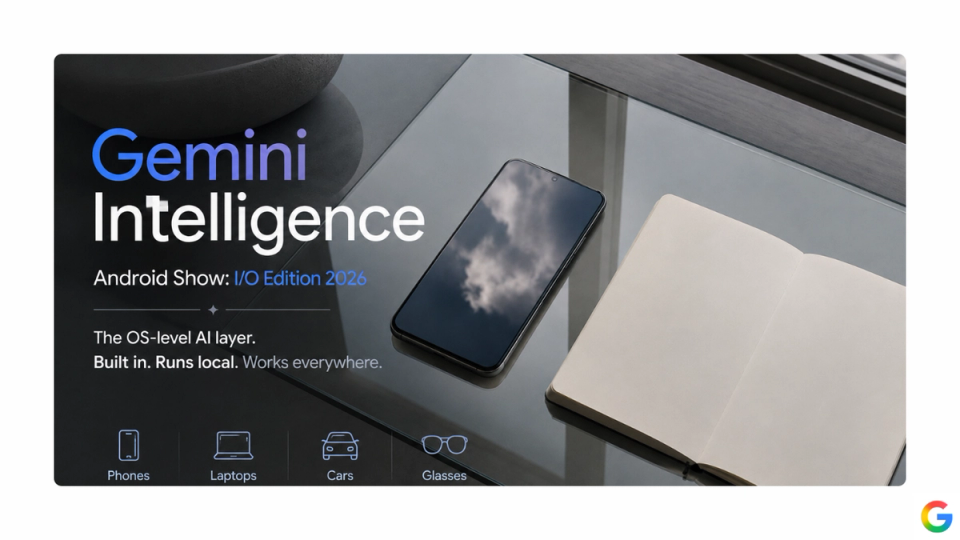
On May 12, 2026, at the Android Show IO Edition, Google announced Gemini Intelligence, and the contrast with Apple's story is hard to ignore. Not because Google made bold promises, but because of what is already shipping, what is rolling out this summer, and what the whole stack looks like together. Google's Android VP Sameer Samat summed up the direction in one line during a CNBC interview: "We're transitioning from an operating system to an intelligence system."
That is not a marketing line. It is a description of what was announced.
What Gemini Intelligence Actually Is
Gemini Intelligence is not a new version of the Gemini app. It is not a chatbot upgrade. It is Google's term for the AI layer now embedded at the operating system level across Android phones, Chrome for Android, Googlebook laptops, Android Auto, Wear OS, and Android XR glasses.
The way Digital Trends described it is accurate: it is the new umbrella term for the most advanced AI features, acting as an intelligent layer between Google's operating systems and you, the user. The AI is not something you open. It is something the device does.
As the official Google blog post on Gemini Intelligence put it, this is about helping you stay a step ahead by working proactively to get things done throughout your day, while keeping your data private and keeping you in control. That last part is not incidental. It is the whole argument.
The rollout starts this summer with Samsung Galaxy and Google Pixel phones, with broader availability across watches, cars, glasses, and laptops arriving later in 2026.
Every Feature, Explained Plainly
App Automation
This is the headline. Gemini can navigate multi-step workflows for you: booking a fitness class, building a grocery cart from a note in your notes app, finding a course syllabus in Gmail and adding required textbooks to your shopping cart. Gemini works in the background, progress shows as a notification, and the user confirms before any purchase or final action is taken.
The practical framing: you stop being the person who switches between five apps to complete one task. Gemini does the switching. You see the result and tap confirm.
Gemini in Chrome for Android
Google is introducing Gemini in Chrome to Android, allowing users to summarize content or ask questions about what they see on a web page. Android users will also get the experimental auto-browse feature that can navigate websites and complete tasks like booking a ticket on a user's behalf.
Gemini in Chrome can also help research, summarize and compare content across the web, and will be available on Android starting in late June. The autofill upgrade is notable: using Personal Intelligence, Android can now fill complex forms automatically, even across apps, by pulling relevant information from connected apps and services. The feature is strictly opt-in.
Rambler
Google launched a new feature in Gboard called Rambler that turns your speech into cleaned-up text, removing filler words like "ums" and "ahs" and also understanding when you say "Let's meet at 3 p.m., um, 2 p.m." and posting "Let's meet at 2 p.m." as a final result.
This is the same core feature as Wispr Flow and others, built directly into the keyboard, for free, as a system default. The connection to Google's standalone AI Edge Rambler app is obvious: Gboard's Rambler is the keyboard-level twin of the same on-device voice cleanup Google has been quietly testing as a standalone app. Together they represent Google's full-stack push into the voice AI space that paid tools have occupied until now.
Create My Widget
Create custom widgets using simple language to keep your most important information front and center. You describe what you want on your screen, and Gemini builds it. On Googlebook, this extends to a personal dashboard that pulls from Gmail, Calendar, and the web simultaneously.
Magic Cue
A proactive background feature. The device monitors context across your day and surfaces suggestions before you ask. Details on how broadly this runs locally versus via cloud are not fully disclosed yet, and the privacy architecture section below matters here.
The Privacy Architecture Behind It
This is the part that separates Gemini Intelligence from previous Google AI efforts, and it is worth taking seriously rather than skimming.
Google has grounded Gemini Intelligence in three core principles: granular user controls, security guardrails, and explicit intent for every feature.
Connecting Gemini to Autofill with Google is strictly opt-in, meaning you choose if and when you want to connect, and you can always turn it off. Gemini app automation for specific apps can be turned on or off individually in settings. Gemini starts to automate a task only when you tell it to, can only access the apps you allow, and is designed to require user confirmation before making purchases.
Google will enhance the Android Privacy Dashboard to show which AI assistants were active and which apps they used in the last 24 hours. Key parts of the AI security architecture are open-source, binary transparent, and audited by third-party experts.
That level of auditability is genuinely different from how most platform AI has been handled. Apple's Private Cloud Compute is private-by-architecture, which is one approach. Google's is transparent-by-publication, which is another. Neither is obviously better, but Google's approach does allow external verification in a way Apple's does not.
The more honest acknowledgment: some Gemini Intelligence features do route to Google's cloud infrastructure. Many Gemini Intelligence features leverage the same infrastructure that already protects Google products used by billions of people. Your data stays protected within Google's secure ecosystem. The choice Google is making is not pure local processing everywhere. It is local processing for most lightweight tasks, with secure cloud routing for heavier ones, with full user visibility into when each is happening.
That is more nuanced than "it all runs locally," but it is also more honest than what most competitors have offered. And for the core daily-use features like Rambler, form autofill, and widget creation, local Gemma-based models handle the bulk of processing.

Googlebook and What It Means for the Laptop Market
Googlebook is a new category of laptops built from the ground up for Gemini Intelligence, designed to work seamlessly with Android phones and powered by premium hardware. It combines ChromeOS and Android into a single operating system with Gemini at the core, and is coming from Acer, Asus, Dell, HP, and Lenovo this fall.
The features that make Googlebook genuinely different are not the specs:
Magic Pointer. Just wiggle your cursor and watch it come alive with Gemini, offering quick contextual suggestions every time you point at something on your screen. Point at a date in an email to set up a meeting, or select two images like your living room and a new couch to instantly visualize them together. This is Gemini Intelligence as a cursor feature. It does not require opening an app, typing a prompt, or switching contexts.
Quick Access. With Quick Access, you can easily view, search, or insert your phone's files on your laptop directly from the laptop's file browser, no transfers needed. Cross-device file access without cables, cloud sync apps, or AirDrop workarounds.
Create Your Widget. Prompt-based widget building on the desktop. You describe a dashboard you want, Gemini builds it from your Gmail, Calendar, and web data, and it sits on your desktop as a living widget.
Google says that Googlebook laptops will be powered by premium hardware as it moves from an operating system to an intelligence system. The target is not students buying budget Chromebooks. The target is MacBook users. Whether it succeeds depends entirely on execution, but the positioning is deliberate.
Googlebook is also part of a wider hardware-and-AI realignment across the industry. OpenAI building a phone to kill the App Store is the same bet from the opposite end: a company that owns the model trying to own the device. Google already owns the model, the OS, the search index, and now is putting all four under one lid. The Microsoft Copilot+ PC comparison is worth noting too. Copilot+ debuted in 2024 to highlight Windows laptops that can handle more Copilot tasks locally. The concept did not exactly catch fire. Google will need to show that Googlebook's AI features actually change daily workflows in ways Copilot+ largely failed to. The advantage Google has is that Gemini Intelligence is already shipping on phones before the laptops arrive, which means the habits form first.
How This Compares to Apple Intelligence
Apple framed its AI around a core claim: your data stays on your device. Apple emphasizes privacy-first on-device intelligence, while Google pushes forward with cloud-native multimodal models. That framing made sense in 2024 when Apple Intelligence launched, because Google's AI was genuinely more cloud-dependent.
What has changed in 2026 is that Google has closed the local processing gap considerably, while Apple has not yet closed the feature gap.
Apple is under pressure to show a more capable version of Apple Intelligence, which has been a relative laggard in the market. Apple has long framed privacy, hardware integration, and control of the user experience as its advantages. Google's Android push is designed to show it can bring AI deeper into the device experience while still giving users control over what Gemini can see, where it can act, and when it needs confirmation.
The specific features where the gap is clearest:
Apple Intelligence shipped writing tools, photo cleanup, notification summaries, and Siri improvements. Most of these ran locally. The cross-app automation, the feature most people actually wanted, shipped late, worked inconsistently, and remains limited to Apple's own apps.
Gemini Intelligence shipped cross-app automation that works across third-party apps like Expedia, DoorDash, and spin class booking apps. It shipped Rambler as a keyboard-level feature. It shipped form autofill with personal context. It shipped a Chrome browsing agent. All announced in one week.
Four months after announcing its Gemini deal with Google, Apple is under pressure to show a more capable version of Apple Intelligence. Google's Android push is designed to show it can bring AI deeper into the device experience while still giving users control over what Gemini can see, where it can act, and when it needs confirmation.
The irony is sharp: Apple's strongest argument was always that it controls the full stack, from silicon to software, in a way Google cannot because Android must run on thousands of different devices. But Gemini Intelligence is launching first on Samsung Galaxy and Pixel devices, where Google does control the full stack. And the features being shown are more complete than what Apple has shipped.
WWDC 2026 is coming. iOS 27 is expected to be a serious Apple Intelligence reset. Whether Apple reclaims the narrative depends on whether they ship, not what they announce.
What Is Still Missing
Being fair about this matters.
Rollout is gated. Gemini Intelligence features will roll out in waves starting with the latest Samsung Galaxy and Google Pixel phones this summer, and will become available across Android devices including watches, cars, glasses and laptops later this year. If you do not have a recent Samsung or Pixel, you are waiting.
True local processing boundaries are not fully disclosed. The privacy architecture post is transparent about controls and oversight but less specific about exactly which tasks route to Google's servers for processing. The open-source auditing commitment is meaningful, but the full picture will only become clear once third-party reviews come in post-launch.
App automation starts narrow. The initial automation features have been fine-tuned for specific apps: food and rideshare apps on Galaxy S26 and Pixel 10. The "soon, devices will do all that and more" framing from Google's blog suggests the current list is limited. Real utility depends on breadth of app support.
No iPhone. Gemini Intelligence is Android-only. If your phone is an iPhone, nothing here applies to your device directly. Though notably, Google's Gemini deal with Apple means Gemini models will power some Apple Intelligence features on iOS regardless.
The Bigger Picture Before IO 2026
Google IO 2026 starts on May 19, six days from today. Everything discussed in this post comes from the Android Show pre-event, which Google explicitly described as the biggest Android Show it has ever done. The IO keynote itself is expected to cover Gemini model updates, a likely Gemini 4 release, Android XR glasses, and platform-level announcements for developers.
What the Android Show revealed is already more substantial than most IO keynotes from three years ago. But the pattern worth watching is the local AI thread running through all of it: Gemini Nano embedded in Chrome, Rambler running on Gboard without a cloud call, the standalone Google AI Edge Rambler app dictating on-device, Googlebook hardware built for on-device inference. This is not a collection of separate features. It is a platform strategy.
The argument Google is making, product by product, is that the privacy advantage Apple claimed for local AI is available on Android too, at no additional cost, across more devices, with better cross-app functionality, and without requiring you to buy specific Apple hardware to access it.
Whether that argument fully holds up after third-party testing and real-world rollout is a question IO 2026 and the months after will answer. But the ambition is real, the features are shipping, and the line from vision to product is shorter than at any point in Google's AI history.
The Codex vs Gemini CLI comparison published earlier this month showed a similar pattern in the developer tools space: Google shipping capable, integrated, and often free tools that compress the distance between announcement and usefulness. Gemini Intelligence is the consumer version of the same move.
Six days until IO. The preview alone was significant.
FAQ
What is Gemini Intelligence?
Gemini Intelligence is the name Google uses for its OS-level AI layer in Android, Chrome, Googlebook, Android Auto, and Android XR. It is not a standalone app. It is intelligence built into the operating system itself, handling tasks, automating workflows, and surfacing context without requiring you to open anything.
Does Gemini Intelligence run locally or in the cloud?
Both, depending on the task. Lightweight features like Rambler and widget creation use on-device Gemma-based models. More complex multi-app automation and Chrome browsing tasks may route to Google's secure cloud infrastructure. Google has committed to showing users via the Android Privacy Dashboard when AI assistants are active and which apps they accessed.
Which phones are getting Gemini Intelligence first?
Samsung Galaxy (S26 and up) and Google Pixel (10 and up) are getting the features first, starting this summer. Other Android devices get broader rollout later in 2026.
What is Googlebook?
Googlebook is a new category of premium Android-powered laptops from Google, built in partnership with Acer, Asus, Dell, HP, and Lenovo. The laptops combine Android and ChromeOS into a single OS with Gemini Intelligence at the core. They include the Magic Pointer cursor feature and come with a distinctive glowbar LED on the lid. They launch this fall. See more at googlebook.com.
How does this compare to Apple Intelligence?
Apple Intelligence prioritized local processing and shipped writing tools, photo features, and notification summaries. Cross-app automation was limited to Apple's own apps and shipped slowly. Gemini Intelligence is shipping cross-app automation across third-party apps, a keyboard-level voice cleanup feature, Chrome browsing agents, and form autofill with personal context. Apple WWDC 2026 is expected to address this gap directly.
What is Rambler?
Rambler is a Gboard feature included in Gemini Intelligence that converts natural spoken input into clean, polished text. It removes filler words and understands corrections mid-sentence. It is similar to apps like Wispr Flow and Google's own standalone AI Edge Rambler app, but built into the keyboard at the system level.
When is Google IO 2026?
The main Google IO 2026 keynote is on May 19, 2026. The Android Show pre-event aired on May 12. Google's IO site has the livestream details.
All feature details sourced from Google's official Android Show blog, the Gemini Intelligence privacy post, TechCrunch, CNBC, Digital Trends, Engadget, and Tom's Guide. Verified May 13, 2026.