
Gemini 4: What Google's Actually Building & Why It Matters
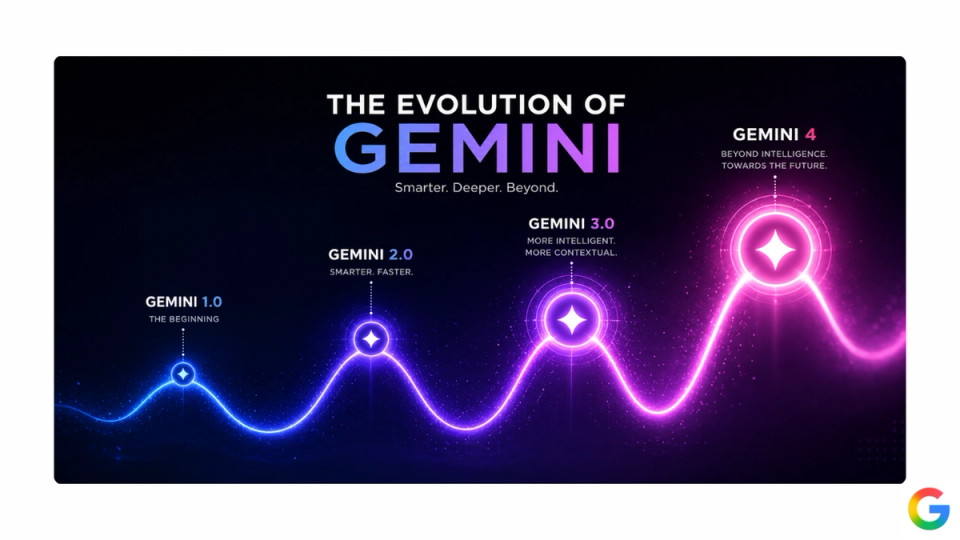
Let us get one thing straight before anything else. As of late April 2026, Gemini 4 does not officially exist. No release date, no confirmed feature list, no public API entry. Developer documentation and Google AI Studio listings stop at the Gemini 3 family. Any article claiming otherwise is filling gaps with guesswork and calling it news.
What does exist is a clear pattern, a set of statements from DeepMind leadership, and a pile of infrastructure spending that tells you exactly where Google is headed. That is what this piece is actually about.
Where Gemini Stands Right Now
Before predicting what comes next, it helps to know where things actually are.
Gemini 3 Pro is the current state-of-the-art model, launched in November 2025. It introduced serious agentic and coding capabilities, Computer Use tools that let it control software on your behalf, and benchmark scores that put it ahead of GPT-5.2 on several reasoning tasks. According to developer analysis on Atal Upadhyay's research blog, Gemini 3 Pro was the first model to break 1500 on LM Arena, and scored 91.9% on GPQA Diamond, outperforming human experts on PhD-level reasoning tasks.
Gemini 3 Flash followed in December 2025 as the faster, cheaper variant for production pipelines. Both share a 1 million token context window. Gemini 2.5 Pro still handles much of the API volume for teams that need stable, cost-predictable inference.
That is the baseline. Now the question is what the next generation actually changes.
The Pattern That Tells You When to Expect It
Google has followed a consistent release rhythm: Gemini 1.0 in late 2023, Gemini 2.0 in late 2024, Gemini 3.0 in late 2025. Prediction markets currently put the probability of a full Gemini 4 public launch before June 30, 2026, at around 15%. That is not pessimism. That is just Google's track record. They announce at I/O in May. They ship months later.
The most likely scenario is a preview or limited API access announced at Google I/O 2026 on May 19, with broader rollout through Q4 2026 and into early 2027.
What Gemini 4 Is Expected to Change
Here is the honest breakdown, separating what is grounded in evidence from what is speculation.
Context window: from 1 million to 2 million tokens (likely)
Gemini 3 Pro already has 1 million tokens, which fits roughly 750,000 words, or an entire mid-sized software codebase. Predictions from multiple analyst sources point toward a 2 million token context window for Gemini 4, which would allow processing entire research archives, legal document sets, or multi-repository codebases in a single pass.
Why does this matter in practice? Because right now even the best models have to prioritize when context gets long. They start quietly ignoring the less important parts. A 2 million token window changes the math on what you can throw at a model without it losing track.
Agents that actually finish tasks (expected)
This is the area with the most evidence behind it. Per reporting on Google DeepMind's published research direction, for Gemini 4 the agent systems are expected to become capable of managing entire multi-step projects across apps and platforms autonomously.
Gemini 3 already has agentic behavior via Project Mariner, which enables autonomous web navigation through a Chrome extension. Users can already delegate tasks like creating shopping carts, booking flights, or filling forms. Gemini 4 is expected to take this further, handling full workflows across Workspace, Gmail, Calendar, and external services without constant re-prompting.
The honest caveat: agents still make mistakes. They hallucinate steps, misread intent, and occasionally do confidently wrong things. Gemini 4 being better at agentic tasks does not mean it will be reliable enough to run unsupervised on anything that actually matters.
World model reasoning: the ambitious one
This is the part Demis Hassabis has been most vocal about. Rather than predicting the next word in a sequence, a world model AI understands how the physical world works, including causality, object physics, and cause and effect. In practical terms, the idea is that Gemini 4 could watch a video of a broken appliance, identify the faulty part, understand how it physically functions, and guide you through a real-world fix, rather than just retrieving a tutorial.
This is genuinely ambitious and also genuinely uncertain. Google has been developing Genie, a system that generates interactive virtual environments, and Sima, a model that can navigate and act within those environments. Whether that foundational work makes it into Gemini 4 in a form regular users actually encounter is a separate question.
Latency under 300ms (likely for Flash variant)
Every Gemini generation has had a faster, cheaper variant alongside the flagship. For Gemini 4, expectations point toward conversational latency under 300ms for the Flash tier. That is close enough to real-time that it changes what agentic systems can actually do in a live session, rather than sitting in awkward pauses between steps.
The Infrastructure Tells the Story
One of the clearest signals that Gemini 4 is a serious generational leap rather than a marketing rebrand is what Google has been spending on compute. Google plans to buy $9.8 billion worth of TPUs from Broadcom in 2025 alone, up from $6.2 billion the prior year. Its Ironwood TPU chip, scaled to a full pod of 9,216 chips, delivers 42.5 exaflops of computing power, more than 24 times that of the world's largest supercomputer at the time of launch. These investments historically precede major generational transitions rather than incremental updates.
You do not spend $9.8 billion on inference hardware to run Gemini 3 Flash more cheaply. That kind of investment signals a model that needs meaningfully more compute to serve at scale.
What Gemini 4 Means for the Competitive Landscape
OpenAI launched GPT-5 in August 2025 and GPT-5.2 in December 2025, featuring a hybrid architecture combining symbolic reasoning and deep learning. Anthropic has been shipping Claude Opus and Sonnet updates at a pace that has kept it genuinely competitive on coding and reasoning tasks. The AI race in 2026 is no longer a two-horse competition.
What Google has that nobody else does is distribution. When Gemini 4 launches, it will touch Google Search, Gmail, Workspace, Android, YouTube, and Chrome simultaneously. That is over 2 billion active devices on day one. No other AI company deploys like that. The question is not whether Gemini 4 will reach users. It is whether the underlying model is good enough that people actually prefer it to what they could use instead.
The One Thing Everyone Is Glossing Over
There is a quiet but important shift happening underneath the headline numbers. As datastudios.org's analysis of the Gemini roadmap notes, rather than positioning each generation as a dramatic reinvention, Google appears to be normalizing continuous evolution. Capabilities roll out progressively, interfaces adapt quietly, and naming catches up later.
Under this model, Gemini 4 would not suddenly appear as a disruptive announcement but as the moment when accumulated changes justify a new generational label.
That matters for how you should read the I/O keynote. If Sundar Pichai walks out and shows a demo that looks like Gemini 3 with more polish and a new name, that might still represent a substantial underlying shift in the model architecture. The visible surface of a Google I/O demo has never been a reliable guide to what is actually happening under the hood.
"Gemini 4 is less likely to feel like a rupture and more likely to feel like the moment the previous few months of updates suddenly make sense together."
Watch for the agent demos. If Google shows Gemini completing a real multi-step task live on stage, without a human touching the keyboard between steps, that is the signal that something genuinely different has arrived.