
OpenAI's GPT-Realtime-2 Collapses the Voice Stack
OpenAI launched three new realtime audio models on May 7, 2026: GPT-Realtime-2, GPT-Realtime-Translate, and GPT-Realtime-Whisper. The headline is GPT-Realtime-2, OpenAI's first voice model with GPT-5 class reasoning, parallel tool calling, and a 128K token context window. The real story is what it makes redundant.
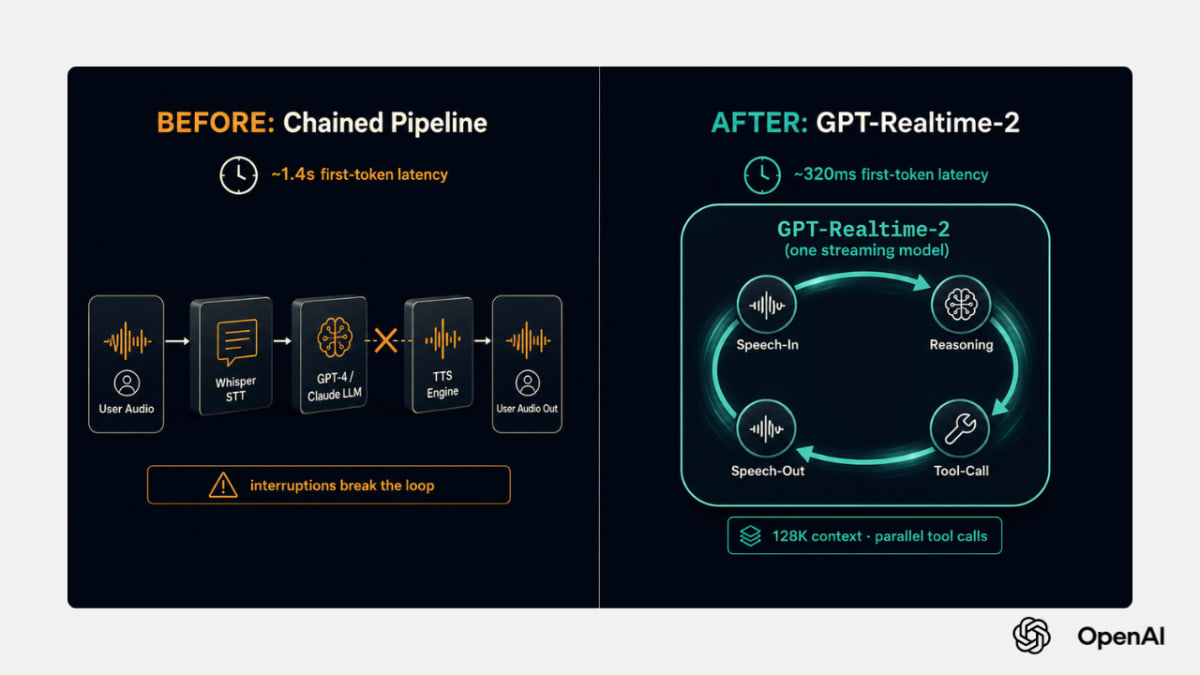
For most voice apps shipped in the last two years, the architecture was a chain. Whisper for speech-to-text, GPT-4 or Claude for reasoning, ElevenLabs or OpenAI TTS for output, plus glue code to handle interruptions, turn-taking, and tool calls. That stack just got collapsed into a single streaming endpoint, and the prices below the headline are how OpenAI plans to take it.
What Happened
GPT-Realtime-2 is a single model that handles speech-in, reasoning, tool calls, and speech-out as one streaming loop. Per OpenAI, it ships with parallel tool calling, adjustable reasoning levels from minimal to xhigh, and stronger handling of interruptions and conversation recovery. Pricing is $32 per 1M audio input tokens, $0.40 per 1M cached input tokens, and $64 per 1M audio output tokens.
GPT-Realtime-Translate is a separate model focused on live cross-language conversation. It translates speech from more than 70 input languages into 13 output languages while keeping pace with the speaker. Pricing is $0.034 per minute.
GPT-Realtime-Whisper is the streaming successor to the original Whisper. It transcribes audio live as a person talks, designed for captions, meeting notes, and AI assistants that update mid-sentence. Pricing is $0.017 per minute.
All three are accessible through the OpenAI Realtime API and Playground. There is no announced ChatGPT consumer surface for these models yet. The play is squarely at developers.
What it actually means
The voice-app stack changed shape this week. Three implications matter.
Did OpenAI just kill the chained voice pipeline?
For most production voice apps, yes. A chained STT to LLM to TTS architecture loses to a single streaming model on latency, on interruption handling, and on tool-call quality. Teams running on the old stack should expect to migrate within two quarters or lose to whoever does.
The chained pipeline was always a workaround for the fact that no single model could hold the loop end to end. GPT-Realtime-2 closes that gap. Latency for first audio token drops because the model never round-trips through serialized text. Interruption handling improves because the same model owns both ears and mouth. Tool-call timing improves because there is no STT latency before the LLM sees the request.
This is a familiar OpenAI move. The same category collapse happened in image generation last month, when ChatGPT Image 2.0 turned out to be much more than an image generator. Voice is the second one in six weeks.
How does this change pricing math for voice startups?
GPT-Realtime-2 at $32 in / $64 out per 1M audio tokens is a meaningful drop from voice-mode pricing twelve months ago, but the more interesting numbers are Translate at $0.034 per minute and Whisper at $0.017 per minute. At those prices, a 30-minute customer support call costs about $1.02 to translate live and $0.51 to transcribe. Voice agent startups whose margin came from packaging Whisper plus a frontier LLM at a markup just lost the markup.
The squeeze hits two segments hardest. Translation startups built on Whisper-plus-GPT chains now compete against a single API call at one third the cost. Meeting transcription startups built on batch Whisper now compete against streaming Whisper at half the latency.
Why is OpenAI shipping this without a consumer surface?
OpenAI is treating voice as developer infrastructure first, ChatGPT feature second. That is a deliberate sequencing choice. Putting the model in the API gives every voice startup a standard primitive to build on, which both expands the ecosystem and gives OpenAI direct revenue from each app instead of one ChatGPT subscription per user.
OpenAI's broader product strategy points the same direction, with voice as the connective tissue between the model and whatever surface, phone, glasses, kiosk, comes next. Shipping the developer tools first lets OpenAI watch what people build and then absorb the patterns that work into its own surfaces.

Who this affects
Voice agent developers should rebuild on GPT-Realtime-2 and benchmark against the chained stack on three things: time-to-first-audio-token, interruption recovery quality, and tool-call accuracy under noise. The cost math probably already works. The latency math definitely does.
Customer support and call-center teams running on Whisper plus a separate LLM should pilot Translate and Whisper on a 5 percent traffic slice this month. The transcription quality bar got higher, and live captions during agent calls are now affordable enough to default-on.
Translation product teams at startups whose moat was "Whisper plus GPT plus a glossary" have a problem. Per the launch coverage, Translate covers 70+ input languages into 13 outputs, which is enterprise-grade range. Differentiation now has to come from domain depth, not stack assembly.
Anthropic and Google owe a response. Anthropic does not yet have a competitive realtime voice product. Google has Live API on Gemini but the pricing is not where OpenAI just dropped the floor. The competitive context here is the same as the broader model race, where the Claude Opus 4.7 vs GPT-5.5 decision is becoming question by question rather than benchmark by benchmark. Voice is now one of those questions.
What to watch for next
Three things in the next 30 days. Anthropic's response on voice. Google I/O on May 19 and what gets announced for Gemini Live. And independent latency benchmarks from teams running GPT-Realtime-2 against the old chained stack on real call traffic, not OpenAI demos.
In the next 90 days, watch for GPT-Realtime-2 to land in ChatGPT Voice Mode for consumers, and for at least one major voice startup to either pivot or shut down because their stack-assembly moat is gone.
The Bottom Line
OpenAI did not just release a better voice model. It released the primitive that makes most existing voice-app architectures look like scaffolding. If you ship voice in production, audit your stack against GPT-Realtime-2 this month. If you sell voice infrastructure, the next 90 days decide whether you are a feature or a product.
FAQ
When can developers use the new GPT-Realtime models?
The models are available now through the OpenAI Realtime API and Playground as of May 7, 2026. There is no waitlist for paid API customers. Consumer access through ChatGPT Voice Mode has not been announced.
How is GPT-Realtime-2 different from the original Realtime API?
GPT-Realtime-2 adds GPT-5 class reasoning, a 128K context window, parallel tool calling, and adjustable reasoning levels from minimal to xhigh. Interruption handling and conversation recovery are also improved. The earlier Realtime API used a smaller, less capable model with shorter context.
Does GPT-Realtime-Whisper replace the original Whisper?
For streaming use cases, yes. GPT-Realtime-Whisper transcribes live as a speaker talks at $0.017 per minute. The original Whisper remains available for batch transcription where streaming is unnecessary.
Is GPT-Realtime-Translate good enough for enterprise use?
For most customer-facing translation, yes. It supports 70+ input languages into 13 outputs at $0.034 per minute. Enterprise teams should still pilot against domain-specific terminology before flipping production traffic.
Will Anthropic and Google respond?
Both will. Neither has a directly competitive product today. Watch Google I/O on May 19 for Gemini Live updates, and expect Anthropic to ship something on voice within two quarters.