
Apple Just Put Google Inside Siri. In Tim Cook's Last Season.
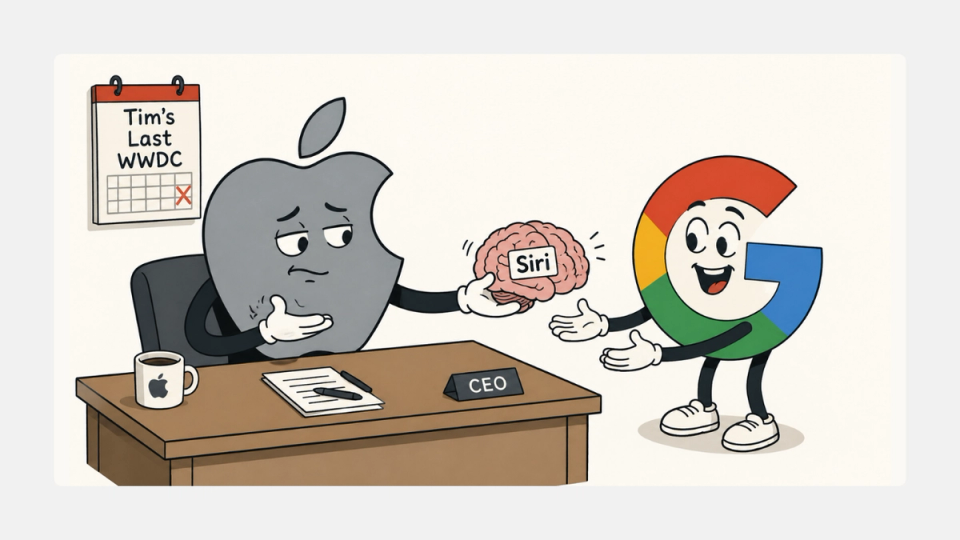
Apple unveiled Siri AI at WWDC on June 8, 2026, confirming a multi-year collaboration with Google that embeds Gemini models directly into Apple's own foundation models running both on-device and through Apple's Private Cloud Compute.
No, you did not misread that. The company that spent years telling you only Apple could be trusted with your data just shipped a Siri that runs on Google's brain. And it did it as Tim Cook's final WWDC keynote as CEO. The optics are a lot.
Here is what actually happened, what it actually means, and why this moment is bigger than the press release suggests.
What Actually Happened at WWDC 2026
Siri AI is not a feature update. It is a full rebuild. The new assistant is conversational back and forth, with real context awareness across the conversation. It has on-screen awareness, meaning it can read what is on your display and act on it. It has a dedicated standalone app with iCloud-synced conversation history. It surfaces in the Dynamic Island.
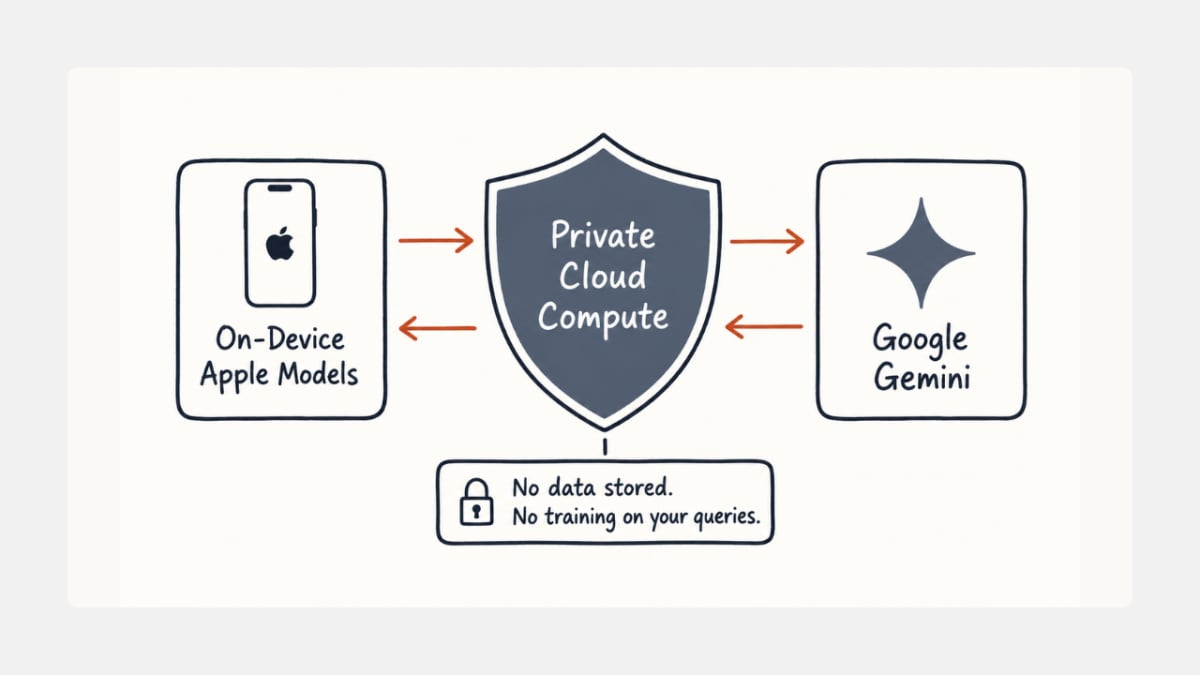
Under the hood, Gemini models are layered into Apple Intelligence not replacing Apple's own models, but powering the requests that go beyond what on-device processing can handle. Apple's Private Cloud Compute handles the privacy layer: no data stored server-side, no training on your queries per Apple's statement at the keynote.
Siri AI launches as part of iOS 27, iPadOS 27, and macOS 27, expected fall 2026. Developer beta dropped June 8. EU and China rollouts are delayed due to regulatory requirements Apple has not disclosed a timeline for those markets.
Tim Cook delivered the WWDC keynote on June 8, 2026 his last as CEO. He announced in April 2026 that he would be stepping down effective September 1, 2026, transitioning to Executive Chairman of Apple's Board. John Ternus, Apple's SVP of Hardware Engineering and a 25-year company veteran, takes the CEO seat on September 1.
Why This Is Actually a Wild Move
Let's be real: this is not something you could have predicted five years ago. Apple's entire privacy narrative the "what happens on your iPhone stays on your iPhone" brand promise was always meant to be a competitive moat against Google specifically. And now Apple is shipping Google inside Siri.
There are two ways to read this.
The charitable read: Apple acknowledged that building frontier AI is genuinely hard and expensive. The capex required to compete with Google's Gemini at model quality level is not trivial. Rather than ship a bad Siri, Apple bought time with the best external option available, wrapped it in Private Cloud Compute, and maintained privacy at the infrastructure level even if it ceded model sovereignty.
The other read: Apple is running behind. Despite years of Apple Intelligence branding and $100+ billion annually in R&D spend, Apple's own models are not competitive with Gemini at the capability level the new Siri needs. The Gemini deal is a strategic admission that Apple's AI division lost the model race. Google, which did what Apple promised on privacy with Gemini Intelligence since IO 2026, did not have to make this kind of deal because Google already had the infrastructure.
Both reads can be true simultaneously. Apple made the smart short-term call. Whether it was also the right long-term call is a different question.
Does This Actually Break Apple's Privacy Promise?
Short answer: not structurally, but the narrative took a hit.
Apple's Private Cloud Compute ensures your Siri queries are not logged or used to train Google's models. The architecture is auditable Apple has published the security research documentation. The model runs in an enclave; your data does not persist on Google's servers.
But here is what Apple has not disclosed: exactly which Siri requests are handled locally by Apple's own models versus which ones are routed to Gemini. The keynote materials do not specify. The threshold matters a lot if you care about the privacy architecture in practice. "According to Apple's announcement, the company has not published the routing criteria for on-device vs. Gemini requests."
For most users this will not matter in practice. For enterprise buyers and anyone in a regulated industry, this is a real due-diligence question for fall 2026.
What Does Gemini Even Get Out of This?
This is the question nobody is asking loudly enough.
Google's end of the deal is distribution at scale potentially 1.3 billion active Apple devices once iOS 27 rolls out. Every time Siri AI routes a request to Gemini, that is a Gemini inference call. Even if Google is not training on user data from the partnership, the volume alone justifies the deal from a model usage and brand positioning standpoint.
It also validates Gemini's position as the enterprise-grade model API of choice a signal that matters for Google's cloud business. What Google is actually building with Gemini, Google's strategy has always been about making Gemini the foundation other products are built on. Apple just gave that strategy a massive co-sign.
For context on what Gemini's technical architecture actually enables in a setup like this, how Gemini Omni actually works under the hood multimodal native processing is exactly what allows Siri AI's on-screen awareness to work at this quality level.
Tim Cook's Last Season: The AI Question He Leaves Open
Okay let us talk about the elephant in the room.
Tim Cook leaves on September 1, 2026 after 15 years as CEO. His tenure delivered the Apple Watch, AirPods, services growth from $20B to $100B+ annually, and a market cap that crossed $3 trillion. The hardware and services story is immaculate.
The AI story is messier.
When every other major tech company was racing to ship AI products in 2023 and 2024, Apple was conspicuously quiet. The original Apple Intelligence rollout was incremental and slower than competitors. ChatGPT integration in Siri launched under Cook before this Gemini deal and now that integration is being largely superseded. Siri AI with Gemini is a correction, not a continuation.
Is it fair to pin the AI gap on Cook? Partially. Apple's culture of shipping only when it is ready the same culture that made the iPhone the iPhone slowed Apple's public AI posture significantly. And while OpenAI was shipping voice models that collapse the old stack, Siri was still losing to Google Assistant on basic questions.
Cook's final WWDC gave Apple's AI story the reboot it needed. Siri AI is genuinely impressive in the demos. The Gemini partnership is a smart move. But it is also the acknowledgment of a gap that built up on his watch.
John Ternus inherits an AI team that just made its biggest pivot. That is both an advantage fresh direction, real technology under the hood and a challenge. Apple does not yet have a Gemini of its own. Whether Ternus builds one or deepens the partnership is the first real strategic question of his tenure.
Who This Actually Affects
For iPhone users: Siri is about to become actually useful. If the demos hold in production, the on-screen awareness and conversational memory features close a gap that has frustrated users for years. Save anticipation for fall 2026. Do not switch to Android yet.
For developers: The new Siri app and API surface opens up integration points that the old Siri locked out. Watch the developer documentation closely WWDC sessions on Siri AI are the ones to attend this week.
For enterprise buyers: The missing routing disclosure is the key item to get answered before deploying iOS 27 in regulated environments. Push Apple's enterprise team for specifics on what is on-device vs. cloud.
For Google: This is a quiet win. No press release needed. Apple just made Gemini ubiquitous on iOS at scale.
For OpenAI: OpenAI's ambitions for a phone that competes with the App Store just got harder. If Siri AI works well, the argument for an OpenAI device collapses. Most people will not switch hardware if their current phone's AI is good enough.
What to Watch For Next
Three signals to track over the next 90 days:
1. The routing disclosure. Apple will face developer and enterprise pressure to clarify exactly what goes to Gemini and what stays on-device. If Apple publishes this and the on-device ratio is high, the privacy narrative holds. If most requests route to Google, the narrative will need work.
2. EU and China regulatory timelines. Both markets are delayed with no announced date. How long Siri AI stays unavailable in those markets directly affects Apple's ability to call this a global AI product.
3. John Ternus's first AI statement. Ternus takes over September 1. His first public comment on Apple's AI strategy whether it's about deepening the Gemini partnership or building Apple's own frontier model will signal whether this is a bridge deal or a permanent direction.
The Bottom Line
Apple just put Google inside Siri, and Tim Cook walked off stage to a standing ovation doing it. The Siri AI announcement is real and the demos are compelling. The Gemini partnership is strategically smart in the short term. But it is also a public admission that Apple's own AI did not get there fast enough.
John Ternus inherits a better Siri than Cook started with. He also inherits the question Cook did not fully answer: can Apple build AI that does not need to borrow Google's.
That question lands on September 1, 2026.