
Sonnet 5 vs GPT-5.5 vs Gemini 3.1 Pro: One Throne, Three Claimants
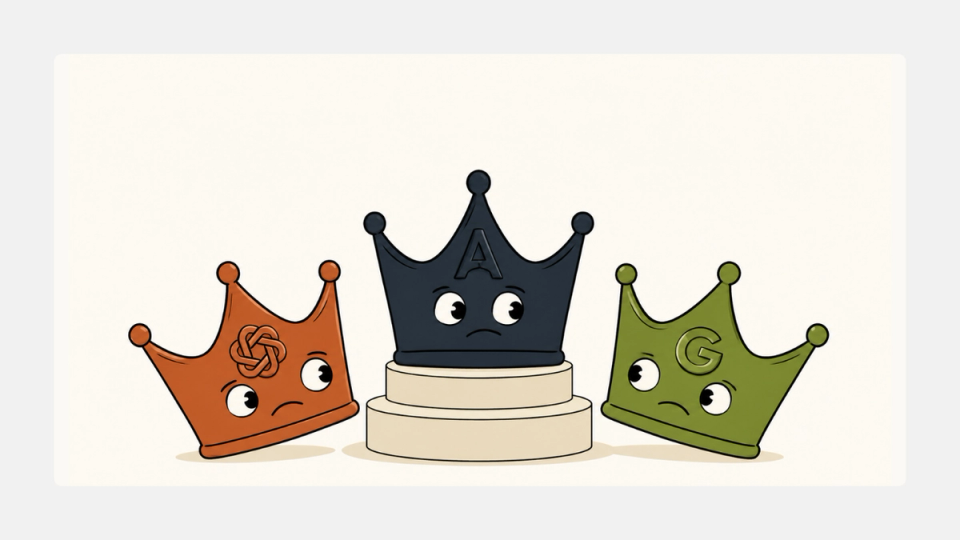
Claude Sonnet 5 is Anthropic's mid-tier coding and agentic model, released on June 30, 2026, designed to close the gap between the affordable Haiku line and the flagship Opus series. GPT-5.5 is OpenAI's general-purpose flagship, launched April 23, 2026, built on a fully retrained base architecture with variants spanning Instant, Thinking, and Pro tiers. Gemini 3.1 Pro is Google DeepMind's multimodal reasoning engine, shipped February 19, 2026, running a Mixture-of-Experts architecture with a 1M token context window and a three-tier thinking system.
The verdict: Sonnet 5 wins for developers who write code all day. GPT-5.5 wins when you need the widest ecosystem and the deepest tool integrations. Gemini 3.1 Pro wins when the problem is bigger than any single model's memory.
The surprise? The cheapest model on paper is not the cheapest in practice, and the most expensive one might actually save you money.
The short answer
For daily coding and agentic tasks: Claude Sonnet 5. It ships near-Opus reasoning at mid-tier pricing, and its adaptive thinking means you pay for intelligence only when the problem demands it.
For building multi-tool autonomous agents: GPT-5.5. OpenAI's ecosystem (DALL-E 2.0, Sora, voice, vision, function calling) gives your agent more arms than a Hindu deity at a juggling convention.
For swallowing entire codebases whole: Gemini 3.1 Pro. When your legacy monorepo is 800,000 tokens deep and you need the model to read the whole thing before making a single edit, nothing else comes close on price-per-context.
If you genuinely cannot decide: Start with Sonnet 5. Switching away from Anthropic's API later costs you an afternoon. Switching away from a GPT-5.5 ecosystem you have built tooling around costs you a quarter.
Why this comparison matters right now
Three things happened in 120 days that reshaped the leaderboard.
First, Anthropic shipped Sonnet 5 with a new tokenizer and scrapped sampling parameters, closing the gap to Opus to just 6 percentage points on internal agentic coding benchmarks: 63.2% vs 69.2%. That gap used to be a canyon. Now it is a puddle you can step over in nice shoes.
Second, OpenAI released GPT-5.5 in April with a fully retrained base (the first since GPT-4.5), then immediately began the GPT-5.6 rollout in late June. GPT-5.5 is still the workhorse most developers are on. The 5.6 Sol tier is in limited preview with government safety reviews pending.
Third, Google's Gemini 3.1 Pro scored 77.1% on ARC-AGI-2, a benchmark that tests whether a model can solve novel logic puzzles it has never seen. That score matters because it is the closest any commercial model has come to the kind of flexible reasoning humans take for granted.
Pricing verified July 2026. Benchmarks current as of July 2026.
Which one writes better code?
Sonnet 5 writes the best code of the three for the tasks most developers actually do: multi-file refactors, debugging sessions that span 10+ files, and architecture decisions that require holding a full project in memory.
Its agentic coding score of 63.2% on Anthropic's internal benchmark puts it in the territory where the four questions that decide between Claude and GPT start favoring Anthropic. The previous Sonnet 4.6 managed only 58.1%. The adaptive thinking feature, enabled by default, lets it scale reasoning depth to match problem complexity. Simple function renames get fast, cheap responses. Architectural redesigns get deep, Opus-grade reasoning. You do not pay the thinking tax on easy problems.
GPT-5.5 is no slouch. Its strength is tool sequencing: when your agent needs to call a shell, read a file, run a test, parse the output, and decide the next move, GPT-5.5 handles the choreography with fewer wasted steps. For terminal-heavy workflows, it is still the best orchestrator. As one developer on Hacker News put it: "Sonnet thinks better. GPT-5.5 acts better."
Gemini 3.1 Pro earns its place when the codebase is simply too large for the others to hold. Its 1M token context window with 65,536 token output capacity means it can read an entire legacy Rails monolith and produce a full-file refactor in one pass. The others can technically match the 1M input, but Gemini's pricing at the long-context tier ($4/$18 per million tokens above 200K) makes it the only economically rational choice for large-context jobs.
Which one costs less at real usage?
This is where the comparison gets sneaky. List prices tell one story. Actual invoices tell another.
| Dimension | Claude Sonnet 5 | GPT-5.5 | Gemini 3.1 Pro |
|---|---|---|---|
| Input (per 1M tokens) | $2.00 (intro) / $3.00 (Sept+) | $5.00 | $2.00 (≤200K) / $4.00 (>200K) |
| Output (per 1M tokens) | $10.00 (intro) / $15.00 (Sept+) | $30.00 | $12.00 (≤200K) / $18.00 (>200K) |
| Context window | 1M tokens | 1M tokens | 1M tokens |
| Output cap | Standard | Standard | 65,536 tokens |
| Prompt caching | Up to 90% savings | Available | Available |
Sonnet 5's introductory pricing ($2/$10 per million tokens through August 31, 2026) makes it the clear value leader right now. Even after the September price bump to $3/$15, it remains cheaper than GPT-5.5 by nearly half on output tokens.
GPT-5.5's output pricing at $30 per million tokens is the elephant doing yoga in the room. For high-output tasks (code generation, document drafting, agent reasoning chains), that cost compounds fast. The Pro tier at $30/$180 is enterprise territory.
Gemini 3.1 Pro plays the best pricing chess. Under 200K tokens, it matches Sonnet 5 on input and undercuts GPT-5.5 by 60%. Above 200K, the price doubles, but it is still cheaper than running multiple shorter GPT-5.5 calls to cover the same context. If your workflow regularly hits the 200K+ range, Gemini's pricing architecture was designed for you.
The non-obvious insight: Sonnet 5's adaptive thinking means a typical coding session consumes fewer total tokens than GPT-5.5 for the same outcome. The model scales reasoning depth dynamically. GPT-5.5 brings full reasoning power to every response, whether you asked it to rename a variable or redesign a database schema. You are paying for a private jet to the corner store.
Which agent breaks first?
Reliability in agentic workflows is the new frontier. Raw intelligence matters less when your agent loops, hallucinates mid-chain, or confidently executes the wrong tool call on step 14 of a 20-step plan.
Sonnet 5 is the most honest of the three. When it does not know something, it says so. When a tool call fails, it recovers with a diagnostic step rather than blindly retrying. As Fable revealed about how Claude models actually run, Anthropic's policy-first architecture prioritizes reliability, and that investment shows in production. For high-stakes code that deploys to production, this honesty is worth more than a few extra benchmark points.
GPT-5.5 is the most persistent. It handles 20+ step chains with better state retention than either competitor. When your agent needs to maintain context across a long debugging session (check logs, read stack trace, edit file, run tests, read output, repeat), GPT-5.5 holds the thread. The tradeoff: it is more likely to push through errors confidently rather than stopping to flag them.
Gemini 3.1 Pro's three-tier thinking system (including a Medium parameter that balances depth against latency) is clever engineering, but in practice, it adds a tuning knob most developers will not touch. The default configuration works well enough. The model's MoE architecture means it routes different parts of a query to different expert subnetworks, which produces excellent breadth but occasionally inconsistent depth on narrow technical questions.
Where each model actually wins
Sonnet 5 was built for the developer who lives in a terminal and ships code daily. Its sweet spot is the 80% of coding work that is not trivially easy but not research-grade hard: refactors, feature builds, debugging, test writing, documentation. If you previously ran Opus for everything because Sonnet 4.6 was not smart enough, Sonnet 5 is the model Anthropic built to get you off that expensive habit. It is the same philosophy that shaped the coding CLI comparison earlier this year.
GPT-5.5 was built for the platform builder. If your product integrates AI into a customer-facing application and you need voice, vision, image generation, function calling, and text generation all routing through one vendor, OpenAI's ecosystem is unmatched. The model itself is excellent. The moat is the toolbox around it.
Gemini 3.1 Pro was built for the enterprise architect. Google Workspace integration, Vertex AI deployment, massive context for document analysis, and pricing that scales linearly with usage rather than punishing you for long prompts. If your company already lives in Google Cloud, switching to Gemini is not a migration. It is an upgrade. And if you are curious about what Google is building next with Gemini 4, the trajectory points toward even deeper Workspace integration.
Where each model actually loses
Sonnet 5 loses when the job is not coding. For creative writing, it reads more like a careful editor than a bold author. For multimodal tasks, it lags behind GPT-5.5's native vision-voice-image loop. And the new tokenizer (introduced alongside Sonnet 5) means existing prompt templates need recalibrating. Anthropic does not publish per-region latency numbers, so non-US developers are operating partially blind on performance expectations.
GPT-5.5 loses on price. There is no way to sugarcoat this: $30 per million output tokens is 3x Sonnet 5's introductory rate and 2.5x Gemini's standard rate. For high-volume production workloads, that gap compounds into a line item that makes finance teams schedule meetings. The Pro tier at $180 per million output tokens is priced like a luxury good.
Gemini 3.1 Pro loses on cutting-edge agentic performance. Its 77.1% ARC-AGI-2 score is impressive for novel reasoning, but on practical software engineering benchmarks (SWE-bench Pro, Terminal-Bench), it trails both Sonnet 5 and GPT-5.5. The MoE architecture is a strength for breadth and a weakness for consistency: two identical prompts can produce noticeably different quality outputs because different expert subnetworks activate. Google does not publish detailed methodology for its Gemini benchmark claims, which makes independent verification difficult.
The bottom line
Claude Sonnet 5 wins for most developers. It delivers the best code quality per dollar, the most honest error handling, and pricing that does not require a CFO's approval. For the 80% of AI coding work that matters, daily production development, it is the model to start with in July 2026.
GPT-5.5 is the right choice if you are building a platform that needs the full OpenAI toolkit. Gemini 3.1 Pro is the right choice if your problems are too big for anyone else's context window.
The action step: if you are on GPT-5.5 and spending more than $500/month on API calls, run a two-week trial with Sonnet 5 on your coding workloads. Track output quality and total cost. The introductory pricing window closes August 31. Make the comparison while it is cheap to test.
If you already use Anthropic's coding agents through Claude Code or similar tools, Sonnet 5 is a drop-in upgrade that requires zero workflow changes.
FAQ
Is Claude Sonnet 5 better than GPT-5.5 for coding?
For daily coding tasks like refactoring, debugging, and feature building, yes. Sonnet 5 scores 63.2% on agentic coding benchmarks and costs less than half of GPT-5.5 on output tokens. GPT-5.5 is better for multi-tool agent orchestration where persistence across 20+ steps matters more than per-step code quality.
Can Gemini 3.1 Pro replace both Sonnet 5 and GPT-5.5?
Not yet. Gemini excels at large-context analysis and Google Workspace integration, but it trails on practical software engineering benchmarks. Most production teams use Gemini for context-heavy tasks and route coding work to Sonnet 5 or GPT-5.5.
Is the Sonnet 5 introductory pricing worth locking in?
The intro rate ($2/$10 per million tokens) runs through August 31, 2026. After that, standard pricing jumps to $3/$15. If you are evaluating, test now. The intro window is effectively a subsidized trial.
Which model has the best context window?
All three support 1M token inputs. Gemini 3.1 Pro differentiates with a 65,536 token output cap and tiered pricing that makes long-context usage cheaper per token than competitors. For prompts under 200K tokens, pricing is identical to Sonnet 5's introductory rate.
Should I wait for GPT-5.6 instead?
GPT-5.6 Sol is in limited preview with government safety reviews pending. The Terra tier (mid-range) matches GPT-5.5 performance at lower cost. If you need a model today, GPT-5.5 or Sonnet 5 are the production-ready options. GPT-5.6 general availability has no confirmed date.
Does Sonnet 5 work with existing Claude Code setups?
Yes. Sonnet 5 is a drop-in replacement for Sonnet 4.6 in Claude Code and the Anthropic API. The new tokenizer may require recalibrating prompt templates, but the API interface is unchanged.