
Claude Sonnet 5 Ships the Capability Gap Closed — With a Hidden Tax

Anthropic released Claude Sonnet 5 on June 30, 2026, cutting the performance distance between its mid-tier and flagship model to the smallest it has ever been — while quietly introducing a new tokenizer and scrapping sampling parameter support. The benchmarks are genuinely impressive. The migration cost is less so.
Sonnet 5 hits 63.2% on Anthropic's agentic coding benchmark, up from 58.1% for Sonnet 4.6 and within striking distance of Opus 4.8's 69.2%. In some knowledge-work evaluations, it edges past Opus 4.8 entirely. Priced at introductory rates of $2 per million input tokens and $10 per million output tokens through August 31, 2026, the raw intelligence-per-dollar math tilts hard in Sonnet 5's direction.
There are two details buried in the release notes that will cost teams real money if they miss them.
What Happened
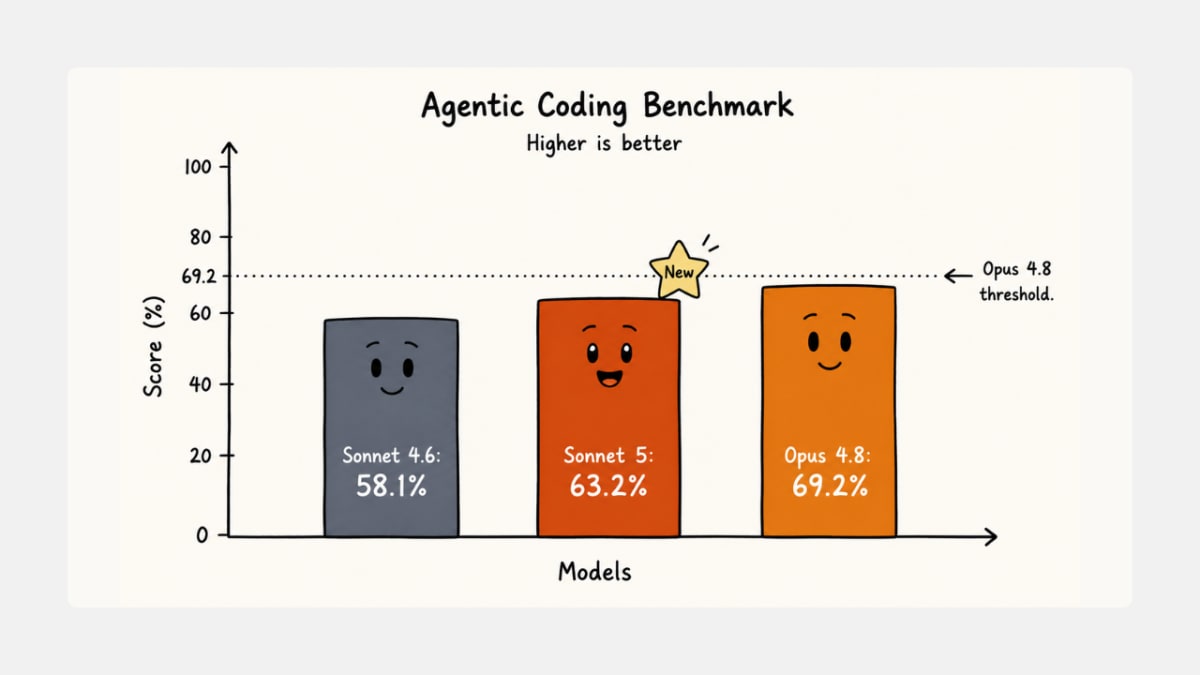
Anthropic released Claude Sonnet 5 on June 30, 2026, available immediately across the Claude Platform, Claude Code, Amazon Bedrock, Google Cloud Vertex AI, and Microsoft Azure AI Foundry.
The headline numbers: a 1-million-token context window, up to 128,000 output tokens, adaptive thinking enabled by default, and agentic coding benchmarks that score 63.2% — up from 58.1% on Sonnet 4.6. For comparison, Claude Opus 4.8, which shipped May 28, 2026, scores 69.2% on the same benchmark.
In Anthropic's own framing, Sonnet 5 is "the most agentic Sonnet-class model to date," designed to handle complex multi-step workflows — planning, tool use, browser and terminal tasks — that previously required Opus-tier spend. The model also ships with real-time cybersecurity safeguards, which is a meaningful addition for anyone running it in autonomous agent loops.
Pricing is on introductory rates through August 31: $2 per million input tokens and $10 per million output tokens. Standard pricing after September 1 will be $3 input / $15 output.
What the Benchmarks Actually Say
Is Sonnet 5 good enough to replace Opus 4.8 today?
For most agentic coding workflows: probably yes. The 6-percentage-point gap on the agentic coding benchmark (63.2% vs 69.2%) closes dramatically when you factor in the pricing difference. At introductory rates, Sonnet 5 is roughly 83% cheaper per input token than Opus 4.8's standard pricing. In knowledge-work benchmarks specifically, Sonnet 5 edges past Opus 4.8 in certain evaluations — a notable reversal for a model one tier down.
The capability gap that justified routing everything to Opus-tier is narrower than it has ever been. Teams running multi-step agentic workflows via Claude Agent SDK will find Sonnet 5's adaptive thinking and tool-use improvements materially better than Sonnet 4.6 for production use cases.
Adaptive thinking — Anthropic's extended reasoning layer — is now on by default, with user-controllable effort levels (low, medium, high, max, x-high). This replaces the old manual extended thinking parameter, which has been removed. Previously you set a budget_tokens value to activate the thinking mode. That API field is now gone.
The Hidden Tax: Tokenizer Change and Removed Sampling Params
What's the actual migration cost for existing Sonnet users?
Two changes that are not in the marketing copy deserve close attention.
First, Sonnet 5 uses a new tokenizer that produces approximately 30% more tokens for the same input text compared to Sonnet 4.6. That is not a typo. If you are running high-volume workloads and your cost model is based on Sonnet 4.6 token counts, your bills will be higher than the posted rates suggest. The introductory per-token price is lower, but the token count for the same text is higher. Anyone building cost-optimized agent instruction files and context management should reprice against real payloads before committing to Sonnet 5 at scale.
Second, the API no longer accepts temperature, top_p, or top_k parameters. Passing any of these with non-default values now returns a 400 error. The same applies to the old manual thinking parameter. If your codebase touches these — and most production wrappers do — you will get silent breakage at deployment unless you audit your API calls before shipping.
Anthropic's guidance is to omit the parameters entirely and use system prompts to shape output style instead. This is a reasonable design decision that centralizes control, but it is a breaking API change for any application that explicitly sets sampling behavior.
Who This Affects
Solo developers and indie builders running single-agent workflows get an unambiguous win. Sonnet 5 at introductory rates gives near-Opus-level capability for a fraction of the cost, and adaptive thinking at default-on means you do not need to wire up reasoning yourself. The only friction is the tokenizer change — reprice your expected spend before assuming the posted rate maps directly to your existing token volumes.
Engineering teams running production agents need to audit the API immediately. Any wrapper that passes temperature, top_p, top_k, or the old thinking parameter will break silently at the 400-error level. This is a migration, not an upgrade-in-place. Anthropic did not introduce a deprecation window — the parameters are already rejected. OpenAI just admitted Anthropic was right about opinionated defaults — and both labs are converging on the same tighter platform control model.
Enterprise buyers evaluating Sonnet 5 as an Opus 4.8 replacement get a credible option for most workloads, but should note that the model's behavior is more opaque than before. With sampling parameters removed and adaptive thinking always on, the output distribution is harder to control deterministically. This matters for regulated contexts where reproducibility is a compliance requirement.
Competitors are watching a clear pattern: other frontier models like GLM-5.2 have been competing hard on agentic coding benchmarks, with GLM-5.2 scoring 81.0% on Terminal-Bench 2.1. Sonnet 5's 63.2% on Anthropic's internal benchmark is not directly comparable — different benchmarks, different methodologies — but the agentic capability race is accelerating faster than model pricing is dropping.
What to Watch For Next
Standard pricing kicks in September 1, 2026 ($3 input / $15 output). That date is the first real test of whether Sonnet 5 holds its position as the default smart choice or whether teams route back to Sonnet 4.6-tier pricing when the introductory window closes.
Anthropic has not disclosed whether existing Opus 4.8 enterprise contracts see any benefit from Sonnet 5's arrival — pricing pages cover published tiers only.
The tokenizer change is the one most likely to generate public friction. As teams deploy Sonnet 5 at scale and compare invoices against projections, the 30% token inflation on unchanged text will surface. Watch for community threads on Discord and Hacker News in the next two weeks.
The removal of sampling parameters is a deliberate platform consolidation move. Fable's policy-engine architecture, where Anthropic controls more of the inference stack, suggests this direction is intentional and will extend to future models. Teams that rely on fine-grained sampling control should plan accordingly.
The Bottom Line
Sonnet 5 is a real generational step for the Sonnet class. The agentic coding score, the adaptive thinking default, and the 1-million-token context window are not marketing headings — they reflect a model that can handle workflows Sonnet 4.6 could not reliably close. At introductory pricing, the intelligence-per-dollar case is strong.
But the migration is not free. The new tokenizer adds 30% to your effective token cost on the same inputs. Sampling parameter removal is a breaking API change with no deprecation window. Both of these deserve more attention than they have received in coverage so far.
If you are evaluating now: test on real workloads before committing. Sonnet 5 will likely replace Opus 4.8 for most teams. Just price it against actual token counts, not the published rate applied to old Sonnet 4.6 counts.
FAQ
When does the introductory pricing end for Claude Sonnet 5?
Introductory pricing of $2 per million input tokens and $10 per million output tokens runs through August 31, 2026. Standard pricing of $3 input / $15 output takes effect September 1, 2026, per Anthropic's pricing page.
Can I still use temperature and top_p with Claude Sonnet 5?
No. Passing temperature, top_p, top_k, or the old manual thinking parameter with non-default values returns a 400 error. Omit these parameters entirely and use system prompt instructions to shape output behavior instead.
How does Sonnet 5's tokenizer change affect my costs?
Sonnet 5's new tokenizer generates approximately 30% more tokens for the same input text compared to Sonnet 4.6. Your effective per-token cost is lower at introductory rates, but you are producing more tokens per request. Test against real production payloads before projecting cost savings.
Is Sonnet 5 available on AWS Bedrock and Google Cloud?
Yes. Sonnet 5 is available on the Claude Platform (web and API), Claude Code, Amazon Bedrock, Google Cloud Vertex AI, and Microsoft Azure AI Foundry as of the June 30, 2026 launch date.