
Fable Isn't the Model You Think You're Running

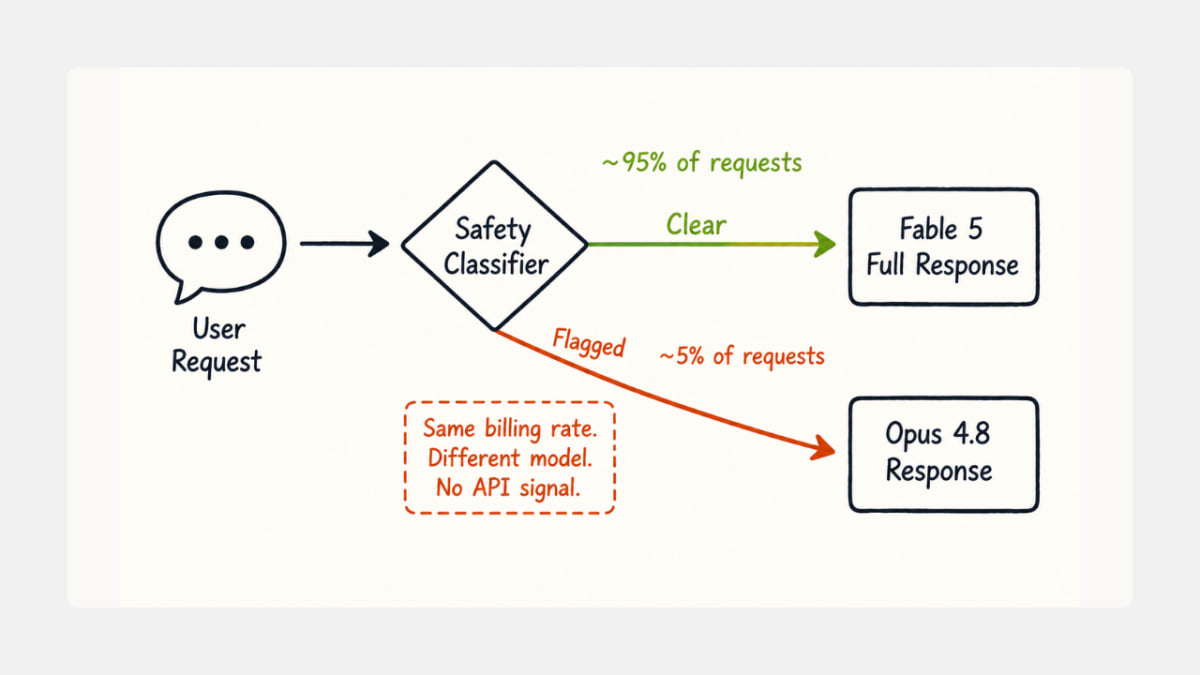
Claude Fable 5 is not a single model. It is a policy engine with a frontier model attached and the policy engine runs first.
Released by Anthropic on June 9, 2026, Fable 5 is the public face of the Mythos-class family: the most capable autonomous-task model the company has shipped. But beneath the benchmark scores and the "agentic-first" positioning sits a mechanism most builders only discover mid-deployment: when Fable decides a request crosses a threshold cybersecurity, biology, chemistry, or anything it classifies as distillation it reroutes your call to Claude Opus 4.8 instead. Not a refusal. A silent swap. A different model, at a different capability ceiling, responding to your system prompt as if nothing happened.
The thesis here is narrow: Fable's fallback architecture creates a class of hidden securities guarantees the model makes implicitly that it can't actually keep and the right response is not to stop using LLMs, but to stop trusting them as black boxes.
What "silent fallback" actually means in production
Fable 5's safety classifiers intercept requests it flags as high-risk and reroute them to Opus 4.8, billing at the Opus 4.8 rate. Anthropic updated this after launch to surface a notification, but the underlying architecture remains: the model you called is not always the model that responds.
For a chat interface, that is a minor annoyance. For a production agentic system, it breaks every assumption in your stack. Your system prompt was calibrated for Fable 5's capability profile. Your prompt chain was sized for Fable 5's context window and reasoning depth. You tested latency, accuracy, and error rates against Fable 5. When Opus 4.8 answers instead, none of those assumptions hold. The swap is not documented in the error code, not surfaced in the model field of the API response, and not predictable from the query alone the classifier's boundaries are not published.
This is not a hypothetical. Cybersecurity engineers building legitimate software analysis pipelines have reported that tasks as routine as "find the SQL injection vectors in this codebase" and "describe the authentication flow in this Express app" trigger the fallback. The classifier is over-broad by design Anthropic has said so explicitly in its system card because false negatives (letting through malicious requests) are weighted more heavily than false positives (blocking legitimate ones). That is a defensible safety call. It is a bad engineering contract.
Why the Fable / Mythos split is the tell
Fable 5 and Anthropic's Fable 5 Has a Cyber Problem It Won't Fully Admit covers why the cybersecurity community is not impressed and the Mythos split is the core of it. Fable 5 and Claude Mythos 5 share the same underlying weights. They are the same model. The difference is which safety classifiers are active at inference time. Mythos 5, reserved for vetted partners through Project Glasswing, ships without the restrictive classifiers that trigger the fallback. Fable 5 ships with them.
If the classifiers were actually necessary for safety, Mythos 5 would not exist. Its existence proves that Anthropic believes the underlying model can be safely operated without the fallback for the right people, in the right context. What the classifier layer adds is not a safety guarantee. It is a deployment gate.
This is the non-obvious read on the dual-model structure. The split is not "safe model" versus "unsafe model." It is "model with access controls" versus "model without." The controls are policy, not capability. They reflect Anthropic's judgement about who should be trusted to use what which is a legitimate thing for a company to decide but the public product sells that policy as a safety feature, which is a different claim.
Compare this to how prompt injection already works as an attack vector: the adversary does not need to break the model, they only need to manipulate what the model's guardrail classifies as safe. Fable's fallback mechanism introduces a second surface with the same vulnerability structure. If you can craft inputs that consistently avoid triggering the classifier, you get Fable 5 behavior without Fable 5 declaring that it's running. If you trip the classifier on legitimate inputs, you get Opus 4.8 without knowing it.
Both outcomes are bad. Neither is a model failure. Both are classifier failures which is a different problem category requiring a different mitigation.
What actually changed when Fable shipped
The capabilities gain is real. Fable 5 scores substantially above Opus 4.8 on long-horizon agentic tasks the internal benchmarks Anthropic published with the system card show meaningful improvement on multi-step software engineering and deep research workflows. At $10 per million input tokens and $50 per million output tokens as of June 2026 (versus Opus 4.8 at roughly half that), you are paying for a capability ceiling that you only reach when the classifier permits it.
The Claude Opus 4.8 and Claude Code platform update from May 28, 2026 shipped a model that is genuinely strong for most agentic tasks. For a large subset of production use cases, the fallback to Opus 4.8 is not a catastrophic failure it is a mild capability downgrade. The real problem is that you did not ask for it and you might not know it happened.
Data retention also changed with Fable's release: Anthropic moved to a 30-day retention window for API traffic, shorter than some enterprise teams' existing agreements. This is a separate policy shift bundled into the same launch the kind of detail that gets missed when the capability headline is loud enough.
How this should change the way you use LLMs
The framing I keep seeing "LLMs are black boxes, so audit their outputs" is correct but incomplete. Fable makes the box darker in a specific way: the model that produces your output is not necessarily the model you selected. That is a new variable, and it requires a different response than general output auditing.
Three shifts that actually matter:
First, treat model identity as an untrusted input. The API response model field is the closest thing to a receipt, but it has historically not surfaced fallback model information. Build detection into your pipeline: probe with calibrated capability tests before committing expensive downstream steps. If the response profile doesn't match Fable 5's expected behavior on your calibration prompts, flag it before proceeding.
Second, architect for capability variance, not just quality variance. Your error handling probably accounts for the model being wrong. It probably doesn't account for the model being a different model. Those are different failure modes. A Fable 5 response that is factually wrong is recoverable with retry and verification. An Opus 4.8 response to a Fable 5-optimized prompt, especially in a multi-step agentic chain, can fail silently in ways that propagate forward. The Claude Agent SDK for customer support triage architecture already recommends treating agent outputs as untrusted Fable's fallback extends that principle to model identity itself.
Third, scope your prompts below the classifier threshold deliberately. This sounds like working around safety it is not. The classifier is not calibrated to your use case. It is calibrated to the average of all possible misuses of similar-looking inputs. For most production workloads, the right inputs are narrower and more specific than a generic security research query anyway. Scoping prompts to the actual task not the domain reduces classifier friction and produces better outputs regardless of which model responds.
The broader shift is this: Anthropic built a zero-day machine and then locked it away from the public because the capability was too dangerous for general access. Fable is the next expression of the same logic, applied to a model that is less dangerous but still controlled via classifier. The pattern capability plus policy layer plus tiered access is the architecture for every frontier model from here forward. Learning to build with it, rather than pretending you're talking to a transparent system, is the skill that matters.
The honest take
I'm arguing Fable's fallback is a bad engineering contract while also acknowledging Anthropic's safety reasoning is defensible. Those are both true. The problem is not that safety classifiers exist it is that they operate on your production system without a documented interface, a predictable boundary, or a reliable signal that they've fired. That is a solvable problem. Anthropic partially solved it after launch by surfacing a notification. They haven't published the classifier boundaries, and "implicit policy at inference time" remains the operating model.
I also can't rule out that the over-broad filtering is partly strategic. If Fable's fallback consistently hits security-adjacent queries, it preserves Mythos 5 as the differentiated product for Glasswing partners. That may be an unintended side effect or an intended one the evidence doesn't tell us which. What the dual-access structure does tell us is that OpenAI admitted Anthropic was right about the tiered safety architecture, and every frontier lab is converging on this playbook. The right response is to understand it, not to be surprised by it.
Finally: Fable 5 is, by available measures, a very good model when you actually get it. The agentic task performance is real. The point is not to avoid it the point is to build systems that know when they're talking to it.
The bottom line
Fable 5 introduced a new contract with builders: you might get Fable 5, or you might get Opus 4.8, and the decision happens at Anthropic's inference layer based on a classifier whose boundaries are not fully public. That is not a bug it is the product. The appropriate response is to instrument your pipelines for model identity verification, architect for capability variance rather than just output quality, and scope your prompts to the actual task rather than the domain. The days of treating an LLM API as a deterministic function with a single model on the other end are already over. Fable made it official.
FAQ
What is Claude Fable 5?
Claude Fable 5 is Anthropic's public-facing frontier model released June 9, 2026, designed for long-horizon agentic tasks including autonomous software engineering and deep research. It is the first publicly available model from the Mythos-class family and shares underlying weights with the restricted Claude Mythos 5.
What is the Fable 5 fallback mechanism?
When Fable 5's safety classifiers detect a request in flagged categories cybersecurity, biology, chemistry, or model distillation the system automatically reroutes the request to Claude Opus 4.8. After launch criticism, Anthropic updated the system to notify users when a fallback occurs, but the classifier boundaries are not publicly documented.
Is Fable 5 the same model as Mythos 5?
Fable 5 and Claude Mythos 5 share the same underlying weights. The difference is which safety classifiers are active at inference time. Mythos 5 is available only to vetted partners through Project Glasswing and operates without the fallback classifiers.
How much does Fable 5 cost compared to Opus 4.8?
Fable 5 is priced at $10 per million input tokens and $50 per million output tokens as of June 2026. Claude Opus 4.8 is roughly half that cost. When a Fable 5 request falls back to Opus 4.8, it is billed at the Opus 4.8 rate.
Should teams stop using Fable 5?
No. The capability gains are real for the use cases Fable 5 actually handles. The right response is to instrument production systems to detect model fallbacks, architect for capability variance rather than assuming a single model, and scope prompts to the specific task rather than the domain to reduce classifier friction.
What is the difference between safety and a policy layer in LLMs?
Safety features prevent a model from producing dangerous outputs due to its capability or training. A policy layer prevents a model from responding to certain inputs regardless of whether the output would actually be dangerous. Fable's classifier is a policy layer it acts before the model reasons about the request, based on input patterns rather than intended outputs.
Is prompt injection still a concern with Fable 5?
Yes. Fable 5's system card claims improved prompt injection resilience, but the classifier mechanism that drives the fallback introduces a structurally similar attack surface: adversarial inputs can be crafted to avoid classifier detection, and legitimate inputs can be incorrectly flagged. Defense-in-depth treating all agent outputs and tool results as untrusted remains the correct posture.