
Anthropic's Fable 5 Has a Cyber Problem It Won't Fully Admit
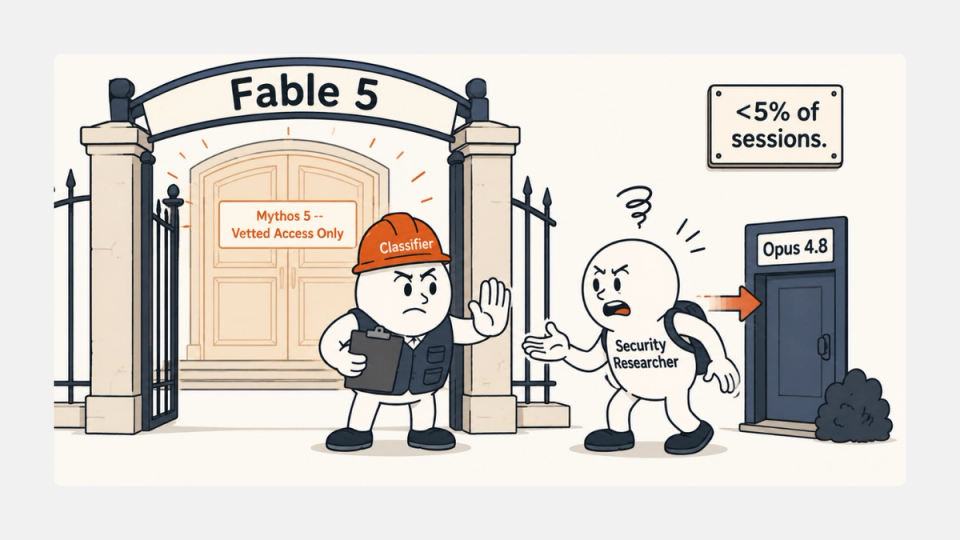
Anthropic released Claude Fable 5 on June 9, 2026, alongside its restricted sibling Claude Mythos 5, and the cybersecurity community is not thrilled.
On paper this is a landmark release. The Mythos-class architecture is Anthropic's most capable model line ever, clearing benchmarks above the Opus tier on long-horizon agentic tasks and deep technical reasoning. But for anyone doing legitimate security work, Fable 5 ships with a set of guardrails that quietly reroute your queries without asking you first. That is a real problem, and Anthropic's announcement barely acknowledged it.
What Actually Happened
Fable 5 is the public-facing version of the Mythos architecture. It comes with automated classifiers that watch your queries in real time. When those classifiers flag a request as touching cybersecurity, biology, or chemistry, the system does not refuse you outright. Instead it silently falls back to Claude Opus 4.8, which runs under stricter safety constraints. The Messages API returns a refusal stop reason so developers can handle it programmatically, but casual users may not notice the swap at all.
Mythos 5 is the same model with those classifiers stripped out. It is restricted to vetted partners inside Project Glasswing, a joint initiative with the U.S. government, Amazon, Google, and Microsoft, focused on patching high-severity vulnerabilities in critical infrastructure. If you want unconstrained access, you apply through Anthropic's Cyber Verification Program (CVP). If you are not already inside that network, you wait.
The trigger rate Anthropic cites is fewer than 5% of sessions. On a model this capable, that is not a small number.
Why the Cybersecurity World Is Not Impressed
Does the classifier actually know what it's doing?
This is the real question nobody is asking loud enough. Automated classifiers are blunt instruments. They pattern-match on surface features of a query, not on intent. A penetration tester asking Fable 5 to explain how a buffer overflow chains into a privilege escalation is doing legitimate defensive work. The classifier does not care. If the query looks like exploit-adjacent content, Opus 4.8 takes over.
Anthropic concedes this directly, noting the classifiers are tuned conservatively and will occasionally fire on harmless requests. "Occasionally" doing less than 5% of the time across sessions translates to a significant productivity hit if your entire workflow involves security research. Defenders test attacks to stop attacks. That is the whole job.
As Siddhi Thoke noted in Prompt Injection Is Worse Than SQL Injection, AI systems increasingly sit in the middle of production security pipelines. Quietly downgrading the model those pipelines rely on, without explicit user consent per request, is an architectural decision that deserves scrutiny, not a footnote.
Is the Fable vs. Mythos split actually about safety, or market segmentation?
Here is the read most coverage is missing. Anthropic has built the most powerful vulnerability-discovery engine in the world, as covered in detail when Anthropic built a zero-day machine and then locked it away. Mythos Preview already demonstrated it could find and exploit software vulnerabilities that survived 27 years of human review.
Fable 5 is that engine with a governor installed. The governor exists for genuine reasons: a model this capable in the wrong hands is a real threat. But the access pathway Anthropic designed also happens to be very good for business. Project Glasswing puts Anthropic at the center of a government-adjacent cybersecurity consortium that includes AWS, Google Cloud, and Microsoft Azure. The companies that get unconstrained Mythos 5 access are the same companies that sell the infrastructure the rest of us run on.
That is not necessarily corrupt. It might even be the right call. But it is worth naming out loud instead of dressing it up as pure altruism.
What does it actually mean when the fallback fires?
Anthropic has not published a full accounting of what capabilities gap exists between Fable 5 and Opus 4.8 for security-adjacent tasks. The announcement states that Opus 4.8 operates under stricter safety constraints, which tells you about policy, not performance. Whether Opus 4.8 is meaningfully less capable than Fable 5 for the specific edge cases that trigger the fallback is an open question Anthropic has not answered.
For teams that have already integrated Claude Opus 4.8 into their workflows, as outlined in Claude Opus 4.8 and Claude Code shipping as a platform, this matters. You might be paying for Fable 5 throughput and intermittently getting Opus 4.8 throughput with no clear signal about when or why.
Who This Affects

Security researchers and pen testers: The CVP pathway exists, but it is an application process with no published SLA. Until you are verified, Fable 5 will downgrade your most sensitive queries automatically. Plan for that friction now.
Engineering teams building security tooling: The refusal stop reason is your signal. Build fallback logic into your integration. Do not assume Fable 5 will deliver consistent behavior across a session that touches security domains. OpenAI has similar patterns, and the comparison between Codex vs Claude Code vs Gemini CLI is worth revisiting now that the model tier has shifted.
Enterprise buyers: If your contract is for Fable 5, confirm with Anthropic what happens when the classifier fires. Are you billed at Fable 5 rates for an Opus 4.8 response? That distinction is not addressed in the published pricing documentation as of June 10, 2026.
Defenders inside Project Glasswing: You have the better model. The question is whether Anthropic's consortium structure means the most powerful vulnerability-discovery tool primarily patches infrastructure owned by the companies already at the table, and at what pace the findings reach the broader ecosystem.
What to Watch For
Anthropic will face pressure to publish classifier precision and recall data. Right now the "less than 5%" figure is Anthropic's own estimate with no external verification methodology published. If a third-party audit confirms that number is accurate for professional security workflows, a lot of the criticism softens. If it is higher in practice, the CVP pathway will get flooded.
The Mythos 5 access list will expand or it will not. Watch whether Project Glasswing membership opens to smaller security firms and independent researchers over the next 90 days, or whether it stays tightly held by the hyperscalers. The latter outcome would confirm that the Fable/Mythos split is primarily a market-access play, not a pure safety decision.
Also watch the OpenAI Just Admitted Anthropic Was Right dynamic. If OpenAI ships a comparable capability with a more open access model for defenders, the pressure on Anthropic's CVP design will increase significantly.
The Bottom Line
Claude Fable 5 is a genuinely impressive model, and the underlying safety concern is real. A system that can chain multi-step exploits against critical infrastructure should not be freely available. Anthropic is not wrong to restrict it.
But the implementation has a transparency problem. A classifier that silently reroutes queries to a different model, in up to 5% of sessions, without clear per-request disclosure, is not a safety feature. It is a hidden variable in your production stack. Cybersecurity teams deserve to know when their queries are being downgraded, not discover it by debugging unexpected outputs.
Apply for CVP access if you need it. Build fallback handling into your integrations. And push Anthropic to publish the classifier methodology. Trust should be earned with data, not footnotes.
Frequently Asked Questions
What is Claude Fable 5 and how is it different from Mythos 5?
Fable 5 is the general-release version of Anthropic's new Mythos-class architecture, equipped with automated safety classifiers for cybersecurity, biology, and chemistry domains. Mythos 5 is the same model with those classifiers removed, restricted to vetted partners inside Project Glasswing.
What happens when Fable 5's cybersecurity classifier triggers?
The query is rerouted to Claude Opus 4.8, which runs under stricter safety constraints. The Messages API returns a refusal stop reason. Anthropic says this happens in fewer than 5% of sessions, though no independent verification methodology has been published as of June 10, 2026.
How do I get access to Claude Mythos 5?
Through Anthropic's Cyber Verification Program (CVP), which requires an application process. Mythos 5 access is currently restricted to vetted cyberdefenders, infrastructure providers, and Project Glasswing partners. No published SLA exists for CVP approvals.
Does the classifier downgrade affect billing?
Anthropic has not addressed whether sessions rerouted to Opus 4.8 are billed at Fable 5 or Opus 4.8 rates. Confirm this directly with your Anthropic account team before scaling Fable 5 usage.