
Kimi K3 Closes the Frontier Gap, With Caveats
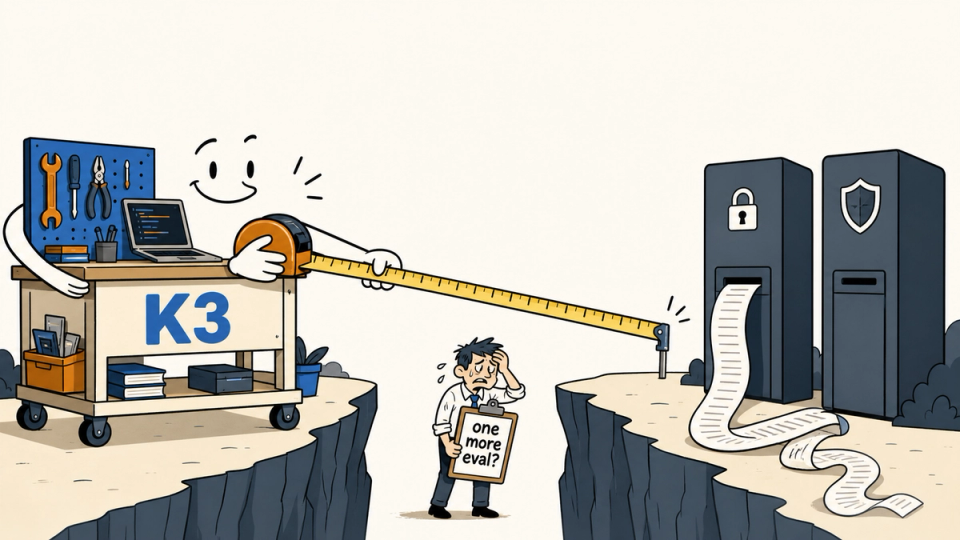
Moonshot AI introduced Kimi K3 in July 2026 as a 2.8-trillion-parameter model with native vision, a 1-million-token context window, and planned full model weights by July 27, 2026.
The important part is not that another lab shipped another very large model. The important part is that K3 is close enough to the closed frontier on coding, long-context work, and agentic tasks that the default procurement question changes. Teams no longer need to ask, "Can an open model do serious work?" They need to ask, "Which serious work can we safely move off the closed-model default?"
That is a smaller claim than the launch hype. It is also the more useful one.
What Happened
Moonshot's official Kimi site lists Kimi K3 as its latest flagship model, with 2.8T parameters, native multimodality, and a 1M-token context window. The more detailed Kimi K3 launch page describes it as a model for long-horizon coding, knowledge work, visual understanding, and deep reasoning, with Kimi API access under the model name kimi-k3.
The official Kimi K3 blog says the model uses Kimi Delta Attention and Attention Residuals, activates 16 of 896 MoE experts, and delivers roughly 2.5x better overall scaling efficiency than Kimi K2. Moonshot also says Kimi K3 is available through Kimi.com, Kimi Work, Kimi Code, and the Kimi API, with full weights planned by July 27, 2026.
The pricing story is unusually clear for launch week. The Kimi K3 launch materials list API pricing at $0.30 per million cache-hit input tokens, $3.00 per million cache-miss input tokens, and $15.00 per million output tokens. Artificial Analysis independently lists the same $3.00 input and $15.00 output pricing, plus 62 output tokens per second and a 1.99 second time to first token from Kimi's API.
The capability story is strong, but uneven. Artificial Analysis ranks Kimi K3 at number 4 out of 189 models on its Intelligence Index, with a score of 57. Its page says K3 is "amongst the leading models in intelligence," but also slower than average and more verbose than comparable models. Moonshot's own launch copy is careful too: it says K3 still trails the strongest proprietary models on overall performance, even while showing frontier-level results across its own evaluation suite.
That tension is the story.
What It Actually Means
Does Kimi K3 actually close the frontier gap?
Kimi K3 closes the practical gap for some high-value workloads, not the absolute frontier gap across every task. The evidence is strongest for frontend coding, long-context work, and agent-style tool use. The evidence is weaker for broad product replacement, reliability, latency-sensitive systems, and undisclosed self-hosting economics.
For builders, that distinction matters more than the leaderboard.
Closed frontier models used to win the argument twice. First, they were better. Second, they were easier to use. Kimi K3 attacks the first advantage in public and the second advantage through hosted access.
That combination changes how teams should evaluate models. The GLM-5.2 Terminal-Bench jump already showed that Chinese open and open-leaning labs were pushing into agentic coding territory. Kimi K3 makes the pressure harder to dismiss because it combines scale, long context, multimodality, and coding strength in one release.
But the right read is not "closed models are over." The right read is "closed models have to justify their premium per workflow."
If a team uses Claude or GPT for broad reasoning, legal review, compliance-heavy enterprise work, or reliability-sensitive customer flows, K3 is not an automatic switch. If the workload is frontend generation, internal code assistance, repo navigation, document-heavy analysis, or long-context research, K3 deserves a controlled evaluation.
That is the new gap. It is no longer capability versus incapability. It is trust, workflow fit, and operational cost.
Why does the 1M-token context matter?
The 1M-token context window matters because it moves K3 into the same product conversation as closed long-context systems. It lets teams test whole repositories, document rooms, research corpora, and multi-file tasks without immediately designing a retrieval layer. That does not remove architecture work. It changes where the first prototype can start.
Long context is not magic memory. It is a larger desk.
You can spread more papers across it, but someone still has to know which page matters. Models with huge context windows can still miss key details, overweight irrelevant passages, or produce expensive verbose outputs. Artificial Analysis flags K3's verbosity directly: the model generated 130 million output tokens during its Intelligence Index evaluation, compared with a 63 million median for similar models.
That number should make every engineering lead sit up.
If K3 is verbose by default, the cost story depends on prompt discipline, cached context, output limits, and task design. A $0.30 cache-hit input price is attractive. A rambling output loop at $15 per million tokens is less cute after the third agent retry.
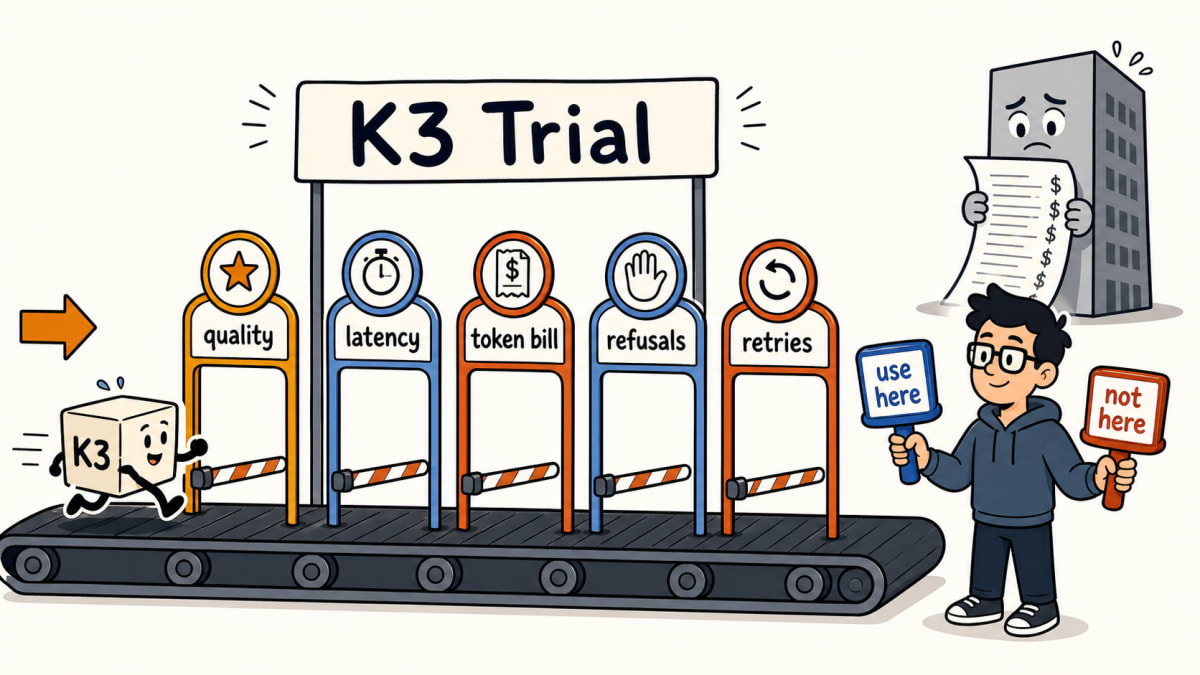
This is why the GLM 4.7 Cerebras tryout workflow is the right mental model. Do not debate K3 in the abstract. Swap it into one bounded workload, hold the prompts constant, and measure quality, latency, token use, and failure shape separately.
What does K3 change for coding agents?
K3 makes model lock-in harder to defend for coding agents. If an open-weight or soon-to-open-weight model can sit near the top of coding leaderboards and run through an API, coding tools need to prove their workflow layer, not just their model access. The IDE moat moves upward.
This is where K3 lands with the most force.
Frontend coding is unusually sensitive to human preference. A model can pass tests and still produce a clumsy interface. The public Arena result matters because it measures developer preference in blind comparisons, not just benchmark pass rates. K3 topping that kind of leaderboard does not prove it is best at all coding. It does prove that "open model equals worse UI code" is now a lazy assumption.
That pushes pressure onto tools like Cursor, Codex, Claude Code, and Gemini CLI. Their value increasingly comes from orchestration: reading the repo, running commands, managing files, showing diffs, preserving context, and keeping the human in control. We already saw that shift in Codex Micro as an agent control surface, where the interesting thing was status and approval control, not the hardware.
K3 fits the same pattern from the model side. If the model gets close enough, the product wrapper has to get much better.
This also makes Fable 5's coding side effects more relevant, not less. Stronger coding models are not just better autocomplete. They are stronger low-level reasoning systems connected to terminals, files, browsers, and production-adjacent tasks. K3 should be evaluated with the same caution: ordinary implementation, benign debugging, security-adjacent work, and full agent-loop behavior should be tested separately.
Who This Affects
For solo developers and indie builders, Kimi K3 is a reason to run a small bake-off. The useful test is not "can it beat my favorite model on a benchmark?" It is whether it can handle one real task in your stack with lower switching pain than expected. Try a repo-aware frontend task, a document-heavy research task, or a constrained bug fix. Track retries.
For startups, K3 is a vendor-pricing lever. Even if you do not adopt it immediately, the existence of another near-frontier option gives engineering and procurement teams more leverage. The old model menu was "pay closed frontier prices or accept a steep quality drop." K3 makes the quality drop less obvious, which changes negotiation.
For enterprise teams, the weights matter more than the launch chart. Moonshot says full weights are planned by July 27, 2026, but until they are actually released, inspected, licensed clearly, and supported by reliable inference partners, K3 is not an enterprise self-hosting plan. It is a strong candidate for evaluation.
For frontier labs, K3 is a warning shot. The gap is not closed everywhere. But a model that gets into the frontier conversation on coding and long-context work at this scale changes the burden of proof. Closed labs now need clearer reliability, safety, tooling, and support advantages. "We are the best" is weaker when "best enough for this workflow" is available elsewhere.
What To Watch For Next
The first watch-for is the July 27, 2026 weight release. The model is being discussed as open, but the practical meaning depends on the actual files, license terms, quantization support, and inference requirements. Open weights that only a handful of labs can run are useful, but not democratizing in the way smaller teams usually mean.
The second watch-for is independent coding evaluation beyond frontend preference. K3 needs repository-scale tests, agent harness tests, and failure-mode writeups from teams that do not have launch-week incentives. The Sonnet 5 vs GPT-5.5 vs Gemini 3.1 Pro comparison is a useful reminder: one throne rarely survives contact with real workflows.
The third watch-for is verbosity control. If K3's default reasoning burns tokens aggressively, the price story becomes workload-dependent. Cached input helps long-context economics, but output discipline decides whether agent loops stay cheap enough to run often.
The fourth watch-for is product integration. Kimi Code, API partners, local serving stacks, and IDE vendors will determine whether K3 becomes a daily tool or a leaderboard event.
The Bottom Line
Kimi K3 does not end the closed-model era. It makes the closed-model premium more conditional.
That is a big shift. The frontier gap used to be a wall. Now it looks more like a set of lanes: closed models still lead in the hardest broad reasoning and trust-sensitive product work, while open and open-leaning models are becoming credible in coding, long context, and agentic workflows.
The practical move is simple: do not switch everything. Pick one workload where context length, coding strength, or cost pressure actually matters. Run K3 against your current default. Measure quality, latency, token use, refusal behavior, and retries. If it wins there, you have not found a new religion. You have found a cheaper lane.
FAQ
Is Kimi K3 open source?
Moonshot describes Kimi K3 as an open 3T-class model and says full model weights are planned by July 27, 2026. As of July 18, 2026, teams should treat the open-weight claim as pending until the weights, license, and serving requirements are public.
Is Kimi K3 better than Claude or GPT-5.6?
Not across every task. Kimi K3 appears highly competitive on coding and long-context work, and it ranks near the top on Artificial Analysis. Moonshot also says it still trails the strongest proprietary models overall. The right comparison is workload-specific.
How much does Kimi K3 cost through the API?
Launch pricing lists $0.30 per million cache-hit input tokens, $3.00 per million cache-miss input tokens, and $15.00 per million output tokens. Pricing should be rechecked before production use because launch pricing can change quickly.
Why are people comparing Kimi K3 to DeepSeek?
Both are examples of Chinese labs pushing open or open-leaning models toward the global frontier. The comparison is less about one model beating another and more about the pace at which non-US labs are reducing the practical capability gap.
Should a startup replace its current model with Kimi K3?
No, not blindly. A startup should test K3 on one bounded workload where coding, long context, or cost matters. If it improves that workflow without new reliability problems, expand the trial. If it only wins a benchmark, keep it as leverage.