
How to Try GLM 4.7 on Cerebras API
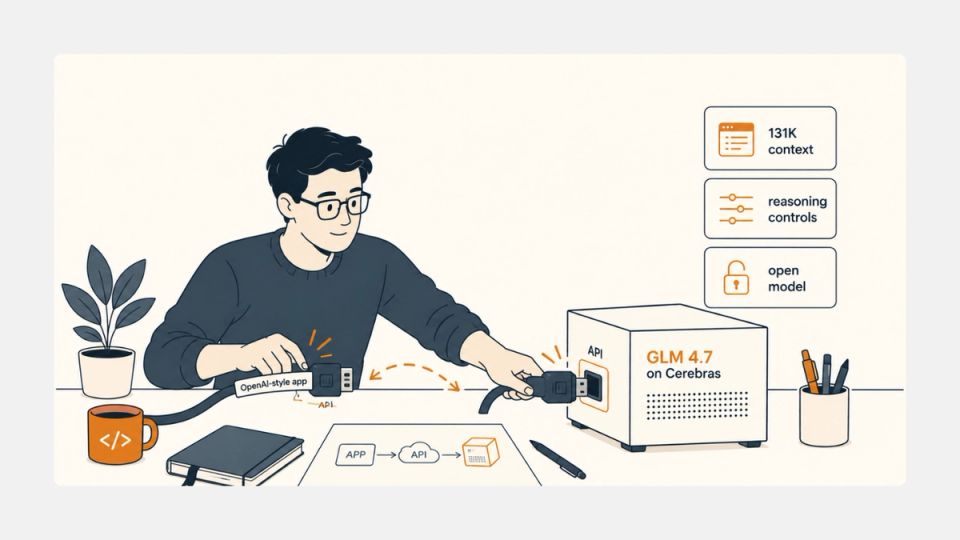
GLM 4.7 is Z.ai's open-source Mixture-of-Experts model for coding, reasoning, and agentic workflows, and Cerebras is the fastest low-friction way to try it without self-hosting. The model matters less because it won another benchmark screenshot and more because Cerebras turns it into an OpenAI-compatible API call you can test inside an existing stack this afternoon.
That is the practical story. Most teams interested in GLM 4.7 do not want to stand up serving infrastructure, parse a new API shape, or rebuild prompts from scratch just to evaluate one model. They want a clean tryout path: keep the same chat-completions pattern, swap the model, adjust a few GLM-specific controls, and learn quickly whether it belongs anywhere near production.
The useful question is not "is GLM 4.7 impressive?" It is "what can I learn by trying it through Cerebras before I commit to self-hosting or dismiss it for a closed model?" That is the angle of this piece.
The Quick Answer
What is GLM 4.7?
GLM 4.7 is Z.ai's open-source MoE model built for coding, reasoning, and agentic use cases. Cerebras describes the main model as 358B total parameters with about 32B active per forward pass, a 131,072-token context window on Cerebras, and up to 40K output tokens.
Why should you care?
Because it gives developers a serious open-model option for coding and tool-use evaluation without forcing them into an entirely new API surface. Cerebras serves it on a public endpoint and documents an OpenAI-compatible migration path.
The non-obvious truth: The best reason to test GLM 4.7 is not ideology about open weights. It is evaluation speed. Cerebras lets you answer "is this good enough for my workload?" before you spend time on infrastructure.
The Foundations
There are really two products here, and mixing them up leads to bad decisions.
The first product is GLM 4.7 itself. In Cerebras' migration guide, the company positions it as a coding- and agent-focused successor to GLM 4.6, with stronger reasoning, better tool usage, and improved general chat quality. The same guide says GLM 4.7 became the top open-source model on the Artificial Analysis Intelligence Index at the time of the update, and highlights gains on tau-bench, SWE-bench, GPQA, and AIME. That is the model story.
The second product is the tryout path. Cerebras exposes GLM 4.7 as zai-glm-4.7, keeps the API OpenAI-compatible at https://api.cerebras.ai/v1, and documents the few knobs that matter when you test it: reasoning_effort, clear_thinking, max_completion_tokens, temperature, and top_p. That is the workflow story.
If you are a builder, the workflow story is usually the more important one. A model can be strong on paper and still be annoying to evaluate. Cerebras removes most of that friction.
There is also a smaller sibling worth knowing about. The Hugging Face model card for GLM-4.7-Flash describes it as a 30B-A3B MoE variant built for lighter deployment, and reports scores like 59.2 on SWE-bench Verified and 79.5 on tau-squared Bench. That matters because a GLM 4.7 evaluation does not have to end with the full-size model. It can end with a realistic local or self-hosted path.
Why does GLM 4.7 matter if GLM 5.x already exists?
Because "latest" and "best model to evaluate" are not the same thing. GLM 4.7 is interesting precisely because it sits at the intersection of strong open-model performance and low-friction evaluation on an API developers can already use.
That is easy to miss. A lot of frontier-model coverage treats version numbers like a conveyor belt: once 5.x exists, 4.7 becomes a historical footnote. But the Cerebras docs still recommend GLM 4.7 across real developer tasks such as code generation, code completion, terminal workflows, tool-using agents, and general planning. On the "Choose a Model" page, Cerebras explicitly lists GLM 4.7 as a public option for code and agentic workloads.
The implication is practical. You do not need GLM 4.7 to be Z.ai's newest headline model for it to be worth trying. You need it to be good enough, cheap enough, and accessible enough to answer a workload question quickly. That is a lower bar, and it is the bar most teams actually care about.
There is also a strategic reason to pay attention. The strongest open models increasingly win adoption not when they top every benchmark, but when they reduce migration cost. That is why GLM-5.2 Just Broke the 80% Barrier on Terminal-Bench mattered as more than another benchmark story. The underlying competitive fight is shifting from raw capability toward how easily a team can test, switch, and operationalize the model.
Why is Cerebras the easiest way to try GLM 4.7?
Because Cerebras already did the annoying compatibility work. The API shape looks familiar, the migration guide is explicit, and the defaults are documented rather than implied.
The shortest path is this:
- Get a
CEREBRAS_API_KEY. - Point your client at
https://api.cerebras.ai/v1. - Change
modeltozai-glm-4.7. - Decide whether you want reasoning on or off.
- Run your own prompts and eval set before you decide anything bigger.
That is unusually clean for an open-model evaluation path. The Cerebras guide recommends leaving temperature=1 and top_p=0.95 at their defaults unless you have a reason to change them, and warns against adjusting both at once if what you actually want is stability. It also notes that reasoning is enabled by default, that reasoning_effort="none" disables it, and that clear_thinking: false preserves reasoning traces across turns.
Those controls matter more than most "just swap the model" articles admit. A lot of failed model evaluations are not model failures. They are evaluation failures caused by reusing prompts and sampling settings that were tuned for a different serving stack.
Cerebras says that directly in its migration guide, warning that a common mistake is reusing old prompts without adapting them for GLM 4.7's prompting style and reasoning behavior. That is the kind of advice that saves people an afternoon.
For teams already comparing terminal and agent workflows, the broader lesson matches the one in Codex vs Claude Code vs Gemini CLI: May 2026 Verdict: the model is only half the product. The surrounding execution loop is the other half. Cerebras makes GLM 4.7 testable inside a familiar loop.
What do you actually change in code to test it?
Almost nothing structural, which is the entire point.
If you already use the OpenAI SDK, Cerebras documents the migration with a custom base_url and the GLM model ID. Here is the minimal Python version:
import os
from openai import OpenAI

client = OpenAI(
    api_key=os.environ.get("CEREBRAS_API_KEY"),
    base_url="https://api.cerebras.ai/v1",
)

resp = client.chat.completions.create(
    model="zai-glm-4.7",
    messages=[
        {
            "role": "system",
            "content": "Always respond in English. Be concise and precise.",
        },
        {
            "role": "user",
            "content": "Design a three-tier microservice architecture for a small SaaS app.",
        },
    ],
    max_completion_tokens=4000,
    reasoning_effort="none",
    extra_body={
        "clear_thinking": False,
    },
)

print(resp.choices[0].message.content)
That gets you a real tryout with very little ceremony.
If you want a slightly more disciplined evaluation, use this checklist instead of random prompting:
- Keep your existing prompt, but add
Always respond in Englishto avoid multilingual drift. - Run the same 10 to 20 tasks you already use for another coding or reasoning model.
- Test one pass with reasoning disabled and one with default reasoning.
- If you use tools or streaming, verify argument parsing before judging quality.
- Track three things separately: answer quality, latency, and failure shape.
That separation matters. A model can lose on polish and still win on cost-adjusted usefulness for narrow agent tasks.
The place where GLM 4.7 looks most promising is structured multi-step work, especially when the evaluation includes agent loops, code critique, or repair flows. That aligns with how Cerebras markets it and with the agent-loop framing in What an Agent Loop Is and How to Set One Up for Marketing Content. A model that plans, calls tools, and recovers from mistakes is being judged on a different axis than a model that only needs to write one clean paragraph.
What should your first GLM 4.7 tryout look like?
It should be narrower than you think.
Do not start with "replace our main model." Start with one workload where open-model economics or deployment flexibility could plausibly matter:
- Code review summaries for pull requests
- Bug-fix suggestions on repeated stack traces
- Structured planning for terminal tasks
- Tool-using internal agents with bounded actions
- Internal documentation drafting with long context
Then write the prompt like a migration test, not a demo prompt. Cerebras says GLM 4.7 puts heightened attention on the beginning of the prompt, so front-load the hard rules. Use directive language like MUST, REQUIRED, and STRICTLY where needed. If you want stable English output, say it explicitly. If you want role fidelity, assign the role cleanly.
That advice sounds small. It is not. The difference between "please try to follow this format" and "you MUST output valid JSON matching this schema" is often the difference between a useful model evaluation and a false negative.
Here is a solid first test prompt for developers:
You are a senior software architect.

You MUST respond in English.
You MUST give a direct answer first, then the reasoning.
You MUST return valid Markdown.

Task:
Review this service design and identify the top three failure risks, then propose the smallest set of changes that would make it production-safe.

Output format:
1. Verdict
2. Top 3 risks
3. Minimal remediation plan
4. Any assumptions
That prompt does three useful things at once: it front-loads instructions, sets language, and makes the output easy to compare against another model.
When should you not pick GLM 4.7?
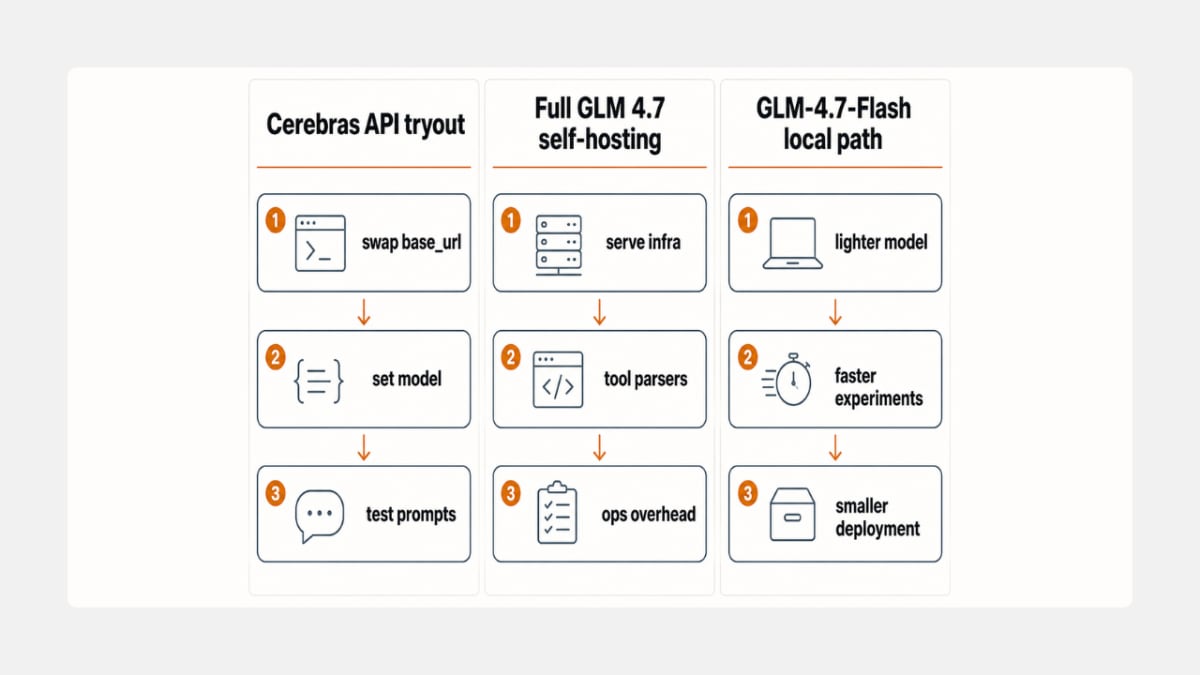
When your evaluation goal is actually "I need the strongest available model regardless of openness," or when your team is not willing to tune prompts and observe reasoning behavior honestly.
GLM 4.7 is not interesting because it erases every closed-model advantage. It is interesting because it changes the cost of learning. If you already know you need the most mature multimodal stack, the deepest enterprise ecosystem, or the most forgiving default behavior, this is probably not your final answer.
It is also not the right fit if your team confuses one good benchmark graph with production readiness. Cerebras itself tells users to validate randomness, latency, long-context behavior, and tool-call parsing on real workloads. That is the correct posture. Treat the migration guide as a starting point, not a verdict.
The local-deployment branch deserves the same honesty. GLM-4.7-Flash looks attractive for lighter self-hosting, but the Hugging Face card also makes clear that serving support depends on current framework branches and specific parsers for tool calling and reasoning. The open model may be free in principle and still expensive in engineering time.
The Honest Take
The biggest risk in articles like this is overstating how much "OpenAI-compatible" really buys you. The request format may migrate cleanly, but evaluation still depends on prompt shape, tool behavior, latency expectations, and your team's tolerance for model-specific quirks. Compatibility is real. Interchangeability is not.
The second limit is source visibility. Cerebras documents the serving path clearly, and the GLM-4.7-Flash card gives usable benchmark details for the lighter model, but not every operational question is fully answered in public. If you are making a production decision, you still need to run your own workload and watch the failure modes yourself.
The third limit is that this article assumes the API path you want is Cerebras, not a platform named "Celebrus." I am making that inference because Cerebras publishes the GLM 4.7 migration guide and OpenAI-compatible examples. If you meant a different vendor, the workflow would need a different verification pass.
The Bottom Line
GLM 4.7 is worth your time if you want to test a serious open model for coding or agentic work without jumping straight into self-hosting. Cerebras makes that evaluation unusually easy: same general chat-completions pattern, one new model ID, a handful of reasoning controls, and enough documentation to run a fair tryout instead of a vibes-based demo.
The right move is not to crown it from a benchmark chart. The right move is to run one bounded workload through Cerebras this week, compare it against the model you already trust, and decide whether GLM 4.7 earns a second round. If it does, then you can decide whether the future path is "keep using Cerebras" or "graduate to GLM-4.7-Flash or another self-hosted variant." That is a better decision rule than arguing about open versus closed models in the abstract.
FAQ
Is GLM 4.7 available through an OpenAI-style API?
Yes. Cerebras documents an OpenAI-compatible path using base_url="https://api.cerebras.ai/v1" and the model ID zai-glm-4.7.
What are the main GLM 4.7 limits on Cerebras?
Cerebras lists a 131,072-token context window and up to 40K output tokens through max_completion_tokens for zai-glm-4.7.
How do I turn off reasoning in GLM 4.7 on Cerebras?
Set reasoning_effort="none". Cerebras also notes that disable_reasoning is deprecated.
What if I want a smaller model I can self-host later?
The practical path is to also evaluate GLM-4.7-Flash. Z.ai's Hugging Face card describes it as a 30B-A3B MoE model with stronger lightweight-deployment economics than the full GLM 4.7 line.
What is the single biggest mistake when trying GLM 4.7?
Reusing old prompts and judging the model too early. Cerebras explicitly warns that migration quality depends on adapting prompts, reasoning settings, and tool-calling flows for GLM 4.7's preferred behavior.