
What an Agent Loop Is and How to Set One Up for Marketing Content
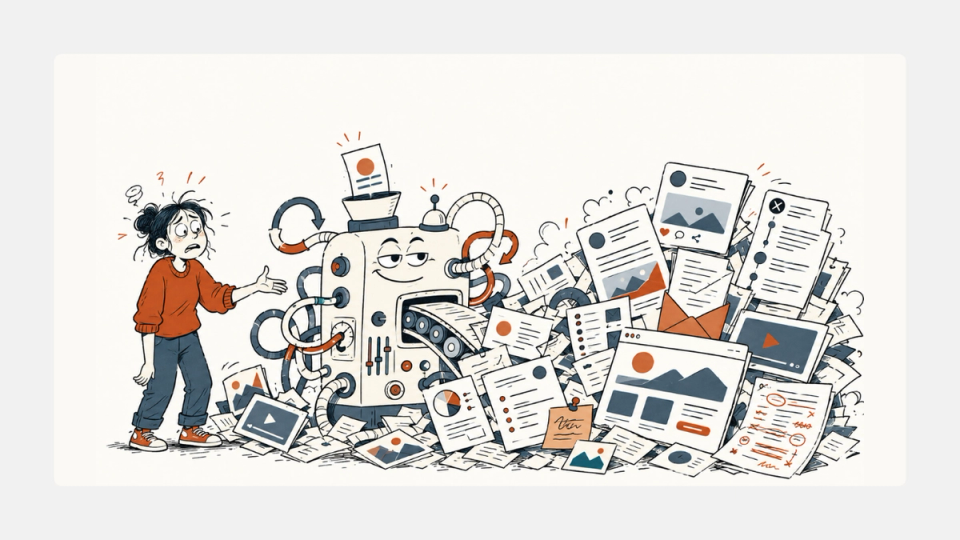
An agent loop is a repeated cycle in which an AI system reads the current state, decides the next action, does the work, checks the result, and either stops or runs another turn. In marketing, that matters because one campaign brief rarely becomes one output. It becomes a blog post, a LinkedIn post, an X thread, an email, a landing-page angle, and usually three revisions nobody planned for.
The thesis of this piece is simple: an agent loop is useful for marketing content only when the loop owns decisions, not just drafting. The right setup is not one giant prompt that says write everything for every channel. It is a bounded workflow where planning, channel adaptation, critique, approval, and publishing are separate turns with explicit stop conditions.
That distinction is what most surface-level explainers miss. Anthropic's guide to Building Effective AI Agents draws a sharp line between fixed workflows and more autonomous agents, and recommends starting with the simplest architecture that can do the job. For marketing teams, that usually means a workflow-shaped agent loop first, not a fully autonomous content machine. Last updated July 2026.
The Quick Answer
What is an agent loop?
It is a repeated sense-decide-act-review cycle for an LLM. The model looks at the current brief, tool outputs, or draft state, chooses the next action, performs it, checks whether the result moved the task forward, and repeats until a stop condition is met.
Why does it matter for marketing content?
Because channel work is iterative by nature. A good LinkedIn post is not a shortened blog post, an X thread is not a broken-up newsletter, and a landing-page hero is not a headline pulled from either. The loop lets each asset be rewritten against the constraints of its channel.
The non-obvious truth: the value is not that the AI writes more words. The value is that the loop can hold a strategy fixed while letting execution vary by channel, then critique the output before it reaches a human reviewer. That is a workflow gain, not a novelty gain.
The Foundations
The term agent loop is used loosely, which is part of the confusion. Some teams use it to mean any multistep prompt. Others use it to mean a fully autonomous system with tools, memory, and approvals. In this piece, an agent loop means a repeated cycle with five parts: goal, state, action, feedback, and termination.
That definition sits close to the original ReAct paper, which combined reasoning and acting in an interleaved loop so the model could gather information, update its plan, and continue. In practical terms, ReAct gave the field a usable pattern: think, do, observe, think again. Modern agent runtimes productize that pattern with tool calls, sessions, state, and guardrails.
OpenAI's current docs describe the split clearly. The Responses API function-calling flow lets your application receive tool calls, execute them, return outputs, and call the model again. The Agents SDK guide says the SDK is the better choice when you want the runtime to manage repeated tool calls, branching, state, and approvals for you. Same idea, different level of control.
Anthropic makes a second distinction that matters even more for marketers: not every agentic system should be an autonomous agent. In its architecture guide, the company separates workflows from agents and recommends using workflows when the task can be decomposed into fixed subtasks. Marketing content creation usually starts there. The sequence is known. The judgment inside each step is what varies.
That is why the right mental model for marketing is not “replace the content team with an agent.” It is “build a loop that keeps the campaign thesis stable while handing each channel to the right specialist step.” If you have already seen this pattern in adjacent work, the article on How to Automate Marketing Reports With AI Prompts shows the same principle in a lower-risk setting: reliable outputs come from scoped roles, explicit context, and fixed output contracts.
Where the surface explanations break
What is the smallest useful agent loop for marketing content?
The smallest useful loop is not brief in, final assets out. It is brief in, strategy note out, then channel drafts, then critique. If you skip the strategy step, every downstream asset becomes locally plausible but globally inconsistent, which is exactly what makes AI content feel generic.
A minimal marketing loop has four stages.
First, a strategist step turns a raw brief into a message contract: audience, pain point, proof, offer, forbidden claims, and one sentence of thesis. Second, a router decides which channels are needed for this campaign. Third, a channel specialist writes each asset against the message contract and the rules of that channel. Fourth, a critic checks whether the output actually preserved the thesis, sounded native to the channel, and made a concrete claim instead of producing mush.
That setup is more useful than a single generalist agent because it fixes the real failure mode: drift. Marketing teams do not usually lose because the first draft is ugly. They lose because the Twitter version overpromises, the LinkedIn version gets preachy, the email subject line chases curiosity clicks the body cannot earn, and the landing page quietly changes the offer.
This is the same reason How to Set Up Claude Agent SDK for Customer Support Triage splits classification, drafting, and escalation into separate subagents. Different decisions need different context windows and different success criteria. Content work is no different.
Why does one giant prompt fail across channels?
One giant prompt fails because channels reward different moves. LinkedIn wants a crisp argument with a professional stake, X rewards velocity and compression, email needs curiosity plus clarity, and a blog post has to sustain depth. One prompt can mention those rules. It cannot enforce them equally well in one pass.
The deeper problem is attention allocation. In an all-in-one prompt, the model is trying to preserve brand voice, maintain campaign thesis, remember channel constraints, obey formatting rules, and generate multiple assets at once. That is exactly the sort of overloaded context that causes a loop to degrade into averages.
A recent position paper, From Agent Loops to Structured Graphs, describes the classic single-loop pattern as one where a model keeps deciding the next step from an ever-growing context window. The paper argues that this creates implicit dependencies, unbounded recovery loops, and messy execution history. That critique maps directly onto content ops. If the draft history, critique history, and all channel outputs live in one running context, it becomes hard to debug why the X thread suddenly adopted a different promise than the newsletter intro.
The fix is not more prompting flair. The fix is architecture. Keep one shared campaign brief. Pass only the relevant slice of context to each channel step. Store the critic feedback separately. Make the approval state explicit. That is how you keep one thesis while allowing multiple channel-native executions.
A good way to think about this is creative velocity with guardrails. The argument in AI UGC Ads Are the New Moat is that the moat is no longer pristine targeting but faster creative iteration. Agent loops matter because they let a team run that iteration without losing the campaign spine every time a new asset is spawned.
How do you stop the loop from producing polished nonsense?
You stop it the same way you stop a junior marketer from doing the same thing: give it evidence, force it to cite the evidence in the draft, and insert a review step that can block publication. Without retrieval, critique, and stop conditions, the loop will optimize for completion, not truth.
This is the part many demos skip because it makes the workflow less magical. A marketing agent loop needs at least three guardrails.
The first is a source pack. That can be product notes, campaign metrics, customer research, prior launch copy, positioning docs, or competitor teardowns. The strategist step should not invent the thesis. It should synthesize from the pack. The second is a critic that checks claims against the pack. The third is a human approval gate before anything is scheduled or published.
If the loop has access to live tools, the same principle applies. A social-copy agent should be allowed to read the campaign brief and performance history. It should not be allowed to publish directly to every channel by default. OpenAI's agent docs frame this as a guardrails and approvals problem, and Anthropic's docs make the same point from another angle: autonomy raises both cost and the risk of compounding errors.
The security version of this problem is prompt injection. For content teams, the more common version is context pollution: outdated positioning docs, stale launch notes, contradictory offers, or competitor claims copied into the working set. The piece Prompt Injection Is Worse Than SQL Injection is about a harder security case, but the operational lesson carries over cleanly: anything the model reads can steer what it writes, so not all context should be treated as trusted instructions.
How to set up an agent loop for marketing content creation
What does the practical setup look like?
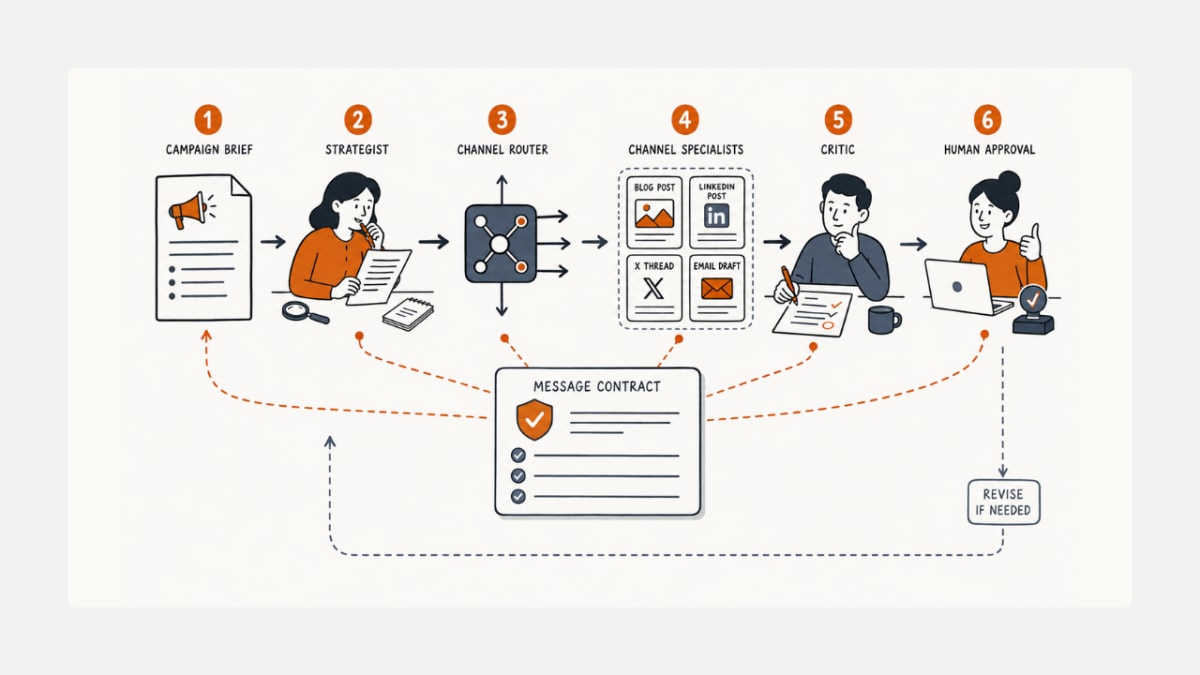
The practical setup is a six-stage loop: strategy, routing, drafting, critique, approval, and distribution. Each stage owns one decision, writes its output into a durable state object, and either stops or hands off to the next stage. That is enough structure for reliability without turning the workflow into a brittle maze.
Here is the version that is simplest to ship and hardest to regret.
- Start with one campaign brief. The brief should include audience, offer, proof, CTA, constraints, and a list of channels. If those fields are missing, the loop should stop and ask for them. A surprising amount of bad AI content is just missing strategy disguised as generation.
- Add a strategist step. The strategist reads the brief and produces a message contract with fields like primary thesis, reader problem, evidence, tone, forbidden claims, and one reusable asset. That reusable asset might be a checklist, a contrarian framing, a data point, or a workflow. This is the piece worth saving and sharing.
- Route by channel, not by format alone. The router should decide whether the campaign needs a blog post, email, LinkedIn post, X thread, landing page, or all of them. It should also know when a channel should be skipped. Not every campaign deserves six assets. Routing is where you protect the team from “because we can” publishing.
- Give each channel its own specialist prompt. A LinkedIn specialist should know how to write an opening claim, pace line breaks, and end with a thoughtful prompt. An X specialist should know compression, thread logic, and how to avoid sounding like a chopped-up blog intro. A newsletter specialist should optimize for open-loop curiosity without becoming clickbait. The article How to Set Up Claude Code for Real SEO Work makes the same broader point for research workflows: scope-first systems outperform general prompts that try to do everything at once.
- Insert a critic before approval. The critic should score each asset on three things: thesis fidelity, channel fit, and evidence grounding. If a draft fails any one of the three, it goes back one turn with specific feedback. If it fails twice, the loop stops and asks for a human rewrite or a better brief.
- End with human approval and optional distribution. The loop should package the approved assets with metadata: campaign id, channel, status, source pack used, and critic notes. Distribution can be another step, but it should be downstream of approval, not hidden inside drafting.
If you want a concrete state object, use fields like campaign_goal, audience, thesis, source_pack, required_channels, drafts, critic_notes, approvals, and final_assets. The point is not the exact schema. The point is that the loop should read and update state, not keep all progress inside one long conversation.
A worked example
Imagine a campaign for a new AI analytics feature.
The brief says the audience is growth marketers at B2B SaaS companies, the pain point is slow campaign analysis, the proof is a 63% reduction in reporting time from an internal pilot, and the CTA is to book a demo.
The strategist turns that into a thesis: most marketing teams do not need another dashboard, they need a faster decision loop. It also defines the reusable asset: a five-part workflow for turning campaign data into channel decisions.
The router decides the campaign needs four assets: a blog post, a LinkedIn post, an X thread, and an email. It skips a landing-page rewrite because the feature is an add-on, not a full product launch.
The LinkedIn specialist writes an argument-led post for practitioners. The X specialist rewrites the idea into a tighter sequence with one statistic and one sharper hook. The email specialist turns the workflow into curiosity around one painful question: how many hours does your team still spend just formatting reports. The critic then checks whether all three assets still revolve around the same thesis: faster decisions, not prettier dashboards.
That is an agent loop doing useful work. It is not impressive because it writes four things. It is useful because it keeps four things aligned.
The Honest Take
First limit: most teams do not need a highly autonomous loop. If your content process is still unstable at the brief stage, an agent will scale the instability. The bottleneck is usually strategy quality, not draft throughput.
Second limit: looped content gets expensive faster than people expect. Every extra critique pass, every extra channel specialist, and every retrieval step adds tokens and latency. The cost is worth it only when the output replaces real workflow, not when it creates a fancier first draft that still needs a full human rewrite.
Third limit: feedback loops can become taste loops. If the critic is trained only on your past “successful” posts, the system may converge on the same cadence, same hooks, and same posture until every asset feels familiar. That is efficient, but it is not necessarily distinctive. Human editorial judgment still has to decide when the loop is preserving a brand and when it is flattening one.
The Bottom Line
An agent loop is not “AI that keeps writing until it feels done.” It is a structured cycle of state, action, feedback, and stopping. For marketing content, the right setup is a workflow-shaped loop that holds the campaign thesis steady while channel specialists adapt execution.
If you are building one from scratch, start smaller than your instincts suggest. One brief. One strategist. Two channel specialists. One critic. One approval gate. Once that loop consistently produces assets that are both aligned and channel-native, then add more channels or more autonomy.
The key decision rule is easy to remember: if the next step is predictable, use a workflow; if the next step is genuinely open-ended, use an agent. Most content systems need more workflow than freedom.
FAQ
Is an agent loop the same thing as an AI workflow?
No. A workflow can be fixed and mostly deterministic. An agent loop contains repeated model decisions about what to do next based on state and feedback. In practice, many useful marketing systems are hybrid: workflow skeleton, agentic judgment inside selected steps.
Do I need tools and APIs to get value from an agent loop?
Not at first. A source pack plus a structured state object is enough to prove the pattern. Tools become valuable when the loop needs to fetch analytics, read docs, pull competitor pages, or push approved assets into publishing systems.
What is the first sign my loop is badly designed?
If different channel outputs disagree about the core offer or sound like watered-down copies of each other, the strategist step is too weak or the context passed to specialists is too broad.
Should the loop publish directly to social channels?
Usually no. Drafting and distribution should be separate until you have strong evidence that the critic and approval steps are catching mistakes reliably.
What should I measure first?
Measure revision rounds, human editing time, approval rate, and post-level quality signals such as saves, shares, qualified clicks, and downstream conversions. If the loop only increases output volume, it is not helping yet.