
How to Set Up Claude Code for Real SEO Work
Claude Code is Anthropic's agentic command-line tool: it reads your repo, runs shell commands, edits files, and chains those steps together under your direction. For SEO teams it is not another writing widget. It is a programmable assistant that can audit a site, generate schema, draft briefs, and ship technical fixes, but only if you wire it correctly and supervise the output.
The thesis of this piece is simple. Claude Code earns its keep on SEO work when you treat it as a force multiplier on top of human judgment. The moment you treat it as a content factory, Google's December 2025 helpful content update is built to find you. Sites that shipped unedited AI output saw traffic drops in the 40 to 60 percent range, while teams that mixed AI drafting with first-hand human review kept their rankings.
Set up matters. The default Claude Code install does almost nothing useful for SEO out of the box. The leverage comes from skills, hooks, project instructions, and a tight feedback loop with the human who owns the page.
The Quick Answer
What is Claude Code for SEO?
A local CLI that runs Claude inside your project, with your files, your CMS bindings, and custom skills you install. It can audit pages, fix schema, draft briefs, refactor sitemaps, and patch technical issues, all from the terminal.
Why does it matter?
SEO work is increasingly half engineering, half editorial. Claude Code is the only mainstream AI tool that can hold both at once on real codebases without copy-paste tax.
The non-obvious truth: the value is not in what Claude Code writes for you. It is in what you stop doing yourself. Use it to delete busywork, not to ship unsupervised content.
The Foundations
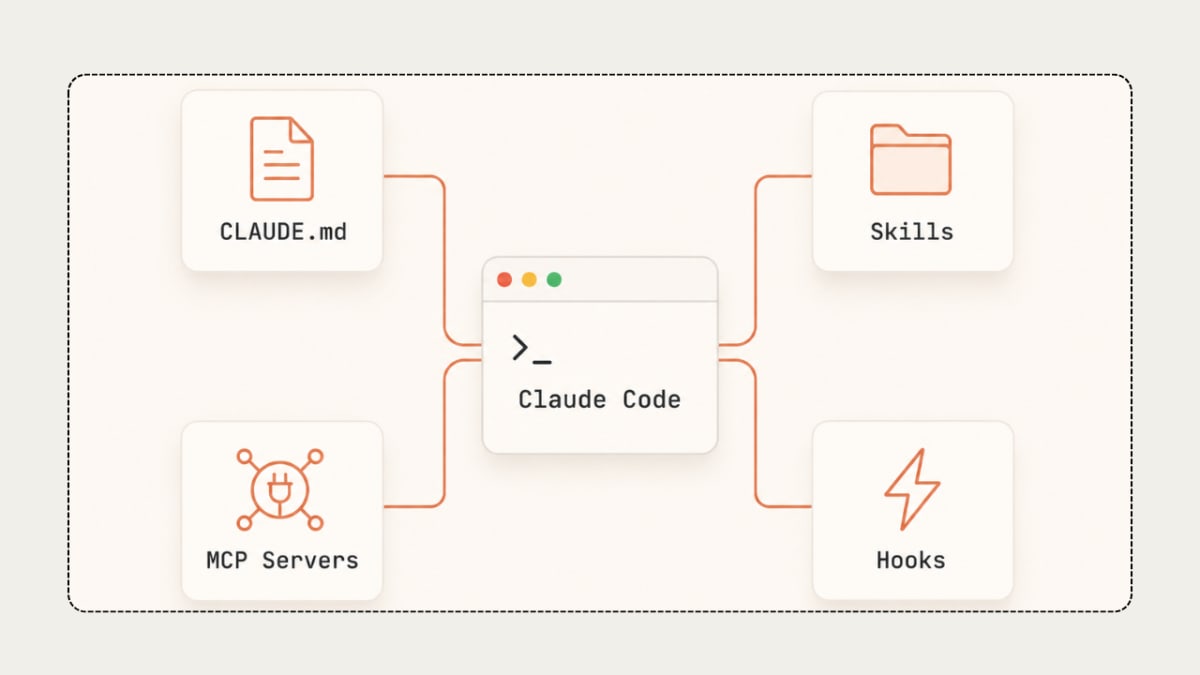
Claude Code installs as a CLI: npm install -g @anthropic-ai/claude-code, then run claude in any project directory. It picks up four pieces of context automatically.
The first is CLAUDE.md, a project instructions file that lives at the repo root. Treat this as your style guide, your stack notes, and your hard rules for what Claude must and must not do. For an SEO project, this is where you list your CMS, your URL conventions, your tone, and the publishing workflow.
The second is skills. Skills are markdown files in .claude/skills/<name>/SKILL.md that bundle a procedure Claude can run on demand. They are knowledge plus checklist. The community-maintained awesome-claude-code repo lists hundreds, and there is a growing SEO-specific subset covering audits, schema, content briefs, technical fixes, and AI search optimization.
The third is MCP servers. The Model Context Protocol lets Claude Code call external systems over JSON-RPC. For SEO you can wire Google Search Console, Google Analytics, Sanity, Ahrefs, Screaming Frog, and any internal CMS. Claude does not "use the API" in the abstract. It calls a server you point it at.
The fourth is hooks. Hooks are shell commands that fire on events: before a tool runs, after a file is edited, when a session ends. Useful for forcing a Lighthouse audit after a page change, or blocking edits to production files without a checklist pass.
This is the same architecture the orchestration tools converged on. Cursor 3 isn't an IDE anymore, it's a control room, and Claude Code is the same shape from a different angle: you are not writing every line, you are directing an agent that does.
Which skills should you install for SEO?

Five categories cover most working SEO teams. Audits, schema, briefs, technical fixes, and AI search optimization. Install the ones that map to weekly work, not every skill you can find. A bloated skills directory makes Claude slower and worse at picking the right one.
Audit skills. A site-wide audit skill should crawl up to a few hundred pages, score each on a fixed rubric, and emit a prioritized fix list. The community /seo-audit and /seo-page skills do this with parallel subagents and a health score. Use them at the start of every engagement and before each quarterly review. Treat the score as a compass, not a grade. The skill cannot tell you which fixes will move revenue.
Schema skills. A /seo-schema skill detects existing JSON-LD, validates it against Google's rich-results requirements, and generates new markup. This is where Claude Code is genuinely better than a human, because schema is mechanical. The hand-written FAQPage and Article blocks from a junior SEO are reliably wrong about mainEntity nesting. Claude is reliably right.
Content brief skills. A brief skill takes a target keyword, pulls the SERP, identifies content gaps, and outputs a structured brief with H2s, suggested word counts, and source URLs. The output is a starting point. The human writes the article. This is the boundary you do not cross in 2026 for any page that matters.
Technical SEO skills. Crawl errors, mobile rendering checks, Core Web Vitals diagnostics, sitemap regeneration, hreflang validation. Boring, deterministic, infinitely repeatable. Exactly the work an agent should own.
AI search and GEO skills. A /seo-geo skill audits pages for AI Overviews, Perplexity, and ChatGPT citation surface area. It checks llms.txt compliance, AI crawler accessibility, passage-level citability, and brand mention signals. This work used to be guesswork. With a skill in front of it, it becomes a checklist.
There is a sixth category worth mentioning. Custom skills that encode your team's playbooks. If your agency runs the same pre-launch checklist on every site, write it once as a skill and run it forever. This is where Claude Code stops being a tool and becomes infrastructure.
How do Google's 2026 updates change what Claude Code should and shouldn't do?

The December 2025 Core and Helpful Content updates extended E-E-A-T evaluation beyond YMYL topics into nearly every competitive query. Two implications matter for Claude Code workflows.
The first is that unsupervised AI output is now a ranking liability, not a neutral choice. Per Synergist Digital's analysis, sites publishing unedited AI content saw 40 to 60 percent traffic declines, while sites that mixed AI drafting with genuine human editing held flat or grew. Google has not banned AI content. Google has banned lazy content, and the cost of laziness went up.
The second is that first-hand experience is now a measurable signal, weighted across more queries than before. Claude Code does not have first-hand experience. You do. The workflow that survives is one where Claude drafts the structure, the boring parts, and the schema, while a human adds the lived examples, the screenshot from the dashboard, the war story from the migration. Strip those out and the page reads like every other page Claude wrote on the same topic.
Practical implications for setup:
- Add a CLAUDE.md rule that says: "Never publish content without a human review pass. Flag every claim that needs first-hand verification."
- Wire a hook that blocks
git commiton any file in/blog/without areviewed-by:frontmatter field. - Use Claude for briefs, outlines, schema, audits, and technical fixes. Use humans for the actual prose on high-value pages.
- Use the AI search optimization skills not as a substitute for editorial judgment, but as a structural pass once the human draft exists.
The harder question is what Google does next. The shift toward AI-mediated search means what Google is actually building with Gemini 4 matters for every SEO setup. The teams who set up Claude Code as a quality multiplier will adapt. The teams who set it up as a quantity multiplier will spend the next two years recovering.
Why is Claude Code an assistant, not an SEO replacement?

Three reasons, in increasing order of weight.
It does not know what your business needs. A skill can score a page. It cannot tell you which page is worth scoring. Strategy, prioritization, and the ranking of fixes by revenue impact are still human work. Without that judgment, Claude Code happily optimizes the wrong page for the wrong keyword for three weeks straight.
It hallucinates statistics. Confidently. With sources. The number looks right, the source URL resolves, and the source page does not actually contain the number. Every published claim still needs verification by someone who clicks the link. The 40 to 60 percent figure cited above came from a real article. The plausible-sounding 47 percent figure that did not exist also came from Claude Code, in the second draft of this piece, before I checked.
It cannot do the thing that earns links. Original research, primary data, named sources, real interviews, first-hand benchmarks. None of these come from an LLM. Claude Code can structure them, schema them, and publish them. It cannot generate them. The team that ships Claude-only content competes against teams that use Claude as scaffolding for actual reporting.
The pattern is the same one that shows up wherever AI assists technical work. Anthropic's own zero-day research showed Claude finding bugs that survived 27 years of human review, but only when wired with the right tooling and supervised by researchers who knew what to look for. Unsupervised Claude on a security audit is dangerous. Unsupervised Claude on an SEO project is expensive in a quieter way.
The Edge Cases and Breakages

Three places where the abstraction leaks.
Programmatic SEO at scale. Claude Code can generate ten thousand location pages from a CSV. It should not. Google's index bloat protections, combined with the helpful content update's pattern detection, mean templated pages without unique value get either de-indexed or weighted near zero. If you are building programmatic SEO, use Claude for the scaffolding and template logic, not for filling cells.
CMS quirks. Claude Code is good at code, less good at the seventeen undocumented behaviors of a 2014-era WordPress install with three custom plugins. Wire the MCP server, document the quirks in CLAUDE.md, and expect the first week of any engagement to be spent teaching Claude what your specific CMS does to its own output.
Long-tail token costs. Running site-wide audits on large sites burns tokens fast. Anthropic's pricing is competitive but not free. Plan for what gets audited weekly, what gets audited quarterly, and what gets audited only on demand. The default mode of "run everything every time" is how a $200 monthly tool becomes a $2,000 monthly tool.
The model you pick matters too. Claude Opus 4.7 vs GPT-5.5 comes down to four questions, and for SEO work the answer is usually Opus on long agentic tasks, Sonnet on bulk schema and audit passes, Haiku on cheap classification jobs. Hard-coding one model for everything is a setup mistake.
The Bottom Line
Claude Code is the right tool for SEO teams in 2026 because the work is split between repetitive technical labor and rare human judgment, and an agent in a terminal is the only shape that handles both without context-switching tax.
Set it up with a tight CLAUDE.md, the five skill categories above, MCP bindings to your real tools, and a hook that forces human review before publish. Run audits weekly. Run schema fixes on demand. Run briefs at the start of every piece. Write the actual content yourself, or have a human writer write it, and let Claude polish, structure, and ship.
Then ignore every guide that tells you to scale to a thousand AI-written posts a month. That guide is from 2023, the playbook is dead, and the December 2025 update was the funeral.
FAQ
Is Claude Code free?
The CLI is free to install. You pay for API usage through your Anthropic account, billed by token. A solo SEO can run productively on $30 to $100 a month. An agency running site-wide audits weekly should budget $500 to $2,000 a month depending on scale.
Can Claude Code replace an SEO agency?
No. It can replace a junior researcher and a junior technical SEO. It cannot replace the senior strategist who decides what to optimize and why. Most agencies that survive 2026 will be smaller teams using Claude Code, not larger teams ignoring it.
Will Google penalize content drafted with Claude Code?
Google penalizes content that lacks expertise, originality, and human review, regardless of how it was drafted. Content drafted with Claude Code and edited by a human expert ranks fine. Content generated and published without review does not.
Which skills should I install first?
A site audit skill, a schema generation skill, and a content brief skill. These three cover 70 percent of recurring SEO work and let you evaluate whether the rest of the ecosystem is worth your time.
Do I need to learn to code to use Claude Code for SEO?
You need to be comfortable in a terminal and willing to read JSON. Most SEO professionals can be productive within a week. The CLAUDE.md file is plain English. Skills are plain markdown. The MCP setup is the only real engineering step, and most popular MCP servers ship with one-line install commands.
How is Claude Code different from ChatGPT for SEO?
ChatGPT is a chat interface. Claude Code is an agent that lives in your project, sees your files, runs your commands, and can chain multiple steps without copy-paste. For one-off questions, ChatGPT is faster. For recurring SEO work tied to a real codebase or content repo, Claude Code is in a different category.
What about Cursor or other AI coding tools for SEO?
Cursor is excellent for engineering work. Claude Code is purpose-built for the agentic workflows SEO needs: long-running audits, scripted fixes, file generation across many pages. Most teams end up using both. Engineers stay in Cursor. SEO and content teams live in Claude Code.
Is it safe to give Claude Code write access to my CMS?
Only with hooks in place and a staging environment. Never wire production write access on day one. Start with read-only MCP bindings, build trust through audit and brief workflows, and expand permissions as the team learns what Claude reliably does well and what it does not.