
AI UGC Ads Are the New Moat. Every Niche Now Knows It.
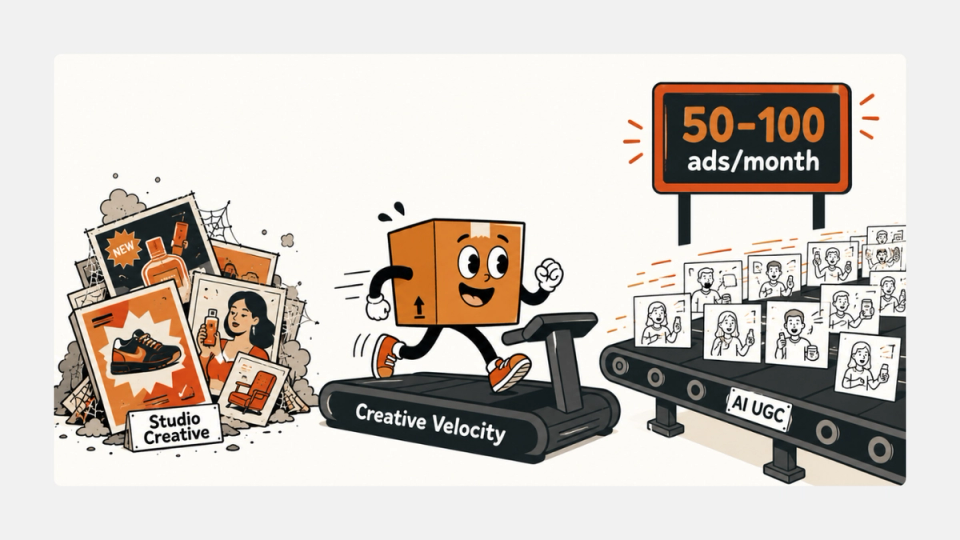
User-generated content advertising — the shaky-cam testimonial, the casual unboxing, the face talking directly to a phone — has been outperforming polished brand creative on Meta and TikTok for three years. The surprise in 2026 is not that UGC wins. It is that AI has made the production of UGC-style ads so cheap and fast that creative velocity itself has become the new moat, and every niche from skincare to B2B SaaS is now inside that shift whether or not they know it.
The thesis is this: for most brands, the primary advertising advantage no longer comes from better audience targeting, smarter bidding, or bigger media budgets. It comes from the ability to produce and test more authentic-feeling creative, faster, than any competitor. AI UGC is the engine. The moat is the system built around it.
The Conventional Wisdom on UGC (Steelmanned)
The standard marketing consensus on UGC ads is not wrong — it is just incomplete. The argument runs like this: real creators build real trust. A genuine testimonial from a customer carries more weight than any scripted ad because it bypasses the brand filter. Nielsen research has long held that 92% of consumers trust recommendations from individuals over branded content, and that figure has not degraded much in the decade since. The platforms reward it: Meta's algorithm systematically deprioritizes overly commercial content, and TikTok's distribution mechanics heavily favour native-feeling video over anything that reads as a produced ad.
The implication for marketers was clear: find creators, pay them to talk about your product, and the algorithm will do the rest. This worked. DTC brands scaled on this model through 2022 and 2023. Agencies built entire practices around creator sourcing, usage rights, and relationship management.
The conventional wisdom also had a ceiling. Creators are slow. Sourcing takes weeks. Deliverables are unreliable. A brand running 50 creative variations per month — what most serious performance marketers now consider table stakes — could not sustain that throughput with human UGC alone. The model worked until volume demands broke it.
That is where AI walked in.
Why Creative Velocity Is Now the Moat, Not Targeting
Here is a specific number: AI-generated UGC assets now cost under $5 to produce, down from $100 to $500 per asset for human-created equivalents. That is a roughly 98% cost reduction per creative. It is not the cost reduction that matters most though — it is what that reduction enables operationally.
Creative fatigue is the leading cause of campaign decline in paid social in 2026. Ad platforms need fresh creative every 3-4 weeks before audiences tune out and CTRs fall. For a brand running campaigns across five audiences and three placements, that is 15 fresh ad sets per month at minimum. At traditional production costs and lead times, most brands cannot hit that cadence. They get outrun by fatigue.
AI flips this. Brands using AI UGC pipelines — tools like Arcads, Creatify, or custom generative workflows built on diffusion models and LLM scripting — can produce dozens of hook variations, script permutations, and visual treatments in hours. Large-scale impression data (500M+ impressions) already shows AI ads achieving a 0.76% CTR versus 0.65% for human-made ads in top-of-funnel campaigns. The gap is modest at this stage. What the gap does not capture is iteration speed.
The brands that now win are not the ones with the best single ad. They are the ones who can test 50 to 100 creative variations per month, identify winners in 72 hours, kill losers before they burn budget, and scale the winners. That cycle is an operational system, not a media buy. And the system is extremely hard to copy once it is running.
This is the moat: not a tool, not a model, not a specific ad format. A creative operating system.
Why It Crosses Every Niche
The common objection is that UGC-style ads only work for low-consideration DTC products — supplements, skincare, fashion — where the visual medium sells the product directly. The data in 2026 says this has stopped being true.
E-commerce and DTC: AI UGC is the primary lever for fighting rising CPMs. Brands refreshing creative every 7-10 days report significantly lower CPMs and higher ROAS against competitors still operating on monthly creative cycles. It works especially well for products under $100 average order value, where attention-capture matters more than trust-heavy storytelling.
B2B SaaS: This is the niche most people did not expect AI UGC to crack. SaaS companies are now using AI-generated avatars and voice synthesis to scale product demo variations, testimonial-style explainers, and feature walkthrough videos across global markets. The format that converts is the same: someone talking directly at the camera, conversationally, solving a specific problem. The fact that the person is synthetic is increasingly irrelevant to the platform algorithm, and increasingly irrelevant to the viewer if the message is specific and credible.
Local services and fintech: Mortgage brokers, insurance comparison platforms, local gyms, and personal finance apps are all now running AI UGC ads with fabricated personas addressing specific audience pain points. The conversion data mirrors what DTC brands found earlier: authentic-feeling, specific, direct-to-camera content outperforms every other format.
The niche agnosticism of the format traces back to a simple fact about human attention on social platforms: content that feels made for the viewer, not at the viewer, wins distribution. UGC style achieves that regardless of what product is being sold. This is the same force reshaping how Google's AI image and video tools have changed content production expectations across every creative category.
What Creative Velocity Actually Looks Like in Practice
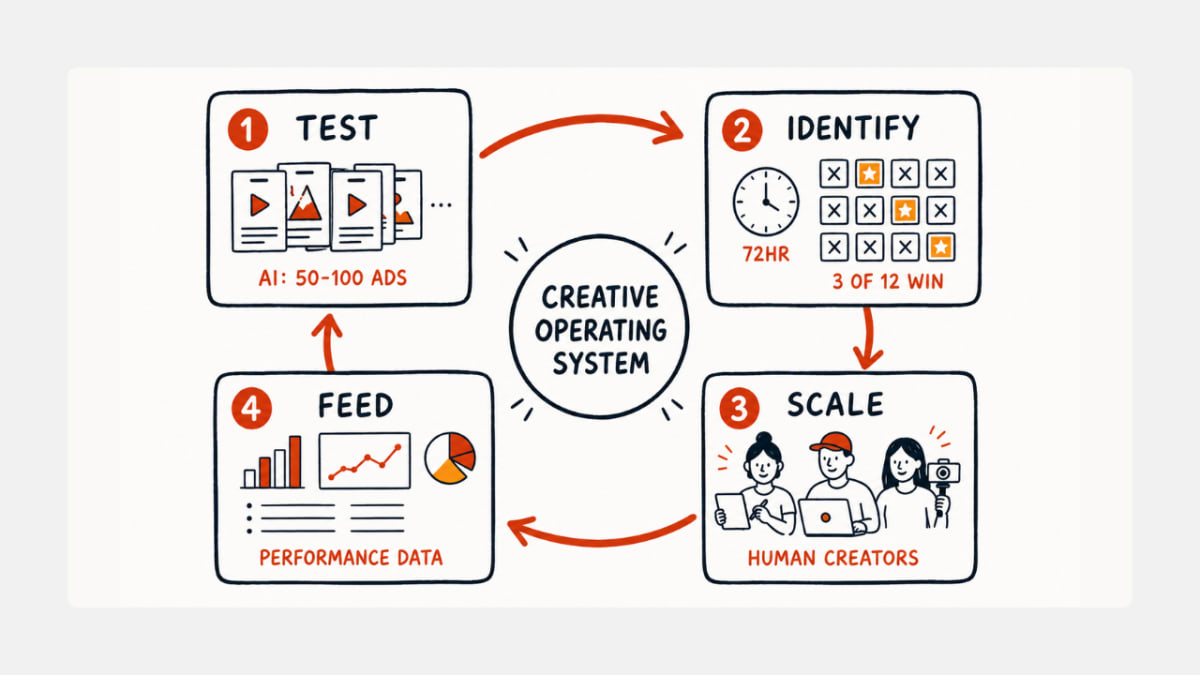
The hybrid model that has emerged in 2026 is sometimes called the 70/30 split: 70% of creative budget goes to AI-generated variations for testing, 30% goes to human-produced creative for scaling proven winners.
In practice it looks like this. A DTC skincare brand runs 80 AI-generated video ads in a given month — different hooks, different personas, different problem framings. Of those 80, roughly 12 get statistically meaningful impression volume. Of those 12, three win on CTR and early conversion signal. Those three concepts then go to human creators who produce higher-trust, more emotionally resonant versions of the same core message. The human versions scale. The AI versions feed the next sprint with fresh hooks.
Note what is happening in that loop: expensive human production is never wasted on unproven concepts. Cheap AI production does all the hypothesis testing. This is structurally different from how most brands ran creative operations in 2022.
Meta's algorithm has already adapted to reward this behaviour. It calls it creative diversity — running multiple ad variations within structured ad families so the system learns which format, not just which audience, converts. AI UGC makes creative diversity operationally trivial. Brands that once shipped 10 ads per quarter can now ship 100 per month without adding headcount.
The marketing automation that AI prompts now enable extends this logic further: once reporting, creative analysis, and iteration briefs are also automated, the entire performance marketing loop shrinks from weeks to days.
Addressing the Counter-Arguments
Three serious objections deserve direct answers.
Consumers will detect AI and trust will fall. The data so far does not support this outcome at scale. The 0.76% versus 0.65% CTR spread in favour of AI-generated ads suggests audiences are not systematically penalizing AI content at the top of the funnel. Trust decay that researchers worry about appears to operate at the conversion stage, not the click stage. For high-consideration purchases — big-ticket items, financial products, healthcare — human UGC still materially outperforms AI on conversion rates. The trust floor has not collapsed; it has become segmented by purchase risk.
Platform algorithms will penalize AI content. Meta has made no such commitment, and TikTok's ranking signals continue to weight watch time and completion rate over content origin. What both platforms penalize is overly polished content that feels like an intrusion into the feed — which is the exact opposite of what good AI UGC aims to produce. As long as AI-generated content passes the native-feel test, the algorithm treats it identically to human-created content.
This advantage will commoditize fast. This is the strongest counter-argument. The tools are available to any advertiser at low cost. What does not commoditize is the operational system: the data loop, the iteration discipline, the media buying strategy that scales winners, and the brand positioning that makes authentic-feeling creative credible. Brands that treat AI UGC as a tool will get commoditized. Brands that treat it as an operating system will build a durable advantage. The distinction is whether the creative engine is integrated with analytics and brand strategy, or just used for cheap clip generation.
The Honest Take
This argument has limits worth naming explicitly.
First, the performance data on AI UGC is still young. The large-scale CTR comparisons come from studies in 2025-2026 and have not been replicated across enough verticals and market sizes to be treated as universal findings. The DTC and e-commerce evidence base is solid. The B2B SaaS and local services data is thinner and often comes from vendors with a stake in the outcome. Treat the niche-agnostic claim as a directional argument, not a settled fact.
Second, the regulatory environment is moving. The EU AI Act's synthetic media disclosure requirements and growing FTC scrutiny of undisclosed AI-generated testimonials create a compliance layer that could erode the authenticity advantage. If platforms are forced to label AI UGC as AI-generated — not yet required, but being actively debated — the trust dynamics shift. The moat narrows, though it does not disappear.
Third, the 70/30 model works well for brands already operating sophisticated performance marketing functions. For small teams or brands new to paid social, the analytical overhead of running 80 creative variations and reading the signal correctly is non-trivial. AI UGC lowers production cost but does not lower analytical complexity. Teams without strong data culture will over-invest in production and under-invest in interpretation, and will miss the winners their own test data is pointing at.
The Bottom Line
Creative velocity is the advertising moat in 2026. AI UGC made it achievable for any brand, at any scale, in any niche. The brands winning on Meta and TikTok today are not winning because they found better audiences or smarter bidding. They are winning because they ship more creative, test faster, and scale proven winners before competitors have finished briefing their creative agency.
The question is not whether to run AI UGC ads. The question is whether to run them as one-off cost cuts or as the foundation of a creative operating system. One is a tactic. The other is a moat.
The way ChatGPT Image 2.0 collapsed an entire creative category is a useful signal of where this is heading: as generative tools get cheaper and more capable, every production bottleneck falls, and the advantage migrates fully to the operators who built the system around the tools first.
Frequently Asked Questions
What are AI UGC ads?
AI UGC ads are advertising creatives that use AI-generated avatars, synthesized voices, or video generation to produce content that looks and feels like organic user-generated content — casual, direct-to-camera, conversational — without requiring human creators. They are primarily used in performance marketing on Meta and TikTok.
Do AI UGC ads actually perform better than traditional ads?
At the top of the funnel, yes. Data from 500M+ impression campaigns shows AI ads achieving a 0.76% CTR versus 0.65% for human-made ads. UGC-style content broadly drives 4x higher CTRs and 25-40% lower CPAs than polished branded creative. Human UGC still outperforms AI at the conversion stage for high-consideration purchases.
Which niches are AI UGC ads most effective in?
E-commerce and DTC have the strongest evidence base. B2B SaaS, fintech, local services, and education are growing rapidly and showing comparable patterns. The format appears niche-agnostic because the core mechanism — native-feeling content that bypasses scroll resistance — applies across verticals.
How much do AI UGC ads cost to produce?
Typically under $5 per creative asset using current platforms such as Arcads, Creatify, and invideo.io. Traditional human-creator UGC runs $100 to $500 per deliverable, sometimes more for experienced creators. The 98% cost reduction is what makes hypothesis testing at volume economically viable.
What is the 70/30 hybrid model?
70% of creative budget goes to AI-generated variations for rapid testing at scale. 30% goes to human-created production for scaling the specific concepts that AI tests prove out. This ensures expensive human production is never spent on unproven creative directions.
Will consumers stop trusting AI UGC ads as detection improves?
The current data does not show a systematic trust penalty at the click stage. For high-consideration purchases, human UGC still converts better. If regulators mandate disclosure labeling for AI-generated synthetic media, trust dynamics will shift. This is the main risk to the moat thesis that deserves ongoing monitoring.
How does prompt injection risk affect AI-generated ad content?
For brands using LLMs to generate ad scripts at scale, prompt injection vulnerabilities are a real operational risk — especially when generative pipelines are connected to ad platforms or CRMs. The attack surface of an AI creative engine is larger than most marketing teams currently model.