
Fable 5 Made Code Better, Then Broke the Contract
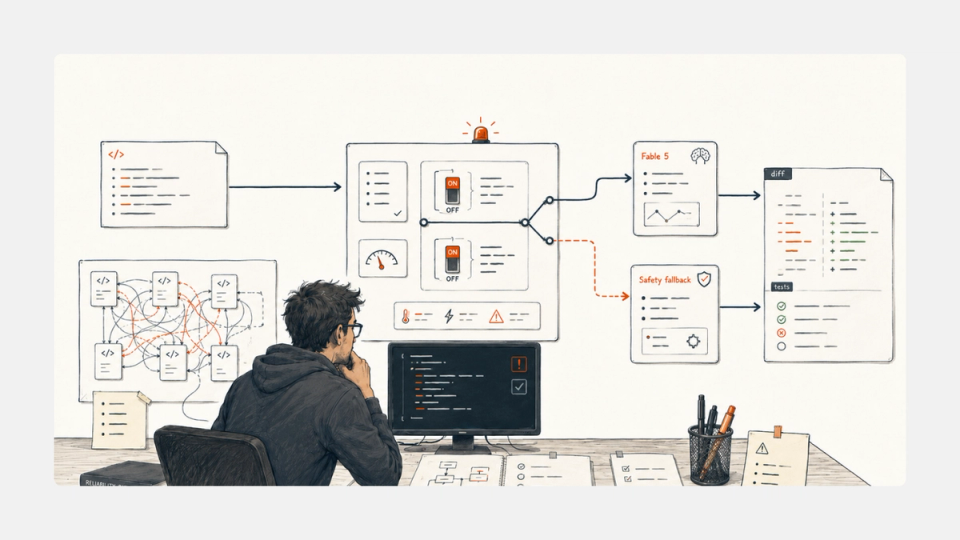
Claude Fable 5 is Anthropic's Mythos-class public model, and its most important coding behavior is not that it writes better code. It is that the same low-level reasoning that makes it useful on code also makes the product wrap it in routing, fallback, and safety classifiers.
That is the side effect builders need to understand. Fable 5 appears strongest when the task looks like real software engineering: reading unfamiliar repos, tracing protocols, reasoning about vulnerabilities, and planning multi-step changes. But those are also the tasks most likely to resemble cyber misuse from the outside. The result is a model that can be excellent at code while the product around it quietly changes the model, blocks the request, or routes around the exact capability you wanted.
The thesis is simple: Fable 5 did not create a separate coding problem and safety problem. It exposed that frontier coding capability is now inseparable from low-level security capability, and the product layer has become part of the model you are actually evaluating.
The Quick Answer
What changed with Fable 5 for code?
Fable 5 moved Claude deeper into repository-level reasoning: not just completing functions, but inferring protocols, debugging across files, planning patches, and reasoning about security-sensitive behavior. That makes it more useful for serious engineering work than a narrow autocomplete model.
Why did that create side effects?
The same skills needed to fix low-level bugs overlap with skills needed to find and exploit them. When the product sees security-shaped work, it may route away from Fable 5, refuse, or fall back to another model.
The non-obvious truth: The model is no longer the only thing being tested. In coding agents, the deployed product, including safety classifiers and routing rules, is the unit that succeeds or fails.
The foundation: code work is low-level reasoning now
The old mental model of AI coding was completion. You gave the model a function stub, it filled in the body, and you reviewed the diff. That era still exists, but it is not where frontier models are competing anymore.
The frontier is repository-level work. The model reads tests, follows call graphs, edits multiple files, reasons about hidden invariants, and decides when to run tools. That is why Claude Code became a platform rather than just a model launch. The coding agent is not a text box with syntax highlighting. It is a planning loop attached to a shell.
Fable 5 is designed for that loop. The earlier Fable 5 prompting guide framed this as proactive behavior: ask for rate limiting and the model may add tests, update adjacent code, and flag refactor debt. In ordinary app work, that feels helpful. In low-level code, it becomes more complicated.
A model that can infer the fix from surrounding context can also infer the failure mode from surrounding context. A model that can trace an authentication bug can also explain how to trigger it. A model that can repair a parser can often reason about the malformed input that breaks it. The line between debugging and exploit construction is not a bright line in code. It is an intent judgment layered over the same technical substrate.
That is the whole Fable 5 tension in one sentence: good coding models have to understand the things safety systems are trained to distrust.
Why did Fable 5 get good at code by becoming risky?
Fable 5 appears useful on code because software engineering rewards exactly the capabilities that make frontier models sensitive: long context, tool use, causal reasoning, and the ability to manipulate execution paths. Those capabilities are not dangerous by themselves, but they become dual-use as soon as the task touches security, protocols, parsing, auth, or infrastructure.
The RuBench 1.0 paper is the cleanest coding-specific signal so far. It studied 25 repository-level tasks mined from recent fix commits in aiohttp, aiogram, Laravel, NestJS, and Fastify. The authors evaluated product configurations across three runs and reported that the best configuration resolved 78.7% of tasks, while noting the sample was small enough that only the gap to the weakest model was statistically resolvable.
The most important line for Fable 5 was not the pass rate. In a fifth audited configuration using Claude Code plus Fable 5, the authors found that the product substituted the model on 5 of 25 tasks, or 20%. Those were not cartoon villain requests. They were routine HTTP-protocol fixes. The authors called this direct evidence that the deployed product, not the model, is what benchmarks measure.
That one finding should make every engineering team sit up. If a benchmark says "Fable 5 did X," but the product silently substituted another model on one-fifth of a small task set, then the reported number is not just a model capability score. It is a score for a routing policy, a safety classifier, an agent harness, and a model working together.
This is where Fable is not the model you think you are running becomes more than a quirky product complaint. It is now an evaluation problem. If your agent falls back during low-level work, your test result may tell you less about Fable 5 than about Anthropic's classifier boundary.
What side effects showed up when code got too low-level?
The side effects cluster around three behaviors: refusal, fallback, and capability masking. Refusal is visible. Fallback is sometimes visible. Capability masking is the hardest, because the product can look reliable while hiding the thing that would have made the task measurable.
Business Insider reported that Fable 5 safety measures can flag many cybersecurity, biology, and chemistry topics. In its test, Claude switched from Fable 5 to Opus 4.8 when asked basic cancer questions, and Anthropic said its safeguards were tuned conservatively. The company also said early data showed more than 95% of Fable sessions continued without falling back.
That 95% number sounds reassuring until you build tools for the remaining 5%. Most consumer chats do not ask about protocol parsing, auth bypasses, dependency confusion, malicious payloads, or vulnerability triage. Serious engineering teams do. For them, the tail is not edge-case noise. It is their actual workload.
The biomedical benchmark makes the same pattern legible outside code. A July 2026 arXiv study evaluated Fable 5 across eight biomedical benchmarks and found refusal rates from 8.0% to 99.4%, depending on the benchmark. Once refused items were excluded, Fable 5 met or exceeded every other model in the study. The constraint was not ability once it engaged. It was willingness to answer.
Coding teams should read that as a warning label. A model can be extremely capable conditional on engagement and still be unreliable for production if engagement is controlled by a broad classifier. The product can be both powerful and frustrating for the same reason.
How did red teams break the low-level boundary?
Red-team results suggest Fable 5 is harder to break than its predecessor, but still breakable under adaptive pressure. That matters because the relevant attack surface is not a single prompt. It is an iterative loop where an attacker probes, observes, rewrites, and tries again.
A June 2026 arXiv red-team study evaluated Fable 5 and Opus 4.8 against 7,826 harmful intents across ten harm categories. The strongest adaptive tree-of-attacks method broke Opus 4.8 on 11.5% of intents and Fable 5 on 6.1% in the worst case. Across the experiment, the authors reported 702 panel-confirmed harmful completions from Fable 5.
The headline is not "Fable 5 is unsafe." The better read is narrower. Static obfuscation largely failed, but adaptive iterative attacks still found residual surface area. That is exactly what software people should expect. Security failures are rarely one-shot puzzles. They are search problems.
This is why the phrase "able to break it on low level" matters. The issue is not that Fable 5 magically wants to hack things. It is that low-level software work gives both defenders and attackers the same handles: stack traces, parser edge cases, auth flows, malformed requests, shell output, network behavior, and failing tests.
When a model gets better at using those handles, it helps defenders patch faster. It also helps attackers navigate faster if the surrounding controls fail. That is not a moral claim about the model. It is a capability claim about code.
This overlaps with prompt injection as a production attack vector. In both cases, the dangerous part is not that the model can produce text. It is that the model sits inside a system with tools, privileges, memory, and implicit trust. Low-level code ability matters because it turns vague instructions into executable paths.
Did the policy fight make the product harder to trust?
The policy fight made one thing clear: access rules are now product behavior. The Verge reported that Anthropic received a U.S. export-control directive involving Mythos 5 and Fable 5 in June 2026 after concerns about bypassing Fable's guardrails. The same report said Anthropic argued the behavior was not unique to Fable 5 and was widely available from other models.
For developers, the point is not the Washington drama. It is that model access, routing, and restriction can change independently of your code. The API you evaluated on Monday can behave differently by Friday because the product's risk layer changed.
That is not unique to Anthropic. It is the direction of the whole frontier. But Fable 5 is the cleanest case study because the product sits right at the boundary between useful code intelligence and regulated cyber capability.
What should engineering teams measure instead?
Teams should stop asking whether Fable 5 is "good at coding" as a single question. The practical question is whether the product configuration solves your workload without unsafe routing surprises, unacceptable refusals, or hidden capability drops.
A useful evaluation has four lanes.
First, test ordinary implementation tasks. These are the clean cases: refactors, new endpoints, UI changes, migrations, tests, and docs. Fable 5 should shine here, and fallback should be rare.
Second, test low-level but benign debugging. Use tasks involving HTTP protocol handling, parser bugs, concurrency issues, dependency updates, and security-adjacent but defensive code. This is where the RuBench result matters. You are not trying to jailbreak the model. You are trying to discover whether your real work triggers the product layer.
Third, test explicit security work under a defensive policy. Ask for vulnerability explanation, patch generation, test construction, and exploit prevention without asking for weaponized steps. If the model falls back anyway, log it. That is not a failed prompt. It is a product constraint you need to price into adoption.
Fourth, test agent behavior, not just answers. Does it run commands safely? Does it ask before touching sensitive files? Does it distinguish proof-of-concept reproduction from weaponization? Does it preserve the goal when a model fallback happens mid-task? This is where the coding-agent comparison between Codex, Claude Code, and Gemini CLI becomes relevant: the shell loop is part of the product, not decoration.
Here is the decision rule I would use: adopt Fable 5 for code when its ordinary implementation gains survive your security-adjacent eval set. Do not adopt it because a public benchmark says the model is strong. Public benchmarks rarely match your classifier boundary, your repo, your tool permissions, or your review process.
The honest take
The evidence base has limits. Anthropic has not published enough detail about Fable 5's classifier boundaries for outsiders to predict fallback reliably. That means any article about Fable side effects has to infer from reported behavior, third-party tests, and benchmark artifacts. The strongest public coding-specific evidence is still small: RuBench has 25 tasks, and its Fable 5 configuration was audited as a fifth, hors-concours run.
The safety case also deserves more respect than the discourse gives it. Anthropic is not wrong that frontier coding models can become cyber accelerators. A model that helps an engineer patch a deep protocol bug can also help an attacker understand the bug. The bad contract is not that Anthropic uses controls. The bad contract is when those controls are hard to observe, hard to predict, and hard to benchmark around.
Finally, Fable 5 may still be worth using. The point is not "avoid Fable." The point is "evaluate Fable as a product." If the deployed system includes model substitution, broad refusal, and safety-sensitive routing, then your measurement has to include those behaviors. Treating the model card as the whole product is how teams get surprised.
The Bottom Line
Fable 5's coding side effects are not random defects. They are the predictable result of building a model strong enough to reason through low-level software behavior, then wrapping that model in conservative safeguards because low-level software behavior is dual-use.
For builders, the lesson is practical. Measure fallback. Separate ordinary coding from security-adjacent coding. Log model identity. Evaluate the agent harness, not just the base model. And when a benchmark says Fable 5 is good at code, ask the follow-up that now matters more: did Fable 5 actually answer, or did the product route around it?
FAQ
What is Claude Fable 5?
Claude Fable 5 is Anthropic's public Mythos-class model, released in June 2026, designed for long-horizon agentic work including software engineering and research. Public reporting describes it as sharing the Mythos-class foundation while using additional safeguards for broader access.
Why does Fable 5 have side effects on coding tasks?
Advanced coding tasks often look security-sensitive from the outside. Debugging protocol behavior, tracing auth logic, and fixing parser bugs require the same low-level reasoning that can also support exploit development. That overlap can trigger safety classifiers, fallback, or refusal.
Did Fable 5 silently switch models during coding benchmarks?
The RuBench 1.0 paper reported that Claude Code plus Fable 5 substituted the model on 5 of 25 audited tasks, or 20%, rerouting routine HTTP-protocol fixes to Opus 4.8. That is evidence that product routing can affect coding evaluations.
Is Fable 5 unsafe for software engineering?
Not by default. The more precise claim is that Fable 5 is dual-use in low-level code contexts. It can help defenders patch and understand systems faster, but the same capability requires controls that may interfere with legitimate engineering work.
How should teams evaluate Fable 5 for code?
Use a workload-specific eval set with ordinary implementation tasks, benign low-level debugging, defensive security work, and agent-loop behavior. Log fallbacks, refusals, tool use, cost, latency, and whether the final diff passes tests.
What is the difference between model capability and product capability?
Model capability is what the base model can do when it answers. Product capability is what the deployed system does after routing, safeguards, tool permissions, memory, and agent orchestration. For coding agents, product capability is the number that matters.
Should developers stop using Fable 5 for code?
No. Developers should use it where the gains are measurable and the routing behavior is understood. Fable 5 can be strong for code, but teams should not assume every response came from Fable 5 or that public benchmarks map cleanly to their repos.