
OpenAI Codex Micro Is a Control Surface for Agents
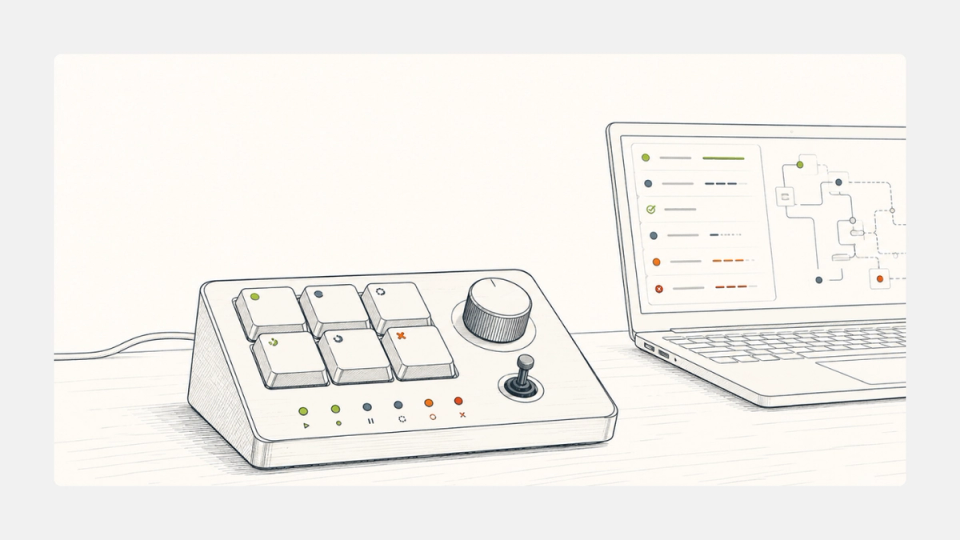
OpenAI opened orders for Codex Micro on July 15, 2026, a $230 limited-run desktop keypad built with Work Louder for Codex power users. It is not the rumored Jony Ive consumer device. It is smaller, nerdier, and more revealing: OpenAI thinks the next interface problem is managing multiple agents without living inside a maze of windows. The useful read is not that OpenAI made a keyboard. The useful read is that agent work is becoming visible, interruptible, and approval-heavy enough to need physical controls. If you already run Codex threads in parallel, Codex Micro may help. If you mostly chat with one assistant, this is a signal to study, not a gadget to buy. What Happened OpenAI launched Codex Micro as a collaboration with Work Louder, the keyboard company behind the Creator Micro line. The Verge reported that the device is a square macro pad with 13 mechanical switches, a joystick, a dial, and a touch sensor. OpenAI said it will sell for $230 through Supply Co while supplies last. The device is designed around Codex threads. Six frosted keys show live agent status, including whether a task is running, complete, waiting for feedback, or in error. Work Louder cofounder Mike Di Genova described those keys as a "live view of your Codex threads" in a product video cited by The Verge. The controls are not just indicators. The command keys can map to common Codex actions such as push-to-talk, send, accept changes, and reject changes. The joystick can start workflows. The dial can adjust reasoning level. OpenAI says the controls are configurable from the ChatGPT desktop app. Business Insider reported that Codex Micro includes six light-up agent keys, shortcut keys, a voice recorder for audio prompts, and two mechanical key options: clicky and silent. The same report cited Codex engineering lead Thibault Sottiaux saying Codex and ChatGPT Work have reached 8 million active users. There are important gaps. OpenAI has not disclosed how many Codex Micro units exist, whether the device will return after the limited run, or whether its Codex-specific controls will become a standard SDK for third-party hardware. As of publication, the strongest public detail comes from OpenAI-supplied product imagery, Work Louder context, and launch reporting rather than a full OpenAI newsroom spec sheet. What It Actually Means Is Codex Micro really OpenAI's first hardware product? Yes, in the practical sense: Codex Micro is the first OpenAI-branded physical product users can order. But it is not OpenAI's big consumer hardware bet. It is a niche developer controller, separate from the Jony Ive project reportedly aimed at a screen-free ChatGPT device. That distinction matters. If OpenAI had launched a voice puck or AI phone, the question would be whether it can invent a new consumer category. Codex Micro asks a narrower question: what should the interface look like when a developer has three or four agents running at once? That is a much better first hardware question. Agent work already has a measurable coordination problem. A June 2026 paper, The Shift to Agentic AI: Evidence from Codex, found Codex active users grew more than fivefold in the first half of 2026. The same paper reported that more than 10% of users manage three or more concurrent Codex agents in a week, and that 26.6% use skills for repeatable workflows. Those numbers explain the keypad better than the product photos do. A single assistant can live in a chat box. A fleet of agents needs status, routing, permissions, and interruption controls. That is why the six status keys are more interesting than the mechanical switches. This also connects to a pattern we have already seen in software. Cursor 3 became a control room because the IDE stopped being only a text editor. Codex Micro is the same idea moved onto the desk: less typing surface, more orchestration surface. Who should actually buy Codex Micro? Buy it only if Codex is already part of your daily workflow and you regularly lose track of agent state. The device is not for better prompting. It is for faster monitoring, approval, and switching when several Codex tasks are running beside your main work. The decision rule is simple: If you run one Codex task at a time, skip it. If you run multiple Codex threads and keep checking tabs for status, consider it. If your team has strict review or security controls, wait until the approval behavior is clearer. If you mostly use Claude Code, Gemini CLI, Cursor, or Copilot, do not buy a Codex-specific controller unless your workflow is moving toward Codex. That last point matters because agent tools are still splitting by workflow, not just by model. Our Codex vs Claude Code vs Gemini CLI comparison made the same point from the software side: the right tool depends on where the agent runs, how it asks for permission, and how much repo context it can safely touch. Codex Micro turns that software question into hardware. A physical accept or reject key sounds efficient. It also changes the failure mode. Axios noted that a button for approving agent access could make accidental authorization easier. That is not a tiny UX footnote. When agents can modify files, call tools, or request access, approval ergonomics are security ergonomics. Why does a reasoning dial matter? A reasoning dial matters because it turns model effort into a visible workflow control. Instead of hiding reasoning depth in settings or prompt phrasing, Codex Micro makes it feel like volume: turn it up for complex changes, turn it down for small edits. That is a neat interaction idea, but it needs guardrails. Reasoning level is not a magic quality knob. Higher effort can cost more, take longer, and still produce a wrong answer if the task lacks context. Lower effort can be perfect for small edits and dangerous for architecture decisions. The practical version is to treat the dial as a review-intensity control, not a genius slider. Use low effort for rote edits, dependency bumps, formatting, and quick searches. Use higher effort for migrations, cross-file refactors, flaky tests, and security-sensitive code. Then measure whether the output actually improves. This is where the keypad becomes more than a toy. A strong agent workflow needs externalized state. Which task is running? Which one is blocked? Which one needs approval? Which one deserves deeper reasoning? The more that state sits in your head, the more likely you are to approve the wrong thing or miss a failure. It is the same lesson behind the most expensive file in your repo: agent workflows are shaped by the instructions and controls that quietly load every time. A physical controller is just another part of that instruction environment. Who This Affects For Codex-heavy developers, Codex Micro is worth watching even if you do not buy it. The six agent-status keys solve a real annoyance: long-running agent work disappears into a window until it needs you. A lighted status key is boring in the best way. It makes invisible work legible. For engineering teams, the buy decision should be slower. The useful question is not whether the hardware is cool. It is whether physical approvals fit your review model. If a button can accept changes or approve access, the team needs clear defaults, logs, and admin controls before it becomes desk-standard hardware. For AI tool builders, this is the more important signal. OpenAI is treating agent orchestration as an interface category, not just a model capability. That raises the bar for every coding agent product. The winner will not only answer prompts. It will help users supervise work without constant context switching. For everyone waiting on OpenAI's consumer device, Codex Micro is not the product you were waiting for. It does not answer whether OpenAI can make a mainstream AI companion. It does show the company testing a smaller truth first: AI hardware probably starts where software pain is already acute. What To Watch For Next Watch three things over the next 90 days. First, whether OpenAI expands Codex Micro beyond a limited run. Scarcity makes sense for a collaboration. Reorders would suggest OpenAI sees durable demand for agent controls. Second, whether third-party hardware gets official Codex control hooks. The real platform move would not be one $230 keypad. It would be a standard way for keyboards, stream decks, and desktop controllers to display agent state and approval requests. Third, watch the approval model. If OpenAI makes physical approvals auditable, configurable, and hard to trigger by mistake, Codex Micro becomes credible for teams. If approval remains a convenience shortcut, it stays a power-user accessory. The Bottom Line OpenAI Codex Micro is a small product with a useful argument inside it. Agent work is no longer only about prompting. It is about supervising parallel work, seeing status at a glance, and approving actions without breaking your flow. For most people, this is not a must-buy. For Codex power users, it may be a genuinely practical desk tool. For the rest of the AI industry, it is a hint: the next interface war will be about control, not chat. FAQ How much does OpenAI Codex Micro cost? Codex Micro costs $230, according to launch reporting from The Verge and Business Insider. OpenAI has not disclosed how many units are available in the limited run. Is Codex Micro the Jony Ive OpenAI device? No. Codex Micro is a Work Louder collaboration for Codex users. It is separate from OpenAI's larger consumer hardware project with Jony Ive, which is reportedly a screen-free ChatGPT device. What does Codex Micro actually control? It shows Codex thread status, maps keys to common Codex actions, supports push-to-talk, can accept or reject changes, starts workflows through the joystick, and adjusts reasoning level with the dial. Should teams buy Codex Micro for every developer? Not yet. Teams should first verify logging, permission behavior, and accidental approval safeguards. The device makes most sense for users already managing multiple Codex agents daily.