
How Ask YouTube Actually Works (And Who It Breaks)
What Ask YouTube Actually Is
Ask YouTube is YouTube's first conversational search system, launched May 19, 2026 to U.S. Premium members aged 18 and older on desktop, powered by Google's Gemini 3.5 Flash model, that returns specific clips inside videos instead of ranked lists of video titles. It is the most consequential change to YouTube's discovery layer since the 2012 watch-time algorithm overhaul, and almost nobody is covering it that way.
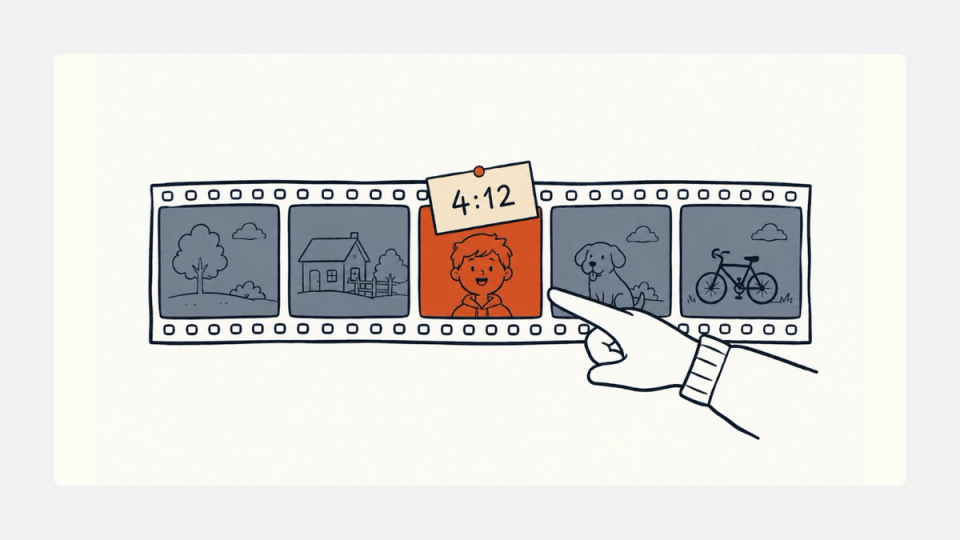
For two decades, YouTube has been a catalog. You typed three or four keywords, the system returned a list of titles ranked by some opaque mix of engagement signals, you clicked one and watched it front-to-back. Ask YouTube turns YouTube into an answer engine. You ask a question in plain language. The system returns the 14 to 60 seconds inside a video that contain the answer, jumping you to the exact timestamp.
Most explainers in the first week of coverage have stopped at "chat with YouTube." That framing misses what actually shipped. The interesting change is not the chat box, it is moment-level retrieval over the transcript corpus at YouTube's scale, a pattern other audio archives can now copy. The first casualty of that change is the creator who built a channel around watch-time.
This piece walks through what Ask YouTube is actually doing under the hood, why the engineering only became possible in 2026, what breaks for creators when the unit of consumption shifts from video to clip, and what to copy if you operate any audio archive bigger than a person can scrub. Last updated May 22, 2026.
The Quick Answer
What is Ask YouTube?
A conversational search system inside YouTube that uses Gemini 3.5 Flash to retrieve specific clips inside videos based on natural-language questions, then jumps the viewer directly to the timestamp.
Why does it matter?
It turns YouTube from a video catalog into an answer engine, which is a fundamentally different product. Watch-time-based creator economics assume the viewer watches whole videos. They will not, going forward.
The non-obvious truth: The chat box is the wrapper. The actual primitive is moment-level transcript retrieval at catalog scale, and Google has effectively published the engineering playbook for any team operating an audio archive.
The Foundations
YouTube search used to be a keyword index. You typed "how to teach kids ride a bike no training wheels" and got a ranked list of videos whose titles, descriptions, and tags contained variants of those keywords. Engagement signals (watch-time, click-through, completion rate) shaped the ranking. The output unit was a video, the input unit was a phrase. That contract held from 2008 until late 2024.
Two things shifted between 2024 and 2026. First, Google's AI Overviews crossed 2.5 billion monthly active users by I/O 2026 and trained that user base that asking Google a full sentence works better than typing four keywords. That is a behavioral floor that did not exist before Search SGE rolled into AI Overviews. Second, YouTube had been quietly auto-transcribing nearly every public upload for years. The corpus is large enough now that retrieval over it produces meaningful results across niche queries, not just popular ones.
Ask YouTube is what happens when those two shifts meet a small enough model. Gemini 3.5 Flash, announced at I/O 2026 alongside Ask, is cheap enough per call that Google can afford to run a query-rewrite plus a ranking pass on every search at YouTube traffic scale. None of those three things alone was enough. All three at once tipped the unit economics. That is the actual story, and it is the same story behind the rest of Google's I/O push — including the local-AI dictation play that I/O 2026 might officially kill Wispr Flow for, which runs on the same "small enough, cheap enough, at scale" thesis on the input side.
Where the Surface Explanations Break
What is Ask YouTube actually retrieving?
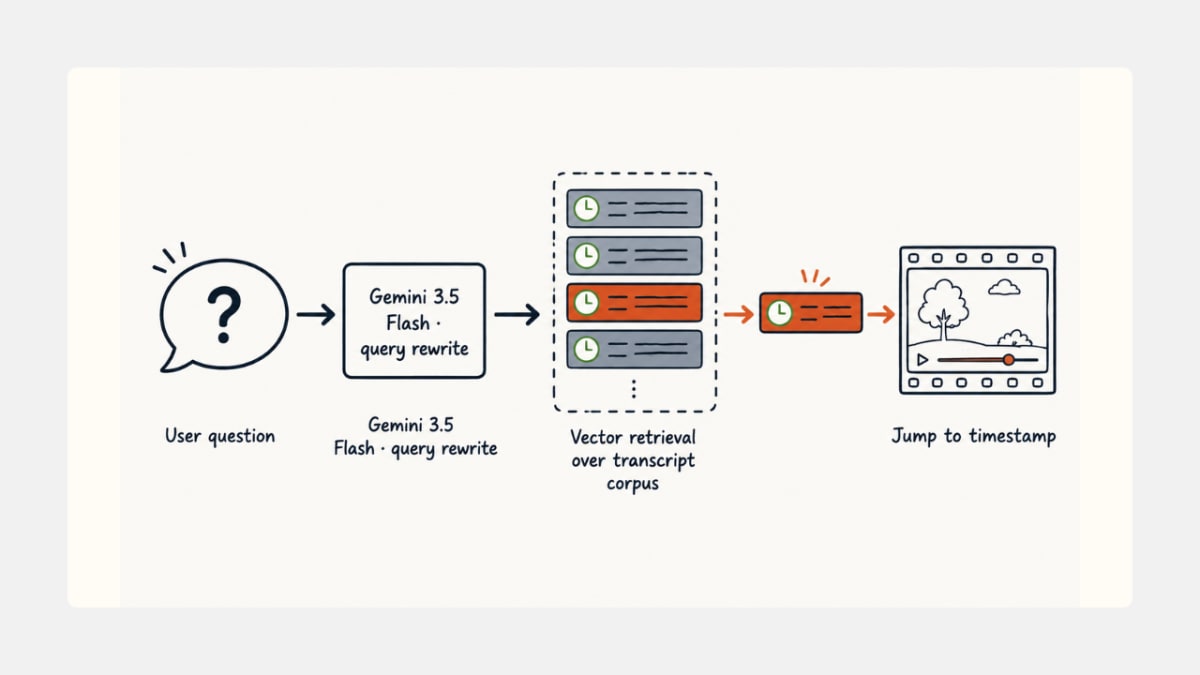
Not videos. Moment-level transcript chunks anchored to timestamps. The retrieval substrate is the multi-billion-document transcript corpus YouTube has built; each chunk is text plus a video ID plus a start time. Gemini 3.5 Flash runs query rewrite and ranking against that index, then maps the top chunks back to playable clips.
That distinction matters more than it sounds. Traditional YouTube search ranked videos. Ask YouTube ranks moments. The "video result" the viewer sees is actually a pointer into a specific time range inside a specific video. The video is a container; the moment is the product. Once you accept that framing, everything downstream — creator economics, search behavior, competitor responses — follows from it.
Why couldn't this exist in 2024?
Three engineering thresholds had to cross at once. Transcripts at full-catalog scale took years of compute and auto-caption iteration. A small enough LLM to ranking-pass every search at YouTube traffic levels did not exist before Gemini 3.5 Flash and its peer-class models (GPT-5 Mini, Claude Haiku 4.5). And AI Overviews had to train 2.5 billion users that asking questions of search bars is acceptable. Any one missing, no product.
That synthesis is the lesson for anyone trying to predict where AI products land next. The visible feature is almost always downstream of two or three infrastructure bets that have to cross cost lines simultaneously. You can see the same pattern in OpenAI's GPT-Realtime-2 collapsing the voice stack — different stack, same story. Speech-to-text plus an LLM plus text-to-speech got cheap enough, in one model, at once. The user-facing change felt sudden. The infrastructure under it took five years.
What does jumping to second 252 actually require?
Four moving parts. First, the transcript corpus chunked into overlapping windows of probably 20 to 60 seconds each — the exact window size has not been disclosed, but the timestamp precision visible in the UI suggests something in that range. Second, an embedding for each chunk indexed in a vector store sized for the full catalog. Third, a retrieval pass that returns top-k chunks across the corpus for a given query, then a ranking pass that picks the best clip per video and the best video overall. Fourth, a presentation layer that streams the video from the chosen timestamp.
The hard engineering problem is none of these in isolation. Each is a solved problem. The hard part is doing all four at YouTube scale, cheap enough to run on every Premium search. That is the cost-line crossing that defines what Ask YouTube actually is, and what other audio archive operators can now afford if they pick the same pattern.
Who eats the cost when a viewer watches 14 seconds?
This is the question Google did not answer at I/O. YouTube has not disclosed whether short partial views still count toward the 4,000-hour Partner Program monetization threshold, whether Ask-driven views pay the same RPM as organic search views, or whether a new "discovery bonus" model is coming. The press materials skip the line entirely.
Until that gets clarified — and the clarification is probably weeks or months out, based on YouTube's typical lag on creator-economics announcements — the cost lands on creators. A viewer who watches 14 seconds and leaves does not trigger the mid-roll ad at minute 8, does not see the like/subscribe prompts at minute 22, does not feed the watch-time signal that boosts future ranking. The Ask YouTube viewer is, by current Partner Program math, worth substantially less to the creator than the keyword-search viewer who arrived two days ago.
That gap is the actual policy question. Whether it gets resolved with a partial-view-aware RPM model, a separate Ask YouTube revenue share, or nothing at all will shape the next 12 months of YouTube's creator economy.
The Edge Cases and Breakages
Transcripts are not uniform. Auto-generated captions on a non-English creator with a strong regional accent and noisy room audio land at roughly half the word-error-rate accuracy of a native-English studio recording. That asymmetry feeds straight into the embedding quality, which feeds straight into the ranking. Whoever owns clean transcripts wins discovery in Ask. Whoever doesn't, doesn't. The first-order effect is that English studio creators get amplified; everyone else gets quieter.
New-channel discoverability collapses in a different way. The keyword-search era let a new creator rank for a low-competition phrase and ride that traffic into the subscriber threshold. Ask YouTube's ranking is opaque, conversational, and biased toward chunks that appear inside videos already showing high engagement signals, because engagement is the cheapest proxy for "good answer" the system has. The same dynamic that Google's AI Overviews triggered for small publishers is now coming for small YouTube channels, on a video timeline. This is the same architectural shift that animates Magic Pointer's challenge to the agentic browser — when the discovery layer changes shape, who gets seen changes with it.
The Shorts and long-form blur is a quieter problem. Ask YouTube returns both formats interchangeably. If a 30-second Short and a clip from a 22-minute long-form video both answer the question well, which one ranks higher? Google has not disclosed how the ranker handles that, and the answer matters because Shorts and long-form are monetized completely differently. Until ranking weights are clear, creators don't know whether to invest in the format that wins Ask. The same question hangs over the rest of Google's video stack right now, which I covered in Google's AI image and video tools and what actually changed.
There is also a hallucination surface. Ask YouTube's structured response card summarizes the top videos alongside the clip jumps. That summary is generated text. Generated text hallucinates. The AI Overviews attribution disputes that played out across late 2025 apply here in a sharper form, because the summary is now attributed to a specific creator's clip. If the summary misrepresents the creator's claim, the creator can name the system that did it.
And there is a privacy line nobody is talking about. Conversational search history per user is now an indexed corpus inside YouTube. Every refinement, every follow-up, every "show me the part about" is a higher-resolution behavioral signal than the keyword query it replaced. Google's privacy policy already covers this in theory. In practice, the granularity of inference available from Ask-style data is a different category than what existed a week ago.
The Honest Take
Three things in this framing I would argue with myself about.
One, Google has not disclosed the model size powering Ask YouTube production retrieval, the per-query cost, the exact chunking strategy, or whether retrieval runs over raw transcripts or precomputed embeddings. The "Gemini 3.5 Flash" assumption is consistent with what was on the I/O stage and with the pricing tier where Ask is available, but Google could pull a smaller distilled variant for production and not announce it. The headline pattern is right; the internals are inferred. A reader building the same pattern should treat the "20 to 60 second window" estimate above as a starting point, not a benchmark.
Two, "the chat is the wrapper, the retrieval is the work" is correct technically but undersells the consumer behavior shift. The wrapper is what made it acceptable for 2.5 billion AI Overviews users to ask questions of a video catalog they used to keyword-search. The retrieval is the real engineering. The wrapper is what unlocks the demand for the engineering. Both matter, in that order. I underweight the wrapper at points in this piece because the engineering is more interesting to me. A creator strategist would correctly weight the wrapper higher.
Three, the creator-monetization concern assumes today's Partner Program math survives. It probably will not. By the time Ask YouTube ships broadly, expect YouTube to surface a partial-view-aware RPM model, framed as a "Discovery Bonus" or "Clip Revenue Share" or similar. Whether that protects mid-tier creators or formalizes a winner-take-most dynamic is the actual fight, and the fight is the next thing worth watching. The pessimistic read in the breakages section above could be wrong if YouTube moves fast on this. The optimistic read could be wrong if they don't.
The Bottom Line
Ask YouTube turned YouTube from a video catalog into an answer engine. The engineering primitive underneath is moment-level retrieval over the transcript corpus, and the pattern is now copyable for any audio archive of meaningful size — podcasts, lectures, customer support call libraries, internal company recordings. If you operate one of those archives, the playbook is public: transcribe, chunk at moment granularity, embed, rewrite the query, retrieve top-k, jump to the timestamp.
If you watch YouTube, your time-to-answer is about to compress sharply. Try Ask YouTube on the next how-to question you would have pasted into ChatGPT, and notice whether the surfaced clips come from creators you recognize or random channels with high engagement signals. That gap is where the ranking is still leaky.
If you create on YouTube, two moves matter this quarter. Chapter every video. Speak the question your section answers before you answer it ("if you're wondering whether to use AWS or Hetzner for a side project, here's the cost math") because the ranker is reading your transcript. Pin a real transcript in the description if YouTube's auto-caption fumbles your accent. The creators who win Ask YouTube's ranking layer are the ones whose transcripts are clean and whose moments are self-labeled. The rest get quieter.
The deeper signal: Google has shipped the moment-level retrieval pattern at the largest possible scale. Anyone with a copy of the playbook can build a smaller version inside a week. Expect the same pattern to appear in Spotify (podcasts), Coursera (lectures), Zoom (recorded meetings), and the open-source RAG frameworks before the end of 2026. The blueprint is out.
FAQ
When will Ask YouTube be available outside the U.S.?
Google has not announced an international timeline. The press release commits only to "broader U.S. availability this summer." Based on YouTube's typical rollout cadence for Premium features (six to nine months from U.S. launch to major international markets), expect English-speaking countries first, with the EU likely delayed by AI Act compliance review.
Do I need YouTube Premium to use Ask YouTube?
Yes, for now. The May 19, 2026 launch limited access to U.S. Premium members aged 18 and older on desktop. A non-Premium rollout has not been ruled out, but Google has historically used new AI features as Premium acquisition levers (see also: Gemini Intelligence on-device features for the same playbook on Android).
Does Ask YouTube work on mobile?
Not at launch. Desktop only. Mobile expansion is "planned" per the YouTube blog post but not dated. Given that 70 percent of YouTube watch-time happens on mobile, the mobile launch is the real product launch — desktop-only is the limited test.
Does Ask YouTube credit the creator when it surfaces a clip?
The video card in the response shows the channel name and links to the full video. The summarized text above the clips does not attribute claims to specific creators inline. This is the AI Overviews attribution debate, on a smaller scale, and it will become a live issue as soon as Ask YouTube hits enough scale for creators to notice their material in summaries without click-through.
Can creators see which clips Ask YouTube is surfacing?
Not in YouTube Studio as of May 22, 2026. Google has not announced a dashboard. The closest signal a creator has is a spike in shorter average view duration on specific videos that historically had longer average views. If that pattern emerges, Ask YouTube is the likely cause.
How is Ask YouTube different from a Google AI Overview that surfaces a YouTube video?
AI Overviews answers a general Google query and may cite a YouTube video alongside web results. Ask YouTube is a YouTube-internal search experience that returns clips. Different products, different surfaces, different ranking. Both retrieve from the same transcript corpus, which is why a future merge is plausible.