
Magic Pointer Could Kill the Agentic Browser
Google DeepMind shipped Magic Pointer on May 12, 2026 (DeepMind blog) — a Gemini-powered cursor that reads whatever it touches and turns the pixels under it into an action. Point at a date in an email and it offers to put it on the calendar. Point at a table and ask for a chart. Point at a recipe and say "double these." No sidebar. No prompt window. No "let the AI take over your browser for a minute."
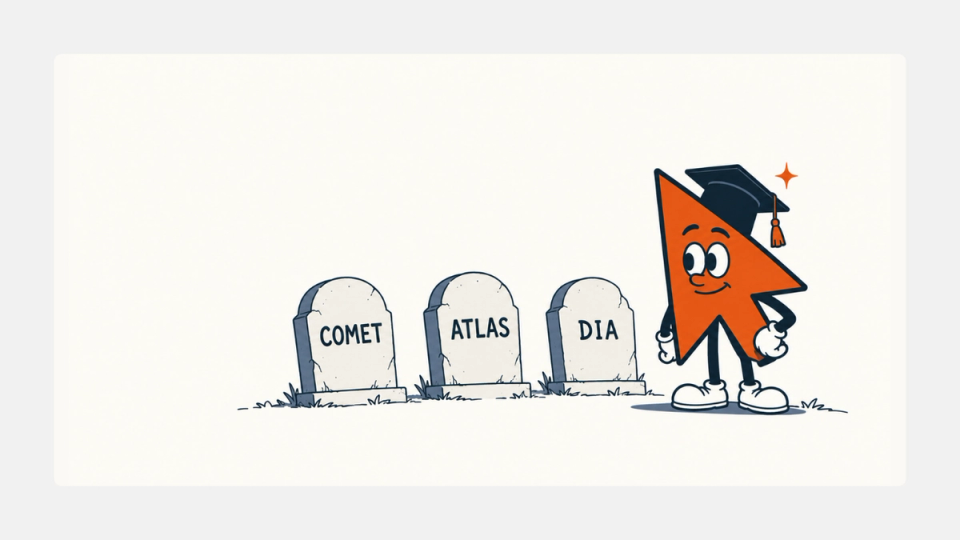
The thesis here is short and sharp. For two years, the agentic-browser bet has been autonomy: get out of the way, let the model click. Perplexity Comet, ChatGPT Atlas, and (almost) Dia all carried versions of that pitch. Combined, they crossed 10 million monthly active users by Q1 2026 (Similarweb). That is real, but it is not browser-replacement money. Magic Pointer reverses the pitch. The model rides your clicks. You stay the driver. The case rests on three things: the failure mode of autonomy in production, the workflow cost of sidebar chat, and what changes when intent capture moves into the cursor itself.
What everyone has been pitching since 2024
The pitch was clean. Browsers, the argument went, are the last unautomated surface in knowledge work. You spend hours inside Chrome doing the same forty-step flows: comparison shopping, expense reports, candidate sourcing, lead research. An AI that can see the page, plan, and click is a 10× productivity unlock.
The pitch ships in three shapes. The first is full autonomy: tell the agent what to do, let it run. Comet does this with Claude Sonnet 4.6 on the Pro tier and Opus 4.6 on Max (Perplexity). ChatGPT Atlas does this with Agent Mode, opened to Plus and Pro users in October 2025 (OpenAI) and made the default execution path for "do this for me" prompts. The second is sidebar chat: keep the user in charge, give them a model in the right rail that can see all tabs. Dia's whole product is this — chat with your tabs, custom skills, no agent mode (The Browser Company). The third is the hybrid: Atlas's chat-plus-agent mode, Edge's Copilot, Brave's Leo.
Steelman the autonomous side, because it deserves it. The companies building it are not naive. They saw that browsers are full of structured DOMs, that planning models keep improving, and that the cost of human attention on tedious work is roughly infinite. If your agent gets a 70 percent success rate on a 30-minute task, the math is obvious. That math is why Anthropic's Computer Use, OpenAI's Operator, and Google's own Mariner shipped within nine months of each other.
The math also explains why both Atlas and Comet reached eight-figure user counts inside a year. Curiosity is doing some of that work. Frustration with the existing web is doing the rest. The autonomous-agent thesis is not stupid.
It is just losing in production.
What actually shipped on May 12
Magic Pointer is not a chatbot. It is the pointer.
Two demos went live in AI Studio the day it launched: image editing and map-based place finding (9to5Google). In the image demo, you hover over an object in a photo, say "remove that," and Gemini edits the pixels in place. In the maps demo, you point at a region and say "find me a Thai place that's open now." Neither demo asks you to type a prompt. Neither demo opens a sidebar. Both demos compress the entire chain of "express intent → describe context → wait for plan → review output" into a single gesture and a four-word command.
The Chrome rollout extends that pattern to any webpage. Select a section of an article, ask Gemini to compare it with another tab, get the answer inline. On Googlebook — Google's just-announced laptop line built on top of Gemini Intelligence — Magic Pointer is the default pointer. The cursor itself is the input.
The DeepMind framing is worth quoting directly. The team's stated goal is to "help the pointer not only understand what it's pointing at, but also why it matters to the user," and to replace "text-heavy prompts with simpler, more intuitive interactions" (DeepMind).
That is the whole argument in one sentence. Stop asking the user to translate intent into a prompt. Read the intent off the gesture.
Why Comet and Atlas have stalled where they have
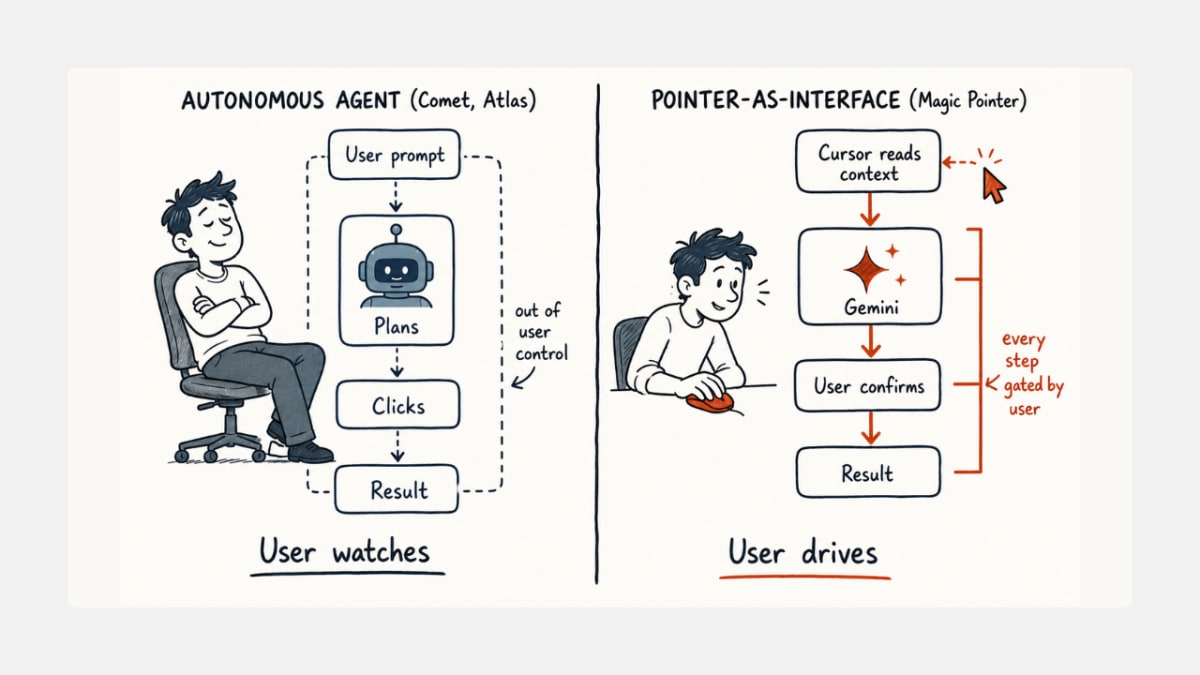
The case against autonomy is not that it doesn't work. It is that it doesn't work often enough to be a primary interface.
Browser agents fail at the long tail. Comet hits roughly 80 percent on flows it has seen during training and roughly 30 percent on anything bespoke. Atlas's Agent Mode in preview ships with a confirmation dialog before every irreversible action, which is exactly the right safety call and exactly the thing that destroys the productivity story. A 30-step booking flow with confirmations every fourth step is not faster than doing it yourself. It is the same task with a stranger in the loop.
The second failure mode is trust. LayerX disclosed CometJacking in late 2025 — a prompt-injection vector that can hijack the Comet agent through a single malicious URL (LayerX). Atlas's agent mode has shipped with a notice that it should not be used on financial or sensitive workflows yet. This is the same prompt injection problem that the industry has been waving at since 2023, except now the agent has your cookies and your card.
The third failure mode is attention. Watching an agent click is not actually faster than clicking yourself, because you cannot context-switch while it works. The "do this in the background" pitch only pays off when the task is long enough to justify the setup cost. Most browser tasks are 90 seconds.
Sidebar chat is a different failure mode. Dia is the cleanest implementation of it — chat with your tabs, custom skills, cross-tab reasoning. The product is loved by the people who use it. The Browser Company sold to Atlassian in September 2025 because that user base, while loyal, is not a browser-replacement market (TechCrunch). Dia is a knowledge-worker accessory. It does not replace Chrome.
So you have two paradigms that captured ten million MAU between them, neither of which is on a path to being the default browser of 2027. Something else has to give.
How the cursor changes the math
Here is what the cursor does that the sidebar and the agent cannot.
A pointer is an intent declaration. Every time you move it, you are telling the OS what you care about in this exact second. That signal has existed for forty years and almost no software has used it for anything other than a click target. The Magic Pointer bet is that the gesture itself — where the cursor is, how it lingers, what surrounds it — is a richer prompt than anything a user would type into a chat box.
This matters for three reasons.
Why is intent capture at the cursor different from intent capture in chat?
A chat box requires the user to verbalize what they want, including all the context the model would otherwise need to infer. The cursor's position already carries the context. "Summarize this PDF" requires you to type the sentence, drag the PDF in, and wait. The pointer version is: hover, say "summarize." The chat version is doing two extra steps that exist only because the interface forced them.
Multimodal vision is the precondition that makes this possible. The cursor only becomes a prompt if the model can see the screen. The same vision capability that powers Muse Spark's visual reasoning and Gemini's screen-grounding work is what lets Magic Pointer treat "this thing under my cursor" as a usable referent.
What does the pointer fix that autonomous agents broke?
The pointer leaves the user in the loop on every action. There is no "letting the agent run for two minutes and hoping." Each gesture is one intent, one model call, one visible result. You never lose track of what is happening because nothing happens that you did not just request. The trust problem and the attention problem dissolve together. You are not delegating; you are co-piloting at a finer granularity than any agent allows.
This is the same paradigm shift the IDE world hit a year ago with Cursor 3 reframing itself as a control room rather than an autocomplete. The unit of interaction stopped being "let the model write the function" and started being "let the model do the part of the work I am pointing at right now." Magic Pointer is the same idea ported from code editing to general computing.
Will voice replace the cursor before the cursor replaces chat?
Probably not at the desktop. Voice replaces typing well in dictation contexts — Google's Rambler dictation app is proof that on-device speech-to-text has crossed the usability bar for short bursts. But voice cannot point. Voice cannot say "this thing, not that thing" without visual reference. The combination is what wins: cursor for reference, voice for command. Magic Pointer's demos already use both in the same gesture. It is not pointer vs voice. It is pointer plus voice vs chat.
The counter-arguments worth taking seriously
There are three of them.
The autonomous-agent thesis isn't dead — it is just early. Models will keep getting better at planning and tool use. The 70 percent success rate today is 85 percent in two model generations. Once it crosses some threshold, the math flips, and confirmation dialogs go away, and the agent is the primary interface. This is a real argument, and it is the one OpenAI and Perplexity are betting on. It assumes, however, that the failure mode is purely capability. If the failure mode is also about trust, security, and the user's preference to stay in the loop on consequential actions — and the evidence so far suggests it is — better models do not fix it.
Sidebar chat is going to converge with the pointer anyway. Dia under Atlassian is reportedly working on a "Cursor-style" agentic feature (efficient.app). Atlas's chat-plus-agent hybrid is already half this pattern. So is Magic Pointer different in kind, or just earlier? The honest answer: the gesture-first framing is different in kind, because it changes the default. Sidebar products treat chat as the home and pointer interaction as a feature. Magic Pointer treats the pointer as the home. Defaults matter more than features when they shape habit.
Apple, or the next OS-level player, will do this too. Almost certainly. Magic Pointer is a research prototype today and a Googlebook default tomorrow. macOS will get its own version. Windows will too. The interesting question is whether Google's two-year head start on multimodal Gemini deployment, combined with Chrome's distribution, makes this the new default before competitors catch up. The agentic-browser race had Comet at three million MAU and Atlas at five million MAU because the OS layer wasn't competing yet (Similarweb). Magic Pointer ships as part of the OS layer. That is a different fight.
Frequently asked questions
Is Magic Pointer a competitor to Atlas and Comet?
Not directly. Atlas and Comet are full browsers built around an agent. Magic Pointer is a cursor capability that ships in Chrome, AI Studio, and Googlebook. The competition is for the same user attention, but the bet is that the pointer-level intervention wins more sessions than the agent-level one. Atlas and Comet compete on "let me do this for you." Magic Pointer competes on "let me help with exactly what you're doing right now."
Does Magic Pointer require Googlebook hardware?
No. The Chrome rollout puts Magic Pointer on any device running Chrome with a signed-in Gemini account, per Google's announcement (Phandroid). Googlebook gets a deeper integration where the cursor is replaced at the OS level, but the underlying capability is browser-side.
What model is behind it?
Gemini, but Google has not specified which Gemini version powers Magic Pointer. The DeepMind blog credits the team's broader multimodal research rather than a single model release. Expect updates as Gemini Intelligence and the on-device Gemini Nano line evolve.
Is this safer than agent mode in Atlas or Comet?
By design, yes. Magic Pointer does not take actions without user gesture and confirmation. There is no "agent runs for two minutes" surface area. Prompt injection risk is dramatically narrower because the model is invoked on the user's explicit pointer-and-speak action, not on background page parsing. That said, no agentic system is safe by default. The same trust boundary problems that haunt prompt injection still apply when Magic Pointer is asked to act on attacker-controlled page content.
Where does Dia go from here?
Dia is the AI browser most at risk from this shift. Its bet is sidebar chat over tabs. If Magic Pointer ships natively in Chrome on the same machines Dia runs on, Dia's primary differentiation — "chat with your tabs" — collapses into a Chrome feature. The Atlassian acquisition gives Dia an enterprise-integration angle that's hard for Google to match, but the consumer market is going to feel this fast.
Does this change what builders should bet on?
For application developers, yes. The next round of AI features should assume pointer-level intent capture is available on the host OS or browser. The right design surface is no longer "open a chat sidebar in your app." It is "make sure your app's elements are semantically labeled so the OS-level pointer agent can do useful things with them." This is roughly the same shift that ARIA introduced for screen readers, but with a financial reason to invest.
The bottom line
The agentic-browser bet has been the loudest narrative in consumer AI for two years. It produced two products with ten million combined MAU, neither of which is on a path to replacing Chrome. The reason is not capability. It is that autonomy is not what users want from a browser. They want help, not a stand-in.
Magic Pointer is the first credible take on that gap. It does not ask you to trust the model with your session. It asks you to trust it with the thing under your cursor for the next four seconds. That is a smaller ask, a smaller blast radius, and — based on what shipped May 12 — a far more useful one. The autonomous-agent thesis isn't dead. It is just no longer the only one in the running. For builders deciding where to spend the next twelve months: the pointer is the new chat box. Plan accordingly.
For the same paradigm playing out in the developer tooling layer, see the Codex vs Claude Code vs Gemini CLI verdict for May 2026 — different surface, identical lesson about where the productive frontier of human-AI control actually sits.