
Claude Fable 5 Is Back. Here's What Changed.

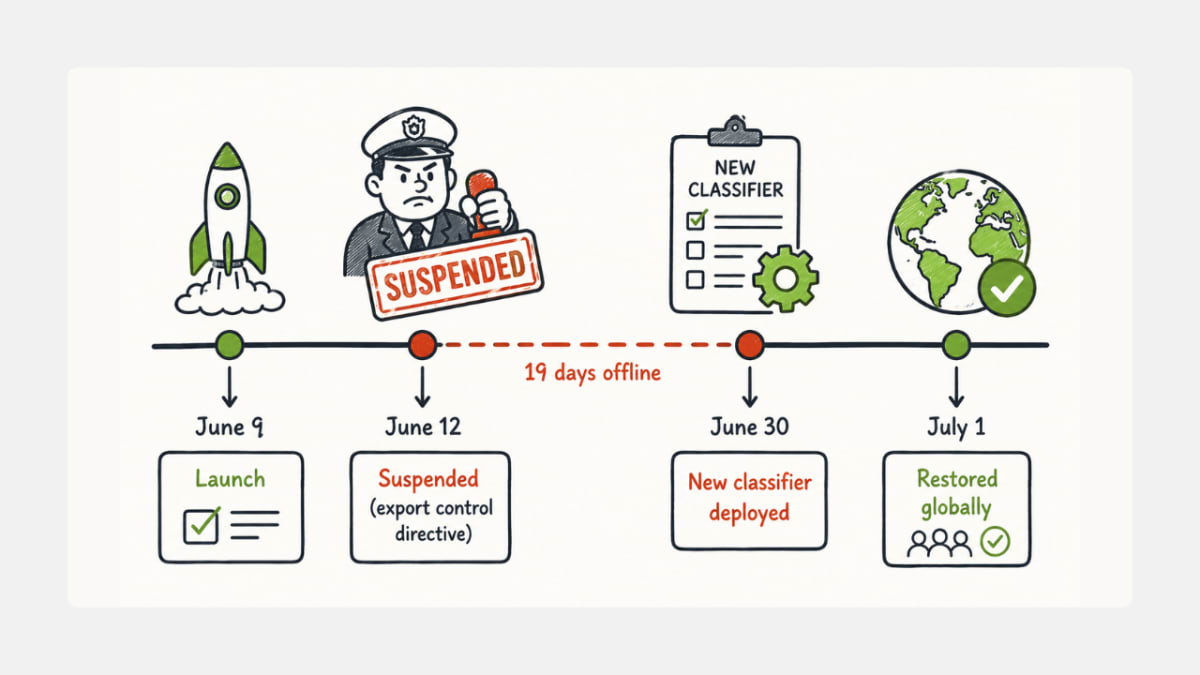
Anthropic's Claude Fable 5, the first general-access model in its Mythos-class tier, returned to global availability on July 1, 2026, after a 19-day suspension triggered by a U.S. Commerce Department export control directive. The model launched on June 9, 2026, was pulled on June 12, and is now back with a new safety classifier and updated access terms. This article covers what actually happened, what the new safeguards do, and what teams using Fable 5 should know before relying on it in production.
What Happened
Anthropic launched Claude Fable 5 on June 9, 2026, alongside the restricted Claude Mythos 5, a sibling model without the safety classifiers that remains limited to a small set of U.S. government-cleared organizations under Project Glasswing.
Three days after launch, on June 12, 2026, the U.S. Department of Commerce issued an export control directive citing national security concerns. The directive required Anthropic to block access for all foreign nationals, regardless of physical location. Because Anthropic had no real-time system to verify user nationality at scale, it took the only compliant path available: it suspended global access entirely.
The trigger was a jailbreak discovered by security researchers that could allow the model to identify software vulnerabilities and generate working exploit code. Anthropic publicly noted the discovered vulnerabilities were relatively minor and that other frontier models could perform similar tasks. The government's position was that frontier models with this capability required tighter export controls regardless.
On June 30, 2026, the Commerce Department lifted the directive after Anthropic implemented enhanced safeguards and agreed to a set of proactive security protocols. Global access was restored across Claude.ai, Claude Code, the Claude API, Amazon Bedrock, Google Cloud Vertex AI, and Microsoft Azure AI Foundry on July 1, 2026.
Why the Safety Classifier Change Is the Story, Not the Return
The headline most outlets ran was "Fable 5 is back." The more useful read is what Anthropic had to build to get it back.
The new safety classifier is designed to block the jailbreak techniques that triggered the directive in over 99% of cases, according to Anthropic's blog post. When it trips, the request doesn't fail. It redirects automatically to Claude Opus 4.8 to keep workflows uninterrupted.
That redirect is worth understanding. Fable isn't a single model running your requests end-to-end: it is a policy engine layered on top of a frontier model, and the policy engine runs first. The new classifier adds another layer to that stack. For the vast majority of professional use cases, the redirect will never trigger. But teams building in agentic or cybersecurity contexts should know it exists and what it catches.
What the classifier does not change: pricing, context window, or output limits. Fable 5 remains $10 per million input tokens and $50 per million output tokens (as of July 2, 2026), with a 1 million token context window and a 128,000-token maximum output. Prompt caching continues to work and can reduce effective input costs significantly for repeated context.
Does the Export Control Episode Affect Production Reliability?
The 19-day outage is the first instance of a frontier AI model being pulled from production by government directive rather than by the vendor. That is a new category of reliability risk for teams running Fable 5 in production pipelines.
Anthropic has not disclosed what the compliance framework looks like going forward. The company agreed to proactive security protocols as part of the reinstatement. It has not said whether another directive could trigger another global suspension, or whether it now has nationality-verification infrastructure that would allow targeted access restriction rather than a full shutdown.
For teams evaluating whether to depend on Fable 5 for long-horizon agentic workloads, the reliability question matters more than it did before June 12. A model that was globally offline for 19 days, for reasons that were not Anthropic's operational failure but that Anthropic could not prevent from affecting its customers, is a different risk profile than a model that's simply been available.
Anthropic's cybersecurity posture with Fable 5 has a structural tension that predates the export control episode: the capabilities that make it useful for complex security work are precisely the capabilities that regulators scrutinize. That tension isn't resolved by the new classifier. It's just managed.
Who This Affects
Developers and API users: Fable 5 is available again with no changes to the API interface. The new safety classifier operates server-side, invisible to callers unless a request triggers it, in which case the response comes from Opus 4.8 instead. There is no API flag to detect this substitution, which is worth flagging for teams that run model-specific evals on production outputs.
Agentic teams running long-horizon tasks: Fable 5 was positioned specifically for multi-stage planning, sub-agent delegation, and self-verification workflows. The 19-day outage would have forced those teams onto fallback models, likely Opus 4.8, which is what they're now being routed to on flagged requests anyway. Claude Opus 4.8 shipped its own platform update in May 2026 and is a capable fallback, but it doesn't match Fable 5's FrontierBench scores on long-horizon reasoning.
Enterprise buyers evaluating Fable 5 vs. other frontier models: The export control episode adds a variable that doesn't exist when comparing to GPT-5.5 or Gemini. Neither OpenAI nor Google has had a government directive take a flagship model offline. That's not an argument against Fable 5's capability. It is a factor in procurement risk assessments.
Security and compliance teams: The new classifier's redirect behavior creates a quiet divergence between what the developer expects (Fable 5) and what is running (Opus 4.8) for flagged requests. If your organization requires knowing which model processed which request for compliance logging, you need to build that detection in now. Anthropic has not announced an audit log feature that surfaces redirects.
What to Watch For
Claude Sonnet 5 shipped on June 30, 2026, the same day the export controls lifted. Anthropic has a pattern of releasing mid-tier updates alongside capability tier expansions, and Sonnet 5 closes the performance gap with Fable 5 more than any prior release. The pricing is significantly lower: Sonnet 5's published rates are a fraction of Fable 5's $50 per million output tokens. Watch whether the tier gap closes further over the next 90 days, because if it does, Fable 5's premium pricing becomes harder to justify for standard agentic workloads.
The government's compliance framework for Fable 5 is not public. If another jailbreak surfaces and the directive is issued again, the current setup suggests the same global suspension would follow. Anthropic's next disclosure to watch is whether they've built nationality-verification infrastructure that would allow targeted access control rather than a full shutdown.
Mythos 5 access under Project Glasswing is expanding, but slowly. As of July 2, 2026, it remains limited to a specific set of U.S. government-cleared organizations. Whether that designation eventually opens to the enterprise tier is the long-term capability question for teams doing classified or high-security work.
The Bottom Line
Claude Fable 5 is back. The core capabilities are unchanged: 1 million token context, top-tier FrontierBench scores for long-horizon reasoning and coding, 128K output limit, and the same pricing. The new safety classifier adds a redirect layer for flagged requests that silently substitutes Opus 4.8. The 19-day export control suspension is the first of its kind for a commercial frontier model, and Anthropic hasn't fully answered the reliability question that raises.
For teams that need Fable 5's specific capability profile, it's available and worth using. For teams making long-term infrastructure bets, the compliance story is still incomplete.
Frequently Asked Questions
What is Claude Fable 5?
Claude Fable 5 is Anthropic's first Mythos-class model available for general commercial use, released June 9, 2026. It is designed for long-horizon agentic tasks, complex coding, and advanced reasoning. It supports a 1 million token context window and a 128,000-token output limit. Pricing is $10 per million input tokens and $50 per million output tokens as of July 2026.
Why was Claude Fable 5 suspended?
The U.S. Department of Commerce issued an export control directive on June 12, 2026, citing national security concerns after researchers discovered a jailbreak that could allow the model to identify software vulnerabilities and generate exploit code. Because Anthropic lacked real-time nationality verification infrastructure, it suspended global access entirely to comply.
What is the new safety classifier?
Anthropic deployed a safety classifier that blocks the jailbreak techniques behind the export control directive in over 99% of cases. When it triggers, the request is automatically redirected to Claude Opus 4.8 rather than failing. This substitution happens server-side with no API flag visible to callers.
Is Claude Fable 5 available everywhere?
As of July 1, 2026, Fable 5 is available globally on Claude.ai, Claude Code, Claude Cowork, the Claude API, Amazon Bedrock, Google Cloud Vertex AI, Microsoft Azure AI Foundry, and GitHub Copilot. Access requires Pro, Max, Team, or Enterprise subscription.