
Claude Fable 5's Breakthroughs Are a Warning Shot
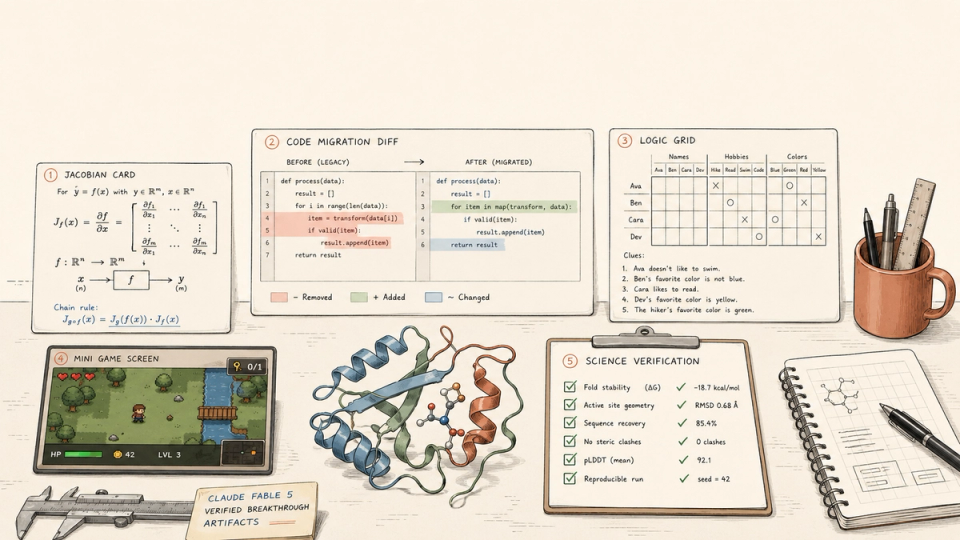
Anthropic released Claude Fable 5 on June 9, 2026, and the model's most interesting month has not been a leaderboard story. It has been a pattern of checkable breakthroughs across long-running code, games, science workflows, vision tasks, and now a reported counterexample to the Jacobian conjecture.
That last item is the headline grabber. A math problem associated with Keller's 1939 conjecture appears to have been knocked down in dimension 3 by a compact polynomial map credited to Fable's help. But the practical lesson for builders is broader: Fable 5 is showing up wherever the output can be tested, simulated, compiled, or independently checked.
That is the frontier shift worth paying attention to.
What Happened
Anthropic introduced Claude Fable 5 and Claude Mythos 5 on June 9, 2026. Fable 5 is the generally available version of Anthropic's Mythos-class model, while Mythos 5 is the restricted version for vetted use cases with some safeguards lifted. Anthropic priced both at $10 per million input tokens and $50 per million output tokens at launch.
The launch was not smooth. Anthropic suspended access on June 12, then marked Fable 5 and Mythos 5 as available again on July 1. On July 2, the company published more detail on Fable's safeguards, saying the model falls back to Claude Opus 4.8 for flagged cybersecurity, biology and chemistry, or distillation requests.
The capability claims were unusually broad. Anthropic said Fable 5 led its public Claude models on software engineering, knowledge work, vision, scientific research, memory, and long-context work. Its examples included a 50-million-line Ruby migration completed in a day during Stripe testing, a vision-only Pokémon FireRed run, a browser-based CAD editor and 3D-printable model, a physics-derived solar eclipse simulation, and Mythos 5 protein-design work that produced strong candidates for 9 of 14 targets.
Then the math story landed. On July 20, 2026, Levent Alpöge posted a polynomial map on X crediting Akhil for the question and Fable for the work. Wolfram MathWorld's Jacobian Conjecture entry now lists the counterexample: a map from C^3 to C^3 with constant Jacobian determinant -2 that sends three distinct points to the same output. If the calculation stands, the conjecture is false in dimension 3 and every dimension n at least 3. The plane case remains open.
The point is not that Fable became a lone mathematician. The point is that it helped surface a small, explicit object other mathematicians can check.
What It Actually Means
Did Fable 5 really solve the Jacobian conjecture?
Fable 5 is credited with helping find the counterexample, but the durable claim is the object itself, not a story about autonomous genius. The map can be checked by direct calculation: its Jacobian determinant is constant, and three different inputs reportedly map to the same output. Journal peer review is still a separate process.
That distinction matters because math does not accept vibes. It accepts proof, counterexample, and verification.
The Jacobian conjecture says, roughly, that a polynomial map with a nonzero constant Jacobian determinant should be invertible. The reported Fable-assisted example breaks that by showing a map whose local behavior looks reversible everywhere, yet globally folds multiple inputs into one output.
That is why this is more serious than a benchmark. A benchmark can be gamed. A compact counterexample can be inspected, normalized, extended, and attacked by experts. Zihan Zhang's note on the three-dimensional counterexample argues that adjoining identity coordinates extends it to every dimension n at least 3.
The conservative read is still important: the exact human workflow has not been fully documented. Alpöge credited Fable, but that is not the same as a reproducible lab notebook showing every prompt, failed path, and verification step. For AI-assisted research, that missing method is not a footnote. It is the part the field needs next.
Why do Fable 5's breakthroughs cluster around checkable work?
Fable 5 looks strongest when a task has a hard external judge: code compiles, a game state changes, a formula checks, a figure yields numbers, or a design can be inspected. That is different from being generally wise. It means long-horizon agents are becoming useful where reality can grade them.
This is the thread connecting the month.
The coding story is not just "better code." Anthropic's launch post says Stripe tested Fable 5 on a 50-million-line Ruby codebase and saw a migration done in one day that would have taken a team more than two months by hand. It also says Fable 5 scored highest on Cognition's FrontierCode evaluation among frontier models at medium effort.
That is exactly the kind of work where an agent can plan, edit, run tests, recover, and keep going. It is also the kind of work where the human does not have to trust the prose. They can inspect diffs, run CI, review failures, and merge or reject.
The game examples point in the same direction. Anthropic says Fable 5 beat Pokémon FireRed using a minimal, vision-only harness. TechCrunch covered Ethan Mollick's experiments where Fable generated playable games from one initial prompt in Claude Code. Quesma's Baba Is You benchmark found Fable 5 and GPT-5.6 Sol solved 13 of 14 levels in The Lake stage, with Fable finishing 3.1x faster than Sol, though a human was still about 4x faster than Fable.
That caveat is useful. Fable can be startling and still inefficient. Capability is not the same as cost-effective deployment.
Is the science work as important as the math story?
The science claims may matter more commercially, but they are harder for outsiders to verify. Anthropic says Mythos 5 accelerated parts of drug design by around 10x, produced strong candidates for 9 of 14 protein targets, and assembled single-cell data across 138 animal species for genomics research. Those are serious claims, but many await publication.
The difference is evidence visibility.
A polynomial counterexample can be copied into algebra software. A code migration can be run through tests. A game-playing agent can be watched. Protein design and genomics pipelines require lab context, unpublished datasets, and expert review.
That does not make the science examples unimportant. It makes them less immediately legible to the outside world.
This is why Fable 5's public story is becoming split. In open, checkable domains, the audience can see the artifact and argue about it. In high-stakes science and security, the same capability triggers access controls, 30-day retention, classifiers, and trusted programs. The Fable fallback model issue is not a side plot. It is the product boundary around the capability.
That boundary will shape adoption as much as raw intelligence.
Who This Affects
For developers, Fable 5 is a reason to test agent workflows where success is externally verifiable. Code migrations, repo-wide refactors, test generation, screenshot-to-implementation tasks, and bug reproduction are better candidates than vague "think through this strategy" requests. The lesson from Fable 5's coding side effects still applies: stronger code reasoning also means stronger low-level action, so sandboxing and review matter.
For technical founders, the key metric is not whether Fable can do something impressive once. It is whether it can make an expensive workflow repeatable. The Quesma Baba results are a perfect warning: Fable was fast among frontier models, but the human baseline still won on time, and token burn changed the economics. Measure price per accepted task, not price per token.
For research teams, the Jacobian story is a template and a challenge. AI-assisted discovery becomes more credible when it produces explicit artifacts that can be independently checked. But the field needs better disclosure norms: prompt logs where possible, failed attempts, human edits, verification tools, and clear attribution. "Fable helped" is exciting. It is not yet a method section.
For enterprise buyers, the model's safeguards are part of the product. Anthropic says more than 95% of Fable sessions avoid fallback, but the remaining cases matter if your work touches security, biology, chemistry, or distillation. The Claude Fable 5 prompting guide is useful only after you know whether your workload actually reaches Fable or gets routed elsewhere.
For competing labs, Fable 5 raises the bar for proof. A model launch is no longer convincing because it wins a general leaderboard. The stronger signal is a trail of artifacts: solved levels, working code, verified equations, completed migrations, and third-party workflows.
What To Watch For Next
The first watch-for is mathematical follow-up. The Jacobian counterexample now needs expert writeups, independent checks, and ideally a clean account of how Fable was used. The most important update will not be another viral post. It will be a durable explanation mathematicians can cite without caveats.
The second watch-for is publication of Anthropic's science claims. The company says it intends to publish some results in the coming months. Until then, the 10x drug-design acceleration, 9 of 14 protein targets, and 138-species genomics result should be treated as promising company-reported evidence, not settled outside evidence.
The third watch-for is cost discipline. Fable 5's breakthroughs often come from long-running, high-effort work. That is powerful, but it changes the budget conversation. Teams should track accepted output, wall-clock time, retries, fallbacks, and human review cost.
The fourth watch-for is whether rival models match the artifact trail. The recent Kimi, Claude, GPT, and Gemini comparison made the model-routing point clearly: pick by failure mode. Fable 5's best failure mode may be expensive persistence with checkable output.
The Bottom Line
Claude Fable 5's biggest breakthrough is not one viral math result. It is the emerging pattern around it.
The model is most convincing when it turns long thinking into something the world can test: a migrated codebase, a solved puzzle level, a working game, a reproduced visual task, a candidate molecule, or a polynomial map that breaks a famous conjecture in dimension 3.
That should change how builders evaluate frontier models. Stop asking whether the model sounds brilliant. Ask whether it can produce artifacts your workflow can verify. Fable 5 is making that question harder to ignore.
FAQ
What is Claude Fable 5?
Claude Fable 5 is Anthropic's generally available Mythos-class model, launched on June 9, 2026 and redeployed on July 1 after a temporary suspension. It is designed for long-horizon agentic work across coding, research, vision, and complex knowledge tasks.
Did Claude Fable 5 disprove the Jacobian conjecture?
The current public claim is narrower: Levent Alpöge credited Fable with helping find a counterexample. MathWorld lists the explicit map and direct checks. Peer review and full process disclosure are still separate from the viral claim.
What are Fable 5's most famous breakthroughs so far?
The most visible examples are the reported Jacobian counterexample, Stripe's large Ruby migration test, vision-only Pokémon FireRed play, one-prompt game generation, Baba Is You puzzle solving, CAD and simulation demos, and Mythos 5's company-reported biology research.
Is Fable 5 available through the API?
Anthropic's launch post says developers can use claude-fable-5 through the Claude API, with launch pricing of $10 per million input tokens and $50 per million output tokens. Teams should recheck pricing before production use.