
Kimi vs Claude vs GPT vs Gemini: Pick by Failure Mode
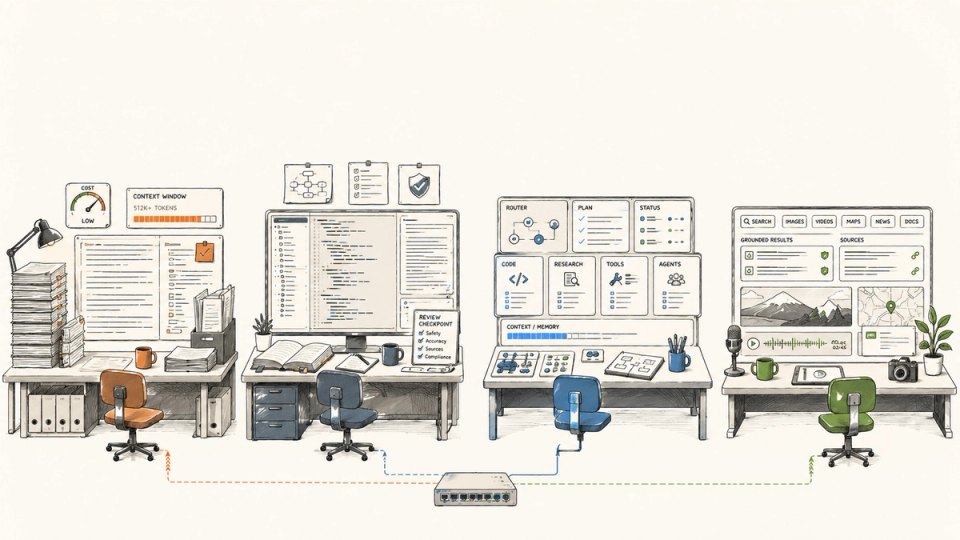
Kimi K3 is Moonshot AI's newest flagship model, pitched on the Kimi API Platform as a 1-million-token model for software engineering, knowledge work, and deep reasoning. Claude Fable 5 is Anthropic's most capable widely released model, built for demanding long-horizon agentic work. GPT-5.6 Sol is OpenAI's current flagship model for complex reasoning, coding, and professional workflows. Gemini 3.1 Pro Preview is Google's latest Pro-class reasoning model, while Gemini 3.5 Flash is the stable Gemini 3 model Google now presents as its most intelligent speed-first option.
The verdict: use GPT-5.6 Sol as the safest default for builders who want one model across coding, research, and agent workflows. Use Claude Fable 5 when the work is hard enough to justify higher price and classifier friction. Use Kimi K3 when cost, long context, and open-model optionality matter more than Western enterprise comfort. Use Gemini when you are already in Google's stack, need grounding/media/tool breadth, or want cheaper high-volume work.
The surprise from Reddit is not that people disagree about intelligence. They mostly disagree about failure mode. Claude users complain about caps and refusals. GPT users complain about sandbox instability and spend. Gemini users complain about confident long-context drift. Kimi users are excited about cost, but still worry about provider quality, rate limits, and trust.
The short answer
For one paid model to run a serious builder workflow: GPT-5.6 Sol. It is not the cheapest, but OpenAI's current docs position it as the default for complex reasoning and coding, with a 1.05M context window and $5 input / $30 output per million tokens.
For hardest coding and long-horizon work: Claude Fable 5. It has a 1M context window, 128k max output, and the strongest "let it think for a while" reputation, but at $10 input / $50 output per million tokens it is the premium pick.
For cost-sensitive long-context agents: Kimi K3. Kimi lists K3 at a 1M-token context window with $3 input / $15 output per million tokens, plus cheaper cache-hit pricing. That changes the math for always-on agents.
For Google-native research, media, and volume: Gemini. Use Gemini 3.1 Pro Preview for Pro-class reasoning, or Gemini 3.5 Flash when stable availability and price-performance matter more.
Pricing and model details checked July 2026.
Why this comparison matters now
This comparison became worth rewriting in July 2026 because the frontier stopped being a clean ladder.
OpenAI launched GPT-5.6 on July 9, 2026, with Sol, Terra, and Luna replacing the old "one flagship plus minis" mental model. Anthropic brought Claude Fable 5 back globally on July 1 after a June access suspension tied to U.S. export-control concerns. Google updated its Gemini model catalog on July 16, showing Gemini 3.5 Flash as stable and Gemini 3.1 Pro Preview as the latest Pro-class option. Kimi's public platform now says Kimi K3 has launched and lists it as the company's most capable flagship.
That means "best model" is the wrong question. The useful question is: which model fails in the way you can afford?
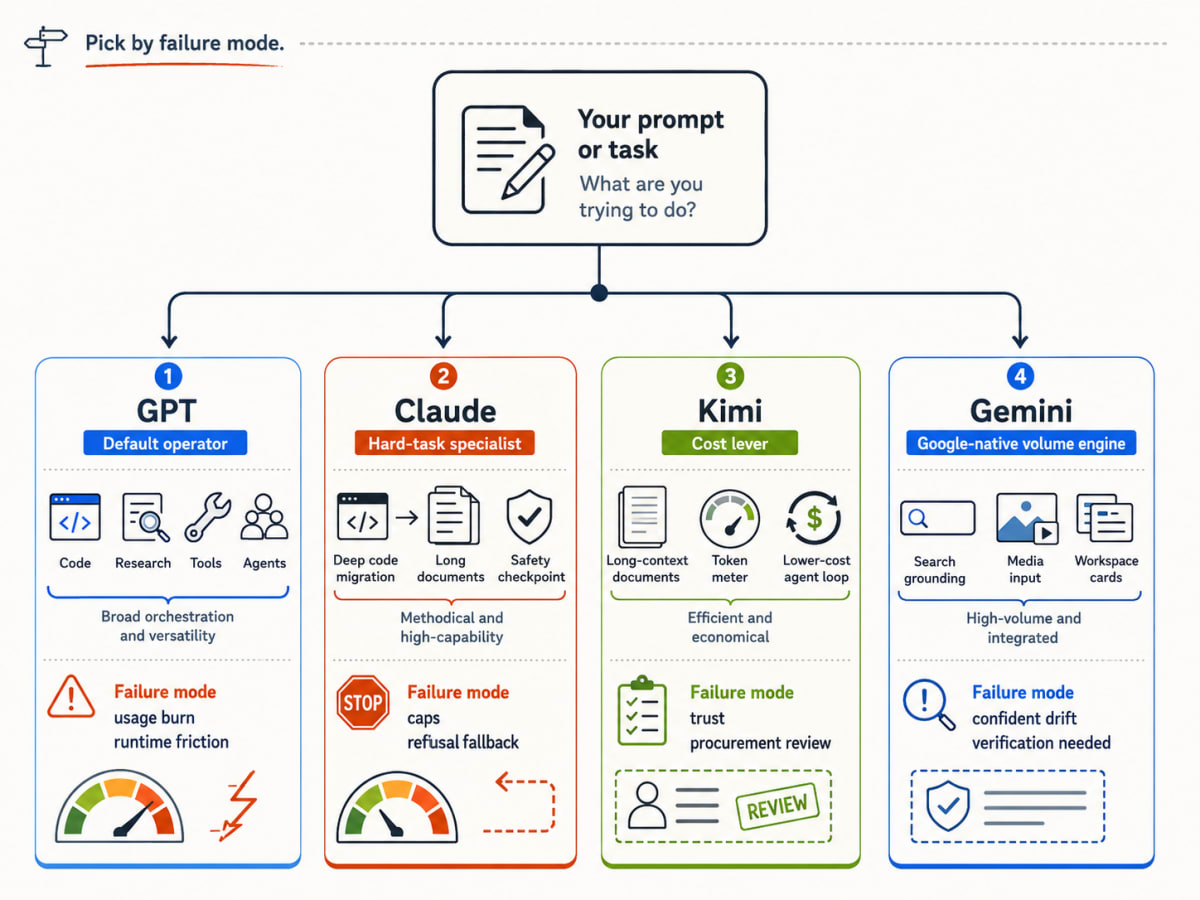
If you are building agents, the model is not just answering prompts. It is spending money, touching files, calling tools, remembering context, hitting caps, and occasionally refusing or drifting. That is why the Reddit layer matters. Benchmarks tell you where the ceiling is. Users tell you where the floor cracks.
Which model is best for coding and agent work?
GPT-5.6 Sol is the best default for coding agents because it combines frontier performance, broad tool support, and a cleaner developer migration path. Claude Fable 5 may win the hardest individual tasks, Kimi K3 wins on long-context cost, and Gemini wins when the agent already lives in Google's ecosystem.
OpenAI's model docs say GPT-5.6 Sol is the recommended starting point for complex reasoning and coding. The API page lists a 1.05M context window, 128k max output, image input, function calling, web search, file search, and computer use. The important bit is not one benchmark. It is that OpenAI is bundling the model with the agent surface: ChatGPT Work, Codex, Responses API, programmatic tool calling, and multi-agent beta.
Claude Fable 5 is the "hard problem" model. Anthropic's platform docs describe it as the most capable widely released Claude model for long-horizon agentic work, with 1M context and 128k output. The catch is operational: Fable 5 includes safety classifiers that can return stop_reason: "refusal" as a successful HTTP 200. If your coding agent needs reliable fallbacks, you must design for that.
Kimi K3 is the new pressure point. Kimi lists K3 as a 1M-context flagship for software engineering and deep reasoning, with $3 input and $15 output per million tokens. That is half the output price of GPT-5.6 Sol and less than one-third of Fable 5. For long agent runs, that matters more than a leaderboard screenshot.
Gemini is harder to place because Google splits the answer. Gemini 3.1 Pro Preview is the latest Pro model for agentic and vibe-coding work, but Gemini 3.5 Flash is the stable model Google now highlights as most intelligent for sustained frontier performance on agentic and coding tasks. In practice, Gemini is the best coding pick when you care about Google tools, Google Search grounding, media, and cost-controlled volume more than the absolute strongest single patch.
For more coding-agent context, ThePromptBuddy's Codex vs Claude Code vs Gemini CLI verdict still maps the tool layer well. The model choice is only half the workflow.
Which one is cheapest for serious use?
Kimi K3 is the cheapest flagship in this group on published API pricing. Gemini 3.5 Flash is cheaper for stable high-volume work, but it is not the same class as Fable 5 or GPT-5.6 Sol. Claude Fable 5 is the premium option, and GPT-5.6 Sol sits between capability and cost.
| Dimension | Kimi K3 | Claude Fable 5 | GPT-5.6 Sol | Gemini 3.1 Pro Preview / 3.5 Flash |
|---|---|---|---|---|
| Best current pick | Kimi K3 | Claude Fable 5 | GPT-5.6 Sol | 3.1 Pro Preview for Pro, 3.5 Flash for stable |
| Context window | 1M | 1M | 1.05M | Pricing page tiers around 200k for 3.1 Pro, model catalog varies |
| Max output | Not clearly listed on homepage | 128k | 128k | Model-specific |
| API input price | $3 / 1M | $10 / 1M | $5 / 1M | 3.1 Pro: $2 / 1M up to 200k, 3.5 Flash: $1.50 / 1M |
| API output price | $15 / 1M | $50 / 1M | $30 / 1M | 3.1 Pro: $12 / 1M up to 200k, 3.5 Flash: $9 / 1M |
| Main strength | Cheap long-context agents | Hardest long-horizon work | Best default across workflows | Google stack, grounding, media, volume |
| Main risk | Trust, availability, procurement | Cost, caps, classifier refusals | Cost spikes, tool/runtime instability | Long-context drift, preview churn |
The non-obvious insight: pricing is no longer a simple "open model cheap, closed model expensive" story. The real cost is wasted agent motion. A cheaper model that loops, drops requirements, or fails tool calls can cost more than a premium model. But a premium model that hits caps halfway through a task also becomes expensive in the dumbest possible way: you pay, then rebuild context elsewhere.
Reddit reflects that pain. In a ClaudeAI usage-limits thread, one user described getting stopped around "70% of the way through the task," then needing another AI to reconstruct what was left. In a ChatGPT thread about GPT-5.6 usage refreshes, another user praised GPT-5.6 for software engineering but said they were burning roughly "19-22% of my weekly allowance per day." These are anecdotes, not data. But they point at the buying decision: the best model is the one whose limits match your work rhythm.
Which model handles long context most reliably?
Claude Fable 5 and GPT-5.6 Sol are the safer long-context choices for critical work. Kimi K3 has the price and window to be extremely interesting, but needs more independent production evidence. Gemini's long-context reputation is more polarized: great when grounded and scoped, frustrating when it silently drops constraints.
The official specs are now clustered around the same headline: roughly 1M tokens. Claude Fable 5: 1M. Kimi K3: 1M. GPT-5.6 Sol: 1.05M. That makes the number less useful than it used to be.
The real question is whether the model remembers the right constraint after 90 minutes of tool calls.
This is where Reddit gets unusually useful. A GeminiAI user who said they used Claude, ChatGPT, Gemini, and GLM on research-heavy long-context work called Gemini "the most frustrating by far" because answers looked polished but dropped conditions, blended sources, or ignored chunks of the prompt. That maps to the classic Gemini risk: strong structure, confident surface, weaker constraint accounting on messy work.
Claude's long-context failure mode is different. People trust the work, then complain about limits, price, and disruption. GPT's failure mode is often the runtime around the model: sandboxes, agent sessions, retries, and billing anxiety. Kimi's failure mode is still market trust: people want the price-performance story to be true, but enterprise buyers will ask about data handling, support, and geopolitical procurement before they move sensitive code.
If you write large instruction files for coding agents, read the most expensive file in your repo before blaming the model. Context quality beats context size more often than vendors admit.
Which model should teams trust in production?
GPT-5.6 Sol is the safest production default because it has the broadest enterprise surface, data controls, and developer tooling. Claude Fable 5 is viable for high-value workflows with fallback handling. Gemini fits Google-native organizations. Kimi is compelling for cost-sensitive teams, but needs procurement review.
Production trust is boring until it breaks. Then it is the whole story.
OpenAI's advantage is surface area. GPT-5.6 is available across ChatGPT, Codex, and the API, and the docs explicitly discuss migration, reasoning effort, prompt caching, persisted reasoning, and multi-agent usage. That does not mean every workflow is stable. It means teams have more knobs and a more mature vendor path.
Anthropic's advantage is task quality and a serious safety posture. Its disadvantage is also that safety posture. Fable 5's classifier behavior is not an edge detail. It changes API design, evaluation, fallbacks, and user expectations. ThePromptBuddy covered that in Claude Fable 5 is back, and it remains the key production caveat.
Google's advantage is integration. If your workflow needs Search grounding, multimodal inputs, Google Cloud, Antigravity-style agents, or media generation, Gemini becomes more attractive than raw leaderboard position suggests. But if your work is strict long-document reasoning, you should test Gemini on your actual failure cases before committing.
Kimi's advantage is economic pressure. Its pricing can make always-on agents realistic for teams priced out of Fable-class usage. The caveat is not intelligence. It is institutional trust. Some companies will not send proprietary code to a Chinese provider. Others will, if the cost curve is good enough and the data policy passes review.
Where each model actually wins
Kimi K3 wins for long-running agents where cost is the bottleneck. It is the model to test when your current workflow works but the invoice makes you flinch. Kimi's 1M context and $15 output price can change the shape of research agents, coding swarms, and always-on internal assistants. It loses when procurement, compliance, or support expectations matter more than price.
Claude Fable 5 wins for the hardest single thread of work. If the task is a gnarly code migration, a deep research synthesis, or a multi-hour plan where one coherent model needs to hold the whole thing, Fable 5 is the premium pick. It loses on cost, access uncertainty, and refusal/fallback complexity.
GPT-5.6 Sol wins as the default model for builders. It is the model I would start with if a founder or developer asked, "I need one subscription or API default for serious work this week." It is broad, strong, well-integrated, and less awkward to operationalize than Claude Fable 5. It loses when your workload is mostly cheap high-volume generation or when OpenAI's agent runtime gets in your way.
Gemini wins for Google-native workflows and high-volume multimodal work. It is not the model I would trust first for a delicate 300-page reasoning task without tests. But it is strong when Search grounding, media, Google tools, and cost tiers matter. Gemini 3.5 Flash especially looks like a practical volume model, not just a benchmark participant.
Where each model actually loses
Kimi loses when the buyer needs institutional certainty. The model may be good enough. The policy conversation may still kill the deal.
Claude loses when limits interrupt the work. A brilliant model that stops mid-task creates a new task: reconstructing context.
GPT loses when the surrounding agent environment becomes the bottleneck. Reddit users praising GPT-5.6 still complain about sandbox failures, heap exhaustion, and usage burn.
Gemini loses when the output looks correct before it is correct. That is the most dangerous failure mode for research and operations teams because it creates confidence before verification.
The bottom line
Start with GPT-5.6 Sol if you want the best single default across coding, research, and agent work. Switch to Claude Fable 5 for the tasks where quality is worth premium pricing and fallback engineering. Test Kimi K3 when long-context cost is what blocks your workflow. Use Gemini when Google's ecosystem is the product surface, or when Gemini 3.5 Flash gives you enough intelligence at a much better price.
The practical workflow is not "choose one forever." It is route by failure mode. Use GPT as the default operator, Claude as the specialist, Kimi as the cost lever, and Gemini as the Google-native volume engine. Then evaluate them on your own tasks, because Reddit is very good at revealing pain and very bad at being a lab.
FAQ
Is Kimi K3 better than Claude Fable 5?
Not as a blanket claim. Kimi K3 looks more attractive on published price and context, while Claude Fable 5 is the safer premium pick for the hardest long-horizon work. If your blocker is cost, test Kimi. If your blocker is quality on difficult tasks, start with Claude.
Is GPT-5.6 Sol better than Claude Fable 5 for coding?
GPT-5.6 Sol is the better default for most builders because it fits Codex, ChatGPT Work, and the OpenAI API cleanly. Claude Fable 5 may still win the hardest coding threads, but its pricing and classifier behavior make it less frictionless as a default.
Which model is cheapest for AI agents?
Among the flagship models compared here, Kimi K3 has the lowest published output price at $15 per million tokens. Gemini 3.5 Flash can be cheaper for stable high-volume tasks, but it is not positioned the same way as Kimi K3, GPT-5.6 Sol, or Claude Fable 5.
Why do Reddit users complain about Claude if it is so strong?
The complaints are usually less about raw intelligence and more about usage limits, caps, price, and interruptions. That distinction matters. A model can be excellent and still be a bad fit for someone who needs long uninterrupted coding sessions every day.
Should I trust Reddit model comparisons?
Use Reddit for failure modes, not rankings. A thread can reveal that Gemini drops constraints, Claude hits caps, GPT burns allowance, or Kimi feels cheap enough to run all afternoon. It cannot prove which model is objectively best for your workload.