
AI Was Supposed to Save Money. Instead, It Taught Us to Want More.
The Thesis
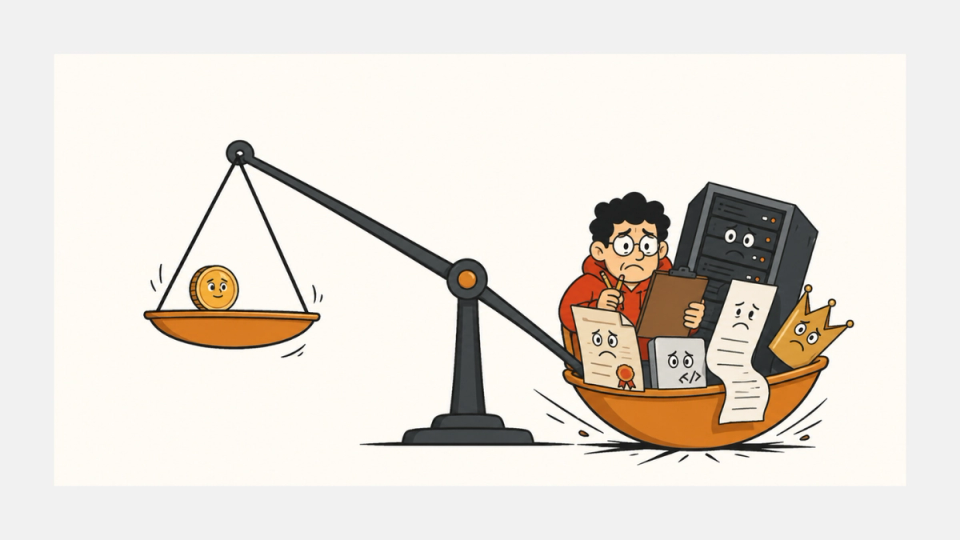
AI was supposed to be a margin story. The pitch was simple: let software do more work, lower the labor cost of each task, and keep the difference. But that is not how powerful tools usually behave in history. When a capability becomes cheaper, we rarely use the savings to become still. We use the savings to do more. That is the real story of AI: not cost reduction, but appetite expansion.
This is the software version of Jevons paradox. In a 2025 paper, Alexandra Sasha Luccioni, Emma Strubell, and Kate Crawford argued that AI debates focus too narrowly on direct efficiency and miss the second-order effect: cheaper capability can drive broader use and higher total consumption (arXiv). The Stanford AI Index 2026 makes the same broader point in a different register: AI keeps getting stronger, but the systems around it, from infrastructure to governance, are struggling to keep up.
The thesis is not that AI never saves money. It often does at the task level. The thesis is that task-level savings are exactly what make organization-level spending rise. Once intelligence becomes cheaper, firms stop asking, "How do we spend less?" and start asking, "What else can we now afford to ask the machine to do?"
Last updated July 2026.
The Conventional Wisdom
The conventional wisdom is respectable, and that is why it is so seductive. If AI writes the first draft, summarizes the meeting, triages the ticket, and reviews the contract, then each unit of work should cost less. A cheaper unit should mean a smaller bill. In that frame, AI is just a sharper knife in the same kitchen.
That story gets one thing right: the knife really is sharper. Small firms are using AI precisely because it compresses time and labor. But the same reporting that celebrates the savings also shows the trap. Business Insider reported on July 6, 2026 that many small businesses are now treating AI as routine overhead, with firms under 50 employees budgeting more than $1,000 per worker annually and adding spending guardrails to control overuse (Business Insider). In other words, the labor-saving device is already becoming a line item that has to be managed like rent.
The error in the conventional wisdom is not technical. It is anthropological. It assumes that when a human being gets a cheaper way to do something, the human being stops there. History says the opposite.
What happens when intelligence gets cheaper?
When intelligence gets cheaper, the demand for intelligence expands into places that previously looked too small, too annoying, or too expensive to justify.
This is what DeepSeek V4 vs Opus 4.7 vs GPT-5.5: Cost Beats Lag is really about beneath the benchmark theater. Lower model cost does not merely help buyers substitute one vendor for another. It changes the threshold of worthiness. Suddenly a company will run ten experiments instead of two, attach AI to internal tools that were never strategic enough to fund before, and generate synthetic abundance where there used to be managerial restraint.
A wider road does not solve traffic. It often invites more cars. A bigger closet does not create minimalism. It invites more clothes. A supermarket with self-checkout does not reduce shopping to pure necessity. It lowers the friction of one more item, one more aisle, one more impulsive decision. AI behaves the same way. It lowers the friction of asking for one more draft, one more workflow, one more layer of automation, one more agent watching another agent.
That is why the more revealing question is not, "Did AI make this task cheaper?" The more revealing question is, "What new category of behavior did the lower price unlock?" The answer is usually: a lot.
Why doesn't the AI bill go down?
The AI bill often does not go down because savings at the unit level become permission to expand scope at the system level.
You can see this in software teams already. In Developers Won't Work Without AI. Companies Are Cutting It., the underlying tension is dependency. Once developers feel a capability should exist by default, removing it feels like a pay cut in speed. The old baseline disappears. The organization does not return to the pre-AI workflow. It reorganizes around the new one and then argues about who pays for it.
The first AI bill is for substitution. The second is for proliferation. The third is for orchestration.
At first, a team uses AI to replace a narrow task: drafts, summaries, support macros, code suggestions. Then it discovers adjacent uses. Sales wants prospect research. Marketing wants content variants. Product wants user-interview synthesis. Support wants routing. Legal wants clause extraction. Finance wants anomaly scans. The tool that began as a helper becomes an expectation. Then comes the final stage: once AI is everywhere, somebody has to govern prompts, vendors, security, identity, audits, fallbacks, and cost ceilings. The efficiency engine creates a management layer of its own.
This is why Claude Sonnet 5 Ships the Capability Gap Closed — With a Hidden Tax matters as more than a model release story. Better models do not simply reduce effort. They also introduce tokenizer changes, pricing shifts, and new operational complexity. Every capability gain arrives carrying a small invoice attached to its ankle.
What do the older analogies teach us?
The old analogies teach us that efficiency is rarely a brake. It is usually an accelerant.
The cleanest analogy is Jevons' original one. In the nineteenth century, better steam efficiency did not cause Britain to use less coal overall. It made coal useful in more places, at larger scale, and with greater economic force. The savings per unit became the reason for expansion, not restraint. That is the exact logic modern AI leaders are now confronting. In December 2025, Satya Nadella said AI needs "social permission" to consume so much energy, because public support depends on whether the output justifies the load (Politico). That is not the language of a technology that quietly disappears into efficiency. It is the language of a technology becoming infrastructural.
The second analogy is cloud computing. Cheaper storage and elastic compute did not produce a generation of austere software. They produced software that assumed abundance. Logs grew. Backups multiplied. Video expanded. Analytics sprawled. Nobody said, "Wonderful, AWS got cheaper, now let us keep our footprint small." They said, "Wonderful, now we can do more." AI is cloud's psychological sequel.
The third analogy is advertising. When content gets cheaper to make, the market does not become calmer. It becomes noisier. That is why AI UGC Ads Are the New Moat. Every Niche Now Knows It. matters here. Lower creative cost does not end the need to spend. It forces everyone to produce more variants, test more hooks, and chase more speed just to defend the same attention. Efficiency changes competition by raising the expected volume.
The fourth analogy is hardware. Once models become central to economic strategy, generic compute stops feeling sufficient. That is the deeper implication of Why Every AI Company Now Wants Its Own Chip. The cheaper intelligence becomes to consume at the edge of a workflow, the more strategic the infrastructure becomes underneath it. Cost reduction at one layer produces capital intensity at another.
But isn't this still good for business?
Yes, often. The paradox is not an argument against AI. It is an argument against naive accounting.
If a law firm drafts more motions per week, a support team resolves more tickets, or a small agency serves more clients with the same headcount, rising AI spend can still be rational. The problem is not that the money disappears. The problem is that managers keep measuring AI as if it were a coupon instead of a force multiplier.
A coupon lowers the bill on the same basket. A force multiplier changes the size of the basket.
That distinction matters. When people say, "AI failed to save money," they often mean, "We kept using the old budget logic after the old scope logic had already died." The machine did not simply replace labor. It made new forms of ambition affordable. Once that happens, a larger bill may be a symptom of expansion rather than waste.
What does the infrastructure race reveal?

The infrastructure race reveals that AI's final product is not software convenience. It is institutional dependence.
Once a technology is truly saving time, a market does not merely adopt it. It rebuilds around it. That is why the frontier labs are not behaving like sellers of a helpful app. They are behaving like utilities, landlords, and arms dealers at once. The Stanford AI Index 2026 frames the moment as one where AI's surrounding systems are struggling to keep pace. That mismatch is revealing. It suggests demand is no longer scaling in a neat line with efficiency gains. It is overspilling into power, policy, chips, and organizational design.
This is also why the next era of AI economics will look less like SaaS optimization and more like industrial planning. You do not ask whether a railroad saved enough on horses. You ask what kinds of cities, supply chains, and empires the railroad made possible. AI belongs in that category more than most software people want to admit.
Addressing the Counter-Arguments
The strongest counter-argument is simple: some efficiency gains really do reduce total spend. Demand is not infinitely elastic. A mature workflow can get faster without exploding in volume. Plenty of businesses will use AI to trim vendors, automate repetitive admin, and stop there.
That is true. Jevons is not magic. It is a pattern, not a law of every spreadsheet. Rebound effects depend on whether new demand exists, whether the output can be absorbed, and whether firms have the ambition to widen scope.
But the burden of proof has shifted. In AI, the evidence increasingly points toward expansionary behavior. Companies are not buying these systems to finish the same week sooner and then rest. They are buying them to ask for more work, run more experiments, compress more time, and compete at a higher tempo. When a technology changes the tempo of competition, restraint stops being an individual virtue and starts looking like strategic negligence.
The Honest Take
The first limit is that not every category will show a full Jevons effect. Some workflows are too bounded, regulated, or low-value to expand indefinitely. AI may simply cheapen those tasks and stop there.
The second limit is that the current spending boom is also shaped by fashion, capital markets, and executive fear. Not every rising AI budget is proof of real demand. Some of it is theater. Some of it is hedging. Some of it is a board asking not to be the last company without a story.
The third limit is that philosophy can make budget mechanics sound cleaner than they are. In practice, AI spend fragments across subscriptions, API credits, cloud bills, new hires, compliance work, and hardware strategy. The paradox is real, but the invoice arrives in pieces.
The Bottom Line
AI was supposed to save money, and sometimes it does. But the deeper pattern is older and more human than any model card. When something valuable becomes cheaper, we do not simply preserve the surplus. We expand our desires to meet the new abundance.
That is why AI keeps consuming more money than the sales pitch promised. It is not failing at efficiency. It is succeeding so well that efficiency stops being the point. The point becomes reach, speed, ambition, and control.
The smart question for operators is no longer, "Will AI reduce this line item?" It is, "What new appetite will this lower cost awaken, and do we want to fund the person we become after that appetite arrives?"