
Developers Won't Work Without AI. Companies Are Cutting It.
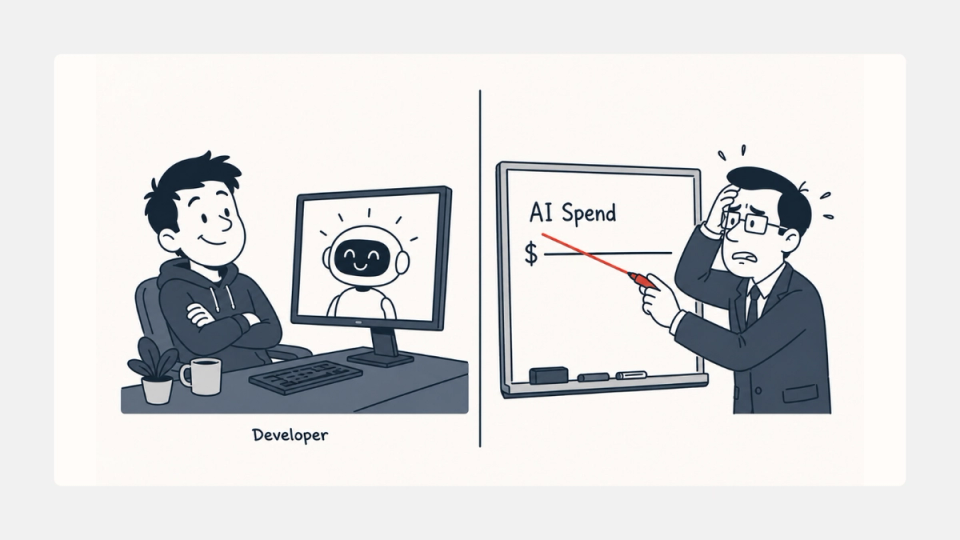
The Split Nobody Is Talking About
Eighty-four percent of developers now use AI coding tools regularly, per the 2025 Stack Overflow Developer Survey. Ninety percent of those who use AI agents say the tools increased their productivity. And yet, in early 2026, Uber exhausted its entire annual AI coding budget by April. Amazon shut down an internal leaderboard that had turned token consumption into a competitive sport. METR — an AI safety research lab — abandoned a productivity study because developers refused to work without AI long enough to complete the experiment.
These are not contradictions. They are the same story from two different sides of the desk.
The thesis here: software developers have structurally integrated AI into how they work, to the point where removal feels like a professional disability. Meanwhile, their employers are discovering that more AI usage does not produce more value — and are pulling back. The collision between those two forces is already happening. It will get louder.
Why Developers Refuse to Work Without AI

The METR story is the sharpest data point available. In 2025, METR ran a randomized controlled trial measuring AI's effect on experienced open-source developer productivity. The headline result was counterintuitive: developers using AI were roughly 19% slower, because of time spent correcting errors, steering the model, and waiting for completions.
In early 2026, METR tried to run a follow-up with newer tools. It failed for a different reason. Researchers found that 30 to 50 percent of participating developers admitted they were selectively skipping tasks they could not complete with AI assistance. Others refused to join studies requiring them to work without AI at all. The experiment could not proceed because the control group — "developers without AI" — no longer existed in any reliable form.
That is not adoption. That is integration. The line between "the developer" and "the AI assistant" has blurred to the point where separating them for measurement is methodologically incoherent.
The 2025 Stack Overflow Developer Survey gives the quantitative shape: 51% of professional developers use AI tools daily. Developer trust in AI output has actually fallen — from 40% in 2024 to 29% in 2025 — but usage kept climbing anyway. Developers are using tools they do not fully trust, every single day, because stopping feels worse than continuing. That is the definition of structural dependency, not enthusiasm.
JetBrains data from early 2026 reinforces the pattern: 74% of developers had adopted specialized AI coding assistants by January 2026. Entry-level hiring expectations have shifted to assume AI proficiency. Junior developers are being evaluated on their ability to orchestrate AI tools, not just write code. The job market is now pricing AI-literacy as table stakes.
This is the market signal that turns preference into necessity. Developers are not using AI because they love it. Many use it because they cannot afford — competitively or perceptually — to be the person who does not.
What Companies Are Discovering About the Bill
The corporate experience is playing out in the opposite direction. Uber's situation is the starkest published example: 95% of its engineers were using AI coding tools, 70% of code was AI-generated, and the company blew through its entire 2026 AI coding budget in four months. COO Andrew Macdonald said publicly that management could not draw a clear line between that spend and the delivery of useful consumer features.
Amazon's internal experience at its Kiro IDE project produced a variant of the same problem. An unofficial employee leaderboard called "KiroRank" tracked AI token usage. The result was textbook perverse incentive design: engineers optimized for token consumption rather than shipped output. Amazon's senior leadership shut down the leaderboard in May 2026. Dave Treadwell, Amazon's VP of Engineering, explicitly told staff to stop "using AI just for the sake of using AI."
"Tokenmaxxing" — maximizing token consumption as a proxy for productivity — is the corporate AI equivalent of vanity metrics in growth marketing. Token counts feel like work. They are not. The 2025 Stack Overflow Developer Survey flagged the symptom independently: 66% of developers report spending more time debugging AI-generated code than expected. Higher usage is producing more correction overhead, not less.
This connects directly to what the most expensive file in your repo explains about context loading costs: every interaction with an AI coding agent carries token costs that compound invisibly until someone reviews the bill. For individual developers, the cost is invisible — the employer absorbs it. For employers, the cost arrives as a quarterly shock.
Why Governance Is Hard When Dependency Is Deep
The standard corporate response to runaway AI spend is governance: usage limits, approval workflows, audits. That approach works when the tool is a SaaS subscription someone forgot to cancel. It does not work as cleanly when the tool has become part of how engineers think.
The METR finding about developers refusing to participate in no-AI research conditions is not a quirk. It is a preview of what enterprise AI policy encounters when it tries to limit developer AI access. Developers who have reorganized their cognitive workflow around AI assistance do not simply revert to pre-AI patterns when a policy says so. They work around the limit, they submit fewer tasks, or they find another employer whose policy is less restrictive.
This is not an argument for permissive AI policy. It is an argument for understanding that governance decisions now carry workforce retention stakes they did not carry eighteen months ago.
Prompt injection vulnerabilities illustrate a parallel friction: companies are discovering that AI-integrated workflows introduce security surface area that did not exist before, and restricting AI access is one of the few reliable mitigations. The security and the productivity cases for restriction are both real. The workforce dynamics case against restriction is also real. None of these cancel each other out.
What the Data Does Not Show (And Why That Matters)
The METR productivity finding — that AI made developers 19% slower — is the most cited single data point in this debate, and it is also the most misused.
The METR 2025 study involved experienced open-source contributors on self-selected tasks with AI tools available at the time. It is not a study of junior developers, enterprise workflows, greenfield projects, or the 2026 tool stack. METR itself acknowledged the study had narrow scope. Using it to conclude "AI does not improve developer productivity" is the same category error as using a 2022 GPT-3 benchmark to evaluate what GPT-5 Codex can do today.
The honest answer is that controlled measurement of AI's effect on developer productivity is now methodologically broken, and the METR team acknowledged this explicitly. The control group does not exist. Developers using AI tools in 2026 are not the same developers who would have worked without them — not in skill profile, not in task selection, not in what they attempt. The tools have changed what gets tried.
Similarly, the Uber and Amazon cases are vivid but not generalizable without context. Uber's budget issue is partly a cost accounting problem — AI coding tool spend was not forecast accurately — and partly a measurement problem. Amazon's leaderboard failure is a management design problem as much as an AI adoption problem. Neither case proves that AI coding tools do not generate value. They prove that gamified metrics and uncapped spend without measurement accountability generate waste, which is true of any tool category.
The developer survey data on trust — 46% of developers say they do not trust AI output accuracy, per Stack Overflow 2025 — is also worth unpacking. Distrust of AI output and reliance on AI in workflow are not mutually exclusive. Developers can distrust AI-generated code and still use it as a starting point, the same way an engineer might distrust a junior developer's first draft but still prefer to edit it rather than start from scratch. The trust metric measures confidence in output quality. The usage metric measures workflow integration. They are measuring different things.
The Counter-Arguments Are Partly Right
The pushback on the "dependency" framing is worth steelmanning.
The most substantive counter-argument: what looks like dependency is actually skill acquisition. Developers who now refuse to work without AI have not lost the ability to code without it — they have learned to integrate a tool so efficiently that removing it is like asking an accountant to do financial modeling without spreadsheet software. The resistance is not cognitive dependency; it is professional standard adjustment.
There is something to this. The evolution of AI coding tools from assistants to agents has been rapid enough that "AI-assisted development" is now a distinct skill set, not simply "development with a suggestion engine turned on." A developer who is excellent at directing AI agents to complete complex tasks is demonstrably adding value that a non-AI-integrated developer in 2026 cannot easily replicate.
The second counter-argument: companies are not slowing AI usage, they are maturing it. Moving from unrestricted experimentation to governed deployment is not retreat — it is how serious infrastructure adoption works. Amazon was not going to keep a token-consumption leaderboard indefinitely. Uber was not going to leave its AI budget unmonitored forever.
Also partly right. The enterprise AI story in 2026 is better described as "governance catches up" than "adoption reverses." The companies making news for AI restrictions are, in almost every case, companies that already deployed AI at scale and are now applying the same operational discipline they apply to any infrastructure that gets expensive.
The Honest Take
The framing of this piece — "developers refuse, companies restrict" — is clean enough to be slightly misleading.
Most developers are not refusing to work for employers who restrict AI access. They are expressing a preference, adjusting their task submission patterns, and, at the margin, weighting employer AI policy as a factor in job decisions. The organized professional refusal is not happening at any documented scale. What is happening is quieter: selection effects in how work gets done, invisible to management until something breaks.
Most companies are not executing strategic retreats from AI. They are discovering that tool spend without measurement accountability is not a sustainable operating mode, and they are adding the measurement layer. The meaningful distinction is between companies that are adding governance because they are committed to making AI work, and companies that are cutting AI spend because the pilots did not justify the cost. The former is healthy. The latter is what would be legitimately alarming, and the available data does not clearly show it is happening at scale.
The most uncomfortable truth is that the productivity question remains open. The Claude Code platform update in May 2026 — and similar advances from OpenAI and Google — continues to shift the capability floor fast enough that any measurement taken more than six months ago is measuring a different product. METR's honest conclusion, after trying and failing to run their study, is that they cannot get a clean signal. That is the actual state of the evidence.
What we know: developers are behaviorally committed to AI tools in a way that makes policy restriction costly and measurement unreliable. Companies are realizing that commitment and ROI are not the same metric. The gap between those two realities is where most of the current friction lives.
The Bottom Line
The developer-employer AI split is structural, not rhetorical. Developers have integrated AI tools into their workflows to the point where removal carries real professional and cognitive costs. Employers are discovering that integration and value generation are not the same thing, and are adding the governance layer they should have built in from the start.
Neither side is wrong. Developers who use AI constantly are responding rationally to market signals about what skills get priced up. Companies that are scrutinizing AI ROI are applying basic operational discipline to a cost center that grew faster than its measurement framework.
The next eighteen months will determine which of two equilibria emerges. In the first, governance matures, measurement improves, and the productivity case for AI development tools becomes legible enough to justify the spend — and the dependency. In the second, the measurement problem proves stubborn, costs continue to outpace demonstrable value, and some employers start treating AI coding tools the way they treated open-plan offices: a productivity narrative that sounded compelling until someone studied it.
The difference comes down to whether the tools can be made measurable. That is the actual stakes of the current friction.
Frequently Asked Questions
Are developers actually refusing to work without AI, or is this overstated?
The METR research incident is real and documented. 30 to 50 percent of developers in METR's 2026 study admitted they were selectively skipping tasks they could not complete with AI. This is not organized refusal — it is behavioral integration that makes the "no-AI" condition feel professionally untenable.
Did METR find that AI makes developers slower?
The 2025 METR randomized controlled trial found that AI tools made experienced open-source developers about 19% slower on a specific set of tasks. The finding applies to the tools and developer profiles in that study, in 2025. METR was unable to replicate the experiment in 2026 because the control group had dissolved. Neither finding should be read as a verdict on modern AI tools across all developer types.
Why did Uber run out of AI budget so fast?
Uber had 95% of its engineers using AI coding tools and reported that 70% of code was AI-generated by early 2026. The company exhausted its entire annual AI coding budget within four months. The root causes were inadequate budget forecasting for AI spend at that adoption scale, and the absence of clear ROI measurement that would have flagged when usage stopped correlating with output.
What is tokenmaxxing and why does it matter?
Tokenmaxxing is using AI token consumption as a proxy for productivity. Employees — and sometimes internal metrics systems — treat high token usage as a signal of high effort or output. Amazon's KiroRank leaderboard was a documented example. The problem is that token consumption and value delivery are uncorrelated at the task level.
Should companies restrict developer AI access?
Restricting access without an alternative measurement framework does not solve the problem; it shifts where the friction appears. A developer who cannot submit tasks without AI does not become a faster manual coder when the AI is removed. Governance that focuses on measuring output quality and shipping rates, rather than limiting tool access, is more likely to produce useful signal.
Is the 2025 METR productivity finding the final word on AI coding tools?
No. METR's study was narrow in scope, covered 2025-era tools, and the researchers explicitly said their 2026 follow-up was methodologically unable to produce clean results. The honest state of the field is that controlled measurement of AI productivity impact is currently very hard to execute, because the control condition is disappearing. Absence of definitive evidence is not evidence of absence.
What is the corporate governance response to runaway AI spend?
The emerging pattern is: usage limits on token consumption, ROI-linked approval workflows for AI tool access, internal audits that compare shipped output to AI spend, and a shift from individual productivity metrics to team-level delivery metrics. Amazon's shift to "normalized deployments" as a metric — measuring whether AI produces useful shipped code, not just token output — is the cleaner direction.