
Why Every AI Company Now Wants Its Own Chip
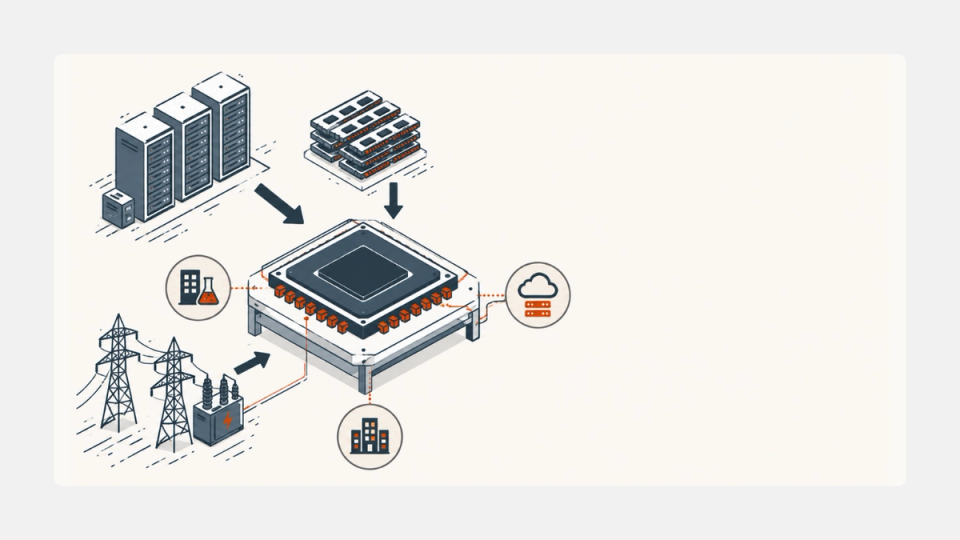
Frontier AI used to look like a model race. It now looks more like a systems race. The labs and clouds winning mindshare are not just training bigger models. They are trying to control the full stack beneath them: compute, memory, networking, power, and increasingly the silicon itself.
That is why custom AI chips are becoming the new norm. Not because every company wants to cosplay as Nvidia, but because the economics of modern AI have changed. When cost per token, inference latency, HBM supply, and energy efficiency become existential constraints, owning your chip roadmap stops being an optimization. It becomes strategy.
We have already seen this shift in plain sight. Google has spent years turning TPUs into productized infrastructure. AWS now describes Trainium as purpose-built for “the best economics” in training and inference at scale, and explicitly frames the data center itself as the accelerator. Meta began MTIA in 2020 because its internal workloads were diverging from what off-the-shelf chips were optimized to do. Even the newer rumors around OpenAI and Broadcom make sense in that context: eventually every serious AI company hits the same wall and asks the same question.
The question is no longer, should we buy GPUs?
The real question is, how much of our future are we comfortable renting?
The conventional wisdom
The conventional wisdom says Nvidia already won. CUDA is the software moat, H100s and B200-class systems are the operational standard, and nobody outside hyperscalers can justify the time, capex, and execution risk of building custom silicon. In that version of the market, the rational move is to buy what works, ship models, and leave chip design to the experts.
That view is not wrong. It is just incomplete.
It assumes the main problem is getting access to enough raw compute. That was true when training runs were the dominant bottleneck and frontier labs were mostly optimizing for who could scale clusters fastest. It is much less true once inference becomes the larger long-term bill, once multimodal workloads diverge, and once power density and memory bandwidth start deciding what is even deployable.
What does the economics actually say?
If you read the official chip messaging coming out of the major platforms, the language has changed. They are no longer selling peak performance alone. They are selling economics.
AWS says Trainium is built for “the best economics for high performance AI training and inference at scale” and emphasizes better cost per token at production scale. That wording matters because it reveals where the market moved. The important metric is not theoretical FLOPS anymore. It is whether the platform can deliver enough useful tokens, at acceptable latency, under a tolerable power bill, without destroying gross margin.
Google is making the same case from another direction. Its Cloud TPU stack now splits training and inference more clearly, with TPU 8t positioned for large-scale pre-training and TPU 8i optimized for post-training and low-latency inference. Google says TPU 8i delivers an 80% performance-per-dollar improvement over the previous generation for large MoE inference, while TPU 8t scales to 9,600 chips in a single superpod for large-scale training. That is not a story about one universal accelerator. It is a story about workload specialization.
Once that happens, the chip conversation changes. If your most expensive AI workload is no longer identical to your competitor's workload, then buying the same general-purpose accelerator as everyone else becomes less rational over time.
Why are GPUs no longer enough on their own?
Because the binding constraint is shifting from raw matrix math to system-level bottlenecks: memory, networking, power delivery, thermals, and how efficiently the whole stack maps to your actual workloads.
Google's recent training-supercomputer paper traces a roughly 100x increase in peak node performance and a 3,600x increase in overall supercomputer performance across its TPU generations. That scaling did not come from a single magic chip trick. It came from steady co-design across compute, memory, interconnect, and datacenter architecture.
AWS makes that same point more directly: “The data center is now the new AI accelerator.” That may be the most important sentence in the whole hardware market. It means the moat is no longer just who buys the fastest chip. The moat is who can shape chip, server, network, compiler, and scheduling together.
This is also why memory keeps showing up as the quiet villain. A 2025 Microsoft Research paper argues that HBM is overprovisioned for write performance but underprovisioned on density and read bandwidth for many inference needs, while carrying meaningful energy-per-bit costs and yield tradeoffs. In plain English: even if you have enough compute, memory architecture can still wreck your economics.
That is exactly why the market is fragmenting. Qualcomm's recent near-memory push is another signal that even newcomers believe there is strategic value in routing around the HBM wall rather than accepting it as fixed.
Why is inference pushing everyone toward custom silicon?
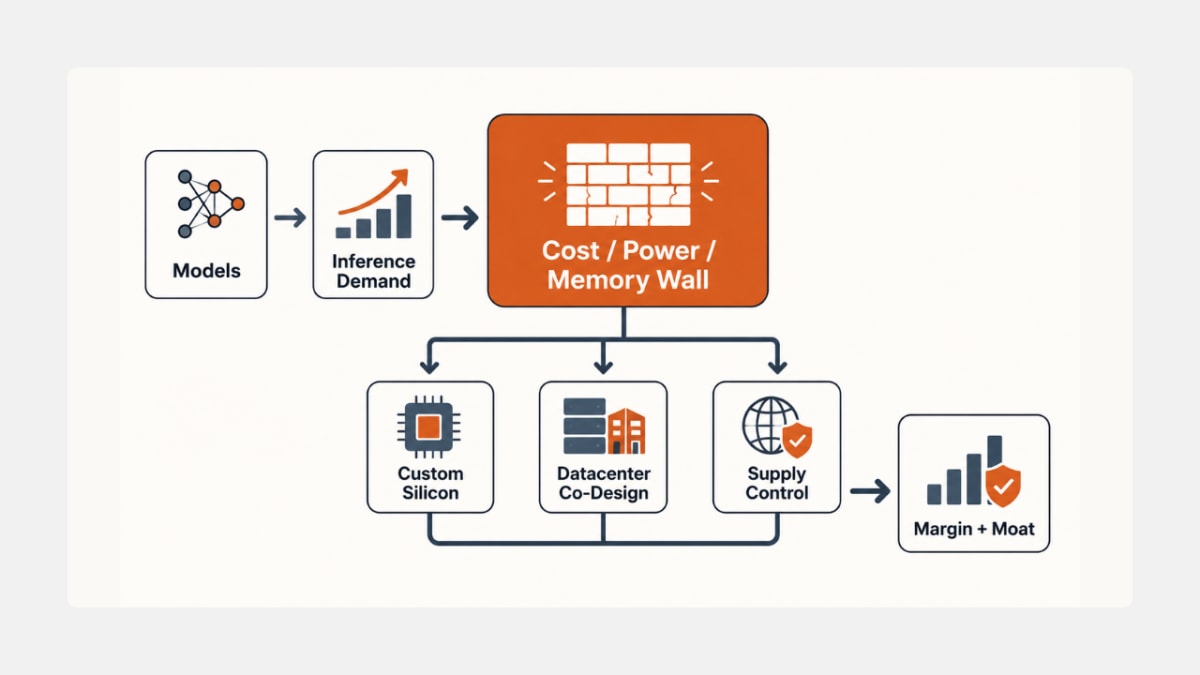
Because inference is where model success becomes operational reality. Training is spectacular, but inference is the bill that repeats forever.
A frontier model that reaches product-market fit does not just need to be trained once. It needs to answer millions or billions of requests cheaply, quickly, and predictably. That makes token cost, latency jitter, power efficiency, memory locality, and fleet utilization more important than headline benchmark glory.
Meta understood this early in a very practical context. Its MTIA effort started to support evolving internal AI workloads, beginning with an inference accelerator ASIC for recommendation models. That was not a vanity project. It was a recognition that the inference profile powering feeds and ads was specific enough, and economically important enough, to justify custom hardware.
Google's product positioning says the same thing from the cloud side. Its TPU roadmap now looks increasingly like a family of chips for different phases of the AI lifecycle. AWS is doing the same with Trainium and Inferentia logic, even when Trainium marketing increasingly spans both training and inference. The pattern is clear: when inference revenue scales, specialization follows.
That is also why the OpenAI custom-chip rumors matter even before they are officially confirmed. According to recent reporting from The Verge and Tom's Hardware, OpenAI is working with Broadcom on a custom inference-oriented processor. Whether that exact program lands on time is almost secondary. The strategic logic is obvious. If your future margin depends on serving frontier models at massive scale, eventually you try to own the economics below the API.
When does building your own chip still fail?
Usually when a company confuses strategic necessity with strategic capability.
Custom silicon is not automatically a moat. It only works when the company also has enough workload scale, enough software leverage, enough deployment consistency, and enough patience to survive a long feedback loop. A chip program without compilers, systems software, packaging, datacenter integration, and real internal demand is just an expensive PowerPoint.
This is why hyperscalers still have the advantage. They can amortize design risk across huge fleets. They control the serving layer. They can test hardware against live traffic. They can spread one generation's mistakes across the next generation's roadmap. Most startups cannot.
So yes, many companies will race to build an AI chip. Fewer will build one that matters.
Addressing the counter-arguments
Isn't Nvidia still too far ahead to displace?
Yes, in software ecosystem depth and operational trust. CUDA remains the default, and Nvidia still benefits when rivals take years to validate alternatives. But that lead does not eliminate demand for custom silicon. It increases it, because dependence on a single dominant supplier becomes more painful as AI becomes a margin business.
Won't buying cloud instances always be cheaper than designing chips?
For most companies, yes. But not for the handful running sustained frontier training or hyperscale inference. Once your AI bill becomes a structural line item rather than burst demand, silicon investment starts looking less like R&D theater and more like margin protection.
Are custom chips only for training giants?
No. Inference is probably the stronger reason now. Training gets headlines, but inference determines long-run unit economics. That is why recommendation systems, on-device assistants, and low-latency multimodal products are all pushing the market toward more specialized accelerators.
The honest take
Not every AI company should build a chip. Most should not. Most should buy access to the best infrastructure they can get, focus on product differentiation, and avoid romanticizing hardware.
But the frontier of AI is moving in a direction where the biggest winners will control more of the stack, not less of it. The moment AI stopped being a one-time research event and became a continuous industrial workload, chips moved from supporting actor to strategic core.
This is the part many people miss. The race to build AI chips is not mainly about prestige. It is about refusing to let someone else's supply chain, someone else's memory architecture, and someone else's gross-margin math dictate your product ceiling.
That is why this trend will keep accelerating.
And it is why Japan's AI Strategy Isn't About Models. It's About Survival. feels less like a country-specific story and more like a preview of the whole market. Sovereignty in AI increasingly means infrastructure sovereignty too.
The same logic shows up at the device layer. Google Did What Apple Promised: Gemini Intelligence Is the On-Device AI That Actually Works is not just an assistant story. It is also a story about what becomes possible when the hardware and model roadmap align tightly enough to ship useful on-device intelligence.
And if you want the cleanest consumer-facing analogy, OpenAI Is Building a Phone. It Wants to Kill the App Store. points at the same endgame: vertical integration is where ambitious AI companies go once they realize the model alone is not the moat.
The bottom line
AI chips are becoming the new norm because the AI market has matured past a simple compute shortage story. The new battle is over cost per token, energy per request, memory efficiency, deployment control, and supply resilience.
In that environment, custom silicon is not a side quest. It is what serious players do when AI becomes too important to run on rented assumptions.
FAQ
Why is everyone racing to build an AI chip now?
Because frontier AI economics have shifted from pure training bragging rights to long-run inference cost, power efficiency, and supply control. Once those become board-level constraints, custom silicon starts to look less like optimization and more like competitive defense.
Does this mean GPUs are going away?
No. GPUs will remain foundational for years, especially where software support and flexibility matter most. The shift is not from GPUs to no GPUs. It is from one universal chip strategy to a more layered stack of general-purpose and custom accelerators.
Who is best positioned to win the custom-chip race?
Hyperscalers and top labs with large, stable workloads are still best positioned because they can amortize design risk across enormous fleets. The advantage comes from combining hardware with compilers, networking, datacenter control, and real production demand.
What is the real bottleneck after compute?
Increasingly, memory and system architecture. HBM limits, bandwidth constraints, energy costs, and interconnect design now shape what AI systems can deliver at scale. That is why so much of the current innovation is happening around packaging, memory, and workload-specific serving paths.