
Japan's AI Strategy Isn't About Models. It's About Survival.
Japan launched Sakana Fugu, a multi-agent orchestration system, on June 22, 2026, the same month the government committed 10.5 trillion yen to Physical AI and semiconductor infrastructure. While the global AI conversation fixates on model benchmarks and parameter counts, Japan is building something structurally different: an AI ecosystem designed not for leaderboard wins, but for national survival.
This article breaks down what Japan actually shipped, why the strategy diverges from the U.S. and China playbook, and what it means for AI professionals watching the sovereign AI trend accelerate.
What Happened
Three developments converged in June 2026 that signal a strategic pivot.
Sakana AI launched Fugu. On June 22, the Tokyo-based startup (valued at over $2.5 billion, backed by NVIDIA, Google, Citi, and Mitsubishi Electric) released Fugu: a multi-agent orchestration system that hides an entire team of specialized frontier LLMs behind a single OpenAI-compatible API. Instead of relying on one monolithic model, Fugu dynamically routes tasks to a swappable pool of models, verifies outputs, and stitches together a final answer. The orchestration logic is learned via reinforcement learning, not hard-coded. Two ICLR 2026 papers underpin the system: TRINITY (a 0.6B-parameter coordinator assigning Thinker, Worker, and Verifier roles) and Conductor (a 7B model trained to discover coordination strategies, including recursive self-calls). The flagship Fugu Ultra variant reportedly competes with Anthropic's latest frontier models.
The government committed 10.5 trillion yen to Physical AI. Japan unveiled a plan combining public and private investment through 2040 to build out AI-powered robotics for healthcare, logistics, retail, and manufacturing. The target: 30% global market share in AI robots by 2040.
Japan revised its AI Basic Plan. The June 2026 draft revision emphasizes cybersecurity evaluations of frontier models, new consent exceptions for AI training data under the amended APPI, and the establishment of an AI Strategic Headquarters led directly by the Prime Minister. On June 12, the government adopted the 2026 IP Strategic Program, formalizing legislative frameworks for generative AI copyright compensation.
Why Japan's AI Play Is Structurally Different
The U.S. AI race is about building the biggest model. China's is about deploying the fastest. Japan's is about something neither country is optimizing for: resilience.
Nearly 30% of Japan's population is over 65. The working-age population is shrinking. In most countries, this is a crisis. In Japan, it became the thesis. The entire national AI strategy, from the GENIAC program funding domestic foundation models to the Physical AI robotics push, is built around a single question: who does the work when there aren't enough humans left?
That is not a thought experiment. That is their policy rationale, stated plainly in the Society 5.0 framework that underpins every major AI investment.
This explains choices that look odd through a Silicon Valley lens. Meta's $145B Spend Only Makes Sense If You Believe in Robots analyzed how the West is slowly arriving at the Physical AI thesis. Japan has been there for a decade. Companies like Telexistence (deploying remote-operated AI robots in retail stores), Gitai (building affordable humanoid robots for industrial and space applications), and Preferred Networks (vertically integrated from custom AI chips to robotic manipulation) are not research demos. They are in production.
Does Sakana Fugu Change the Multi-Agent Landscape?
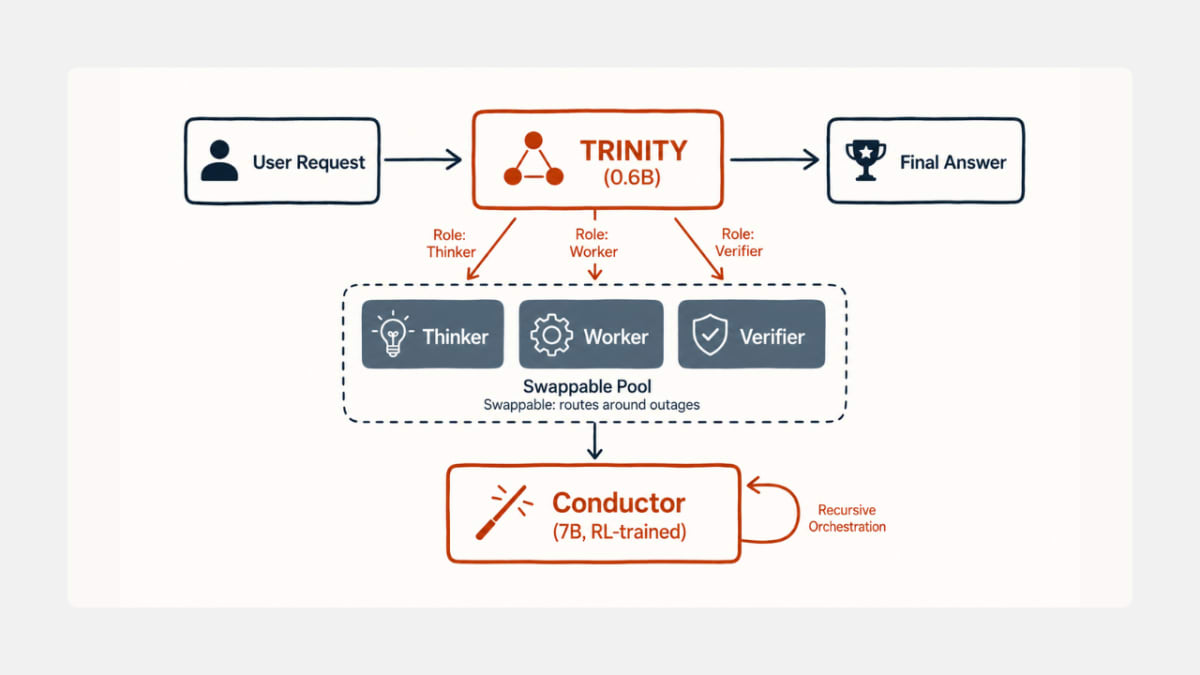
Fugu is the most technically ambitious multi-agent orchestration product to ship in 2026. Its core innovation is treating orchestration as a learned skill rather than a developer-authored workflow.
Most multi-agent frameworks today (LangChain, CrewAI, AutoGen) require developers to hand-code the coordination logic: who talks to whom, when to verify, how to route. Fugu replaces that with trained coordinators. The TRINITY module assigns roles across the agent pool. The Conductor module discovers coordination strategies through reinforcement learning, including recursive self-calls, a behavior that emerged from training rather than being designed in.
But the strategic point is not the architecture. It is the geopolitical hedge. Sakana AI explicitly positioned Fugu as a response to single-vendor dependency risk. The June 12, 2026 U.S. export control order affecting Anthropic's model availability underscored the vulnerability: if your AI stack depends on one provider, a single regulatory action can ground your operations. Fugu's swappable model pool means the system routes around provider outages, access restrictions, or geopolitical disruptions without downtime.
The same week, Anthropic locked down all of SpaceX's Memphis compute, a move that centralized enormous capacity under one company. Fugu is the architectural opposite: distributed, redundant, provider-agnostic. Japan is betting that the world with export controls and fractured supply chains needs resilience more than raw scale.
Rakuten AI 3.0 and the Domain-Specific Turn
Quietly, Rakuten trained a 700-billion parameter Mixture of Experts model under the government-backed GENIAC (Generative AI Accelerator Challenge) program. Rakuten AI 3.0 is not a general-purpose world model. It is optimized for Japanese language, culture, and business context.
This reflects what industry insiders call the "2026 Problem": high-quality internet training data is running dry. The companies that win from here are not the ones with the biggest models. They are the ones with the best proprietary data and the sharpest domain focus. Japan understood this early, and the GENIAC program exists to fund exactly this kind of domestic, domain-specific model development.
For context on how the compute investment race is playing out globally, Bezos Bets $12B on the AI That Engineers Hardware showed how American investors are also placing massive infrastructure bets, but with a different thesis: general-purpose industrial AI rather than sovereign, culturally-tuned models.
Who This Affects
Enterprise AI buyers outside the U.S.: Fugu's provider-agnostic architecture is a direct answer to the growing anxiety about single-vendor lock-in. Any enterprise team that lost sleep over the June 12 export control order should watch Sakana's API adoption numbers.
Robotics and manufacturing teams: Japan's 10.5 trillion yen Physical AI commitment means the talent, hardware, and integration pipeline for AI-powered robotics is about to get significantly more competitive. Teams building in industrial automation now have a government-backed ecosystem to partner with or compete against.
AI infrastructure investors: Japan's spend is shifting from cloud experiments to long-term national strategic assets. The infrastructure market is projected to exceed $5.5 billion in 2026 alone. This is a new demand center that was not in most 2025 investment theses.
AI policy watchers: Japan's "innovation-first" governance model, including APPI consent exceptions for AI training data, stands in sharp contrast to the EU's regulatory-first approach. The developer dependency on AI tools is accelerating globally, and Japan's permissive data policy may attract companies looking for regulatory arbitrage.
What to Watch Next
Sakana AI's Marlin research agent, launched shortly before Fugu, runs continuous reasoning loops for up to eight hours to produce 100-page strategy documents. If Fugu proves the multi-agent architecture in production, Marlin is the enterprise product that monetizes it. Watch for enterprise adoption numbers in Q3 2026.
The AI Strategic Headquarters is expected to define technical thresholds for "high-impact" AI models by late 2026. Those thresholds will determine Japan's compliance framework and signal whether the country maintains its innovation-first stance or tightens toward the EU model.
Japan's 30% global market share target for AI robots by 2040 is the long play. The near-term signal: watch Telexistence's retail deployment numbers and Gitai's humanoid production capacity through the rest of 2026.
The India-Japan AI Strategic Dialogue (April 2026) opened a bilateral channel that positions Japan as a neutral AI partner between U.S. and Chinese spheres of influence. More bilateral AI agreements will follow.
The Bottom Line
Japan's AI strategy is not about building the biggest model or winning benchmarks. It is about building the most resilient, most integrated, most sovereign AI ecosystem on the planet, one that fuses software intelligence with physical robotics, backs it with national infrastructure, and designs for a world where supply chains fracture and export controls drop without warning.
The next time someone tells you the AI race is between the U.S. and China, ask what Japan shipped this week. As of June 22, the answer is a multi-agent orchestration system that treats geopolitical risk as a first-class engineering constraint. That might be the most strategically honest AI product anyone has shipped in 2026.
FAQ
What is Sakana AI's Fugu?
Fugu is a multi-agent orchestration system launched on June 22, 2026 by Tokyo-based Sakana AI. It hides a team of specialized frontier LLMs behind a single OpenAI-compatible API, dynamically routing tasks to the best-fit model from a swappable pool. The orchestration logic is learned via reinforcement learning, not hard-coded.
How much is Japan investing in AI?
Japan has committed over 10 trillion yen in public support for AI and semiconductor infrastructure, with a specific plan of 10.5 trillion yen (combined public and private) through 2040 for Physical AI and humanoid robotics. The AI infrastructure market alone is projected to exceed $5.5 billion in 2026.
What is Japan's Physical AI strategy?
Physical AI is Japan's term for intelligent robots that perform complex real-world tasks. The government aims for 30% global market share in AI robots by 2040, targeting healthcare, logistics, retail, and manufacturing to address labor shortages caused by an aging population.
What is the GENIAC program?
GENIAC (Generative AI Accelerator Challenge) is a Japanese government-backed initiative funding the development of domestic foundation models. Rakuten's 700-billion parameter AI 3.0, a domain-specific Mixture of Experts model optimized for Japanese language and business context, was developed under this program