
Studio by Spotify Labs Proves the Future of Audio Is Local
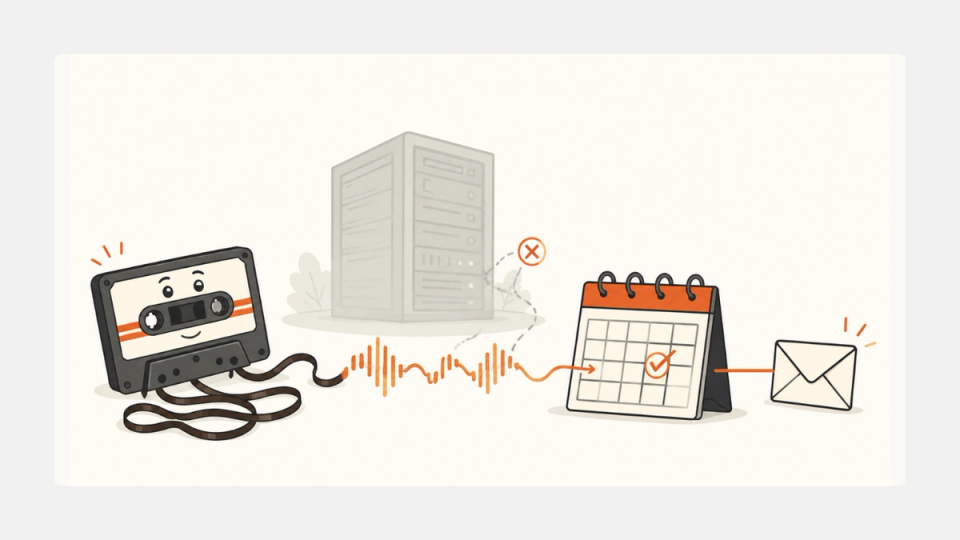
Spotify launched Studio by Spotify Labs on May 15, 2026, as a standalone macOS desktop application that generates personalized, interactive audio briefings and podcasts on demand.
The research preview signals a fundamental shift in how the streaming giant approaches AI. Instead of keeping intelligence trapped inside a centralized server farm pushing passive playlists, Spotify has built a local-first agent that reads your personal context to synthesize audio you actually want to hear.
Published July 11, 2026.
What Happened
Studio by Spotify Labs is currently an invite-only research preview available in over 20 countries. The application uses a conversational interface to generate custom audio, ranging from daily briefings to "Personal Podcasts."
The technical foundation is the surprise: rather than relying entirely on proprietary internal stacks like they did when building Spotify's ElevenLabs Tool, Spotify built Studio on top of Pi, an open-source agent framework created by developer Mario Zechner.
Crucially, the app asks for permission to connect to local device data—calendars, email inboxes, notes, and maps. When a user asks for a morning briefing, Studio doesn't just pull global news; it reads their 9:00 AM meeting prep and synthesizes it into the audio feed. Generated content can be saved directly to the user's Spotify library, living seamlessly alongside traditional music and podcast tracks.
Why the local context matters more than the voices
Does this train foundation models on my inbox?
Directly, no. Spotify explicitly states that local data accessed by Studio is not used to train the underlying AI provider's models.
This is the architectural wedge that makes the app viable. By keeping memory, preferences, and conversation history locked locally on the device, Spotify sidesteps the privacy nightmare of cloud-syncing an inbox to an LLM. It's the same localized trust model we're seeing across the ecosystem, echoing the architecture shift that happened when OpenAI's GPT-Realtime-2 enabled lower-latency local handoffs.
How does this change the podcast format?
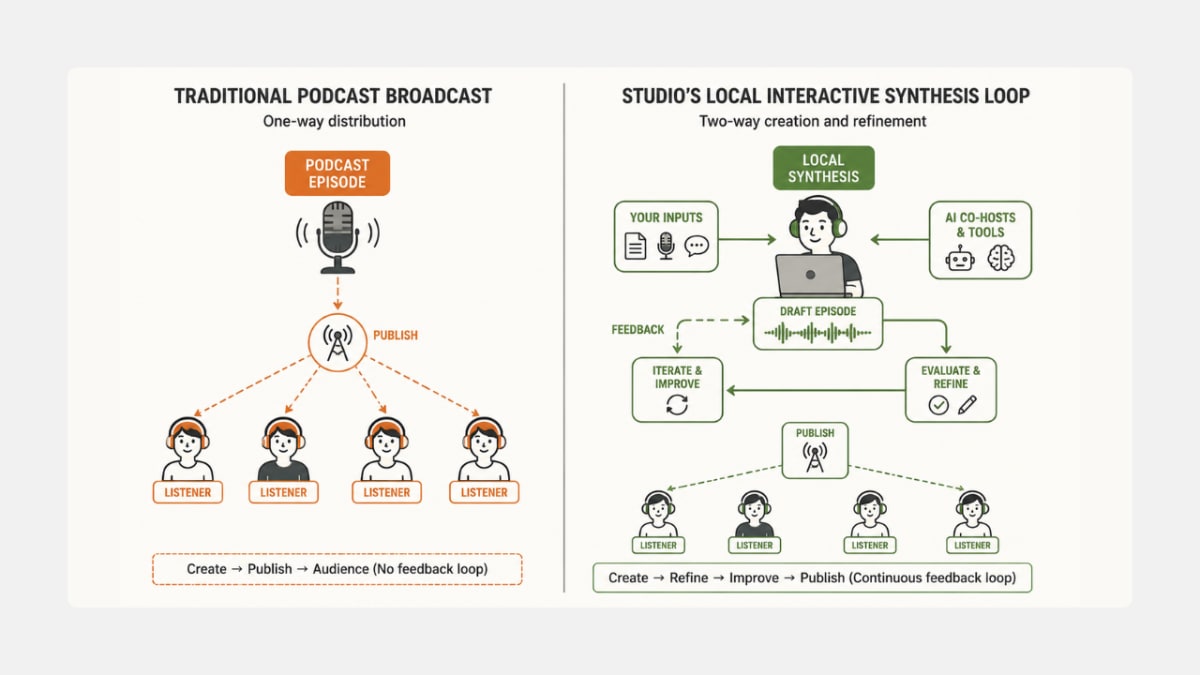
It breaks the assumption that audio is a one-way broadcast. Studio's conversational interface allows users to interrupt, refine the format, or adjust the "vibe" of the audio on the fly.
If a daily briefing is too formal, you can tell the agent to loosen up. If you need it to elaborate on a specific email thread it summarized, it adjusts in real-time. This interactive layer makes passive listening obsolete for informational content. While interactive video concepts like How Ask YouTube Actually Works focus on querying static media, Studio generates the media dynamically around the query.
Who this affects
For podcast creators: The informational podcast market (daily news, tech summaries, market updates) is about to face severe pressure. If a user can generate a 10-minute briefing perfectly tailored to their exact portfolio and calendar, the utility of a generic broadcast drops to zero.
For indie developers: Spotify formalizing Pi as its agent framework is a massive validation for open-source orchestration layers. You don't need a custom corporate engine to build consumer-grade agents anymore. The playbook used in How to Set Up an ElevenLabs Voice Agent for Lead Capture is rapidly moving from B2B to consumer desktops.
What to watch for next
Watch for the iOS and Android rollouts. A macOS desktop app is a safe sandbox for a research preview, but audio is fundamentally a mobile-first medium. The real test of Studio's local-first architecture will be how it handles the battery and memory constraints of a smartphone while trying to maintain real-time synthesis and local context indexing.
If Spotify successfully ports this to mobile in the next six months, the moat for third-party audio generation apps disappears entirely.
The bottom line
Studio by Spotify Labs isn't just another voice generator. By anchoring the agent to local data and open-source frameworks, Spotify has built a highly defensible wedge into personalized audio. The era of the one-size-fits-all daily playlist is ending; the era of the context-aware personal DJ has arrived.
Category: AI News Subcategory: Product Release Audience: Developers and Audio Creators Title: Studio by Spotify Labs Proves the Future of Audio Is Local Meta description: Spotify launched Studio by Spotify Labs in May 2026. Built on the open-source Pi framework, it uses your local calendar and inbox to generate daily audio. Primary keyword: Studio by Spotify Labs Secondary keywords: Spotify AI audio agent, Pi agent framework, personalized podcasts, local AI audio Tags: #Spotify #AIAudio #Personalization Author: Pranav Sunil Published: July 11, 2026 Pillar page: Sibling links: /insights/spotify-elevenlabs-tool-voice-ai-is-now-infrastructure, /insights/openai-gpt-realtime-2-collapses-the-voice-stack, /insights/how-ask-youtube-actually-works-and-who-it-breaks Schema recommended: NewsArticle Image asset: Required