
Spotify's ElevenLabs Tool: Voice AI Is Now Infrastructure
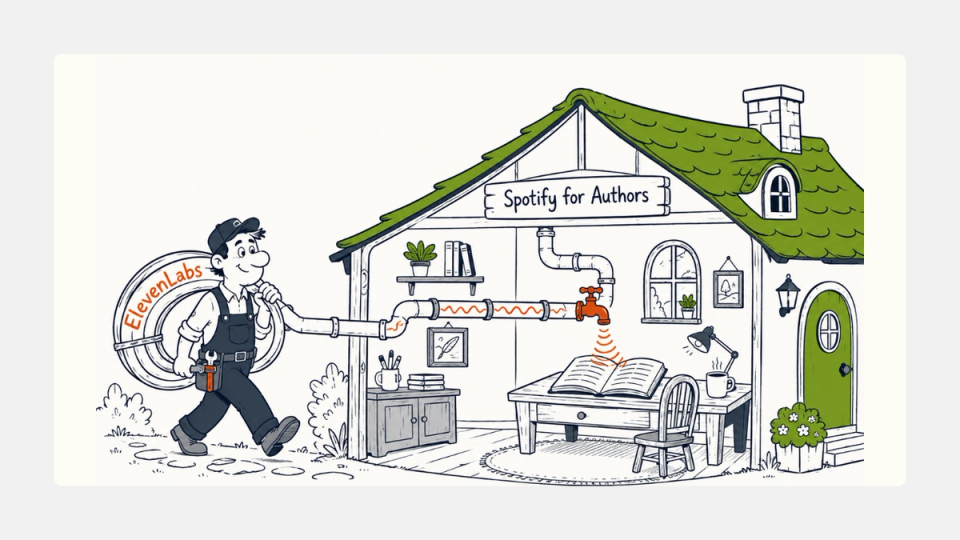
Spotify launched an ElevenLabs-powered audiobook creation tool inside Spotify for Authors on May 21, 2026, at its Investor Day. The beta arrives in June, invite-only, English first. Authors keep distribution rights and can ship the generated file to Audible, Apple Books, or any other store. Spotify did not ask for exclusivity. (Spotify Newsroom)
The headline is the integration. The story is what the integration means for everyone still trying to build voice AI as a destination.
What Happened
Spotify added a self-service audiobook generator to Spotify for Authors. A writer uploads a manuscript, picks a voice, ElevenLabs synthesizes the read, the file goes live inside Spotify's audiobook catalog. (TechCrunch)
The specifics:
- Beta starts June 2026, invite-only.
- English-only at launch. Spotify for Authors itself expands to ten more languages (French, Canadian French, German, Dutch, Latin American Spanish, Swedish, Finnish, Icelandic, Danish, Norwegian), but the AI tool follows later.
- No exclusivity clause. Authors can publish the generated file anywhere.
- Total Spotify listening hours are up 60% year over year, per the same Investor Day.
The partnership itself is not new. ElevenLabs has been allowed to upload finished audiobooks to Spotify since February 2025. What changed yesterday is that the synthesis is now a button inside Spotify's own author dashboard, not a separate workflow that ends with a file upload.
Why this matters more than the audiobook angle
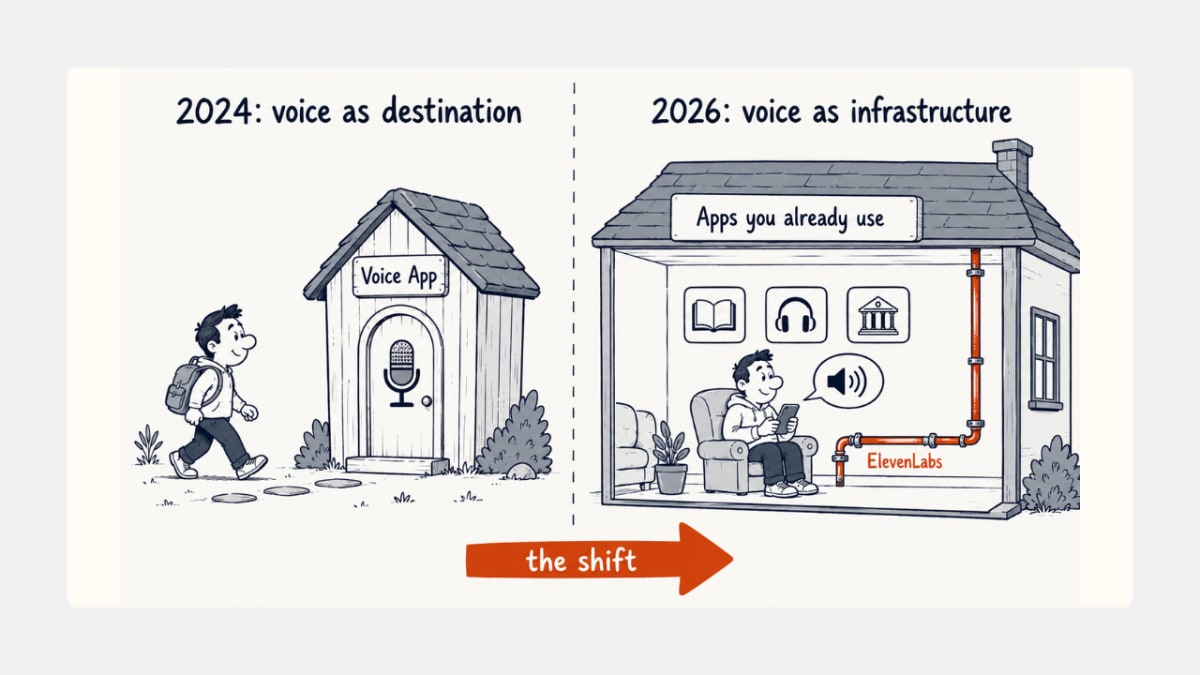
Voice AI spent 2024 and most of 2025 trying to be a destination. A standalone app. A new tab. A character you talked to. Most of those plays stalled because nobody changes their workflow to talk to an model in a separate window.
What worked was the opposite move: stop being an app, start being a layer. OpenAI's GPT-Realtime-2 collapsed the voice stack by replacing the old STT, LLM, TTS chain with a single multimodal model. ElevenLabs is winning the same fight from the other direction, by letting partners like Spotify treat voice generation as a server endpoint that gets called inside an existing product.
This is the same pattern Google is running with on-device dictation. Google's Rambler killed Wispr Flow's destination model by making the dictation layer system-wide, not app-shaped. It is the same pattern behind how Ask YouTube actually works: the AI does not ask you to leave; it shows up where you already are.
Has ElevenLabs become a B2B infrastructure company?
Yes, and the customer list confirms it. Deutsche Telekom, Square, Revolut, and the Ukrainian Government all use Eleven Agents for inbound customer support, citizen engagement, and internal training. (ElevenLabs Commercial Partner Program) Spotify is the first consumer platform at scale to put ElevenLabs inside the surface its users already pay for.
The enterprise list earned the partnership. Banks do not ship voice infrastructure that hallucinates a phone number. ElevenLabs cleared that bar before Spotify signed.
What does this do to the standalone voice agent app?
It compresses it. The destination apps that defined "voice AI" in 2024 are losing the same way that standalone autocomplete apps lost to inline LLM assistants. When voice generation is a feature inside the tool you opened to write a book, market a podcast, or run a support queue, the case for a separate app gets thin. The case that survives is identity-shaped: voice cloning, character work, IP-licensed reads. Everything else is a button in someone else's app.
This is the Magic Pointer pattern playing out in audio: the winning AI surface is the one that meets the user inside their current task, not the one that demands a new tab.
Who this affects
Self-published authors. The economics shift hard. Studio-quality audiobook narration runs $200 to $400 per finished hour in the human-narrator market, per the Audio Publishers Association. Spotify's tool collapses that to a synthesis pass. The ceiling on quality drops a bit; the floor on price drops a lot. Authors with thin midlist titles that never made commercial sense as audiobooks just got a path.
Audible. Audible's moat was supply, not demand. If ElevenLabs-narrated audiobooks ship into Spotify, Apple Books, and Audible itself (no exclusivity clause), Audible's catalog advantage gets eroded by the long tail. Amazon will respond by deepening human-narrator exclusives or shipping its own AI narration tool. Expect both.
ElevenLabs competitors. OpenAI's voice models, Google's voice stack, Cartesia, Hume: they all need a Spotify-shaped distribution moment, and there are not many Spotify-shaped partners left at this tier. The consumer platform integration is now a category-defining lever, not a nice-to-have.
Voice union talent. SAG-AFTRA's 2024 deal covered AI-narrated audiobooks under specific consent and compensation rules. Spotify's announcement does not name how it handles narrator consent. Spotify has not disclosed whether the voices inside the tool are licensed from existing narrators or synthesized identities. That gap is the next negotiation.
What to watch for next
- June 2026. Beta opens. Watch which authors get invited and whether the tool ships with usable voices in genres beyond literary fiction (romance, thriller, and non-fiction self-help are where unit economics actually decide this).
- September 2026. Language expansion. The ten new Spotify for Authors languages are the real test. ElevenLabs' multilingual quality is uneven; whether the tool ships to non-English markets at parity is the product question.
- Q4 2026. Audible's counter-move. Amazon will not let this stand without a response, and it has the leverage (catalog, exclusives, Whisper, Polly) to ship a competitive tool by year-end.
- Pricing. Spotify did not disclose what it charges authors per minute of generated audio, what cut ElevenLabs takes, or whether there is a free tier. The economics decide whether this is a hobbyist tool or a serious commercial route.
FAQ
When does Spotify's ElevenLabs audiobook tool launch?
The beta opens in June 2026, invite-only, English only at launch. The rollout will follow the Spotify for Authors expansion into ten more languages (French, German, Dutch, Latin American Spanish, Swedish, Finnish, Icelandic, Danish, Norwegian, and Canadian French) but Spotify has not committed to a multilingual date for the AI tool.
Do authors lose distribution rights to other audiobook stores?
No. Spotify explicitly did not include an exclusivity clause. Authors can publish the same ElevenLabs-narrated file on Audible, Apple Books, Google Play Books, or any other store while still distributing through Spotify.
Is this the first time ElevenLabs voices appear on Spotify?
No. ElevenLabs has been allowed to upload finished audiobooks to Spotify since February 2025. The May 21, 2026 launch moves the synthesis step itself inside Spotify for Authors, so writers no longer need a separate ElevenLabs workflow.
Why does this matter beyond audiobooks?
Because it is the cleanest consumer-side example of voice AI moving from standalone app to embedded infrastructure. ElevenLabs already powers voice agents at Deutsche Telekom, Square, Revolut, and the Ukrainian Government on the enterprise side. The Spotify deal mirrors that pattern on the consumer side and signals that voice generation now wins inside other products, not as a destination of its own.
The bottom line
The Spotify partnership is not a product launch. It is a category signal. Voice AI graduated from "interesting model you talk to" to "service that gets called inside the apps you already use." The destination era is closing. The infrastructure era is what 2026 has been about, and yesterday's announcement is the cleanest consumer-side proof of it.
If you are building a standalone voice product in 2026, the strategic question changed yesterday: who embeds you, and how soon?