
OpenAI Bought a Talk Show. The Ad Revenue Was the Point.
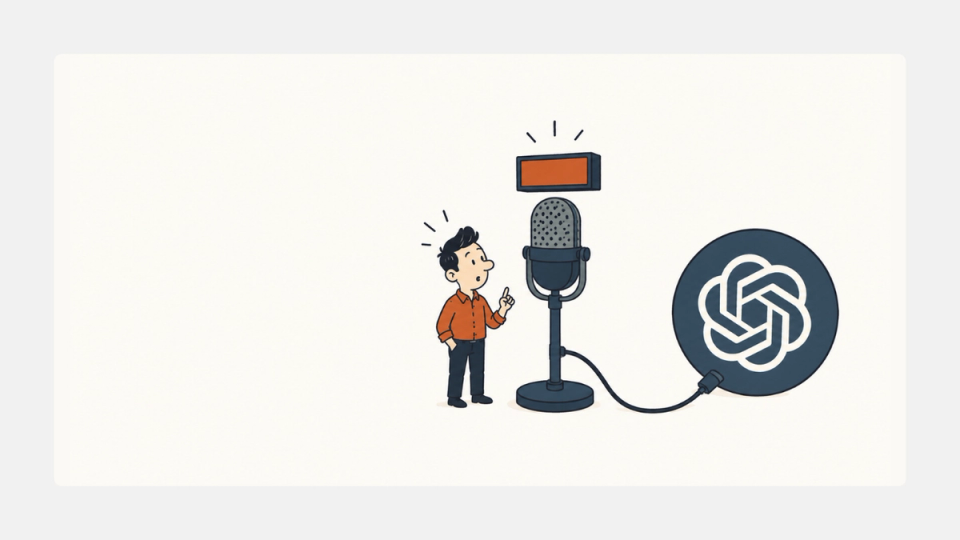
On April 2, 2026, OpenAI announced the acquisition of TBPN, a Los Angeles-based daily live talk show hosted by John Coogan and Jordi Hays, for an undisclosed sum reported to be in the low hundreds of millions of dollars. It is the first time OpenAI has acquired a media property — and Business Twitter has not stopped arguing about it since.
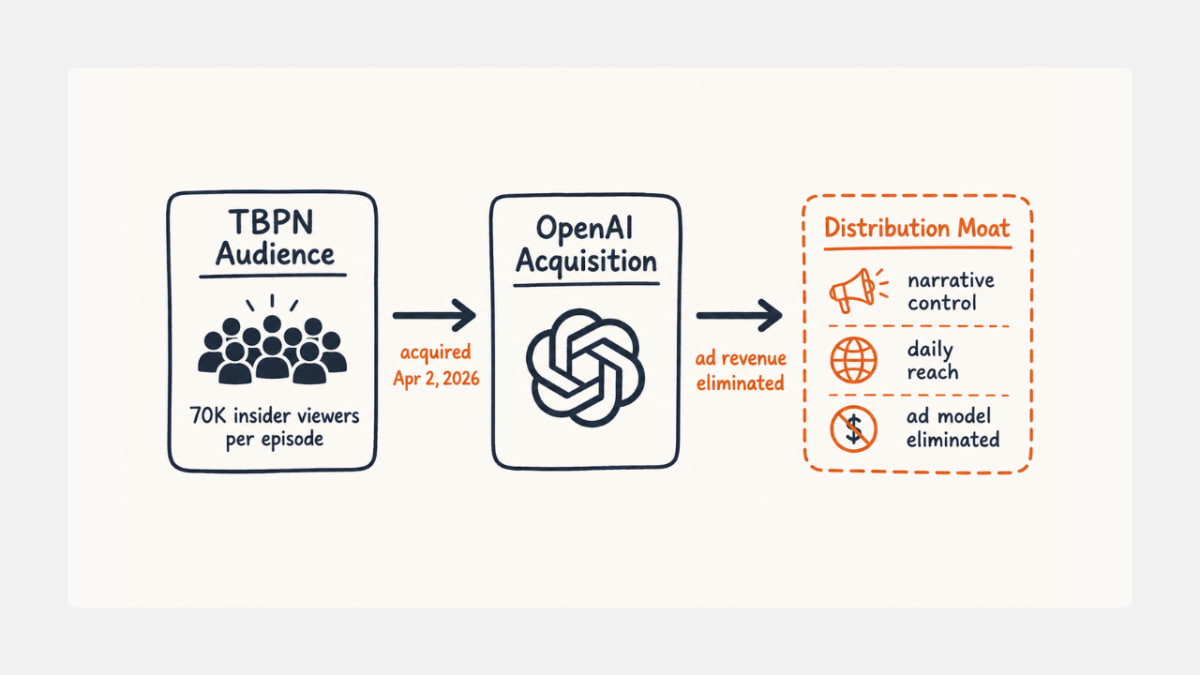
The numbers that make this unusual: TBPN was founded in October 2024, generated $5 million in advertising revenue in its first full year, and was tracking toward $30 million in 2026 before the deal closed. The show runs three hours a day, five days a week, live across YouTube, X, and LinkedIn, and averages roughly 70,000 viewers per episode. Guests have included Sam Altman, Mark Zuckerberg, and Satya Nadella.
OpenAI has not said what it paid. What it has done is immediately phase out TBPN's advertising business entirely.
That detail is the tell.
What Happened
Coogan and Hays continue to produce the show daily. TBPN reports to OpenAI's Strategy organization under Chris Lehane, OpenAI's chief global affairs officer. OpenAI's stated rationale: the acquisition gives the company a direct, credible channel to engage with builders, investors, and the broader tech community — the exact audience TBPN already had.
OpenAI described TBPN's editorial independence as "foundational" and committed to preserving it. Guest selection, programming choices, and editorial decisions remain with Coogan and Hays. The team is also expected to contribute their communications and marketing expertise to OpenAI's broader organization.
That dual mandate — keep the show credible, also help OpenAI communicate — is where most of the skepticism on Business Twitter is aimed.
Why Killing the Ad Revenue Was the Strategic Move
A media company tracking $30 million in annual ad revenue is not cheap. An AI company that pays low-hundreds-of-millions for it and then immediately kills the revenue model is doing something different from a normal acquisition.
The ad business was TBPN's financial justification as a standalone company. Without it, TBPN is not a media business anymore. It is a distribution asset that OpenAI now owns outright, with no third-party advertiser relationships competing for the show's editorial positioning.
This is not subtle. OpenAI is not buying a revenue stream. It is buying a weekly commitment from 70,000 tech-industry insiders — VCs, founders, engineers, and operators — to sit down and watch OpenAI's preferred framing of AI developments for three hours a day.
At that scale, with that audience composition, the asset is worth more as a distribution moat than as an ad-supported media company. The $30 million in projected revenue would have taken years to compound into anything that moves the needle for a company building a phone to kill the App Store and filing a confidential S-1.
Does Editorial Independence Actually Hold?
This is the hard question. OpenAI has pledged it. Coogan and Hays have said it was a founding condition of the deal. The early evidence from the show's continued operation suggests the format is unchanged.
But the structural incentives point in one direction. TBPN's team now reports inside OpenAI. Their communications expertise is explicitly part of what OpenAI is using. The advertising revenue that made independence self-sustaining — TBPN could have walked away from a bad deal because it had its own revenue — is gone.
Independent editorial judgment is easier to maintain when there is a financial exit if things go wrong. That exit no longer exists for Coogan and Hays. They work for OpenAI now.
Whether that produces meaningful editorial capture is unknowable from the outside. But the architecture of independence has changed, even if the stated commitment has not. OpenAI's legal and institutional credibility is already under scrutiny — a talk show that visibly softens on OpenAI coverage would accelerate that damage faster than any competitor criticism.
There is a self-interest argument for maintaining the show's credibility. A captured TBPN is worth nothing as a distribution asset to OpenAI. The audience it reaches is sophisticated enough to notice. That audience is also what OpenAI paid for.
What Business Twitter Is Actually Arguing About
The debate splits roughly into two camps.
Camp 1: This is a distribution play, and OpenAI is playing it correctly. The AI narrative war is real. Traditional tech PR is not reaching the audience that matters at the speed required. A daily live show that is already embedded in the workflow of the people who fund, build, and deploy AI is a better investment than a larger communications team. The $30 million in projected revenue signals audience quality, not just size. OpenAI is buying the audience, not the show.
Camp 2: This is a symptom of strategic drift. The argument is that a company at OpenAI's stage — with a OpenAI phone to kill the App Store, a voice stack collapse in GPT-Realtime-2, an active legal fight, and a looming IPO — does not need to own a talk show. It needs to win on product. Acquiring distribution to shape the narrative around product gaps is what companies do when the product is not speaking for itself.
Both camps have evidence. Neither is obviously wrong.
The more interesting read is what this acquisition signals about how OpenAI thinks about moats as it approaches public markets. Meta spent $145 billion on capital expenditures in 2026 because it concluded distribution alone is not a moat — you have to own the infrastructure. OpenAI's TBPN move is the opposite theory: in a world where model quality is converging and every lab is racing toward the same frontier, owning the attention of the people who decide which models matter may be worth more than another GPU cluster.
That theory is contestable. But it is coherent.
A Note on What OpenAI Has Not Disclosed
The exact acquisition price is undisclosed. The specific contractual terms governing editorial independence have not been published. OpenAI has not explained how it will handle coverage of competitors on the show, or whether Coogan and Hays face any formal restrictions on topics. The mechanics of how their communications expertise feeds into OpenAI's broader organization are not public.
These are the gaps. A credible editorial independence commitment should be able to survive those disclosures. The fact that they have not been made does not confirm bad faith — acquisitions routinely close with undisclosed terms. But readers watching the show should know what was not disclosed, not just what was.
Who This Affects
For AI builders and developers: The show is currently continuing in its existing format. If editorial independence holds, TBPN remains a useful signal-to-noise filter for AI industry developments — the audience quality that made it attractive to OpenAI also makes it worth watching. If the coverage visibly shifts, that signal degrades quickly.
For founders and investors: The AI narrative war is not abstract. Which models get recommended in influential circles, which companies get serious critical coverage versus press-release amplification, and which leaders are platformed regularly all have downstream effects on hiring, deal flow, and enterprise adoption. Owning the room where those conversations happen is valuable. OpenAI now owns a piece of that room.
For competing AI labs: This is a harder problem than it looks. Anthropic, Google DeepMind, and xAI do not have owned media assets with comparable audience quality. They can respond by becoming more available guests on TBPN — which now requires OpenAI's cooperation — or by cultivating alternative platforms. Neither is a clean answer. PewDiePie's AI workspace launch and the broader creator-economy-meets-AI moment suggest there is no shortage of emerging platforms, but none has TBPN's insider penetration right now.
For the media industry: A tech company paying low-hundreds-of-millions for an 18-month-old talk show signals something about where value sits in the attention economy. The show's audience is small by mass-media standards. By industry-insider standards, it is extraordinarily concentrated. That concentration, not the view count, is what got priced.
What to Watch For Next
Three signals will tell you whether this acquisition is working:
- Coverage balance in the next 90 days. If TBPN's critical coverage of OpenAI decisions noticeably softens while coverage of competitors intensifies, the editorial independence claim is failing. This is measurable.
- Whether competing labs get fair guest access. Coogan and Hays have historically featured Anthropic, Google, and xAI leadership. If booking patterns shift toward OpenAI-adjacent guests, the show's usefulness as an industry signal degrades.
- The IPO filing. When OpenAI's S-1 becomes public, watch whether TBPN is listed as a strategic asset, how it is valued, and whether the ad revenue elimination is presented as a cost center removal or as a distribution investment. The accounting will be clarifying.
OpenAI's strategy organization, which now owns TBPN, has made several moves this year that individually look like tactics but together suggest a coherent theory: distribution, developer trust, and narrative control are durable moats in a world where model quality is converging. The TBPN acquisition is the most legible expression of that theory yet.
Whether it holds depends almost entirely on whether Coogan and Hays can keep the show as good as it was before OpenAI bought it.
The Bottom Line
OpenAI acquired TBPN on April 2, 2026, for a sum in the low hundreds of millions of dollars. It immediately phased out the show's $30 million revenue trajectory in advertising. That move converts a media company into a pure distribution asset, which is both the most strategically coherent reading of the deal and the one that most directly threatens the editorial independence OpenAI has publicly committed to preserving.
The show continues. The format is unchanged. The audience that made it valuable is still there. Whether it stays there as something worth trusting is the only question that matters.