
OpenAI's Real Risk Is the Judge, Not the Jury
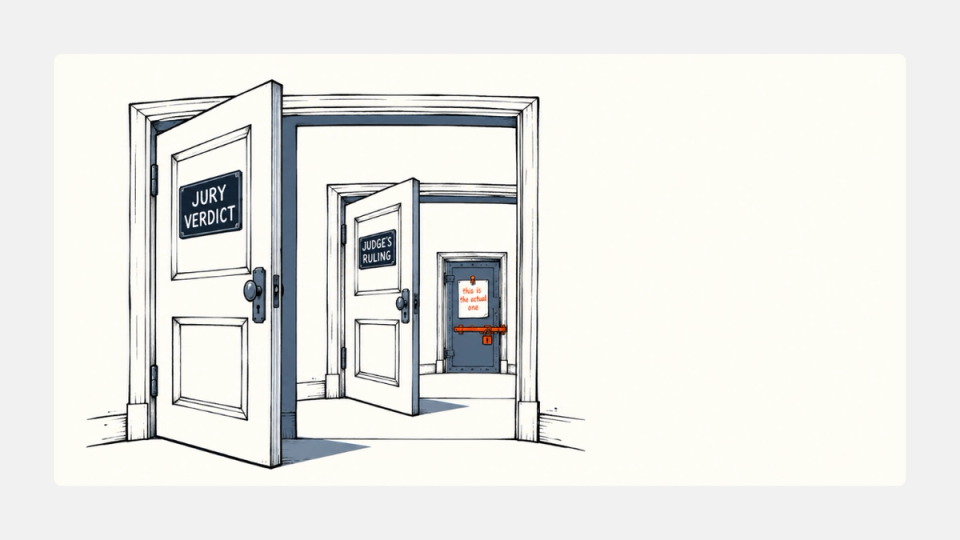
The Musk v. OpenAI jury starts deliberations on Monday, May 18, 2026, on two civil claims — breach of charitable trust and unjust enrichment — that have eaten 12 trial days in U.S. District Judge Yvonne Gonzalez Rogers' Oakland courtroom (Tech Times). The reasonable read of every closing argument, every Sutskever and Murati line, every "stole a charity" quote is that the verdict on Tuesday or Wednesday will decide whether Sam Altman keeps his job and whether OpenAI's October 2025 recapitalization gets unwound.
That read is wrong. The jury verdict is advisory. Judge Gonzalez Rogers retains sole authority to issue the binding ruling, and the case structure shipped a separate bench trial for damages if Musk prevails (Axios). The case the cable networks have been covering is the warm-up. The case that decides whether Microsoft's 27 percent stake gets touched, whether Altman and Greg Brockman lose their leadership positions, and whether $14 billion of projected 2026 losses run through a different corporate structure is the bench phase that starts after the jury hands its non-binding opinion back. Three things rest on this distinction: the timing of any structural change at OpenAI, the legal route through which Microsoft's stake actually moves (if it moves), and what builders shipping on the API should plan for between now and end of Q3.
What everyone has been writing this week
Every outlet has the same shape. Closing arguments concluded May 14. Musk attorney Steven Molo argued the company "violated its nonprofit mission to pursue safe, powerful AI for the world — and that its executives instead sought to reap personal gain through stock grants" (Axios). OpenAI's defense leaned on Musk's $38 million in donations carrying no specific conditions, plus the procedural argument that the lawsuit was filed too late and that Musk's own misconduct should bar him from prevailing. Five witnesses testified that Altman was dishonest, including Musk himself, former board members, and former chief scientist Ilya Sutskever. The jury is nine people in Oakland. The deliberation lottery is now the news. That focus is consistent with the broader pattern this year of OpenAI's shipping cadence — including GPT-Realtime-2 collapsing the voice stack — pulling editorial attention to product news and leaving structural questions for legal blogs.
Steelman the framing fairly. Jury advisories carry weight in practice. Federal judges routinely defer to jury credibility findings on disputed facts because the jury actually watched the witnesses lie or not lie. If nine people sit in a room for three days and come out unanimously convinced that Altman breached a charitable trust, Judge Gonzalez Rogers is unlikely to write an opinion that calls them all wrong on the facts. That is the strongest case for treating the jury verdict as the trial's outcome, and it is the case implicit in every cable-news segment this week.
It is also not how the actual order of operations works.
What "advisory" means in this case
A jury verdict in an equitable claim — and breach of charitable trust is an equitable claim, not a damages-at-law claim — is advisory under Federal Rule of Civil Procedure 39(c). The judge can accept it, modify it, or replace it with her own findings of fact and conclusions of law. In this case the parties expressly agreed the jury would be advisory, and Judge Gonzalez Rogers explicitly preserved the right to issue the binding ruling. The separate bench trial for damages, if Musk prevails on liability, is the second movement of the same case (Tech Times).
So the order of operations is: jury returns advisory verdict; judge issues binding findings (timing at her discretion); if liability is found, the remedies phase begins; remedies phase produces a separate set of orders that can include redirecting "ill-gotten gains" to OpenAI's nonprofit foundation, unwinding the October 2025 recapitalization, and removing Altman and Brockman from their positions. The judge can also decline to order any of those things while still finding liability.
This is the same structural pattern that played out in the FTC's earlier antitrust attempts against Big Tech: liability and remedy are separate questions, decided on separate timelines, and the remedy is where the actual product changes live. Microsoft's $135 billion stake, Brockman's roughly $30 billion personal stake, and the public benefit corporation conversion are remedy-phase questions, not liability-phase questions.
Why does the remedies phase decide more than the verdict?
The verdict tells you who won the moral argument. The remedies phase tells you what changes on Monday morning at Pioneer Tower. A judge who finds liability still has to decide what to do about it. The closest contemporary analogue for how a court weighs operational disruption against principled remedy is the pattern that emerged when Anthropic built a zero-day machine and then locked it away — a voluntary, internally-imposed limit that the courts now have to evaluate on a different timescale than they evaluate market harm. The options run from a written admonition with no operational consequence on one end, to forcibly unwinding a recapitalization with $135 billion in third-party equity tied up in it on the other end. Almost every realistic outcome sits in the middle, and almost every middle outcome takes months to draft, brief, and appeal.
The middle is where Microsoft's lawyers earn their fees. Microsoft was not a party to this trial, but its 27 percent equity is the load-bearing wall of OpenAI's current capital structure. Any remedy that touches the recapitalization either touches Microsoft's stake or it doesn't. If it does, expect Microsoft to be in the courtroom within a week filing motions to limit the scope. If it doesn't, the remedy is mostly cosmetic.
What does the bench-trial damages phase actually decide?
Musk's headline ask was up to $134 billion in damages, with a public commitment to donate any winnings back to OpenAI's nonprofit arm. The damages number is theater. What the bench trial on damages actually decides is whether OpenAI's enterprise customers will see a single-judge order that requires the company to ring-fence specific contracts, returns, or assets pending appeal. That is the part of the ruling that flows downstream into the API contracts that founders signed last quarter. It is also the part nobody has been writing about because the jury verdict story is easier to put on a chyron.
Why does this matter for builders shipping on the API right now?
If you ship on the OpenAI API and your contract has any change-of-control language, you should re-read it this week. The plausible-but-not-imminent outcome is that a remedy order between July and September forces a corporate structure change — not necessarily a reversal, but a meaningful one — that triggers change-of-control clauses in your vendor agreement. That is a different planning horizon than "Sam Altman might be fired on Tuesday." The right move is to log what your fallback path looks like (Anthropic, Google, Bedrock-hosted alternatives) and how long it would take to switch — not because you will need to, but because the cost of finding out you can't is asymmetric.
The strategic context here is the same one that emerged when OpenAI quietly killed its long-promised features in the most recent model cycle: the company has been incrementally absorbing the constraints Anthropic has been arguing for from the start, and a charitable-trust ruling that demands a recommit to the nonprofit foundation is consistent with that drift, not a reversal of it.
Three counter-arguments worth taking seriously
The jury will be unanimous and the judge will defer. This is the strongest argument for ignoring the bench-trial distinction. If the jury comes back unanimous against OpenAI on both claims, Judge Gonzalez Rogers will almost certainly find liability — the credibility findings are functionally locked. But finding liability does not lock the remedy. A unanimous jury verdict in May does not predict the shape of an order that has to balance a $135 billion Microsoft equity stake, the $14 billion 2026 loss trajectory, and the disposition of OpenAI's nonprofit foundation against a sympathy-poor plaintiff who is asking for damages he has publicly committed to give back. The order writes itself in fall, not Monday.
OpenAI will appeal whatever lands, so the trial outcome is academic. Half true. OpenAI will absolutely appeal an adverse ruling. Bench rulings in equitable cases are reviewed for abuse of discretion on remedy and de novo on legal conclusions, which is a friendlier appellate posture for OpenAI than a jury fact-finding posture would have been. The appeal calendar adds 12 to 18 months to any structural change. But there is a meaningful interim period — between the bench ruling and the Ninth Circuit stay — where a district-court order could compel actions that don't unwind cleanly later. Microsoft's lawyers know this. The operational reality is not "OpenAI will appeal and life goes on" — it is "OpenAI will appeal and there is a 30 to 90 day window of operational uncertainty for everyone downstream."
The damages number is the headline, and it is too small to matter. Musk's $134 billion headline ask scaled down dramatically through trial, and any final number — whether $5 billion or $50 billion — is dwarfed by what OpenAI is raising and spending. So why care about damages at all? Because the damages judgment, once entered, creates a creditor with seniority over equity, which is the legal mechanism by which a court can effectively force a corporate-structure change without ordering one directly. A creditor with a multi-billion-dollar judgment against the for-profit entity can object to the recapitalization in ways a plaintiff with no judgment cannot. The damages number is not the story. The mechanism the damages number creates is the story. The same pattern emerged when Meta's $145 billion capex commitment shifted Meta's leverage profile in ways the press release did not name.
What to watch this week

Three signals between now and end of Q2 that matter more than the verdict itself:
- The judge's scheduling order. Whatever Gonzalez Rogers signs between Monday and the verdict announcement about the remedies-phase calendar tells you everything. A four-week remedies hearing scheduled for early July means she is taking remedies seriously. A 90-day extension at OpenAI's request with no firm date means OpenAI's lawyers think they can run out the clock.
- Microsoft's first filing. Microsoft is not a party but has Article III standing to intervene if any remedy touches its stake. The day Microsoft's outside counsel files a motion to limit remedy scope is the day the bench trial becomes a three-way negotiation.
- The nonprofit foundation's position. OpenAI's nonprofit foundation is the would-be beneficiary of any "redirect ill-gotten gains" remedy. If the foundation's own counsel files anything between Monday and the bench ruling — even a single letter brief — that is the strongest possible signal that an internal split is forming about how to receive any remedy ordered.
The downstream context for AI infrastructure is also worth holding. Anthropic's reservation of every megawatt at SpaceX's Memphis Colossus 1 data center two weeks ago is the kind of move that makes more sense in a world where the structural certainty of OpenAI's compute partnership becomes wobbly, even briefly. The compute market reads court schedules.
The bottom line
The verdict is not the verdict. The Musk v. OpenAI jury returns an advisory finding next week, the judge issues a binding ruling on her own schedule, and the remedies phase is where the actual reshaping of OpenAI's corporate structure happens. The right framing for anyone watching this trial as a builder, a customer, or an investor is not "did Musk win" but "how wide is the remedy and how fast does it move." Watch Microsoft's first filing, the judge's scheduling order, and the nonprofit foundation's position. Ignore the cable chyrons. Plan your vendor contingencies for a 30 to 90 day window in Q3, not a Tuesday morning headline.
Frequently asked questions
When does the actual binding ruling land?
There is no fixed date. The jury verdict is expected the week of May 18, 2026. Judge Gonzalez Rogers will then issue her own findings of fact and conclusions of law on liability, typically within four to eight weeks. The remedies phase opens after that — most likely between July and September 2026. Any final order is appealable to the Ninth Circuit, which adds another 12 to 18 months.
Can the judge actually unwind the October 2025 recapitalization?
Legally, yes. Practically, it is the most disruptive remedy on the table and would require unwinding Microsoft's 27 percent stake, the public benefit corporation conversion, and the equity grants that include Brockman's roughly $30 billion personal position (Tech Times). Judges do not usually issue orders that nuclear without a clear roadmap from the parties for how to execute them. Expect a narrower remedy if one is ordered at all.
Will Sam Altman actually be removed?
Removal of Altman and Brockman is one of the remedies the judge is weighing, per the case docket. It is the most legally aggressive option short of recap reversal. Most observers — including those who think Musk has a strong liability case — view removal as a low-probability final order, mostly because the operational disruption would be massive and the judge would be writing the order under intense Ninth Circuit appellate pressure.
What happens to my API contract if there is a structural change?
Re-read the change-of-control clause now. Most enterprise OpenAI contracts contain language that triggers on a "material change in corporate structure." Whether a public-benefit-corporation reversal or a forced equity restructure clears that bar is contract-specific and worth a real conversation with counsel this week, not in August.
Is this trial similar to any prior nonprofit-conversion case?
Not at this scale. Charitable-trust litigation has unwound smaller nonprofit conversions before, but no prior case involved a $500-billion-tier organization with a sovereign-scale third-party equity holder. The doctrine being applied is conventional. The facts and dollar amounts are without precedent.
Why is everyone covering the jury and not the bench trial?
Because the jury delivers a clear narrative beat on a known date, and the bench trial is procedurally messy and stretches into the fall. Cable news is structured around the first. Anyone planning around OpenAI's actual structure should be paying attention to the second.
Could Musk drop the case after the jury verdict?
He could, but unlikely. Musk has publicly committed to donating any damages back to the nonprofit, which removes the financial-incentive read of the case. The political and reputational stakes for both Musk and Altman effectively force the case to run to a final binding ruling. Settlement at this point would require concessions that neither side has signaled willingness to make