
PewDiePie Shipped an AI Workspace. The Timing Is Not a Coincidence.
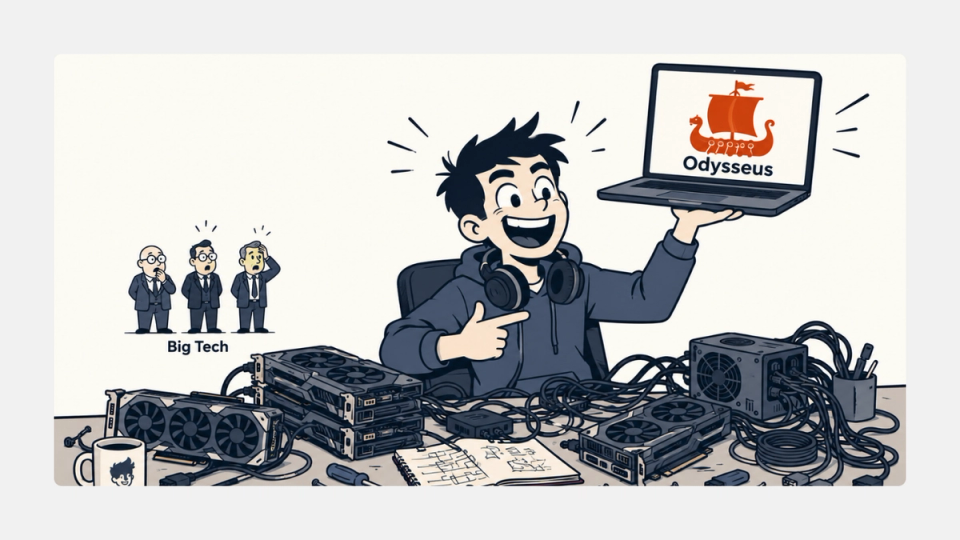
Felix Kjellberg, better known as PewDiePie, launched Odysseus on May 31, 2026 — a free, open-source, self-hosted AI workspace that lets anyone run large language models on their own hardware or via external APIs, with zero telemetry and zero subscription fees.
I want to be honest with you: when I first saw the headline, I scrolled past it. Another creator pivoting to tech. Another GitHub repo that would get 10,000 stars and then collect dust. But I gave it an hour, set it up, and now I am writing about it — because what Felix built is more interesting than what people are calling it.
What Happened
On May 31, 2026, Kjellberg posted a YouTube video titled MY trillion $Dollar Project is finally OUT! and dropped a link to the repository pewdiepie-archdaemon/odysseus on GitHub. The repository crossed 10,000 stars within hours. By the time this goes live, it is sitting above 27,000 stars.
Odysseus is not a chatbot wrapper. It is a persistent workspace. It supports:
- Local model inference via Ollama, llama.cpp, and vLLM
- External API connections to OpenAI, Anthropic, and OpenRouter
- Autonomous agent workflows for tasks like email management and deep research
- Persistent memory across conversations
- A "Cookbook" that scans your hardware and recommends models your machine can actually run
- MCP server compatibility for custom tool integration
The project is MIT licensed and runs on Windows, macOS, and Linux. Docker setup is available if you prefer not to go native.
Kjellberg has been building toward this for roughly 12 months, documenting his journey on YouTube — including the point where he assembled a 10-GPU NVIDIA rig just to run LLMs locally. His launch line: "The war on big tech has just begun."
Why a YouTuber Building This Actually Matters
Most coverage of Odysseus frames this as a celebrity curiosity. That framing misses what is actually happening.
I tried running local models myself about eight months ago. The friction was real. You had to know which GGUF file to download, which quantization worked for your VRAM, which frontend did not crash on first launch. The tooling existed but it was clearly built by engineers for engineers. The "just run Ollama" advice assumes you already know what Ollama is.
Odysseus has a Cookbook. It scans your hardware. It tells you which models fit. That one feature — a software-side concierge for your own machine — is the gap that has kept local AI as an enthusiast hobby for years. It is not technically novel. But someone finally shipped it in a product that 27,000 people wanted to try in the first 72 hours.
The real story is distribution, not technology. Felix has 110 million YouTube subscribers. When he builds something and says it works, a segment of that audience will try it regardless of technical ability. The local AI pattern Google itself is building toward has been slowly legitimized by on-device inference shipping in Pixel and Gemma. Odysseus legitimizes it for the creator and enthusiast audience in a way that no technical blog post ever could.
Does This Threaten ChatGPT?
Not directly. Not yet.
The honest answer: Odysseus requires setup. You need hardware. You need patience. For the casual user who opens ChatGPT on their phone between meetings, Odysseus is not a replacement. OpenAI is not losing sleep over this.
But that is the wrong frame. OpenAI and Anthropic have both been navigating this question — what happens when capable models become commodities and the platform layer is the only differentiation — for the past 18 months. Odysseus is an answer from outside the industry. It says: the platform layer can be local, community-run, and free.
In my experience, the projects that start as enthusiast tools and end up mattering are the ones that solve a real friction with good enough defaults. Odysseus does that for local AI. What comes next depends on whether the community can maintain the codebase — some developers have already flagged security questions about the speed of growth — and whether Felix stays involved past the launch energy.
Who This Actually Affects
Developers and solo builders. If you have been running Codex, Claude Code, or Gemini CLI and paying $20 or more a month for the privilege, Odysseus gives you a path to local inference with a UI that is not a raw shell. You trade some capability ceiling for zero cost and full data ownership. Depending on your use case, that is a fair trade.
Privacy-conscious professionals. Journalists, lawyers, researchers — anyone whose work cannot go through a third-party cloud. Self-hosted has always been the answer for this group but the setup tax was too high. Odysseus lowers that tax.
Creator-economy builders. This is the longer tail. Felix building a serious technical project signals something to the creator community. The ceiling on what a creator can ship is higher than it used to be, and the audience for a creator shipping open-source AI turns out to be 27,000 GitHub stars large in 72 hours.
OpenAI and Anthropic. Not as an immediate threat. But the platform shift from model to workspace is already underway. Anthropic shipped Claude Opus 4.8 and Claude Code as a platform move. OpenAI has Codex Cloud. A free, open-source alternative in that workspace category, backed by one of YouTube's largest audiences, is a data point neither company can ignore.
What Happened in the First 72 Hours
The Hacker News thread surfaced the usual mixed bag. Praise for the Cookbook feature and the MCP support. Criticism for the security review speed and what some called a "Frankenstein" assembly of existing tools. Both are accurate.
The criticism about novelty is fair but irrelevant. Most infrastructure software is assemblage. The value is in what you assemble, how you default it, and who you ship it to. Odysseus defaulted well enough to get 27,000 stars before the week ended.
The security criticism is worth watching. A codebase that grows this fast under maintainer pressure is a real risk. Kjellberg has not yet indicated the team size or the security review process. That is the thing I would want to know before running Odysseus on a machine with sensitive documents.
What to Watch For
- Whether Kjellberg stays actively involved or hands off to community maintainers. Open-source projects driven by founder attention tend to stall when that attention moves on.
- A credible security audit. The community is already raising questions. An external review would signal this is a serious long-term project.
- Whether enterprise or creator teams start building on top of Odysseus. That would mark the shift from viral tool to actual platform.
- The competitive response. OpenAI and Anthropic have not commented. If Odysseus keeps growing, that changes.
- Local model progress. As models like Llama and Mistral continue to compress without losing capability, Odysseus becomes more useful across a broader hardware range.
The Bottom Line
Odysseus is real software that solves a real problem. The person who shipped it happens to have 110 million subscribers, which is the thing that makes it a story and the thing that will make most people underestimate it.
I tried it. The Cookbook works. The agent setup is rough around the edges but functional. The vision — a persistent, private AI workspace you actually own — is the right vision for 2026, when trust in big tech platforms is lower than it has been in a decade.
Whether Odysseus becomes the Obsidian of AI workspaces (beloved, community-run, permanently indie) or the product that makes someone else build the better version — either outcome moves the category forward.
That is worth paying attention to.