
NVIDIA RTX Spark vs Apple M5: Trading Battery for CUDA

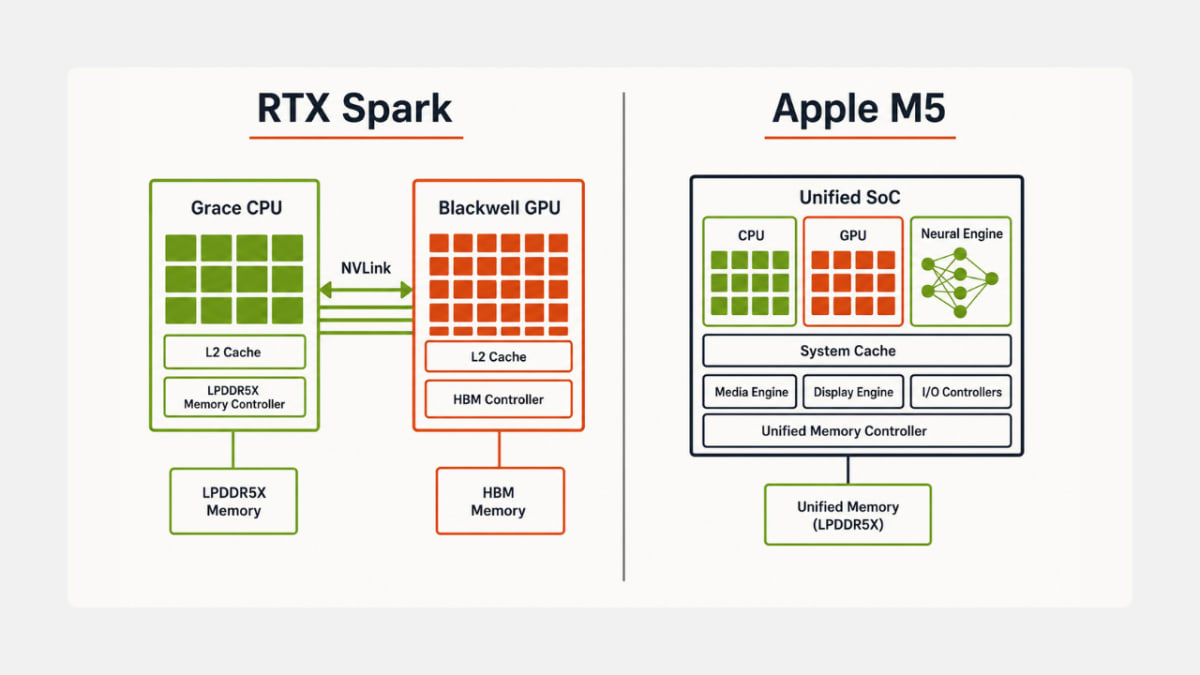
NVIDIA's RTX Spark is a new Arm-based superchip announced in May 2026, combining a 20-core Grace CPU with a Blackwell architecture GPU via NVLink to deliver 1 petaflop of FP4 AI performance locally.
Apple's M5 is the latest evolution of Apple Silicon, a unified SoC architecture released in late 2025 that prioritizes unmatched performance-per-watt and seamless on-device AI efficiency via its Neural Engine.
For two years, my daily driver has been a maxed-out MacBook. It’s quiet, the battery lasts a flight across the Atlantic, and it runs local LLMs reasonably well. But yesterday, I looked at my pre-order for an RTX Spark laptop and realized why I'm leaving Apple Silicon behind. The verdict is straightforward: if you develop AI models, run local agents, or rely on CUDA, NVIDIA's RTX Spark wins. If you want battery life and silence, Apple M5 holds the crown.
The arrival of the RTX Spark marks the end of Apple’s unchallenged reign in the premium developer laptop space. It represents a brutal trade-off that AI builders have been avoiding: raw local CUDA access at the cost of mobility.
Why this comparison matters right now
In May 2026, NVIDIA didn't just announce a chip; they announced a new architecture for the Windows PC. The RTX Spark isn't meant for checking email; it's designed to run 120B parameter models locally. For anyone who has struggled to adapt MLX frameworks on their Mac just to prototype an agent, this release forces a real decision.
Which chip gives you the software ecosystem you need?
For native CUDA compatibility and large model training, the RTX Spark is the only choice.
Apple's M5 is deeply integrated with Metal and MLX. While Apple has made strides—most notably embedding Gemini directly into Apple's foundation models—it remains a walled garden. Most of the AI research world publishes in CUDA.
With the RTX Spark, you are running the exact same software stack (CUDA, TensorRT) locally as you do in the cloud. You don't have to rewrite or compile your PyTorch scripts through a compatibility layer. You get a Blackwell GPU with 6,144 CUDA cores sitting right on your desk.
Which chip actually handles local AI agents better?
For running autonomous agents that consume massive context windows, the RTX Spark's unified memory and raw compute pull ahead.
Apple has always been the champion of on-device AI that actually works, leveraging its Neural Engine for system-level intelligence. But when it comes to developer-grade agentic workflows, throughput matters.
NVIDIA designed the RTX Spark with NVLink-C2C, allowing the CPU and GPU to share up to 128GB of LPDDR5X unified memory with workstation-class bandwidth. It delivers 1 petaflop of AI performance. When you are running a local code assistant parsing a 500K context window while simultaneously running a background embedding model, the M5 Max begins to stutter where the RTX Spark just hums.
Which is better for the traveling developer?
Apple M5 remains entirely undefeated on battery life and thermal efficiency.
This is where the marketing meets reality. NVIDIA claims the RTX Spark will be available in laptops as thin as 14mm with "all-day" battery life. If you believe a 20-core Grace CPU and a Blackwell GPU will sip power while running a 70B model, you are ignoring physics.
If you code in coffee shops, on airplanes, or away from a charger, the Apple M5 is your machine. It provides 80% of the local AI capability for 20% of the power draw. The RTX Spark is a desktop replacement that happens to fold in half.
Where RTX Spark actually wins
The RTX Spark is built for AI engineers, researchers, and serious Cursor power users who want to run heavy local inference without renting cloud GPUs. If your daily workflow involves fine-tuning, training, or running un-optimized open-weights models, this chip gives you a localized data center.
Where Apple M5 actually wins
The Apple M5 wins for 90% of the population, including most software engineers. If your AI usage is API-based, or you only occasionally spin up a local 8B model for quick prototyping, trading Apple's battery life, build quality, and silent thermals for CUDA is a bad deal.
The Bottom Line
I am buying the RTX Spark because my bottlenecks are CUDA compatibility and raw local throughput. But I am keeping my MacBook. If you make your living building AI models, the RTX Spark removes the friction between your local machine and the cloud. Just make sure you sit near an outlet.
FAQ
Will RTX Spark laptops be more expensive than MacBook Pros?
Industry reports indicate RTX Spark base models (N1) will start around $1,799, with flagship models (N1X) exceeding $2,899. This puts them directly in line with Apple's M5 Pro and M5 Max pricing.
Do I really need CUDA on my laptop?
If you are doing web development, no. If you are fine-tuning open-weights models, running local autonomous agents, or developing directly in PyTorch, having native CUDA eliminates the headache of cross-compiling for MLX.