
SpaceX Just Bought Cursor for $60B. The Code War Is Over.
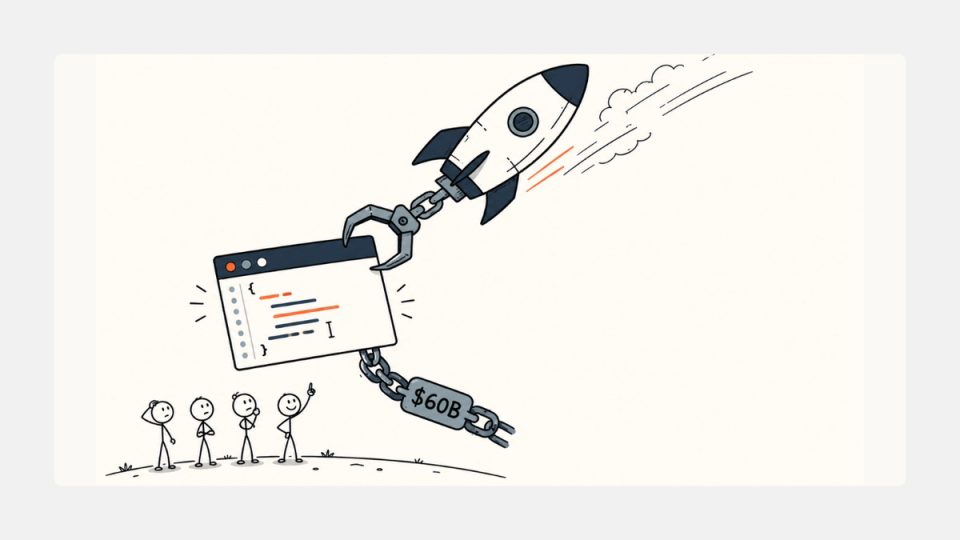
SpaceX announced on June 16, 2026 a definitive agreement to acquire Anysphere, the parent company of AI coding editor Cursor, in an all-stock deal valued at $60 billion. The transaction, expected to close in Q3 2026 pending regulatory approval, will make Cursor a wholly owned subsidiary of the company that already absorbed Elon Musk's xAI division in February.
This is the largest acquisition in developer tooling history. It is also the most honest signal yet about where the real AI war is being fought: not in chatbots, not in image generators, but in the place where code gets written.
What Happened
The deal was not a surprise if you were paying attention. In April 2026, SpaceX and Anysphere signed a partnership agreement that included a baked-in option: SpaceX could either acquire Anysphere outright for $60 billion or pay a $10 billion fee for a collaborative partnership. SpaceX chose the acquisition, days after completing its own record-breaking IPO.
Michael Truell, the 25-year-old CEO and co-founder of Anysphere, confirmed the deal in a statement: the team "looks forward to working with SpaceX to advance our frontier AI capabilities." Under the terms, Cursor's common and preferred stock will convert into SpaceX Class A common stock (SPCX), with the exchange ratio pegged to the volume-weighted average closing price over the seven trading days before close.
The numbers behind Cursor tell a story of velocity that no other developer tool has matched. Anysphere hit $100 million in annual recurring revenue in January 2025. By November 2025, it crossed $1 billion. By early 2026, it passed $2 billion. Mid-2026 estimates put it at roughly $4 billion ARR, with over 7 million monthly active users, more than 1 million daily actives, and penetration in over 50% of Fortune 500 companies.
The valuation trajectory matched: $400 million (Series A, August 2024), $2.6 billion (Series B, December 2024), $9.9 billion (Series C, June 2025), $29.3 billion (Series D, November 2025), and now $60 billion.
Why SpaceX Wants a Code Editor
This is the part the press releases skip. SpaceX is not buying Cursor because it needs a code editor. It is buying Cursor because xAI's Grok model has been losing the code war despite having one of the most powerful compute stacks on the planet. The Copilot vs Claude Code vs Codex vs Antigravity: June 2026 comparison lays out exactly how far behind Grok sits in real developer workflows.
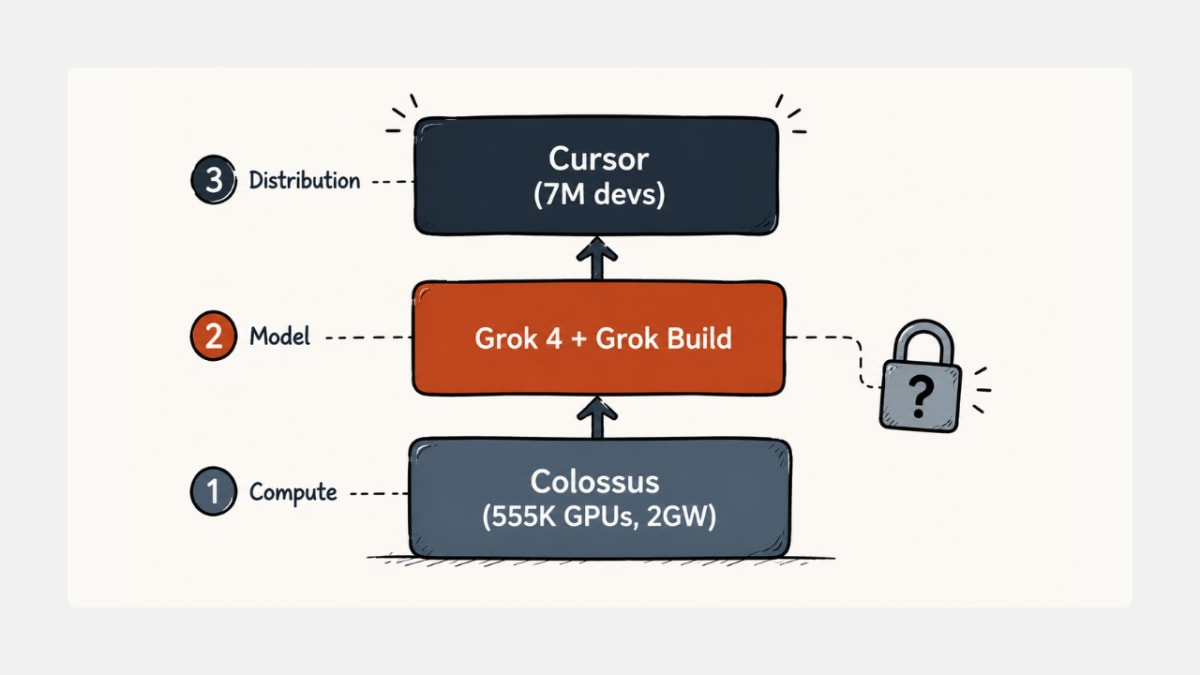
xAI's Colossus supercluster in Memphis houses roughly 555,000 NVIDIA GPUs and draws about 2 gigawatts of power. Grok 4 scores approximately 75% on SWE-bench Verified. Grok Build, launched in May 2026, can spawn eight parallel sub-agents for complex refactors. The infrastructure is serious.
But infrastructure without distribution is a data center burning money. xAI had compute. It did not have developers. Cursor has 7 million of them.
The strategic logic is the same pattern that played out when Anthropic Just Took All of SpaceX's Memphis Compute: Colossus is the weapon, but the weapon needs an application layer. Anthropic leased the compute for model training. SpaceX is now buying the application layer outright.
Does Cursor Stay Model-Agnostic?
This is the $60 billion question, and SpaceX has not answered it directly. Much of Cursor's popularity comes from its flexibility. Developers choose which model runs under the hood: Anthropic's Claude, OpenAI's GPT line, Google's Gemini. Cursor 3 Isn't an IDE Anymore. It's a Control Room. showed how the team rebuilt the entire interface around agent orchestration, and that orchestration layer works precisely because it is not locked to one model.
The developer community has already split on this. Some expect SpaceX to keep Cursor model-agnostic because restricting it to Grok would destroy the product's core advantage. Others see the acquisition as a clear signal that Grok will become the default, with third-party models gradually deprioritized.
History suggests a middle path. When Microsoft acquired GitHub, Copilot initially supported multiple models before gravitating toward OpenAI's GPT line. The multi-model pitch survived in marketing materials long after the product had quietly centered on a single provider.
If SpaceX follows that playbook, Cursor will ship Grok as the default while technically supporting alternatives. The question is whether "technically supporting" means real parity or an increasingly degraded experience on non-Grok models.
Who This Affects
Developers using Cursor today: The short-term risk is low. Cursor will continue operating as a subsidiary, and the deal does not close until Q3 2026. The long-term risk is model lock-in. If you are building workflows that depend on Cursor + Claude or Cursor + GPT, start documenting those dependencies now.
Competitors (Replit, Tabnine, Codeium, Windsurf): The acquisition just opened a window. Every developer concerned about Cursor's independence is shopping for alternatives. The positioning play is obvious: "We're the model-agnostic option." But none of these alternatives has Cursor's adoption numbers or revenue trajectory.
OpenAI and Anthropic: Both just lost a major distribution channel. Cursor was the single largest non-captive surface for Claude Code and GPT-family models in professional coding workflows. The shift mirrors what happened when OpenAI Just Admitted Anthropic Was Right: the competitive dynamics in AI coding are moving faster than any single player can control.
What to Watch For Next
The regulatory process will reveal whether antitrust regulators treat AI developer tools as a distinct market. If the FTC or DOJ scrutinize the deal, it sets a precedent for every future AI tooling acquisition.
Watch for Cursor's model partnership announcements in Q3 2026. If Anthropic and OpenAI renew their integration agreements with Cursor post-acquisition, the multi-model story holds. If those renewals go quiet, the lock-in has started.
The 30-day signal: watch Cursor's pricing page. Any mention of "Grok-powered" tiers or compute credits tied to xAI infrastructure will tell you the integration timeline.
The 90-day signal: watch developer migration patterns. Tools like Codeium and Windsurf will start publishing adoption numbers. If they spike, the market is voting with its feet.
The Bottom Line
SpaceX did not buy a code editor. It bought the largest developer distribution channel in AI coding, and it paid $60 billion in freshly minted public stock to do it. The deal gives xAI what Colossus alone could not deliver: 7 million developers who actually use the product every day.
The real question is not whether the deal closes. It is whether Cursor's defining quality, its model-agnostic flexibility, survives contact with an owner that has its own model to sell.
For developers, the calculus is simple. Keep using Cursor. But start thinking about what you will do if Grok becomes the only model that runs at full speed.
FAQ
When does the SpaceX-Cursor deal actually close?
The acquisition is expected to close in Q3 2026, pending standard regulatory approvals. Until then, Cursor continues operating independently as Anysphere, Inc.
Will Cursor still support Claude and GPT models after the acquisition?
SpaceX has not directly addressed model support post-close. Cursor currently supports multiple model providers, and the company's blog post about the deal did not mention changes to that flexibility. No announcements have been made about restricting third-party models.
How much is Anysphere actually worth?
The deal values Anysphere at $60 billion. For context, the company was valued at $29.3 billion just seven months earlier in its Series D round. Cursor generates approximately $4 billion in annual recurring revenue as of mid-2026.
Who founded Cursor?
Anysphere was founded in 2022 by four MIT classmates, including CEO Michael Truell, who is 25 years old. The company will become a wholly owned subsidiary of SpaceX upon deal close.
What is Colossus?
Colossus is SpaceX/xAI's supercomputing cluster in Memphis, Tennessee. It houses approximately 555,000 NVIDIA GPUs and draws about 2 gigawatts of power. It is one of the largest AI training installations in the world.