
Copilot vs Claude Code vs Codex vs Antigravity: June 2026
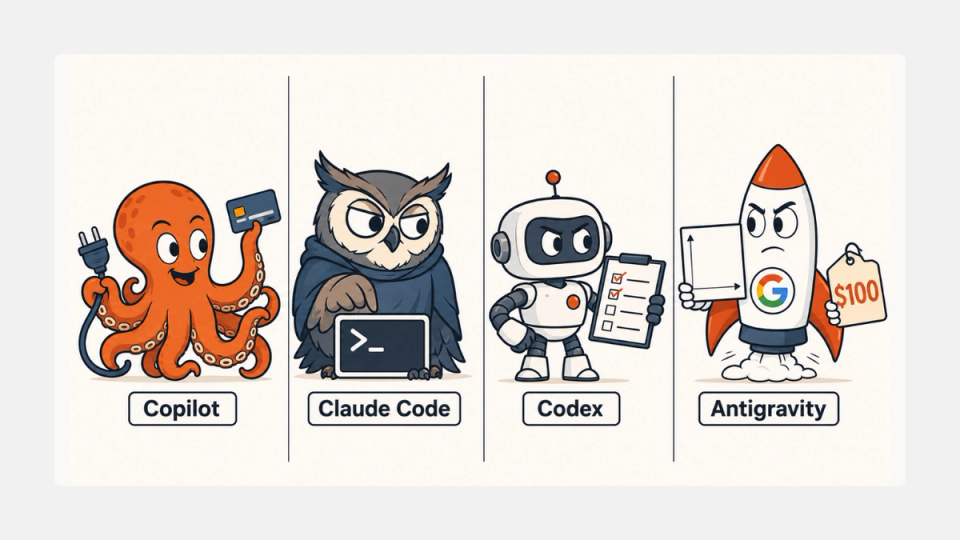
GitHub Copilot is Microsoft and GitHub's AI coding assistant, now rebuilt around the Copilot App — a desktop "command center" for autonomous agentic workflows, powered primarily by GPT-5.5 and optionally Opus-class models on the Pro+ tier. Claude Code is Anthropic's terminal-native coding agent, driven by Claude Opus 4.8, designed for autonomous multi-file tasks with deep codebase reasoning. OpenAI Codex is a standalone desktop app and CLI from OpenAI that orchestrates multi-agent task loops on GPT-5.5, with tight ChatGPT ecosystem integration. Antigravity is Google DeepMind's agent-first development platform, launched as a standalone desktop app in May 2026, running Gemini models and supporting dynamic subagents, scheduled tasks, and artifact-based workflows.
Three months ago, this was a two-horse race. Now every major AI lab has a desktop agent, a credit-based billing model, and a claim to the phrase "autonomous software development." The pricing structures changed the same month: GitHub flipped to AI Credits on June 1, Claude Code separated autonomous credits from subscription on June 15, and Antigravity pulled access behind Google's $100/month AI Ultra plan. The old comparison is stale. Here is where they actually stand in June 2026.
The short answer:
- For solo developers who want the fastest path to a working diff: Claude Code, if you already pay for Claude Pro or have API credits. SWE-bench Pro score of 69.2% is the current ceiling on hard tasks.
- For teams already on GitHub Enterprise: Copilot. The agent orchestration is real, and pooled AI Credits make enterprise pricing manageable for average usage. Bill shock is real if your team ships heavy autonomous workloads.
- For developers building on Google Cloud or Firebase stacks: Antigravity. The "Build with Google" skill bundles and tight GCP integration offset the $100/month AI Ultra sticker price if you are already spending there.
- For parallel agent workloads with OpenAI ecosystem lock-in: Codex Desktop. Cheapest entry point among the four for supervised multi-agent runs.
- If you cannot decide: Start with Claude Code at API pricing. Easiest to evaluate on real work, easiest to switch away from if it doesn't fit.
Why This Comparison Matters Now

Every tool in this comparison changed materially in May or June 2026. GitHub moved Copilot to usage-based AI Credits on June 1, 2026, replacing flat subscription allowances. Anthropic announced autonomous Claude Code tasks will consume a separate credit pool starting June 15, 2026. Google launched Antigravity 2.0 as a standalone desktop app at Google I/O in May 2026. OpenAI continued expanding Codex Desktop access across ChatGPT tiers.
The story these changes tell is the same one: flat-rate AI coding subscriptions are ending. The labs discovered that the gap between a "light user" and an "agentic user" spans three orders of magnitude in token consumption. Metered billing is the response. That changes the calculus for every team making a tool choice right now.
Pricing verified June 2026. Benchmarks current as of June 8, 2026.
Which One Is Cheaper for Real Workloads?
The honest answer: it depends almost entirely on how many autonomous tasks you run per day, not on the headline subscription price.
GitHub Copilot Pro costs $10/month and includes $10 in AI Credits, with unlimited code completions and "next edit" suggestions not counting against credits. Agentic and chat usage draws from the credit pool at $0.01 per credit. Copilot Pro+ is $39/month ($39 in credits, access to premium models). Copilot Max is $100/month with $200 in credits — the only plan that offers a credit-to-price ratio above 1:1.
Claude Code autonomous tasks (starting June 15, 2026) run at full API rates against a separate credit pool: Opus 4.8 costs $5/million input tokens and $25/million output tokens at standard speed. An average autonomous coding task consuming roughly 200K tokens in and 50K out runs approximately $2.25. At that rate, Claude Pro's subscription allowance for agentic use doesn't stretch far for a developer running a dozen tasks per day.
Antigravity is behind Google's AI Ultra plan at $100/month, which includes 5x higher Gemini usage limits and 20TB of storage. If you are not using other Google AI products heavily, the entry cost is high. If you are, the marginal cost of Antigravity access is low.
Codex Desktop runs on ChatGPT plans starting at $20/month (Plus), with higher usage via Pro ($200/month). OpenAI has not yet published per-task token consumption estimates for Codex, which is a gap worth naming: you cannot model your costs in advance the way you can with API-priced tools.
The non-obvious insight here: GitHub Copilot Max ($100/month, $200 in credits) is the only plan where your credit budget exceeds your subscription fee. At roughly $0.005 effective per credit-dollar spent on agentic tasks, it offers better unit economics for high-volume agentic use than Claude Code at API rates for developers running five or more heavy autonomous tasks per day. This is the opposite of the conventional wisdom that "Copilot is cheaper for lite use, Claude is for power users."
Which One Ships the Hardest Coding Tasks?
Claude Code on Opus 4.8 wins on raw task completion quality. It is not close on published benchmarks.
According to Anthropic's published benchmarks (May 28, 2026), Claude Opus 4.8 scores 88.6% on SWE-bench Verified and 69.2% on SWE-bench Pro. GPT-5.5, the model powering Codex and Copilot's agentic tier, scores 58.6% on SWE-bench Pro. That is a 10.6-point gap on the benchmark that most accurately represents real autonomous coding tasks.
Antigravity's Gemini model performance on SWE-bench has not been publicly disclosed for the Antigravity 2.0 product. Google publishes Gemini 3 benchmark scores separately, but does not publish Antigravity-specific agentic benchmarks. That absence is worth flagging: you are buying the platform without a published baseline for the thing the platform exists to do.
Developer sentiment on Reddit in June 2026 consistently favors Claude Code for hard architectural tasks and complex, multi-file refactors. Copilot earns praise for fast, reflex-based completions inside VS Code and Visual Studio, which remain its strongest surface. The emerging pattern: dual-stack workflows where Copilot handles IDE completions and Claude Code handles autonomous tasks.
As one developer noted in an r/MachineLearning thread in June 2026: "I don't think of them as competitors anymore. Copilot is in my editor every second. Claude Code runs when I want something to actually think."
Which One Is Better for IDE vs. Terminal Workflows?
Copilot wins the IDE. Claude Code and Codex win the terminal. Antigravity is building toward both.
GitHub Copilot's core product was always an IDE extension, and the Copilot App desktop launch does not change that. The "command center" experience for orchestrating multiple agents is new and genuinely useful, but the heart of the product remains real-time suggestions in VS Code and Visual Studio. Copilot's "next edit suggestions" feature, which predicts where you will edit next based on prior context, has no equivalent in the other three tools as of June 2026.
Claude Code is terminal-first by design. The Agent View dashboard added a parallel session management interface, but the workflow is fundamentally: open terminal, delegate a task, review the diff. Developers who already live in the terminal find the workflow natural. Developers who live in a GUI IDE find it jarring at first.
As covered in Cursor 3 Isn't an IDE Anymore. It's a Control Room., the broader shift in 2026 is away from IDEs as the primary interaction surface and toward orchestration-layer apps. Copilot, Codex, and Antigravity are all converging on that model. Claude Code was already there.
Antigravity 2.0's standalone desktop app is the most interesting new entrant in this dimension. It sits above the IDE, delegates to subagents, and manages artifacts as first-class outputs rather than incidental files. For developers building on Google Cloud, the Firebase skill bundles make it feel native in a way that none of the other tools achieve on GCP stacks.
Which One Has the Best Agent Configuration System?
Claude Code has the deepest configuration. Copilot has the most approachable defaults.
Claude Code's 29 programmable hook events and Skills marketplace allow fine-grained control over how the agent enters, traverses, and exits tasks. The CLAUDE.md, GEMINI.md, and AGENTS.md instruction files load into context on every interaction — every tool call, every file read, every output is shaped by what you wrote in that file. It is powerful and requires investment to use well.
Copilot's agent skills and MCP server connections are now configurable, and the /chronicle session history feature adds persistent context across sessions. But the configuration surface is smaller. Copilot is engineered to work well for most developers without a dedicated AGENTS.md — a deliberate choice that lowers the barrier to entry but caps the ceiling for teams with highly specific workflows.
Codex relies on AGENTS.md for project-level instructions, similar to Claude Code. Setting up Codex for legacy code migrations requires careful AGENTS.md configuration to get good results — the defaults are loose.
Antigravity's "Build with Google" skill bundles handle much of the configuration for Google-stack projects, but custom configuration beyond those bundles is less mature than Claude Code's hook system.
The Comparison Table
| Dimension | GitHub Copilot | Claude Code | OpenAI Codex | Antigravity |
|---|---|---|---|---|
| Model | GPT-5.5 (Pro+: Opus-class) | Claude Opus 4.8 | GPT-5.5 | Gemini (version unspecified) |
| SWE-bench Pro | ~58.6% (GPT-5.5) | 69.2% | ~58.6% (GPT-5.5) | Not published |
| Entry price | $10/month | API-priced ($5/M in, $25/M out) | $20/month (ChatGPT Plus) | $100/month (AI Ultra) |
| Agentic credits | $0.01/credit, pooled | Separate pool from June 15 | Not yet metered publicly | Included in AI Ultra |
| Primary surface | IDE + Desktop App | Terminal + Agent View | Desktop + CLI + IDE | Desktop App + CLI |
| Best-in-class feature | Next-edit suggestions in IDE | Task completion quality | Multi-agent orchestration | Subagent architecture |
| Weakest point | Bill shock on heavy agentic use | High cost at scale | No published per-task pricing | Gemini benchmark gap |
Pricing as of June 2026.
Where Each Tool Actually Wins
GitHub Copilot wins for enterprise teams on GitHub with moderate autonomous task volume. The AI Credit pooling across an org means one power user doesn't consume the whole budget. The IDE integration is still the best in class. If your team ships in VS Code and uses GitHub Actions, Copilot's agent orchestration feels native rather than bolted on.
Claude Code wins for any developer who needs the agent to actually solve a hard problem unattended. SWE-bench Pro at 69.2% is not a vanity metric — it translates to tasks that the other three tools defer or fail. It also wins for teams that want deep customization of agent behavior via hooks and skills, covered in depth in our Codex vs Claude Code vs Gemini CLI: May 2026 Verdict.
OpenAI Codex wins as the entry point for teams already paying for ChatGPT Pro who want to try desktop agentic coding without a separate subscription. The multi-agent parallel orchestration is real, and the desktop app is the most polished consumer experience of the four.
Antigravity wins for teams building on Google Cloud, Firebase, or using Gemini models already in their stack. The $100/month entry cost is only rational if you are already paying for Google AI products — but for teams that are, the subagent architecture and scheduled task system are features the other three do not yet match.
Where Each Tool Actually Loses
GitHub Copilot loses on cost transparency. The shift to AI Credits has generated significant bill shock complaints on Reddit in June 2026 among teams running heavy agentic workloads. The new pricing model rewards moderation — teams that use autonomous agents aggressively will find the economics worse than Claude Code's API pricing for the same work. New sign-ups for Pro, Pro+, and Max plans were also temporarily paused by GitHub as of June 2026.
Claude Code loses on up-front cost predictability for teams that want flat-rate billing. API-rate billing with a separate autonomous credit pool (starting June 15) means the bill fluctuates with usage. For organizations with compliance or budget approval requirements, "pay per token" is harder to sell than "$X per user per month."
OpenAI Codex loses on pricing transparency. OpenAI has not published per-task token consumption estimates for Codex's agentic mode, making it impossible to model costs before you are committed. The tool may be cheaper than alternatives at scale, or it may be more expensive — there is no way to know from public information alone.
Antigravity loses on benchmark transparency and product maturity. The $100/month price point demands a clear answer to "how good is this at coding tasks?" Google has not provided it for the Antigravity 2.0 product specifically. For more on what Antigravity actually delivers, see Antigravity vs Claude Code: Google IO Changed the Math.
The Non-Obvious Insight
Every tool in this comparison announced metered billing within 60 days of each other. That is not a coincidence. The labs reached the same conclusion simultaneously: autonomous agentic coding is a different product category from chat, and it needs a different cost structure.
The implication for teams making a tool choice today: the safe move is to pick the tool whose pricing model you can actually model in advance. Claude Code at API rates lets you calculate cost per task before you commit. Copilot's AI Credits let you calculate cost per session. Codex is the tool you cannot fully price before you try it — which makes it harder to justify at budget review, regardless of how good the product is.
The Bottom Line
Claude Code is the best autonomous coding agent in June 2026 by published benchmarks, and Copilot is the best embedded IDE tool. The two are no longer in direct competition for the same use case — they cover different surfaces in the developer workflow.
The real decision is whether you are buying a coding agent or a coding assistant. If you want something that runs unattended and ships real diffs on hard problems, Claude Code wins. If you want the fastest next-edit suggestion while you are writing code, Copilot wins.
For teams on Google Cloud, Antigravity is the only tool that feels native. For OpenAI-native teams, Codex Desktop gets you into multi-agent workflows at the ChatGPT Plus price point.
Pick based on your primary pain. The tool you do not pick will still be used by the developer at the next desk — and in 2026, that is not a problem to solve.
FAQ
Is GitHub Copilot still worth it after the June 2026 pricing change?
For light to moderate users, yes. Unlimited code completions remain free of credit charges. If your agentic and chat usage stays within your monthly credit allowance, the economics are the same as before. The problem hits teams running heavy autonomous workloads — for those users, Claude Code at API rates often comes out cheaper for the same volume of agentic tasks.
Does Claude Code work without a Claude subscription?
Yes. You can use Claude Code with API keys directly, billed at API rates ($5/million input, $25/million output for Opus 4.8). A Claude Pro subscription adds interactive use allowances but the autonomous credit pool starting June 15, 2026 is separate from that subscription.
Is Antigravity available without the $100/month AI Ultra plan?
The Antigravity 2.0 standalone desktop app and highest usage tiers are currently gated behind AI Ultra. A legacy Antigravity IDE preview remains available, but priority access to the 2.0 feature set requires the Ultra plan as of May 2026.
Can I use GitHub Copilot and Claude Code together?
Yes, and many developers do. Copilot for real-time IDE completions and Claude Code for autonomous task runs is the dual-stack setup that appears most frequently in developer community discussions in June 2026.
How does OpenAI Codex Desktop differ from the old Codex CLI?
Codex Desktop is a standalone Mac and Windows application with a visual interface for managing multiple parallel agent runs. The CLI still exists but targets headless and CI/CD environments. The desktop app replaces the CLI as the primary consumer interface for interactive agentic work.