
Meta's Zero-Click Search Is Starving Creators
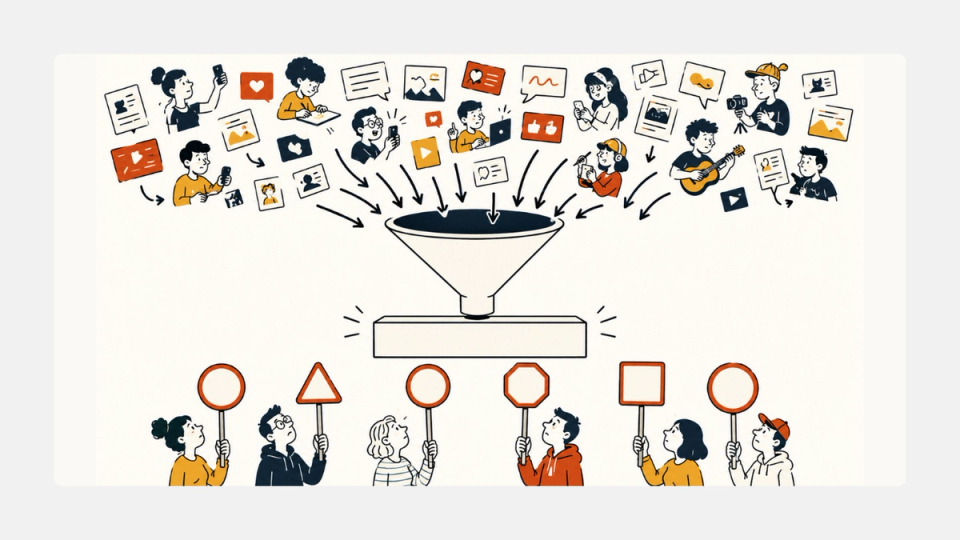
Meta's new AI mode on Facebook pulls public information across its platforms including Instagram, Threads, and public groups to answer user queries directly in the search bar, creating a zero-click environment that bypasses creator profiles entirely.
This matters because Gen Z creators have spent the last three years optimizing for algorithmic discovery across Meta's ecosystem, only to see their content digested and returned without attribution. The shift from Search Engine Optimization (SEO) to Answer Engine Optimization (AEO) isn't just a tactic change; it's a structural reset of how attention flows.
The Quick Answer
What is Meta's new AI mode?
A search interface across Facebook and Instagram that uses Llama 4 to answer questions directly by summarizing public posts, comments, and profile data without requiring a click. Why does it matter? It breaks the traditional traffic contract. Instead of sending users to your profile, Meta's AI absorbs your content to answer the user's question locally. The non-obvious truth: The only way to survive a zero-click ecosystem is to become the named entity the AI relies on, not just the generalized answer it scrapes.
The Foundations
For years, creators built audiences by understanding what the algorithm wanted: engagement, dwell time, and shares. You posted a detailed tutorial on Instagram, the algorithm pushed it to the Explore page, and users clicked through to your profile. You optimized your captions for search, and the platform rewarded you with traffic.
Meta's new AI search feature fundamentally breaks this loop. When a user asks "what are the best indie coffee shops in Austin," the AI doesn't return a list of your reels. It reads your reels, reads the comments, synthesizes the answer, and hands it to the user. No click. No profile visit. No traffic.
Where the Surface Explanations Break
What do most AEO guides get wrong about Meta?
Most advice treats Answer Engine Optimization (AEO) as a simple formatting exercise—use more bullet points, state things plainly, and wait for the AI to cite you. But Meta's implementation doesn't care about your formatting. It cares about your data density. It is executing a massive data grab to feed its models, meaning your content is training data first and an answer second.
Why is zero-click search devastating for early-stage creators?
A zero-click search environment benefits established entities and starves newcomers. If you are already famous, the AI recommends you by name. If you are a new creator sharing actionable advice, the AI strips the utility from your post and discards your identity. This is the exact dynamic we saw when Google introduced conversational search systems like Ask YouTube, now accelerated across social surfaces. As platforms push to keep users in-app, the traditional SEO model of trading information for traffic is dead.
How does this change the way Gen Z creates content?
Gen Z creators are already adapting by moving away from purely informational content toward personality-driven parasocial models. If the AI can answer the "how," the creator must pivot to the "who." We are seeing a massive shift toward long-form, unscripted video and deeply personal storytelling—formats that an LLM cannot easily synthesize into a bulleted list. The goal is no longer to be the best answer, but to be the only source.
The Edge Cases and Breakages
The abstraction leaks when users search for hyper-local, real-time, or deeply subjective information. Meta's AI struggles with the nuance of niche communities. If a user asks a complex question about a highly specific subculture, the AI often hallucinates or returns a homogenized, lowest-common-denominator summary. This is where creators still have leverage. The AI can summarize the consensus, but it cannot generate the contrarian take or the localized insight.
The Honest Take
The reality is that nobody outside Meta knows exactly how heavily Llama 4 weights individual creator data in these real-time summaries. We are inferring intent from product behavior. It is entirely possible that Meta introduces an attribution model later this year to placate angry creators.
We also assume that users want zero-click answers for everything. The data suggests that for high-stakes or deeply personal queries, users still prefer human voices over synthesized text. But for transactional or informational queries, the zero-click loop is already the default behavior.
The Bottom Line
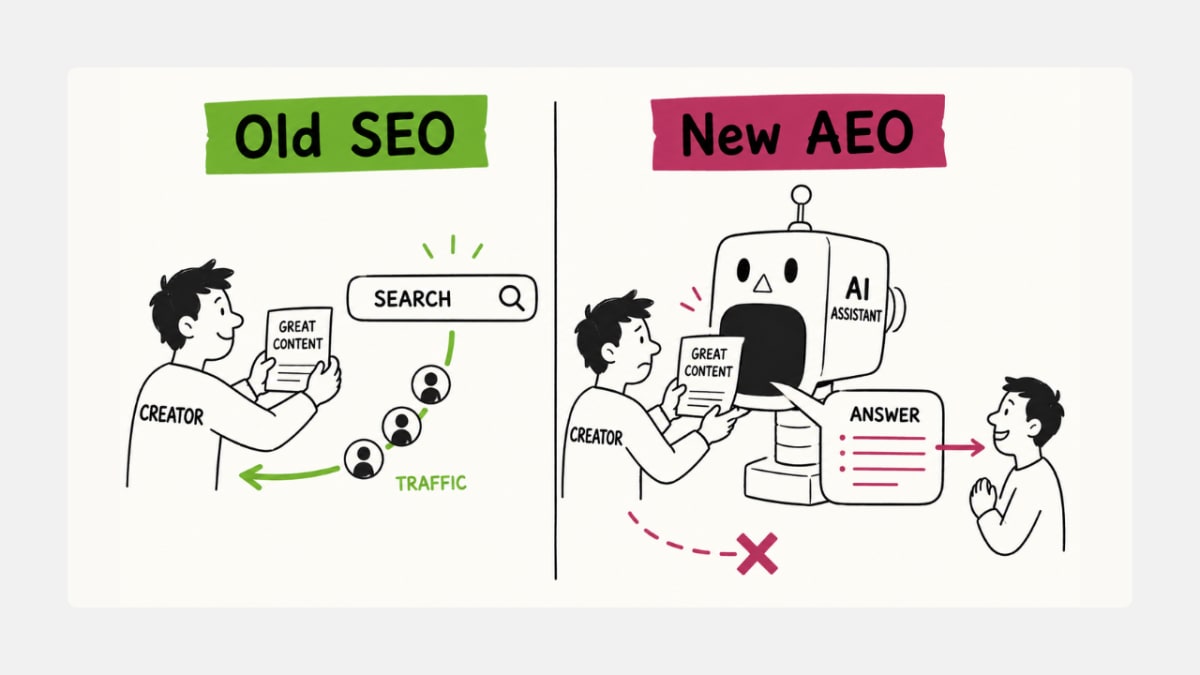
Meta's new AI mode is the final nail in the coffin for purely informational creator content. The shift from SEO to AEO means your content is now raw material for an LLM. To survive, you must stop competing on information and start competing on identity.
FAQ
Is Meta's AI search actually different from Google's AI Overviews?
Yes. While Google summarizes the open web, Meta's AI summarizes its own walled garden. It relies heavily on social graphs and public comments, making the answers more conversational but often less verifiable.
Can creators opt out of having their public info used by Meta's AI?
Currently, if your account is public on Facebook or Instagram, your content is eligible to be scraped. There is no granular opt-out without taking your entire profile private.
When should teams focus on AEO instead of SEO?
Focus on AEO when your target audience is asking direct, informational questions that an AI can summarize. Focus on traditional SEO when the journey requires deep reading or visual evidence.