
AI's New Data Grab: Your Brain, Your Home
The Data Rush Has Gone Physical
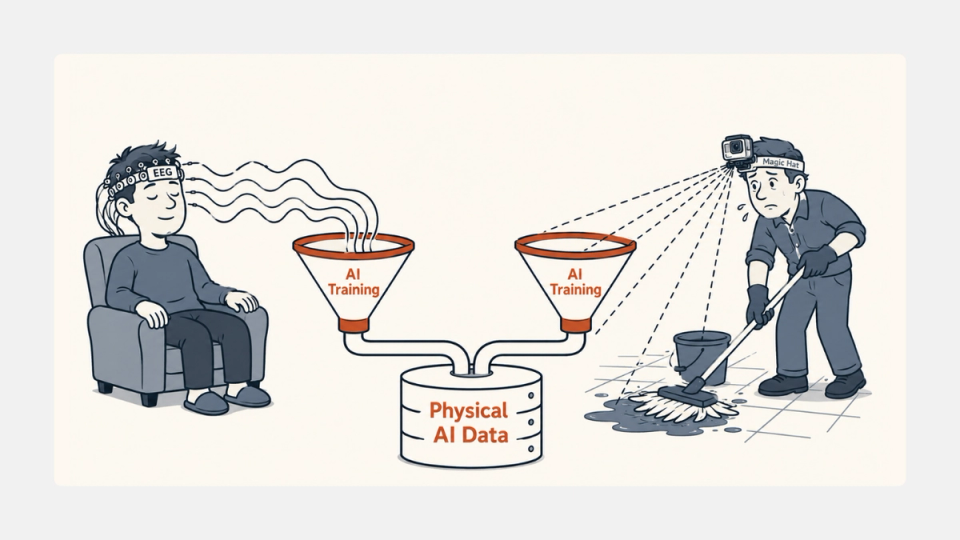
In the last two months, AI companies stopped waiting for users to generate data passively through clicks, searches, and prompts. They started going to the source directly: the inside of your skull and the inside of your home.
Two stories, appearing weeks apart, signal the same underlying reality. Neurotech headbands worn on your head are quietly feeding EEG brain signals to companies building AI-driven cognitive models. A New York startup called Shift, backed by German data firm MicroAGI, offers free professional apartment cleaning in exchange for recording the entire cleaning session on head-mounted cameras. Both are legal. Both involve explicit consent buried in terms of service. And both represent a meaningful escalation in the types of data AI companies are now willing to pay, or subsidize, to collect.
This is not a coincidence. It is a strategy.
What Happened: Headbands Reading Your Brain
Consumer EEG headbands, devices like those sold by Emotiv, Muse (InteraXon), and Neurosity, have existed for over a decade. They sit on your head and measure electrical activity across the scalp to estimate mental states: focus, calm, fatigue, engagement.
What has changed in 2025 and 2026 is what happens to that data once it leaves your head.
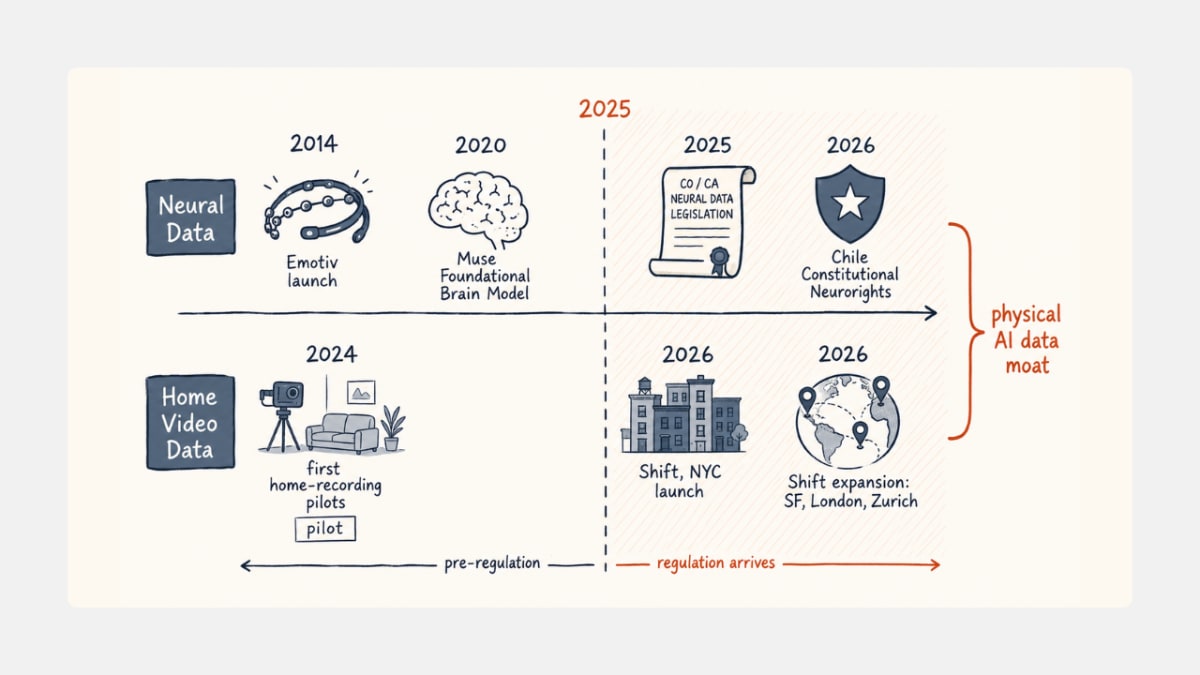
Muse has publicly discussed using its longitudinal EEG dataset, one of the largest of its kind, to train what it calls a "Foundational Brain Model," a transformer-based neural network designed to decode brain activity the way large language models decode text. The company states in its privacy policy that it uses "your data to improve its products and services" and that aggregated, de-identified brain data may be used in research. Emotiv uses similar language: de-identified EEG data is used for scientific research and to train its AI algorithms.
Neither company explicitly states, in plain terms, that purchasing a headband for meditation or focus may contribute to training an AI system. That gap between what is disclosed and what is understood is exactly where regulators are now focusing.
By 2026, California, Colorado, and Connecticut have enacted or updated legislation classifying neural data as sensitive personal information, requiring explicit opt-in consent rather than buried consent-by-use agreements. Chile went further, amending its constitution to protect "neurorights" and taking direct legal action against Emotiv regarding data ownership transparency. The Neurorights Foundation's 2024 survey found that most consumer neurotech companies reserve the right to share user data with third parties for purposes that extend well beyond the product's stated function.
The question is not whether these companies are breaking the law. In most jurisdictions, they are not. The question is whether users understand what they are agreeing to, and whether regulators move fast enough to close the gap.
What Happened: The Startup That Cleans Your Apartment for Your Data
Shift launched in New York City in early 2026 with a straightforward proposition: let us send a vetted professional to clean your apartment, at no cost to you. In exchange, the cleaner wears a head-mounted camera, what the company calls a "magic hat," and records the entire session in first-person video.
The footage is not a home security recording. It is physical AI training data. Shift, backed by German data firm MicroAGI, sells or licenses this footage to companies building humanoid robots and physical AI systems. Per Forbes reporting on the launch, the company believes the value of the training data exceeds the cost of the labor, making the economics work in their favor.
The reason this data is worth that much comes down to a fundamental bottleneck in robotics. Simulated environments cannot replicate the chaos of a real home: the irregular placement of furniture, the variety of textures, the unpredictable behavior of household objects. Robot developers need real-world, first-person footage of manual domestic tasks such as vacuuming, mopping, dishwashing, and organizing. Without it, their models do not generalize. Shift is selling exactly that, and homeowners are willingly inviting the cameras in to avoid paying a cleaning bill.
Shift states that faces, ID cards, screens, and other personally identifiable information are automatically blurred before footage is processed for AI training. The company's terms of service also relieve it of liability for theft, property damage, or personal injury during the cleaning session, a clause that has attracted scrutiny from privacy advocates.
Expansion plans announced by the company include San Francisco, London, Zurich, and Munich. The company has also signaled ambitions to extend the data-collection model into other skilled domestic trades: plumbing, cooking, and home repair.
This is the same service-for-data trade-off that shaped the early internet economy. The new version operates in your living room.
What It Actually Means
Is this brain data really that sensitive?
Yes, and the risk compounds over time. EEG signals are not just metadata about your mood. Research published in multiple peer-reviewed journals has demonstrated that brain signals can encode personal preferences, cognitive biases, political leanings, and susceptibility to certain types of persuasion, none of which is immediately obvious to someone strapping on a meditation headband.
The standard defense from neurotech companies is that data is de-identified. Privacy researchers have pointed out a consistent problem with that claim: brain signals appear to be individually distinctive enough that re-identification from anonymized datasets carries genuine risk, particularly as the AI models trained on those datasets grow more powerful. A model trained on millions of de-identified EEG samples may still be able to match a pattern back to an individual if given enough supplementary context.
This is not a hypothetical. It is why Colorado and California classified neural data as sensitive in the same legislative cycle that covered biometric data. The legislature recognized that de-identification is a process, not a guarantee.
Does Shift's anonymization actually protect homeowners?
Blur filters address the most obvious risk: a stranger watching the footage and recognizing a face or reading a document. They do not address secondary risks. A detailed first-person video of your home's layout, the location of valuables, the daily cleaning routine, and the physical characteristics of your living space constitutes a profile that is worth something to actors beyond robot developers.
What happens to this data if Shift is acquired? What happens if there is a breach? Shift's privacy policy, like those of most early-stage data-focused startups, does not specify retention limits or provide meaningful transfer restrictions in the event of a corporate transaction.
Privacy advocates have also raised the consent quality issue: a digital checkbox during sign-up, combined with terms that most people do not read, is not the same as informed consent. The people most likely to accept a free cleaning service are also those who can least afford to evaluate the risk properly.
As noted in Google Did What Apple Promised: Gemini Intelligence Is the On-Device AI That Actually Works, privacy architecture is now a genuine competitive differentiator in AI products. Shift has no comparable architecture to surface.
The Pattern Behind Both Stories
These two developments are not unrelated. They are both expressions of the same supply constraint.
Training AI on text and images from the internet has, for most domains, hit a ceiling. The models that needed that data have consumed most of what exists. The next frontier, physical AI (embodied systems that navigate and interact with the real world), requires a fundamentally different data type: sensory, spatial, first-person, and contextual. Brain data and home video are both inputs to that frontier, and neither can be synthesized at the quality and scale required.
Meta's B capital expenditure in 2026 is partially a bet on this future: that the company with the best physical and embodied data moat will win the next generation of AI. The robotics thesis is not separate from the data collection thesis. They are the same thesis.
This is also why the "free service for data" model is expanding beyond surveys and search queries. Investors now view proprietary real-world training data as a more defensible competitive moat than model architecture or hardware design. Shift's free cleaning offer is not a customer acquisition strategy. It is a data acquisition strategy.
OpenAI's move to build its own phone follows the same logic at the device layer: the company that controls the ambient data collection surface controls the input pipeline. Headbands and head-mounted cameras in apartments are two versions of the same move.
Who This Affects
For consumers using neurotech devices: Read the privacy policy for the specific phrase "improve our services" or "third-party research." That language typically covers AI training use. If you are in California, Colorado, Connecticut, or the EU, you have explicit rights to request deletion or opt out of data sharing. Exercise them if you care about this.
For enterprise buyers evaluating cognitive monitoring tools: Workplace EEG use, for fatigue monitoring, focus tracking, or attention metrics, introduces a data governance question most procurement teams have not asked yet. Who owns the data the headband generates? Can the vendor use it to train models? If those questions are not in the contract, assume the answer is "we do" and "yes."
For anyone considering Shift or similar services: The cleaning is real. The anonymization is partial. The terms of service relieve the company of most liability. Make the calculation accordingly. If your home's spatial layout, daily routine, and physical environment feel private to you, this trade-off is not worth a free cleaning.
For the robotics and physical AI industry: The data-for-service model is going to attract regulatory attention at the same velocity as the technology itself advances. Companies building on Shift-style data pipelines should expect state-level legislation to arrive before their products do.
What to Watch For Next
The neurotech regulation cycle is now synchronized with broader AI privacy legislation. Watch for federal-level action in the United States during 2026's second half: several bills currently in committee treat neural data, biometric data, and behavioral data under the same umbrella, which would functionally require opt-in consent across all three categories.
On the physical data side, the city of New York has indicated it is reviewing whether home-recording operations require local business licensing or disclosure to building management. San Francisco's city council, which Shift has listed as its next expansion target, has a history of preemptive tech regulation. Shift may face local ordinances before it can expand.
The broader watch-for: when a major humanoid robot company, Figure AI, 1X Technologies, or a comparable player, formally discloses a data partnership with a service-for-data provider like Shift, that disclosure will mark the moment the industry acknowledges the pipeline rather than obscuring it. That disclosure has not happened yet.
The Bottom Line
Two things are true simultaneously. Neurotech companies and physical AI startups are collecting genuinely valuable, deeply personal data through arrangements that are technically consensual but practically opaque. And the regulatory infrastructure to govern this is lagging 12 to 24 months behind the practices.
The headband you bought to sleep better and the free cleaning you accepted because the alternative cost are both data collection events for AI systems you will likely never interact with directly. That is not inherently wrong. It is, however, worth knowing.
As the security implications of AI data inputs become clearer across the stack, the question of what goes into these models upstream will matter as much as what comes out downstream.
FAQ
What brain data do EEG headbands actually collect?
Consumer EEG headbands measure electrical activity across the scalp using 4 to 32 sensors depending on the device. The raw signal captures oscillations across frequency bands (alpha, beta, theta, gamma) that correlate with cognitive states like focus, relaxation, drowsiness, and stress. More advanced analysis can infer emotional valence, workload, and, in research settings, certain cognitive preferences. Muse uses 4 sensors; Emotiv's research-grade devices go up to 32.
Does Shift actually blur everything sensitive in the footage?
Shift states that its system automatically blurs faces, ID cards, screens, and personal documents before footage is used in AI training. Independent verification of this claim has not been published. The blur is applied pre-training, not pre-capture, meaning the raw footage is briefly unprocessed before the anonymization pipeline runs. Shift's privacy policy does not specify retention limits for the raw (pre-blur) footage.
Which states have the strongest neural data protections?
As of June 2026: Colorado (Biometric Identifier Protection Act, updated 2025), California (Consumer Privacy Act plus neural data addendum), and Connecticut (Data Privacy Act). Chile is the only country with constitutional-level neurorights protection. The EU's GDPR does not have a neural data carve-out but treats biometric and health data as special categories requiring explicit consent.
Is there a safe way to use neurotech devices without contributing data to AI training?
Look for devices that offer a "no-training" guarantee and that explicitly state user data is not shared with third parties or used for model improvement. Neurosity's Crown is marketed as developer-first with local data control via SDK, though its privacy policy permits de-identified aggregate use. No major consumer EEG brand currently offers a blanket opt-out from all AI training use. Pricing as of June 2026.