
How to Implement AEO for Your Site

Answer Engine Optimization (AEO) is the practice of structuring your content so that AI-powered systems like Google AI Overviews, ChatGPT Search, and Perplexity can read, extract, and cite your site as a trusted source. It is not a new layer on top of SEO. It is a different set of instructions for a different kind of reader: one that is a machine assembling an answer, not a human scanning a list.
The reason this matters right now: AI-generated answers have pushed click-through rates down by 34% to 61% on queries where AI Overviews appear. At the same time, traffic that does come through AI-cited sources converts at up to 4x the rate of traditional organic search. The volume shrinks. The quality of each visit goes up. That shift is already happening, and sites that have not restructured their content for machine readability are losing ground.
The thesis here is simple. The actions that earn AI citations are specific, technical, and learnable fast. Most sites skip 90% of them.
The Quick Answer
What is AEO?
AEO is the process of making your content easy for AI search engines to extract, summarize, and cite. Where SEO targets human readers clicking links, AEO targets AI models pulling passages for generated answers.
Why does it matter?
AI engines now handle a significant share of search queries. If your content is not structured for AI retrieval, you do not get cited, even if you rank on page one of Google.
The non-obvious truth: Traditional top-10 Google rankings are no longer a guarantee of AI citation. Studies show that 44% to 75% of URLs cited by AI engines do not appear on the first page of Google results. Structure and clarity matter more than rank.
The Foundations
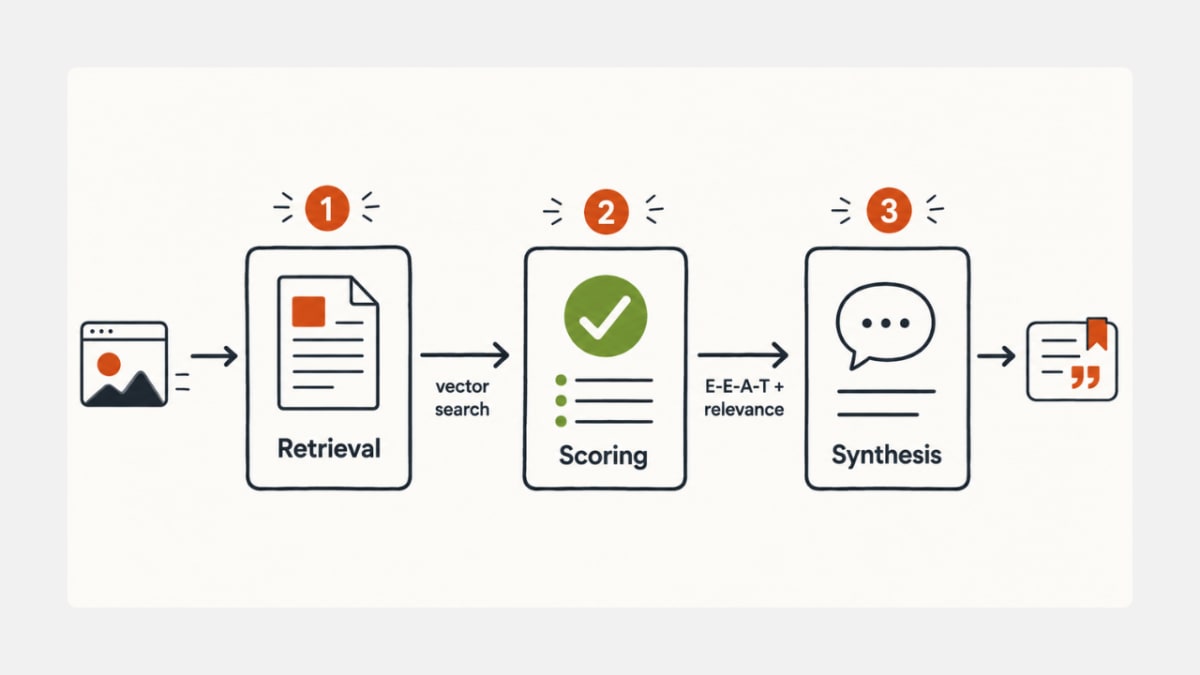
AI search engines do not rank pages. They retrieve passages. The process works in three stages. First, the system encodes your content into vectors and retrieves relevant passages from its index. Second, it scores those passages using signals like topical consistency, E-E-A-T (Experience, Expertise, Authoritativeness, Trustworthiness), and how well the passage directly answers the query. Third, it writes a response and inserts citations where it can link a claim to a specific source.
That third step is the one most sites miss. An AI model only cites a source when it can point to a specific, extractable claim. A 3,000-word essay with no clear structure gives the model nothing to grab. A 300-word section that opens with a clean question and a 50-word direct answer gives it exactly what it needs.
This is why AEO implementation is mostly about structure, not volume.
What does "answer-first" formatting actually mean?
Answer-first formatting means that every section of your article opens with a direct, complete answer before expanding into detail. The answer appears in the first 40 to 60 words under a question-shaped heading.
This is the single most cited content shape across AI engines, according to BrightEdge and Princeton GEO research. AI models are trained to extract the most direct answer to a query, and they look for it at the top of each section. If your paragraphs build to a conclusion, the model never waits around for it.
Here is what it looks like in practice. Write an H2 like: "How long does AEO take to work?" Then write the answer in the next 2 sentences: "Most sites see measurable changes in AI citation within 4 to 12 weeks of restructuring their content. The speed depends on how often AI engines re-index your domain." Then go deeper. That is the pattern.
One practical rule: if you cannot state the answer in under 60 words, the section is not focused enough. Split it.
How do you add structured data for AEO?
Structured data is the machine-readable layer that tells AI engines what type of content you have, who wrote it, and what questions it answers. Without it, the model has to infer context from plain text. With it, the model reads a clear signal.
Three schema types matter most for AEO:
FAQPage schema is the highest priority. Add it to any page that contains question-and-answer blocks. It explicitly marks up question-and-answer pairs so AI engines can extract them directly. According to frase.io, FAQPage schema is one of the most critical signals for AI answer extraction in 2026.
HowTo schema applies to step-by-step guides. It tells the model the sequence of your instructions and what each step accomplishes. This is relevant for this article.
Article schema provides context about the author, the publication date, and the organization. This feeds into E-E-A-T signals, which is how AI models evaluate whether your site is trustworthy enough to cite.
Here is a minimal FAQPage schema block in JSON-LD:
{
  "@context": "https://schema.org",
  "@type": "FAQPage",
  "mainEntity": [
    {
      "@type": "Question",
      "name": "What is AEO?",
      "acceptedAnswer": {
        "@type": "Answer",
        "text": "AEO is the practice of structuring content so AI search engines can extract and cite it."
      }
    }
  ]
}
Paste this in a <script type="application/ld+json"> tag inside the <head> of your page. Validate it with Google's Rich Results Test before publishing.
What technical checks does AEO require?
AEO sits on top of SEO fundamentals. If your site has crawl issues, AI engines cannot index it. A site that AI cannot read cannot be cited. These are the checks worth running first:
Crawlability. Check that robots.txt does not block AI crawlers like GPTBot, PerplexityBot, or Google-Extended. By default, many WordPress security plugins and CDN configs block unknown bots. Review the list in your server logs.
Server-side rendering. AI engines do not wait for JavaScript to run. If your page content loads via JavaScript after the initial HTML response, AI crawlers see a blank page. Move critical content into the initial HTML. If you are on Next.js, App Router's server components handle this correctly by default. As covered in How to Set Up Claude Code for Real SEO Work, AI-native tooling increasingly handles this at the framework level.
Page speed. AI crawlers time out. A page that takes more than 3 seconds to return HTML puts you at risk. Run a quick check with Lighthouse or Google's PageSpeed Insights. Fix your largest contentful paint (LCP) if it is above 2.5 seconds.
Last modified signals. AI engines favor fresh content. The dateModified field in your Article schema should update every time you meaningfully revise a page. Do not update it for typo fixes. Do update it when you add new data or rewrite sections.
How do you build topical authority for AEO?
Topical authority means your site covers a subject in enough depth that AI engines trust it as a reliable source, not just on one page, but across many. A single well-optimized article will not override a weak domain. A cluster of 10 to 20 tightly linked articles on the same subject will.
The structure that works: one hub article that covers the full topic at a high level, supported by spoke articles that go deep on each sub-question the hub raises. Every spoke links back to the hub. The hub links out to each spoke. AI engines read this graph and weight your domain higher for the topic.
For AEO specifically, the ideal cluster looks like:
- One explainer on what AEO is
- One guide on structured data implementation (this article)
- One piece on AEO measurement and tracking
- One piece on AEO vs SEO differences
- One piece on AI-specific content strategy
This is the same internal linking logic described in How Ask YouTube Actually Works (And Who It Breaks). AI answer systems read content clusters the same way: depth signals authority.
You do not need to build the whole cluster before starting. Begin with the hub. Each subsequent article strengthens the signal.
How do you measure AEO results?
Standard analytics do not track AI citations directly. A user who got your answer from a Google AI Overview and then typed your URL manually shows up as direct traffic. A Perplexity citation that drove a click shows up as referral. Most teams are flying partially blind.
Here is what to track today:
Brand mentions in AI responses. Use tools like Ahrefs Brand Radar, Peec AI, or manual spot-checks: ask ChatGPT, Perplexity, and Google relevant questions and look for your domain in the citations. Do this weekly. According to diggrowth.com, citation patterns shift fast: 40 to 60% of AI-cited sources rotate monthly.
Referral traffic from AI sources. In Google Analytics 4, check referral sources for perplexity.ai, chat.openai.com, and bing.com/chat. These will undercount because of direct attribution issues, but trends matter more than exact counts.
Conversion rate by source. Filter sessions by AI referral sources and compare conversion rate to organic. AI-referred users should convert at a higher rate. If they are not, the content that earned the citation does not match what the user actually needs.
Search Console impressions. AI Overviews pull from the Google index. Pages earning AI citations typically show in Search Console as featured snippet winners first. Track featured snippet share for your target queries.
Avoid vanity metrics here. The How to Automate Marketing Reports With AI Prompts piece has more on building measurement workflows that distinguish signal from noise in AI-era analytics.
The Honest Take
This guide treats AEO as a learnable, implementable process. That is accurate but incomplete. A few limits to hold alongside it.
The citation logic is opaque. Google, OpenAI, and Perplexity do not publish the specific weights their models assign to structured data, freshness, or domain authority. What we know comes from reverse-engineering citation patterns at scale. The rules will shift. A tactic that earns citations today may stop working in six months without any announcement.
The platform split is real and inconvenient. Only 11% of domains are cited by both ChatGPT and Perplexity, per platform comparison research. Optimizing for one does not guarantee visibility on the other. Until a cross-platform standard emerges, expect to do platform-specific audits.
The accessibility of AEO favors established domains. If your site is new, lacks backlinks, or has thin E-E-A-T signals, structured data alone will not get you cited. AI engines weight authority heavily. The foundational SEO work is not optional because AEO is available. It is required first.
The Bottom Line
AEO is not a replacement for SEO. It is an extension of it, with a different primary reader. The steps are:
- Restructure every key section to open with a question heading and a direct 40 to 60 word answer.
- Add FAQPage, HowTo, and Article schema to relevant pages.
- Check that AI crawlers can access your content (no blocking in robots.txt, no JS-only rendering).
- Build a content cluster around your core topic, not just a single article.
- Track AI citations weekly and watch for rotation shifts.
None of this requires a tool subscription or an agency. It requires restructuring how you write and adding a JSON-LD block to each page. Start with your highest-traffic article and apply the pattern. Then move to the next. The sites already doing this are pulling AI citations on queries where their Google rankings are nowhere near page one.
Frequently Asked Questions
Is AEO only for big sites?
No. AI engines pull from the full index, not just high-DA domains. A small, well-structured site on a specific topic can outperform a large site with generic content. The advantage goes to clarity and topical depth, not domain age.
Does AEO work without fixing SEO first?
Not reliably. AI engines use the Google index as a base. If Google cannot crawl your site, AI engines usually cannot either. The technical foundations (crawlability, speed, indexation) apply to both.
Which AI engine should I optimize for first?
Optimize for Google AI Overviews first, since it draws from the largest index and serves the most queries. Then audit Perplexity, which has different citation logic and favors structured, recent, community-sourced content.
How often should I update content for AEO?
Update pages with new data every 90 days at minimum. AI engines track the dateModified signal in schema. Pages not refreshed within 90 days are roughly 3x more likely to lose AI citations, per gen-optima.com research.
Does social media presence help with AEO?
Not directly. AI engines do not read social signals into citation decisions. Brand authority built through backlinks, original research, and expert quotes feeds E-E-A-T, which does influence citation likelihood.
What is the difference between AEO and GEO?
GEO (Generative Engine Optimization) is a broader term covering all optimization for generative AI outputs. AEO is a subset focused specifically on structured content that earns citations in AI-generated answers. The terms overlap and are often used interchangeably in 2026.
Can I track AEO without paid tools?
Yes. Manual spot-checks in ChatGPT, Perplexity, and Google cover the basics. Google Search Console tracks featured snippets, which often predict AI Overview inclusion. Free tier of Ahrefs has limited Brand Radar access. Paid tools speed up the process but are not required to start.