
Ideogram Opens the Vault: 4.0 Is Free to Run
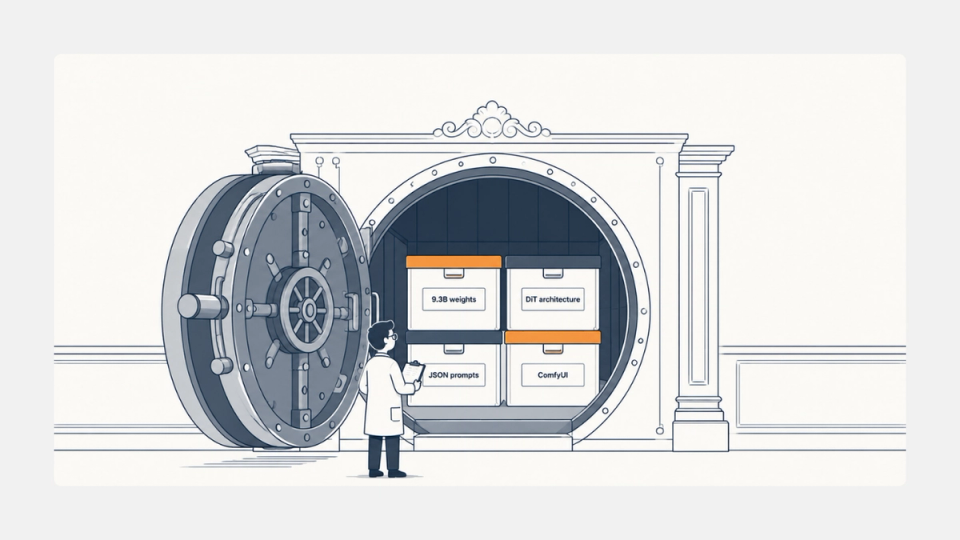
On June 3, 2026, Ideogram released the weights for Ideogram 4.0, a 9.3-billion-parameter Diffusion Transformer trained from scratch, making it free to download, fine-tune, and run on your own hardware. Every prior Ideogram model since the company launched out of stealth in August 2023 was proprietary and closed. This one is not.
That shift matters more than the model specs. The specs are already impressive. The shift in strategy is the real story.
The Ideology That Got Here First
There is a belief, held quietly by a specific type of AI researcher, that the best creative tools eventually have to be open. Not open as a PR move. Not open as a way to win developers who would never pay for an API anyway. Open because creative work requires iteration that no SaaS pricing model can fully accommodate. Because the fine-tuned workflows that solve real production problems live at the intersection of a model's weights and a team's specific dataset, not inside a chat interface.
I've watched image generation evolve from Stable Diffusion's raw but open foundations to the closed dominance of Midjourney, DALL-E, and Firefly. Each time a closed model pulls ahead on quality, the community fragments: some users migrate to the polished product, others dig into open weights and extend them into territory the original team never imagined. The open path is messier. It is also, consistently, more durable.
Ideogram's founders know this history. Mohammad Norouzi, William Chan, Chitwan Saharia, and Jonathan Ho built their careers at Google Brain, where they contributed to the foundational diffusion model research that the entire current generation of image generators is built on. They left to do it better. For three years they did it quietly, behind a closed API, building what critics called a typography moat: the ability to render legible, accurate text inside generated images, a problem that had embarrassed every other model on the market.
Now they're handing the moat to the community.
What Happened
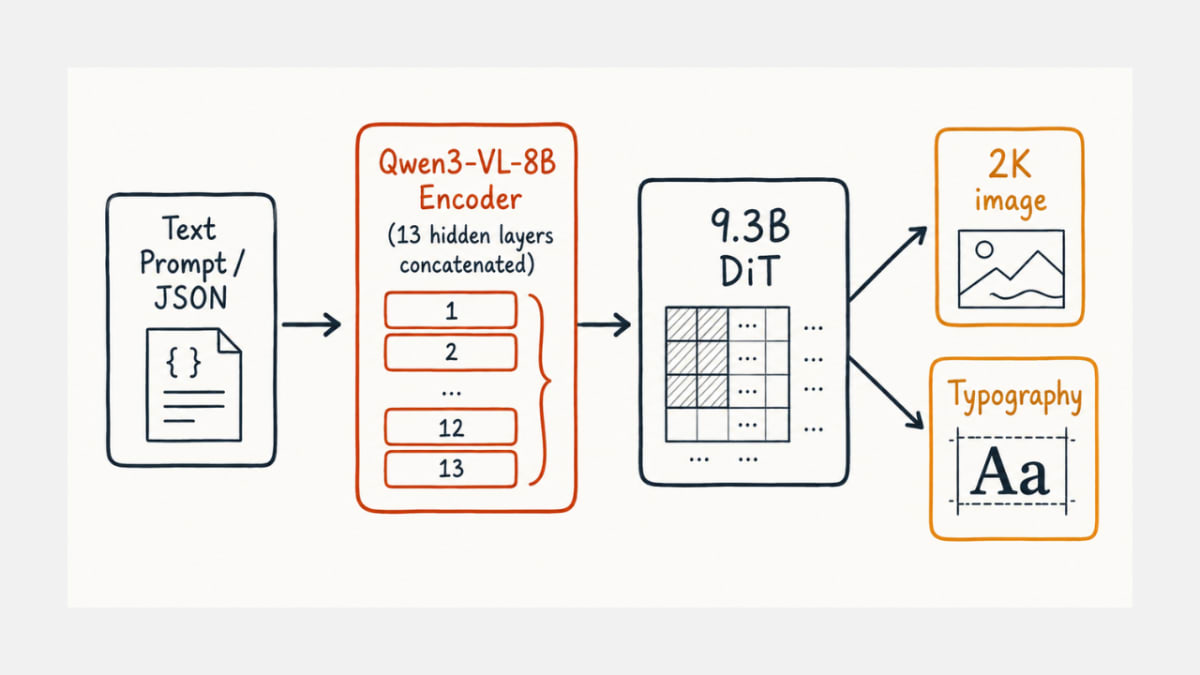
Ideogram released Ideogram 4.0 on June 3, 2026, via Hugging Face (gated access, available in nf4 and fp8 quantized variants) and GitHub (inference code under Apache 2.0). The model is a 9.3B single-stream Diffusion Transformer. Its text encoder is not CLIP or T5, the standard choices for this architecture class. It is Qwen3-VL-8B-Instruct, a vision-language model, with hidden states concatenated from 13 intermediate layers. That architecture choice is significant: it gives the model richer spatial and semantic understanding than a text-only encoder can deliver.
Day-zero support in ComfyUI means the community can run it in the same pipelines they already use for FLUX, HunyuanDiT, and SD3. That is not an accident.
The licensing structure is dual-track:
- Non-commercial: Research, evaluation, and personal projects under the Ideogram Open Model Agreement.
- Commercial: A separate license is required for production or client-facing use. Pricing is not publicly disclosed as of June 5, 2026.
The weights are not fully permissive. Ideogram is not giving away its commercial advantage. They are giving researchers, fine-tuners, and local-gen enthusiasts the thing they actually want: the ability to run and adapt the model. The commercial gate is clear and expected.
What Makes It Different
Does it actually beat larger models on text rendering?
Yes, and the margin is not close for its size class. In the ContraLabs Typography Evaluation, a blind study run by professional designers, Ideogram 4.0 was chosen as the best-performing model 47.9% of the time. The next closest was Gemini 3.1 Flash and FLUX.2 [max], a 32B model. Ideogram 4.0 runs at 9.3B parameters. It also outperforms HunyuanImage 3.0, an 80B Mixture-of-Experts model, on text rendering benchmarks.
On DesignArena, it immediately ranked first among all open-weight models and ninth overall, trailing only closed proprietary models from OpenAI and Google. ChatGPT Image 2.0 and Google's image tools hold the top closed-source positions, but the gap is now visible and measured.
What does JSON prompting actually give you?
Structured JSON prompts are the feature that separates Ideogram 4.0 from every other open model in this space. Instead of writing a flat text prompt, you specify bounding boxes for layout, exact hex color palettes, object positioning, and text placement as structured data. The model interprets it as spatial constraints, not suggestions.
For anyone building Google's AI image and video pipelines, programmatic layout control over an open-weight model is a meaningful unlock. Automated ad creative pipelines, localized content at scale, branded asset generation with color enforcement — these workflows require precision that a text prompt alone cannot guarantee.
Native 2K resolution generation is included. Not upscaled. Generated.
Who This Affects
Independent creators and local-gen enthusiasts: This is the most straightforwardly good news for this group. A top-tier typography model, runnable locally, with ComfyUI support from day one. The only question is whether your GPU has the VRAM headroom. The nf4 quantized variant is the practical starting point for consumer hardware.
Fine-tuners and researchers: Ideogram 4.0 offers something rare in the image generation space: a high-performing base model with architecture transparency. If you are training a domain-specific model on your own data, having access to weights from a model that already handles typography and layout at this level is a significant head start. The Qwen3-VL backbone is a documented choice you can reason about, not a black box.
Agencies and studios building automated pipelines: The JSON prompting interface is the unlock here. Programmatic layout control at generation time, combined with open weights and no per-call API cost, changes the economics of high-volume asset generation. The commercial license requirement is the variable to check before committing a production stack to it.
Competitors: The open-weights release by Ideogram does what PewDiePie's Odysseus open-source AI workspace did for the LLM interface space two weeks ago: it signals that the commoditization pressure on closed tools is real. Midjourney, Adobe Firefly, and DALL-E now have to compete with a model the community can extend, fine-tune, and price at infrastructure cost. That is a different kind of pressure than a competing API.
What to Watch For Next
Ideogram has not disclosed commercial licensing pricing as of this writing. That number will determine whether the "use it in production" story is actually compelling for studios and agencies, or whether it becomes the research-community model that feeds fine-tuned variants into ComfyUI pipelines.
The community response on Hugging Face and ComfyUI forums in the first 72 hours will reveal whether the architecture is as extensible as it looks on paper. Multimodal text encoders in diffusion models are relatively new; the fine-tuning behavior on custom datasets is not yet documented.
Watch for Midjourney's response. The company has been the dominant closed creative tool for three years and has never released weights. If Ideogram 4.0 gains real adoption in professional workflows, the pressure on Midjourney to either match quality or justify its closed moat will intensify.
The 30-day signal to watch: community fine-tunes on Civitai and Hugging Face. If the model produces a meaningful set of fine-tuned variants in the first month, Ideogram has successfully seeded a developer ecosystem. If it does not, the weights are technically available but practically inert.
The Bottom Line
Ideogram 4.0 open-sourcing its weights is not a surprise move from a company that has run out of options. It is a confident one from a team that spent three years building something worth opening. A 9.3B model that outruns 80B competitors on typography, with a structured JSON prompting interface, ComfyUI support on day one, and architecture decisions that are transparent enough to build on, is a meaningful contribution to the open image generation ecosystem.
The closed API is still there for teams that want managed inference. The weights are now there for everyone else. Ideogram is betting that giving the latter group what they want is how you win the former group's trust.
That bet has worked before.
Frequently Asked Questions
Can I use Ideogram 4.0 for commercial projects?
Not under the default non-commercial license. A separate commercial license is required for production or client-facing use. As of June 5, 2026, Ideogram has not publicly disclosed commercial pricing. Contact them directly at ideogram.ai for terms.
How does Ideogram 4.0 compare to FLUX.2 dev on typography?
In the ContraLabs Typography Evaluation blind study, Ideogram 4.0 was preferred by professional designers 47.9% of the time, outperforming FLUX.2 [max] (a 32B model) despite running at 9.3B parameters. On DesignArena it ranked first among all open-weight models.
What hardware do I need to run Ideogram 4.0 locally?
The nf4 quantized variant is the most accessible starting point for consumer GPUs. Exact VRAM requirements depend on resolution and batch size. The model is supported in ComfyUI from day one, which includes community-maintained memory optimization workflows.
Why does Ideogram use Qwen3-VL instead of CLIP or T5 as a text encoder?
Qwen3-VL-8B-Instruct is a vision-language model that captures richer spatial and semantic relationships than a text-only encoder. Ideogram concatenates hidden states from 13 intermediate layers to give the DiT backbone more precise layout and typography guidance at generation time.