
How to Train a Small Language Model for Your Niche
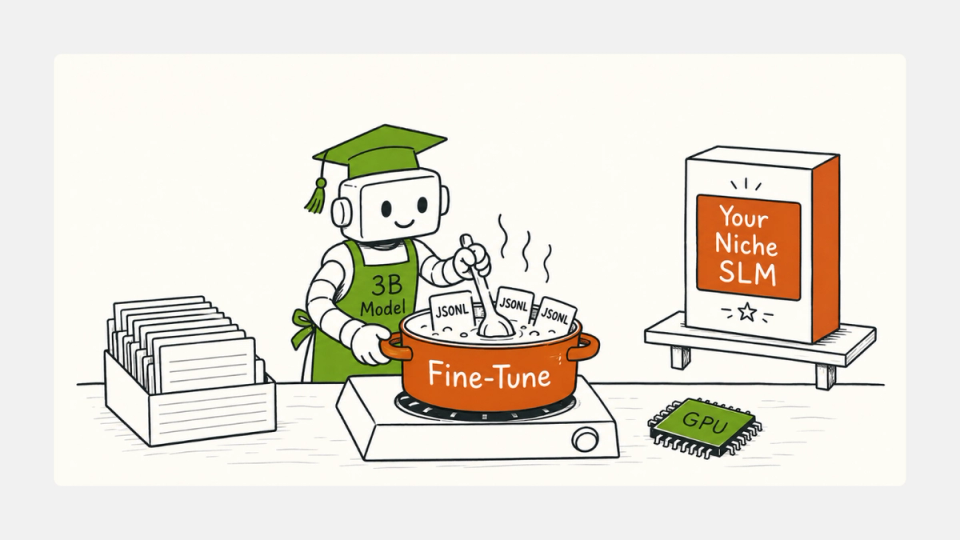
Small language models (SLMs) are transformer-based language models typically ranging from 1 billion to 8 billion parameters, designed to be fine-tuned and deployed on constrained hardware rather than served from a hyperscaler data centre.
The conventional wisdom in 2026 is that bigger models win. That is wrong for 70% of production use cases. A fine-tuned 3B model running on a single GPU often beats a frontier model on a narrow, repetitive task, costs a fraction of the API bill, and never sends your users data to a third-party server. The SLM-first strategy is not a budget compromise. It is the correct architecture for most real applications.
This piece covers what SLMs actually are, where they beat large language models, and exactly how to fine-tune one for your specific niche. Last updated May 2026.
The Quick Answer
What is an SLM?
A language model small enough to fine-tune on a single consumer GPU and deploy locally. Current examples: Microsoft Phi-3.5 Mini (3.8B), Qwen2.5-1.5B, Gemma 3-1B. Same transformer architecture as GPT-4, much smaller weight count.
Why does it matter?
For tasks with clear boundaries — intent classification, entity extraction, domain-specific Q&A, structured output generation — a fine-tuned SLM running at 400+ tokens per second locally will outperform a general-purpose frontier model queried over an API at 60 tokens per second.
The non-obvious truth: The performance gap between SLMs and LLMs is an artifact of training data distribution, not parameter count. Fine-tune an SLM on 1,000 high-quality domain examples and you remove that gap for the specific task you care about.
What Is an SLM, Actually?
SLMs are not a different architecture from LLMs. They are the same decoder-only transformer design that powers every major language model, scaled down and trained with different data mixes. The line between SLM and LLM is fuzzy in the research literature, but the working definition in 2026 is models below 10 billion parameters that can run inference on a consumer GPU with 8-16 GB of VRAM.
The class that matters for this article:
- Microsoft Phi-3.5 Mini — 3.8B parameters, trained on 3.3 trillion tokens with a heavy emphasis on synthetic reasoning data. Runs in 4-bit quantization on an 8 GB GPU.
- Qwen2.5-1.5B and 3B — Alibaba's open-weight series, strong on structured output and long-context tasks, available under Apache 2.0.
- Gemma 3-1B and 4B — Google DeepMind's smallest production-grade models, designed explicitly for on-device deployment.
- Mistral 7B — still the fine-tuning community's workhorse for anything needing strong general reasoning at minimal cost.
These are not toys. Phi-3.5 Mini scores 69.0 on MMLU, competitive with models 10x its size trained two years ago. The architectural efficiency gains — better data curation, synthetic training data, grouped-query attention — mean today's 4B model is roughly as capable as a 2023-era 30B model on reasoning benchmarks.
The piece on how Gemini Omni actually works under the hood covers the architectural shifts that made this possible across the industry.
Where the Surface Explanations Break
Do SLMs actually outperform GPT-4 on niche tasks?
Yes, on narrow tasks with clear boundaries, routinely. Domain-specific SLMs fine-tuned on healthcare, legal, and financial datasets have shown accuracy parity or superiority over general-purpose frontier models on structured extraction, regulatory compliance checks, and diagnostic support tasks. The ceiling is not parameter count — it is training data distribution.
The mechanism is straightforward. A frontier model trained on the general web has seen millions of topics in millions of registers. It has no strong prior for your specific domain's vocabulary, output format, or decision rules. A 3B model trained on 1,000 curated examples of your exact task develops a very strong prior for that task. The frontier model is generalist by design. You want a specialist.
The DeepSeek V4 vs Opus 4.7 vs GPT-5.5 cost comparison illustrates why the cost argument compounds: when you run your own model, you pay hardware once, not per-token forever.
Why does fine-tuning beat prompting for domain mastery?
Prompting a frontier model to behave like a domain specialist is an approximation. Fine-tuning is a structural change. When you fine-tune with LoRA (Low-Rank Adaptation), you inject small trainable weight matrices into the model's attention layers, updating roughly 0.1-1% of total parameters. The model's prior — its entire pre-training distribution — acts as a regulariser. You shift it toward your domain without overwriting the general reasoning capacity.
The practical difference: a prompted GPT-4 will occasionally revert to generic patterns when inputs are ambiguous. A fine-tuned SLM has learned your domain's specific output format as a strong prior. For structured outputs, classification, and extraction tasks, this is the difference between 85% and 98% task accuracy.
RAG (Retrieval-Augmented Generation) solves a different problem. Use RAG when the information you need is dynamic and changes faster than fine-tuning cycles. Use fine-tuning when the task structure, output format, and domain vocabulary are stable.
When does the SLM advantage break down?

Three failure modes are worth naming plainly.
Complex multi-step reasoning. Tasks requiring the model to hold and manipulate more than 3-4 reasoning steps, especially across domains, still favour larger models. A 3B model solving a multi-constraint scheduling problem will fail where GPT-4 succeeds. Know the complexity ceiling of your task before committing to SLM.
Out-of-distribution inputs. A fine-tuned specialist fails gracefully on in-distribution inputs and fails badly on out-of-distribution ones. If your users will occasionally ask general questions your training set did not cover, you need a router or a fallback to a larger model. Google's local AI pattern shows how this router architecture is already shipping in consumer products.
Low-data regimes with high output diversity. Below roughly 200 training examples, fine-tuning on diverse open-ended outputs tends to underfit. If you cannot generate or curate at least 500 high-quality examples of your task, SLM fine-tuning is not the right move yet.
How to Fine-Tune an SLM for Your Niche
This section is the practical guide. You can run the entire pipeline on a single RTX 3090 (24 GB VRAM) or on a RunPod instance costing roughly $1-2 per hour.
Step 1: Define Your Task Precisely
Before touching code, write one sentence that completes: "My model takes [input] and returns [output] in the format [format]." If you cannot write that sentence, you are not ready to fine-tune.
Examples of well-defined tasks:
- "My model takes a customer support ticket and returns a JSON object with intent, urgency, and suggested_response fields."
- "My model takes a legal clause and returns a one-sentence plain-English summary plus a risk rating of 1-5."
- "My model takes a product description and returns structured SEO metadata in JSON."
Vague tasks produce fine-tuned models that understand nothing better than the base model.
Step 2: Build Your Dataset
Quality over quantity is correct. For niche tasks, 500-2,000 high-quality examples routinely outperform 10,000 noisy ones. The dataset shape that works:
{"instruction": "Classify the sentiment of this review", "input": "The checkout process was confusing and the item arrived damaged.", "output": "Negative"}Format your data as JSONL with instruction, input, and output fields. This maps directly to the prompt templates that Phi-3, Qwen, and Mistral expect.
Four practical data sources:
- Existing business outputs from your CRM, ticketing system, or annotated documents.
- Synthetic generation via GPT-4 from a small seed set, with human quality review.
- Human annotation for tasks where GPT-4 does not know your domain well enough.
- Public datasets on Hugging Face Hub for legal (LexGLUE), medical (MedQA), and financial NLP tasks as supplementary data.
Always hold out 10-20% of your data as a validation set.
Step 3: Choose Your Base Model
For most niche fine-tuning in 2026, the decision is:
| Use case | Recommended base |
|---|---|
| On-device / edge deployment | Phi-3.5 Mini (3.8B) or Gemma 3-1B |
| Structured JSON output | Qwen2.5-3B |
| Strong general reasoning plus domain | Mistral 7B |
| Long-context documents | Qwen2.5-7B |
All are available on Hugging Face Hub under Apache 2.0 or MIT-equivalent licenses.
Step 4: Set Up Your Environment
Install the core stack: transformers, peft, trl, bitsandbytes, accelerate. For faster training and lower VRAM usage, add Unsloth — it cuts training time by 2-4x on Nvidia GPUs through kernel-level optimisations.
Step 5: Run QLoRA Fine-Tuning
QLoRA is LoRA plus 4-bit quantisation of the base model weights. The base model loads in 4-bit (roughly 2 GB for a 3.8B model), while the LoRA adapter weights train in full precision. You get a fine-tuned model for the VRAM cost of running inference on the base.
Key parameters: LoRA rank (r) of 8 for simple classification, 16 for generation tasks. Learning rate of 2e-4 as a starting point. Two to four epochs for most tasks — more epochs on small datasets cause overfitting.
A 3.8B model on 1,000 examples takes roughly 30-60 minutes on an RTX 3090. On an A100 on RunPod, under 10 minutes.
Step 6: Evaluate Before You Deploy
Evaluate on your held-out validation set using task-specific metrics. For classification: F1 score, not accuracy — accuracy hides class imbalance. For structured output: JSON parse success rate. A model that generates syntactically valid JSON 99% of the time is deployable. One at 85% is not.
Dataset quality issues are responsible for roughly 80% of fine-tuning failures.
Step 7: Merge and Deploy
Merge the LoRA adapter back into the base model weights and export. For local deployment, Ollama wraps your model in a local API that accepts the same request format as OpenAI's API, so you can swap endpoint with a one-line change. For edge deployment, export to GGUF format with Q4_K_M quantisation for under 2 GB.
Google's on-device AI strategy shows where this deployment pattern is heading at scale.
The Edge Cases and Breakages
Catastrophic forgetting is real but manageable. When you fine-tune on a narrow dataset, the model can lose general capabilities. The mitigation: use LoRA not full fine-tuning, keep your training dataset diverse enough to include paraphrases and edge cases, and evaluate on general benchmarks alongside your task metrics.
Prompt format mismatch breaks everything. Each base model expects its own prompt template. Phi-3 uses a specific format, Qwen uses ChatML, Llama variants use yet another. Always use the apply_chat_template() method from the Hugging Face tokenizer — it applies the correct format automatically.
VRAM spikes kill training runs. Peak VRAM during training is higher than during inference. Use gradient checkpointing to trade compute for memory — roughly 30% longer training time for about 40% VRAM reduction.
The Honest Take
The fine-tuning pipeline described above works. But three things are harder than the tutorials suggest.
Dataset curation is the bottleneck, not the training code. Generating 1,000 good examples of your task is a week of work, not an afternoon. Synthetic generation via GPT-4 sounds like a shortcut, but it requires careful prompt engineering and significant human review to catch the 10-15% of outputs that drift from your format spec.
Deployment consistency between training and inference is fragile. The model you evaluate in a Python script is not identical to the model behind your Ollama API if there are quantisation differences, prompt format differences, or sampling parameter differences. Build evaluation tests that run against the deployed endpoint, not just the raw model.
The router pattern is harder to build than the fine-tuned model itself. If you are combining an SLM for simple cases with a frontier LLM for complex ones, the router requires its own dataset, its own evaluation, and its own maintenance cycle.
The Bottom Line
A frontier LLM is the right choice for tasks you cannot define precisely, tasks requiring broad cross-domain reasoning, or tasks where you lack training data. For everything else — which is most production workloads — a fine-tuned SLM is faster, cheaper, more private, and often more accurate.
The pipeline is not exotic: QLoRA on a consumer GPU, 500-2,000 curated examples, SFTTrainer, Ollama for local deployment. The hard part is the dataset. The tooling is mature.
Start with the smallest model that could plausibly solve your task. Fine-tune it. Evaluate it honestly. Deploy it. If it fails at the complexity ceiling, build a router to a larger model for those cases. That architecture — as OpenAI admitted when it adopted Anthropic's own safety playbook — is where production AI is going regardless of which lab you follow.
Frequently Asked Questions
What is the minimum dataset size to fine-tune an SLM?
For classification and structured extraction tasks, 200-500 examples can produce usable results if quality is high. For generation tasks requiring diverse outputs, aim for at least 1,000. Below 200 examples on any generative task, fine-tuning will underfit and few-shot prompting is the better option.
Can I fine-tune an SLM without a GPU?
Yes, on small models. Phi-3.5 Mini in 4-bit quantisation can be fine-tuned on Google Colab's free T4 GPU (16 GB VRAM) for datasets under 1,000 examples. For larger datasets, a RunPod RTX 3090 at roughly $0.44 per hour is the cheapest practical option.
How is fine-tuning different from RAG?
Fine-tuning modifies the model's weights to encode task structure, output format, and domain vocabulary as a prior. RAG retrieves external documents at inference time to ground outputs in current information. Fine-tuning wins when task structure is stable. RAG wins when your knowledge base changes frequently. They compose: a fine-tuned SLM with RAG is a common production pattern.
What is LoRA and why not full fine-tuning?
LoRA adds small trainable weight matrices to attention layers instead of updating all weights. Full fine-tuning a 7B model requires roughly 60 GB of VRAM and risks catastrophic forgetting. LoRA achieves comparable task performance while training less than 1% of total parameters, fits on a consumer GPU, and preserves the base model's reasoning capacity.
How do I know when my fine-tuned SLM is good enough to deploy?
Define acceptance criteria before training. Run the model against 50-100 held-out examples it has never seen. If it meets your criteria consistently, deploy. If it fails on more than 10% of examples, investigate whether the failures are systematic before retraining.
Should I use Phi-3, Qwen, or Mistral as my base?
Phi-3.5 Mini for on-device or resource-constrained environments. Qwen2.5-3B or 7B for structured JSON output or long-context documents. Mistral 7B for the strongest general reasoning at 7B scale. For most classification and extraction tasks, start with Phi-3.5 Mini.
How long does fine-tuning take?
On a single RTX 3090: 30-90 minutes for a 3B model on 1,000 examples at 3 epochs. On free Colab T4: 2-4 hours. On an A100 via RunPod: under 20 minutes. The training run is not the bottleneck — dataset preparation and evaluation are.
Can I commercialise a fine-tuned SLM?
Depends on the base model license. Phi-3.5 Mini, Qwen2.5, and Gemma 3 permit commercial use of fine-tuned derivatives without royalties. Llama 3 requires a separate commercial license above 700 million monthly active users. Always read the model card on Hugging Face before committing to a base model for a commercial product.