
How to Use X's Official MCP for SEO Research
The quick answer
X now ships an official hosted MCP server for its API and a separate hosted MCP server for its docs, which means AI clients can call X endpoints and read X documentation without you having to build a custom wrapper first (X MCP docs, Agent Resources). That matters for SEO because X is still one of the fastest places to see language shift in public: phrasing, objections, repeated questions, emerging entities, and news-shaped demand.
What is X's official MCP?
It is a first-party MCP layer from X with two hosted endpoints: https://api.x.com/mcp for X API actions and https://docs.x.com/mcp for documentation lookup, both documented in X's own developer docs (X MCP docs).
Why does it matter for SEO?
It turns X from a tab you manually scan into a queryable signal source inside your AI workflow, which is useful for topic discovery, query framing, and social listening, especially when paired with editorial judgment and a structured content backlog.
The non-obvious truth: the edge is not "let the model do SEO." The edge is using MCP to compress research time while keeping human control over thesis, source validation, and publication standards. Last updated June 2026.
The foundations
MCP itself is an open-source standard for connecting AI applications to external systems, tools, and workflows, so the basic idea here is not X-specific (MCP introduction). What is new is that X is no longer just another API you have to wire up yourself. Its docs now expose a dedicated MCP page, an AI tools page, llms.txt, llms-full.txt, skill.md, a docs MCP endpoint, and an API MCP endpoint as first-party resources (Agent Resources, X MCP docs).
That official packaging matters more than it sounds. It reduces setup ambiguity, gives you a supported path for authentication, and makes X legible to agentic tools in the same way OpenAPI made REST APIs legible to client generators. It also means the real SEO question changes. We are no longer asking, "Can I force an agent to scrape X?" We are asking, "How should I use live social data inside a repeatable editorial system?"
That distinction is exactly why this piece sits closer to How to Set Up Claude Code for Real SEO Work and How to Implement AEO for Your Site than to generic prompt-hack content. The workflow is not about replacing a strategist. It is about giving a strategist faster access to raw public language.
Why is X's official MCP actually useful for SEO research?
X's official MCP is useful for SEO research because it gives an AI client direct access to the same fast-moving language layer that search demand often follows: live posts, trends, news, user conversations, and archive search. It is best used to surface signals, not to write final conclusions for you.
The official X MCP page says the hosted server can search posts, look up users, fetch trends and news, and even work with bookmarks and Articles, all through your account permissions (X MCP docs). X's broader developer overview also frames the platform around real-time global data, posts, users, and trends, with pay-per-use pricing on the API side (X Developer Platform overview).
For SEO, that creates three practical advantages.
First, it helps you find phrasing before the SERP fully settles. Search data is usually lagging or aggregated. X is messy, but it often reveals the language people are using while a topic is still forming. That is valuable for title testing, FAQ capture, objection mapping, and identifying what the audience thinks the story is.
Second, it gives you better raw material for answer-engine content. If your goal is to publish pages that can be cited by AI systems, you need to know the exact questions, framings, and entity pairings users are already reaching for. That connects directly to How to Implement AEO for Your Site, because answer-first formatting works better when the answer is built from real demand language rather than guessed keyword variants.
Third, it is useful as an input to analysis workflows, not a replacement for them. Think of it as the front end of the pipeline. The back end is closer to How to Automate Marketing Reports With AI Prompts: cluster what you found, compare it with site performance and Search Console data, decide which signals are real, and then turn those into content decisions.
There is also a strategic reason to care now. X's MCP docs page was last modified on June 30, 2026, which is a strong freshness signal that this is an actively maintained first-party path, not an abandoned experiment (X MCP docs). At the same time, the current site already has almost no deep content on X as an agent-readable research source. That makes this article a cleaner niche bet than trying to rank for broad head terms like "what is MCP" or "AI SEO tools."
What does the setup look like in practice?
The setup is straightforward once you understand the split: app-only Bearer auth is the fast read-only path, while the xurl mcp bridge is the full user-context path with OAuth 2.0 PKCE and token refresh. For most SEO research, start read-only and only add the bridge when you need user-context tools.
X documents two routes.
The simple route is direct app-only Bearer auth. X's getting-started guide shows the standard Bearer-token flow for API requests, and the MCP page says clients that support remote MCP with custom headers can point directly at https://api.x.com/mcp using an Authorization header (Make Your First Request, X MCP docs). That is the fastest way to validate that the workflow is useful.
{
  "mcpServers": {
    "xapi": {
      "url": "https://api.x.com/mcp",
      "headers": {
        "Authorization": "Bearer YOUR_APP_ONLY_BEARER_TOKEN"
      }
    }
  }
}
The fuller route is the local xurl mcp bridge. X explicitly recommends the open-source xurl bridge because X OAuth requires your own developer app, does not offer dynamic client registration here, and the hosted MCP endpoint does not advertise native MCP OAuth discovery. The bridge handles OAuth 2.0 login, injects fresh Bearer tokens, and keeps stdout clean for JSON-RPC traffic (X MCP docs).
The practical setup flow is:
- Create an X app with OAuth 2.0 enabled in the developer portal.
- Register
http://localhost:8080/callbackas the redirect URI unless you are overriding it. - Copy
CLIENT_IDandCLIENT_SECRET. - Make sure Node.js is installed.
- Run the bridge via
npxor an installedxurlbinary.
npx -y @xdevplatform/xurl mcp https://api.x.com/mcpIn Cursor, for example, X's docs show an MCP config that passes CLIENT_ID and CLIENT_SECRET into the bridge (X MCP docs):
{
  "mcpServers": {
    "xapi": {
      "command": "npx",
      "args": ["-y", "@xdevplatform/xurl", "mcp", "https://api.x.com/mcp"],
      "env": {
        "CLIENT_ID": "YOUR_X_APP_CLIENT_ID",
        "CLIENT_SECRET": "YOUR_X_APP_CLIENT_SECRET"
      }
    }
  }
}
If your goal is SEO research, keep the first workflow narrow. Ask the model to pull repeated user questions around a topic, compare trend phrasing across a few related entities, or assemble a candidate list of language patterns worth checking against Search Console. Do not ask it to decide what your content strategy is. Let it propose; make it justify; then validate externally.
What should X MCP replace, and what should it not?
X MCP should replace slow manual scanning, scattered tab-hopping, and one-off copy-paste research sessions. It should not replace source validation, editorial prioritization, or your judgment about whether social chatter reflects real search demand, brand fit, or commercial intent.
This is the line most teams miss. They either underuse MCP as a novelty demo, or they overuse it as a strategy oracle. The better model is a layered workflow.
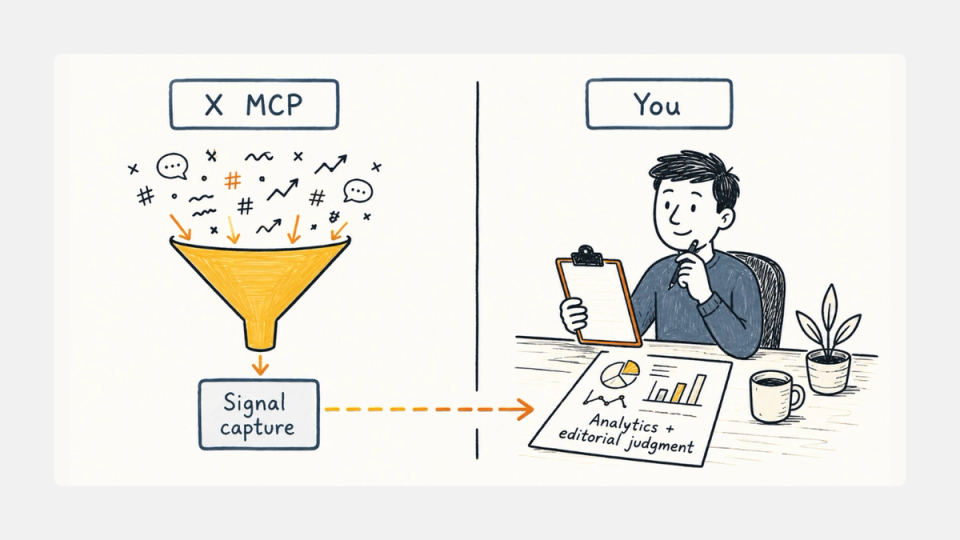
Use X MCP for signal capture: emerging phrases, recurring questions, creator complaints, launch reactions, product confusion, and language variants.
Use your analytics stack for validation: Search Console, site search, CRM notes, revenue data, support tickets, and historical content performance.
Use human editorial strategy for synthesis: what thesis is worth owning, what can actually rank, what fits your authority, and what deserves a landing page versus a reaction post.
That is also why Meta's Zero-Click Search Is Starving Creators matters here. In a zero-click environment, chasing raw attention signals is not enough. You need a workflow that turns distribution signals into durable owned assets.
Where should you stop trusting the model?
You should stop trusting the model the moment the task shifts from retrieval and summarization into authorization, interpretation, or irreversible action. MCP is excellent at connecting systems, but the protocol's own documentation and independent security research both make it clear that access and tool safety still require careful boundaries.
The official MCP security guidance spends significant time on proxy-server risks, consent boundaries, and the need for proper per-client consent, CSRF protection, signed cookies, and redirect-uri hygiene (MCP security best practices). That is a reminder that "official MCP" does not mean "safe by default in every client configuration."
Invariant Labs went further in April 2025, publishing a security notification about tool poisoning attacks against MCP-based systems (Invariant Labs). You do not need to become paranoid to use X MCP well, but you do need a rule set:
- Keep SEO workflows read-only by default.
- Separate research servers from write-capable publishing systems.
- Require source citations for claims that could shape your article thesis.
- Treat trend summaries as leads, not conclusions.
- Review prompts and server scopes the same way you would review API keys and production permissions.
The strategic version of the same warning is simpler: social data has a recency bias. It overrepresents what is loud, not always what compounds. If you let a model optimize only for what is hot on X today, you will produce thin reaction content instead of durable search assets.
The honest take
The first limit is that X is not search demand. It is a public conversation layer. Sometimes those overlap beautifully. Sometimes they do not. A spike in posts can tell you what people are talking about, but not whether the topic will sustain organic traffic or convert.
The second limit is that official tooling lowers friction, not complexity. X's hosted MCP server and docs server make access cleaner, but the real work still lives in scoping, validation, and editorial judgment. If your team does not already have a content operating system, MCP will accelerate noise as easily as signal.
The third limit is that security and permissions still matter. Official docs, OAuth, and a hosted endpoint are helpful, but they do not remove the need to think carefully about bridge software, account scopes, and what an agent should be allowed to do unattended. For SEO teams, the safest win is usually insight retrieval, not automated execution.
The bottom line
X's official MCP is real, useful, and timely. It gives SEO teams a first-party way to pull live language, trends, and conversation data directly into AI workflows through hosted X and docs MCP servers (X MCP docs, Agent Resources). That is enough to make it a meaningful research tool.
But it is not your strategy.
Use it to collect signals faster. Use your analytics and editorial brain to decide what deserves a page. If you treat X MCP as a research accelerant instead of an autopilot, you get the upside that matters: faster insight extraction, cleaner topic discovery, and better alignment between what the market is saying and what your site should publish next.