
Figma Config 2026: What's Actually Coming
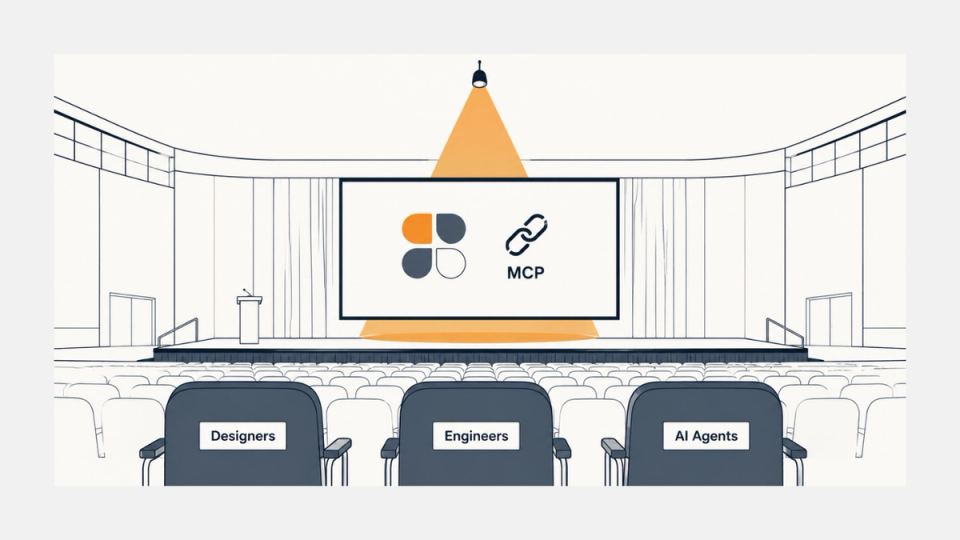
Figma Config 2026 runs June 23–25 at the Moscone Center in San Francisco, and Figma has said almost nothing specific about the keynote. That is intentional — Config is the company's biggest annual stage, and the reveal is the point.
But Figma has not been quiet. The company has shipped faster in the past 12 months than in any previous year: Figma Sites, Figma Make, Figma Draw, Figma Buzz, and the Grid layout system all launched at or after Config 2025. The product roadmap is legible if you read the signals instead of waiting for the press release.
This article argues one thesis: the headline features at Config 2026 will not be the flashiest AI prototyping demos. The strategic centerpiece will be Figma's bet on MCP as the connective layer between design and engineering — and that bet has implications far beyond the Figma canvas.
What the Config 2025 launches actually meant
Six new products at one conference sounds like product sprawl. It was not. Config 2025 established a single thesis across all six launches: Figma is no longer a design tool. It is a design operating system.
Figma Sites let designers ship production websites without leaving Figma. Figma Make let them generate UI from a prompt. Figma Draw expanded the vector toolset to include expressive illustration. Figma Buzz handled branded asset scaling across channels. Grid gave layout a more flexible, responsive model.
Taken individually, each is a feature. Taken together, they answer the question Figma has been building toward for four years: what happens when the handoff between design and code disappears?
The answer is not that designers become developers. The answer is that the boundary between the two gets replaced by a continuous AI-assisted loop — and Figma's model context protocol integration is the technical mechanism making that loop real.
What is MCP, and why is Figma's bet on it the biggest story at Config 2026?

Model Context Protocol is an open standard that lets AI agents interact with external tools — design files, codebases, APIs — through a structured protocol rather than ad-hoc integrations. Figma adopted MCP in early 2026 and it changed what "design-to-code" actually means.
Before MCP, design-to-code meant exporting CSS properties and hoping your developer could translate them. After MCP, AI agents running inside Cursor 3 or Claude Code can read the live Figma canvas — design tokens, component structure, auto-layout constraints — and generate code that actually respects the design system.
The reverse is also true. Engineers can use those same agents to create components on the Figma canvas from existing code, keeping design and code in sync without a manual handoff meeting.
This is not a prototype feature. Teams at Vercel, Linear, and Stripe have reported using the Figma MCP server in their production workflows as of Q1 2026. The vendor does not publish usage data, but the GitHub repo for Figma's MCP server accumulated over 4,000 stars in three months — which, for a developer tooling project, is a strong signal.
At Config 2026, expect Figma to make this the headline infrastructure story: MCP as the standard plumbing for the design-to-engineering loop, with concrete case studies from enterprise teams who have already shipped it.
Why Figma Make will not stay a prototyping toy
Figma Make launched at Config 2025 as an AI prototyping tool: generate interactive layouts from a prompt. The demo was compelling. The production reality was messier — generated code was often layout-correct but design-system-blind, producing components that didn't match the actual token set.
That gap is closing. With the MCP integration, Make now has access to the full design system context — variables, tokens, component properties — when generating. The difference between Make in May 2025 and Make in June 2026 is the difference between a capable autocomplete and a system that understands the design language.
At Config 2026, Figma will almost certainly show Make generating production-ready components that slot directly into the design system rather than approximating it. The demo will probably involve a real enterprise design system — the kind with 300 components and strict brand rules — to signal that this works at scale, not just in a clean sandbox.
This matters for product teams beyond the prototyping workflow. If Make can generate design-system-compliant UI from a prompt, the shortest path from idea to production-ready design gets compressed by a significant factor. Teams running AI coding agents for complex work already feel this compression on the code side. Config 2026 is where the design side catches up.
What the State of the Designer data signals
Figma's State of the Designer 2026 report — released ahead of Config — includes a striking number: 91% of designers now use AI tools weekly, up from 38% in the equivalent 2024 survey. That is not incremental adoption. That is a category shift happening at the pace of a hardware cycle, not a software one.
The distribution matters more than the headline. Among designers at companies with over 500 employees, the number is higher. Among freelancers and indie designers, it sits closer to 75%. The enterprise adoption is ahead of the individual adoption, which is the opposite of what happened with Figma itself — early Figma was the indie designer's tool; it only went enterprise later.
This inversion tells you something about where Figma is placing its bets. Config 2026 will be enterprise-heavy in a way that previous Configs were not. Expect pricing announcements for Figma's AI features that are clearly aimed at seat-licensed enterprise accounts rather than individual subscribers.
The Figma Weave and multi-channel question
Figma's acquisition of Weavy — rebranded as Figma Weave — introduced a node-based creative platform for chaining AI models across image, video, and asset pipelines. It lives at weave.figma.com and is positioned as an orchestration layer for creative teams producing content at scale.
Weave has gotten less attention than Make and Sites because it serves a different audience: brand teams and creative operations, not product designers. But the overlap with Buzz (Figma's branded asset scaling tool) creates an interesting architectural question: are these two products converging?
At Config 2026, the answer will likely be yes, partially. Expect Figma to announce deeper integration between Weave and Buzz, enabling creative teams to build AI-assisted content pipelines that are aware of the brand design system living in their main Figma workspace. The pitch will be that consistency enforcement — keeping brand visuals coherent across web, mobile, print, and social — no longer requires a human review layer for every asset.
This is not the sexiest Config announcement. It is probably the one that drives the most enterprise contract renewals.
What Figma is unlikely to announce
Prediction articles have an obligation to name what will not happen, not just what will.
Figma will not announce a native code editor. The company has been explicit that it is a design-first tool and that coding lives in the IDE. The MCP integration is how Figma connects to code environments — it does not replace them. Anyone expecting Figma to compete directly with agentic dev tools on the coding side will leave Config 2026 disappointed.
Figma will not announce a mobile app authoring feature that generates production-grade React Native or SwiftUI. The design-to-code gap for mobile is wider than for web, and Figma's current tooling closes it for web-first teams. Native mobile remains a harder problem — expect incremental improvement, not a breakthrough.
Figma Sites will not add e-commerce functionality in any meaningful form. The product is well-positioned for marketing sites and documentation. It is not positioned to compete with Shopify or BigCommerce, and adding checkout logic would pull Figma into a category it has not staffed for.
The competitive pressure Config 2026 has to answer
Figma does not operate in a vacuum. Since Config 2025, the pressure on its position has intensified from two directions.
From the code side, tools like v0, Lovable, and bolt.new allow product teams to skip the design step entirely — going from a text prompt to a functional web app without ever opening a Figma file. As Gemini Intelligence at I/O 2026 demonstrated, the speed of iteration in AI-native tools is compressing the timeline between idea and testable product. If that timeline compresses enough, teams may rationalize skipping the dedicated design tool.
From the creative side, Adobe's Firefly has become genuinely good at generative creative work — Photoshop's generative fill, Illustrator's generative AI, and Express's AI templating are all stronger in 2026 than they were 12 months ago. Figma's creative tools (Draw, Buzz, Weave) are newer and less mature. Adobe has the creative professional audience by habit and by workflow depth.
The answer Config 2026 needs to give to both pressures is the same: Figma is the connective layer between the place where products are imagined and the place where they are built. It is not trying to replace Cursor or Adobe Firefly. It is trying to be the environment where both of them connect.
That positioning is credible. But it only holds if the MCP integration is fast, reliable, and broadly adopted by the engineering tools teams already use. Config 2026 will either validate that story or expose where it is still aspirational.
The Honest Take
The limitations in this analysis are real, and naming them matters.
Figma keeps its keynote contents tightly controlled. The signals I have read — the MCP GitHub stars, the State of the Designer survey numbers, the pattern of what shipped at Config 2025 — are real, but they are external indicators, not insider access. Figma could choose to surprise on any of these predictions. The company has done it before: nobody predicted Figma Sites the way it actually landed.
The MCP thesis is the strongest conviction here, partly because the infrastructure is already shipping in production. The specific claims about how Figma Make will evolve — toward design-system-compliant generation — are inferred from the logical progression of the technology, not from any leaked roadmap material.
The competitive pressure analysis is also constrained by what is public. The actual churn rate from Figma to prompt-to-app tools like v0 or Lovable is not published. If enterprise design teams are retaining their Figma seats even as they experiment with code-first tools, the competitive threat is less acute than the narrative suggests. If seat counts are quietly declining, Config 2026 is more urgent than it looks from the outside.
The Bottom Line
Config 2026 will arrive on June 23 with a full keynote and a set of product announcements that have been locked for weeks. The flashy demos will involve AI — that is a certainty. The question is whether Figma uses the stage to cement the MCP-as-infrastructure story or pivots to something less expected.
The smart bet is on the former. Figma's strongest hand is not that it has the best AI features — v0 and Lovable can match or beat it on pure generation speed for simple UI. Figma's strongest hand is that it is the design-to-code operating system that engineering teams already trust, now extensible to every AI agent in the stack.
If Config 2026 lands that story cleanly, Figma enters the second half of 2026 with a defensible position that no single-purpose AI tool can replicate. If the keynote is a feature parade without a connective thesis, the market will read it as a company still searching for its AI strategy.
The evidence says the thesis is there. The execution at Config is what proves it.