
Telecom Is Quietly Replacing Its Entire Front Desk With AI Voice Agents
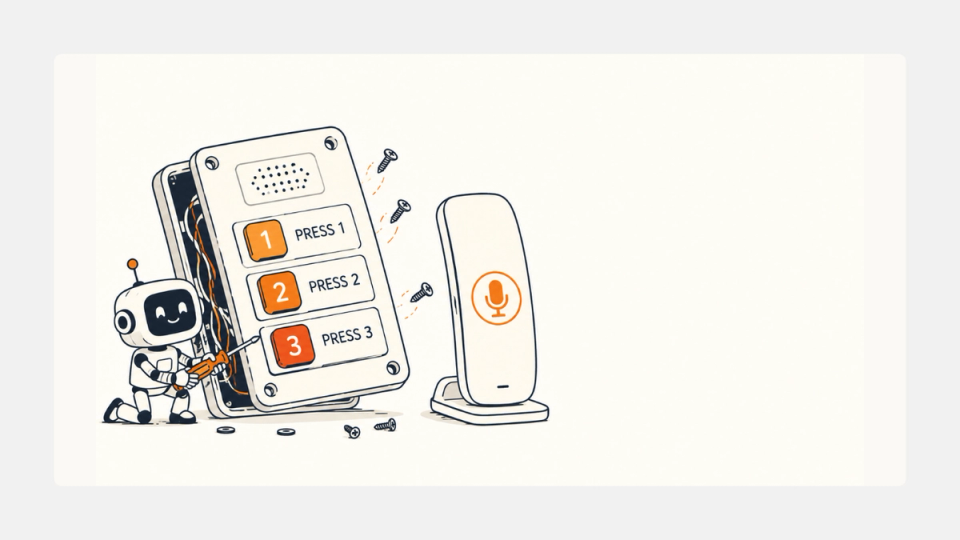
Somewhere in 2026, a T-Mobile customer called in to dispute a bill. The phone rang twice. Then a voice answered. It knew the account history. It understood the dispute in plain English. It issued a credit, updated the record, and ended the call in under three minutes. No hold music. No menu tree. No "press 1 for billing."
The agent was not a person.
That call is no longer an experiment. It is Tuesday morning at scale across every major telecom on the planet. The IVR tree, that infuriating gauntlet of numbered menus that has defined customer service since the 1990s, is being dismantled. In its place: AI voice agents that authenticate identities, execute multi-step workflows, negotiate retention, and hand off to human agents only when the emotional stakes genuinely require a person.
The speed of adoption has surprised even the operators running these systems. The share of organizations deploying AI agents in customer service rose from roughly 39% in 2025 to 66% in 2026, a jump that took cloud computing a decade to achieve. In telecom specifically, the numbers are sharper: approximately 95% of telecom contact centers now have some form of AI deployed in the customer voice path.
The question is no longer whether AI voice agents will transform telecom. It is how deep the transformation goes, how fast the carriers can execute it without collapsing call quality, and what happens to the 21.5% annual churn rate that has defined the industry's economics for years.
What Happened
T-Mobile and OpenAI Built an Intent Engine, Not a Chatbot
In early 2026, T-Mobile's IntentCX platform, built in partnership with OpenAI, moved from extended pilot into active production rollout. IntentCX is not a chatbot dressed up as a phone agent. It is an intent-decisioning system that pulls T-Mobile's proprietary customer data in real time and routes it through GPT-5 class models to understand not just what the customer is saying, but what they actually need.
The architecture matters here. Legacy voice AI systems operated in stitched pipelines: separate vendors handling speech-to-text, a middle-layer LLM for understanding, and a separate text-to-speech system for the response. Each hop added latency. The result was that robotic, half-second pause before the AI agent responded. OpenAI's GPT-Realtime-2 changed the calculus in May 2026 by collapsing the entire stack into a single model. IntentCX is running on that new architecture. Early reporting from Customer Experience Dive describes the system as having "simplified complex workflows," citing device trade-ins and plan selections as the processes with the most measurable improvement.
The headline figure, surfaced mid-2026: AI voice is now handling approximately half of T-Mobile's inbound customer service calls.
For context, T-Mobile runs approximately 127 million subscribers as of early 2026. Routing half of that call volume through an AI system is not a feature launch. It is an operational transformation at a scale most software companies never see.
Deutsche Telekom Moved the AI Into the Network Itself
At Mobile World Congress in early 2026, Deutsche Telekom unveiled something that reframes what a carrier AI product can even be. The Magenta AI Call Assistant is not an app. It is not a software layer sitting on top of a phone. It is embedded directly into the telecommunications network, which means it works on any device, from the latest flagship to a five-year-old handset.
The capabilities it delivers from that position: real-time language translation across 50-plus languages during a live call, conversation summarization, and contextual assistance. No install. No subscription. No premium hardware required.
Deutsche Telekom partnered with ElevenLabs for voice synthesis, a relationship that began with Telekom's participation in ElevenLabs' Series C in January 2025. The ElevenLabs voice agent stack is the reason this deployment does not read like another IVR replacement. It reads like a call upgrade. The full rollout in Germany began in 2026, with 50-language coverage planned within 12 months. The company's stated ambition: to make voice the "default AI interface" for its customers.
Beyond the consumer product, Deutsche Telekom is running AI agents across 10 countries to support its 130,000-plus employees, and using network-integrated AI agents to autonomously manage traffic surges during large-scale events, a capability that moved from a 2025 concept to active operational deployment in Germany by 2026.
Vodafone Put AI Between Businesses and Their Customers
Vodafone's approach is split. On the consumer side, its TOBi assistant, rebuilt on generative AI foundations, now assists live agents with real-time context and suggested responses. On the business side, Vodafone launched the Vodafone Business AI Concierge in partnership with Google Cloud. It allows small and medium businesses to deploy an AI voice agent that handles inbound calls, books appointments, and captures leads, outside of standard business hours.
This is a significant positioning move. Vodafone is not just deploying AI for its own customer service. It is packaging the same capability as a product it sells to enterprise customers. The carrier becomes the infrastructure layer for the AI voice economy, not merely a beneficiary of it.
AT&T Went All-In on the Network-Integrated Receptionist
AT&T's agentic AI push runs on two tracks. The customer-facing track introduced a digital receptionist in 2025 that uses agentic AI to screen spam and fraud calls in real time at the network layer, before a call ever reaches the subscriber. The back-office track is the Microsoft-backed "Ask AT&T" system, which automates internal workflows and synchronizes data across employee tooling to reduce friction at both the customer and employee touchpoints simultaneously.
What It Actually Means
Does Replacing the IVR Tree Actually Fix the Call Experience?
For most use cases, yes, but the bar the industry set was deliberately low. Gartner estimates that 90% of customer interactions beginning in an IVR tree end in frustration or abandonment before resolution. An AI voice agent that resolves an issue in a single, uninterrupted conversation is a dramatic improvement by any measure.
The operational data supports this. AI agents are reducing average handle time per case by 30 to 40 percent across documented deployments. Companies deploying AI for Tier-1 support are resolving roughly 65% of issues without human intervention. Cost-per-interaction is dropping by an average of 32% in successful telecom deployments, per 2026 industry data.
The infrastructure challenge separating good from broken: latency. The gold standard for natural-feeling voice conversation is a response delay of under 300 milliseconds from the end of the caller's speech to the first audio from the agent. Legacy stitched pipelines routinely miss this. The leading deployments in 2026 achieve it by co-locating inference within the carrier's own infrastructure, running ASR, LLM, and TTS in the same datacenter, and using native SIP trunking rather than media gateway hops. Deutsche Telekom's network-embedded approach sidesteps the problem entirely by operating inside the call path itself.
Gartner projects that conversational AI will reduce contact center labor costs by $80 billion in 2026. The voice AI agent market crossed $22 billion in total valuation this year. Those numbers move in one direction.
What Does This Mean for the People Who Used to Answer These Calls?
The honest answer: the job is changing faster than the industry's official statements suggest, but it is not disappearing at the rate the most alarming forecasts predicted.
Of customer service leaders surveyed in mid-2026, 95% say they plan to retain human agents for the foreseeable future. The actual model across T-Mobile, Vodafone, and Deutsche Telekom is hybrid: AI handles Tier-1 volume, authentication, routine billing, simple troubleshooting. Humans handle escalations, complex disputes, emotionally charged situations, and the retention conversations where a real person still closes more deals.
But "95% plan to retain human agents" describes intent, not headcount. When AI is handling 50% of inbound calls at T-Mobile and 65% of Tier-1 issues resolve without human touch, the required headcount for that same call volume is structurally lower. That pressure will take years to show up in mass layoff announcements. It is already showing up in slower hiring.
For the builders in this audience: 87% of consumers prefer a hybrid model, which means the interface design question is not "how do we automate everything" but "where is the handoff, and how do we make it invisible."
Who This Affects

Developers and AI engineers. The technical surface area here is real. The companies winning in this space have solved the latency problem end-to-end, not just the LLM response time. If you are building on top of stitched vendor APIs, you are building on yesterday's architecture. The direction of travel is integrated real-time models that collapse STT, LLM, and TTS into a single pipeline.
Telecom operators. The carriers that move first own the AI voice relationship with their customers. Deutsche Telekom's network-embedded approach is the most defensible moat: if your AI is inside the call path, no competitor's app displaces it without the subscriber switching carriers. Vodafone's enterprise packaging of the same capability turns a cost center into a revenue line.
Enterprise buyers using telecom as a platform. Vodafone's Business AI Concierge is the leading indicator. The carrier is not just running your calls. It is selling you the AI layer on top of those calls. Within 24 months, most major enterprise telecom contracts will include an AI voice agent component as a standard line item, not an add-on.
End users. The consumer experience is improving faster than consumer trust is building. 87% of consumers prefer a hybrid model not because they dislike AI but because they have been burned by enough bad IVR to distrust any automated voice system on first contact. The carriers that communicate clearly about when the caller is talking to an AI, and that guarantee a real person is available when needed, will earn trust faster than the ones that obfuscate it.
What to Watch for Next
T-Mobile's IntentCX churn numbers. The company has not publicly disclosed whether its AI voice rollout has moved its 21.5% annual churn rate. The thesis is that proactive AI intervention in the first 30 minutes of a cancellation-intent call is the retention lever the industry has never had at scale. If IntentCX data surfaces in T-Mobile's Q3 earnings in October 2026, watch for language around "proactive resolution" and "first-call resolution rates."
Deutsche Telekom's multi-country expansion. The Magenta AI Call Assistant launched in Germany. The 50-language rollout extends into 2027. Watch for which markets Deutsche Telekom prioritizes next, specifically whether it enters markets where a competitor has already deployed a carrier-embedded AI system.
Regulatory response to AI disclosure. The EU AI Act's transparency requirements cover AI agent disclosure, but enforcement timelines and carrier-specific guidance remain unclear. A single high-profile enforcement action will clarify the disclosure standard for the entire industry. OpenAI is building a phone to kill the app store, and the telecom AI wave are converging toward the same unresolved regulatory question about AI agent disclosure.
The ElevenLabs tier-up. Deutsche Telekom is one of ElevenLabs' largest enterprise deployments. As more carriers look to replicate Telekom's voice quality, the ElevenLabs conversational pipeline becomes the vendor telecoms call first. Watch for carrier partnership announcements in H2 2026.
The Bottom Line
The IVR tree took thirty years to become the most hated technology in customer service. Its replacement is taking roughly thirty-six months.
T-Mobile, Deutsche Telekom, Vodafone, and AT&T are not running AI voice pilots. They are running production systems at scale, with real churn economics and real headcount decisions attached. The transformation is not coming. It arrived while everyone was still debating whether AI could pass a Turing test.
The carriers that move fastest on three things will define the next decade of telecom customer experience: latency (sub-300ms is table stakes, not a differentiator), hybrid design (the handoff to a human must be invisible when it happens), and trust (disclosure and reliability determine whether consumers stop dreading the call to their carrier).
The old front desk is gone. The new one answers on the second ring, speaks 50 languages, and never puts you on hold.
Frequently Asked Questions
Is T-Mobile's AI voice agent replacing human customer service agents?
Not entirely. T-Mobile's AI handles roughly 50% of inbound calls in 2026 through its IntentCX platform with OpenAI. Human agents remain for complex disputes, escalations, and high-empathy interactions. The model is hybrid, not full replacement. The structural effect on hiring is real but slower than mass-layoff rhetoric suggests.
What is Deutsche Telekom's Magenta AI Call Assistant?
An AI voice capability embedded directly into Deutsche Telekom's telecommunications network, not an app or device feature. It provides real-time translation across 50-plus languages, call summarization, and contextual assistance during live calls. It works on any phone, announced at MWC 2026, initially rolling out in Germany.
How does telecom AI voice handle latency to sound natural?
The leading deployments co-locate speech recognition, LLM inference, and text-to-speech within the carrier's own infrastructure, eliminating the multi-vendor stitched pipeline that caused robotic delays. The target is sub-300ms from end of caller speech to first agent audio. Deutsche Telekom's network-embedded approach achieves this by operating inside the call path itself.