
Meta Didn't Buy CRED. It Bought a Map of India's Money.
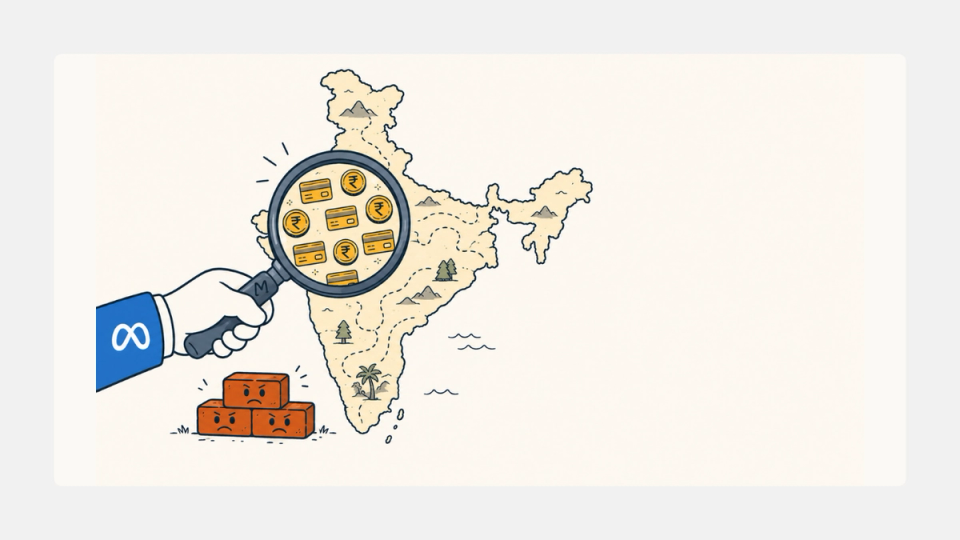
Meta invested $900 million in Indian fintech startup CRED on June 22, 2026, acquiring a 20% minority stake at a $4.5 billion valuation and hiring CRED founder Kunal Shah as the new global head of WhatsApp. Both parties say Meta gets no access to CRED's customer data. The deal structure tells a different story.
This is not a fintech investment. This is the most expensive hiring package in Indian tech history, wrapped in a strategic investment that positions Meta inside the financial data layer of India's most affluent digital consumers.
What Happened
Meta led CRED's Series H round, investing approximately $900 million through a mix of primary capital (going to CRED) and secondary transactions (buying out existing shareholders). The deal values CRED at roughly $4.5 billion post-money, according to Business Wire and VCCircle.
The headline number is large. But the real news is the personnel move underneath it.
Kunal Shah, CRED's founder and the architect of India's premium credit card payments stack, is stepping down as CEO to join Meta as the global head of WhatsApp. He replaces Will Cathcart, who held the role for seven years. Shah retains his personal shareholding in CRED. Miten Sampat, CRED's head of strategy and finance since 2020, takes over as interim CEO.
Both Meta and CRED released statements emphasizing that the investment is purely financial. Meta will not receive access to CRED member data, transaction histories, or credit information. The companies framed this as a clean investment with a clean wall.
Why the "No Data Sharing" Claim Deserves Scrutiny
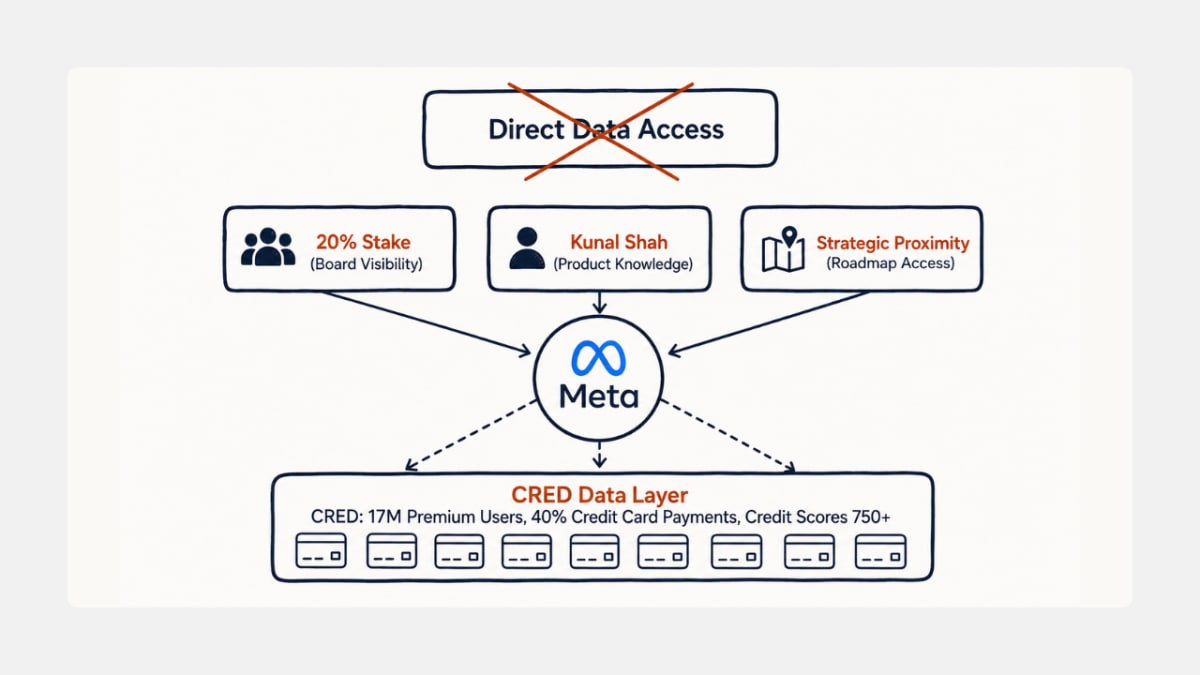
The formal position is clear: Meta gets no CRED data. But the deal does three things that make the data wall less relevant than it sounds.
First, Meta now has a 20% stake in a company that processes over 40% of India's credit card bill payments, according to Outlook Business. CRED serves approximately 17 million monthly active users, all of whom have credit scores above 750. That is not a random user sample. That is the financial top 5% of India's digital population: high earners, high spenders, high credit utilization.
Second, the person who built that data architecture now runs WhatsApp globally. Kunal Shah spent six years building CRED's understanding of how India's affluent consumers think about money, credit, rewards, and spending. He does not need to export a database to bring that knowledge to WhatsApp Pay. He brings the mental model, the product instincts, and the behavioral frameworks.
Third, 20% ownership gives Meta board-level visibility into CRED's strategy, product roadmap, and financial performance. That is not the same as raw data access. But it is not nothing. As The Hindu reported, the investment gives Meta structural proximity to one of the richest consumer financial datasets in Asia.
Meta has a pattern here. The company's broader strategy of pulling information into its own ecosystem, whether through zero-click search features on Facebook or through capital expenditure bets worth $125 to $145 billion, consistently points in one direction: owning the data layer, not just the distribution layer.
Does This Change WhatsApp Pay's Position in India?
WhatsApp has 500 million active users in India and a payments market share of approximately 0.65%. That gap between distribution and transaction volume is the single biggest unsolved problem in Meta's India strategy. PhonePe and Google Pay together control roughly 79% of UPI transaction volume. WhatsApp Pay, despite its massive installed base, has never broken through.
Hiring Shah is a direct response to that failure. Shah built CRED from zero to 17 million premium users and 40% credit card payment share without a messaging app underneath it. He did it with product design, rewards psychology, and a deep understanding of Indian financial behavior.
Meta is betting that Shah can do for WhatsApp Pay what he did for CRED: build a payments experience that users actually choose, not just one that exists inside a chat window. The difference is that Shah now has 500 million users on day one instead of zero.
WhatsApp Pay's regulatory cap was only fully removed in late 2024, by which point user habits had already solidified around PhonePe and Google Pay. Shah's job is to break those habits. With CRED's playbook (rewards, premium positioning, credit integration) running on WhatsApp's distribution rails, the competitive dynamics in Indian fintech shift significantly.
The Regulatory Alarm Bells Are Already Ringing
The Global Trade Research Initiative (GTRI), an Indian trade think tank, issued a public warning within hours of the deal's announcement. GTRI cautioned that the deal could provide Meta with a foothold in a platform holding a "rich repository" of sensitive financial data, including credit card details, loan histories, investment patterns, insurance purchases, and UPI transactions, per Economic Times.
GTRI's core argument: India risks allowing ownership and strategic control of critical financial data to migrate into foreign-controlled digital ecosystems. The think tank drew a direct comparison to China, which built its digital payment infrastructure through domestic champions (Alipay, WeChat Pay) specifically to maintain strategic control over financial data.
India's Digital Personal Data Protection (DPDP) Act technically governs how personal data can be processed and shared. Corporate assurances that Meta will not access CRED's data are aligned with the Act's requirements. But critics, including NDTV Profit and The Wire, have raised a harder question: whether the regulatory framework is robust enough to prevent "data arbitrage at national scale" by foreign technology giants.
The Reserve Bank of India's digital payment security frameworks, NPCI's market-share rules, and the Competition Commission of India are all watching. The deal structure itself may be compliant. Whether it stays that way as WhatsApp Pay scales with Shah's playbook is the real regulatory test.
The pattern of AI's new data grab, from brain headbands to apartment cleaning, from brain-reading headbands to apartment-cleaning startups, makes this investment part of a broader industry shift. Data is the new territory, and fintech data is the richest kind.
Who This Affects
Indian fintech users (17 million CRED members): Your credit card payment history, credit score, and spending patterns are now inside the orbit of a company that monetizes user data across Facebook, Instagram, and WhatsApp. The data wall exists today. Whether it survives CRED's next funding round, a future acquisition, or a product integration push is an open question.
PhonePe and Google Pay: The competitive threat just changed shape. WhatsApp Pay was a dormant giant with no product edge. Adding Shah's fintech playbook to WhatsApp's distribution creates a credible challenger for the first time. PhonePe's upcoming IPO could face pressure if WhatsApp Pay gains meaningful share in the next 12 months.
Indian regulators: This deal is the biggest test case for the DPDP Act's ability to govern indirect data influence. A 20% stake plus the founder running a Meta product creates structural proximity that formal data-sharing agreements may not fully capture.
What to Watch For Next
30 days: Look for NPCI and RBI commentary on the deal's implications for market-share caps. WhatsApp Pay was previously subject to a 30% UPI volume cap that was eased in late 2024. Any re-imposition or new conditions would signal regulatory discomfort.
90 days: Watch for WhatsApp Pay product changes. Shah's first moves, whether rewards integration, credit features, or merchant-side tools, will reveal whether Meta is building a CRED-inside-WhatsApp experience or something different entirely.
6 months: The DPDP Act's enforcement mechanisms face their first real test. If Meta and CRED announce any shared product feature, even something as benign as CRED rewards in WhatsApp, the data wall will face immediate regulatory scrutiny.
The Bottom Line
Meta did not buy CRED. It bought something more valuable: the person who understands India's money, a board seat at the table where India's richest financial data sits, and a strategic option on integrating fintech into the world's largest messaging platform. The no-data-sharing pledge is real today. The question is whether the structure Meta just built makes that pledge survivable over the next two years.
FAQ
Did Meta acquire CRED?
No. Meta invested $900 million for a 20% minority stake in CRED's Series H round. CRED remains an independent company with Miten Sampat as interim CEO.
Will Meta have access to CRED user data?
Both companies have stated Meta will not receive access to CRED member data. India's DPDP Act mandates that personal data be processed only for lawful purposes with clear consent. The structural proximity of the deal, however, has drawn scrutiny from think tanks like GTRI.
Why is Kunal Shah leaving CRED?
Shah is stepping down from his operating role at CRED to become the global head of WhatsApp at Meta. He retains his personal shareholding in CRED. The move is seen as Meta's biggest bet on cracking India's payments market.
How many users does CRED have?
CRED serves approximately 17 million monthly active users, all with credit scores above 750. The platform processes over 40% of India's credit card bill payments.
What is WhatsApp Pay's current market share?
WhatsApp Pay holds approximately 0.65% of India's UPI transaction volume. PhonePe and Google Pay together control roughly 79% of the market.