
Grok 4.5 Lands With 500K Context. The Cursor Flywheel Is the Real Story.
What Happened
SpaceXAI officially released Grok 4.5 on July 8, 2026, making it the first major model to ship after SpaceX's $60 billion acquisition of Anysphere (the company behind Cursor) and after the subsidiary formerly known as xAI was rebranded to SpaceXAI in early July 2026.
The model is built on a new V9 foundation architecture with approximately 1.5 trillion parameters. It was trained on xAI's Colossus supercomputer infrastructure and on trillions of tokens drawn from Cursor's real-world developer session data, including interactions with production codebases. Public rollout began July 9, 2026. It is available through the SpaceXAI console, Grok Build, and is integrated directly into Cursor across all subscription tiers.
Pricing: $2.00 per million input tokens ($0.50/million for cached input), $6.00 per million output tokens. Context window: 500K tokens.
SpaceXAI has positioned this as an "Opus-class" model, claiming performance comparable to Anthropic's Claude Opus 4.8 at a fraction of the inference cost.

Why the Cursor Data Matters More Than the Parameter Count
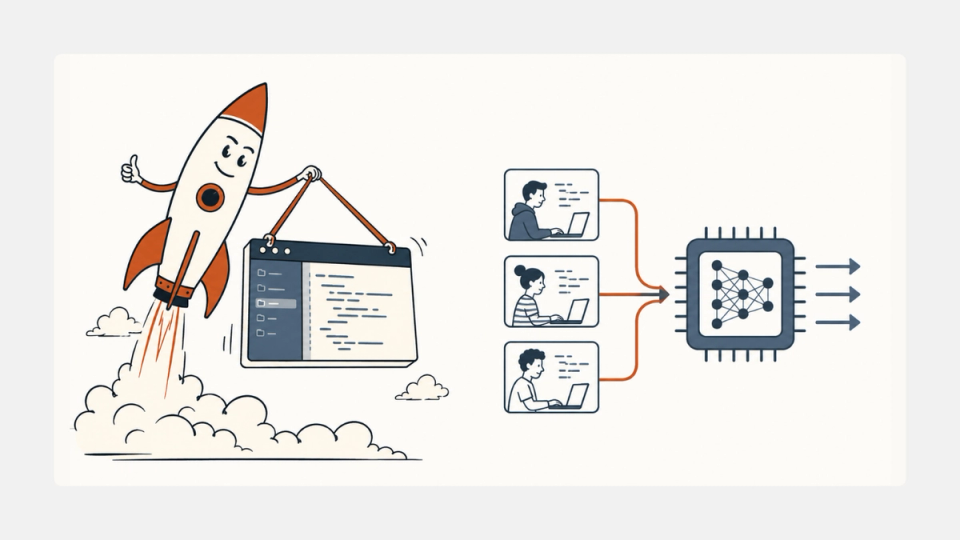
SpaceXAI has Colossus. Other labs have compute. What no other frontier lab has acquired in a single move is a data flywheel tied to 4 million active developers writing production code in real time.
When SpaceX acquired Cursor for $60 billion in June 2026, the stated rationale was distribution. The deeper rationale was the training signal. Cursor's session data is not scraped code from GitHub. It is structured interaction data: the prompt the developer typed, the suggestion the model produced, the edit the developer accepted, the next error the editor caught. That feedback loop, at scale across 4 million seats, is worth more than a parameter count.
The benchmark numbers on SWE-Bench Pro (64.7%) and DeepSWE 1.0 (62.0%) are competitive but not dominant. GPT-5.5 and Claude Opus 4.8 both score in comparable ranges on coding evals. The thing Grok 4.5 has that neither of those models has at this moment is: it is the default model inside the editor that generated the training data. That is a compounding advantage.
Does the Cursor Integration Actually Change the Development Experience?
Yes, in one specific way: latency. Independent developer testing in the first 24 hours after rollout has consistently cited faster completions compared to the previous Claude Opus default inside Cursor, even at 500K context. SpaceXAI's V9 architecture appears to optimize inference speed over raw capability headroom, which is the right tradeoff for an IDE context where a 3-second wait breaks flow.
The question of whether quality holds up in complex multi-file refactors is less settled. Early feedback on Hacker News and the Cursor Discord (as of July 9, 2026) is mixed: Grok 4.5 handles greenfield code generation well and struggles more than Claude Opus 4.8 on deep context reasoning across large legacy repositories. SpaceXAI has not released the benchmark methodology for the GDPval+ dataset numbers it has cited for professional reasoning tasks.
What It Actually Means
Does This End Cursor's Model Agnosticism?
Not officially, but the economics say otherwise. Before the acquisition, Cursor 3's Composer 2 system was explicitly model-agnostic, letting developers route tasks to Claude, GPT-5.5, Gemini, or whatever model they paid for separately. Cursor's value proposition was the orchestration layer, not the model itself.
After the acquisition, Grok 4.5 becomes the free default on all Cursor plans. That is not neutral positioning. When developers get a frontier-class model for free inside the tool they already use, the activation energy required to switch to a competitor model grows. SpaceXAI is not removing the option to use Claude inside Cursor. It is just making the economics of staying with Grok 4.5 obvious.
Anthropic, which had previously reserved all of the compute capacity at SpaceX's Memphis Colossus data center in a deal announced in May 2026, now finds itself in the unusual position of renting compute from the same company whose coding editor is now defaulting away from its models. That irony is not lost on the people watching this market. Anthropic's Colossus compute deal now reads differently: you cannot out-leverage a landlord who also controls the IDE.
How Does Grok 4.5 Compare to the Current Frontier?
The honest answer in the first 48 hours: it is competitive, not dominant. On SWE-Bench Pro, Grok 4.5 scores 64.7% and DeepSWE 1.0 at 62.0%. Those numbers put it in the same tier as Claude Opus 4.8 and ahead of GPT-5.5 on code-specific evals, but the margin is inside noise for most production use cases.
The differentiated claims are in professional knowledge work. SpaceXAI has positioned Grok 4.5 as capable of creating complex documents in Office applications (PowerPoint, Word, Excel), handling long-running agentic workflows in legal, finance, and data science contexts. These are harder to benchmark quickly. The 500K context window is real and practically relevant: it means you can feed an entire mid-sized codebase plus documentation into a single inference call.
For pricing context: at $2 input / $6 output per million tokens, Grok 4.5 undercuts Claude Opus 4.8 meaningfully on output costs while maintaining a comparable context window. At high-volume inference loads, the cost delta is significant. OpenAI's own recent strategic acknowledgment that safety-focused model design was being underserved suggests the lab race is converging on cost and latency, not just benchmark scores. Grok 4.5 bets on that convergence arriving sooner rather than later.
The competitive field is expanding beyond the usual three. GLM-5.2 from Z.ai crossed 80% on Terminal-Bench 2.1 in June 2026, a benchmark specifically designed for long-horizon agentic coding tasks. SpaceXAI's SWE-Bench numbers do not address that benchmark, and SpaceXAI has not released comparable Terminal-Bench figures for Grok 4.5. That gap will be a target for independent reviewers in the coming days.
Who This Affects
Cursor subscribers (all tiers). You get Grok 4.5 as the default model starting today. Nothing to configure. You keep access to Claude Opus 4.8, GPT-5.5, and Gemini models if you prefer them for specific tasks. The practical advice: test Grok 4.5 on your greenfield work first, watch how it handles your largest context tasks, and make a deliberate decision rather than defaulting to habit.
Engineering teams paying for both Cursor and a separate API contract. Your cost structure just changed. If your team is currently routing code generation through the Anthropic or OpenAI API and paying for that separately from your Cursor seats, you now have a free frontier-class alternative built into the tool. The math of keeping that external API contract should be revisited, at minimum.
Anthropic and OpenAI. The platform integration problem has arrived. Neither company controls the primary developer interface their frontier models run inside. Anthropic's model still runs in Cursor, but it no longer runs as the default. The difference between "available" and "default" in a 4-million-user IDE is not semantic.
Enterprise buyers evaluating AI coding infrastructure. The Grok 4.5 + Cursor bundle changes the make-vs-buy calculus. If your evaluation criteria included model agnosticism (deploying the best available model at any given time), you now have a vertically integrated alternative that argues the best model is the one that was trained on the same editor your team uses. That argument is worth stress-testing before committing to a multi-year contract with either incumbent.
What to Watch For Next
The first credible independent SWE-Bench and Terminal-Bench comparison between Grok 4.5 and Claude Opus 4.8 in a controlled setup (not SpaceXAI's internal numbers) will land within the next two weeks. That will be the moment where the "Opus-class" claim gets verified or qualified.
Watch whether Anthropic adjusts pricing or creates a native IDE product in response. The company has the talent for it, and losing the Cursor default is a distribution hit that pricing alone cannot fix.
Watch the enterprise contract renewal cycle. The Cursor acquisition closed in Q3 2026. The first enterprise accounts that signed 12-month Cursor agreements before the acquisition are now up for renewal with a different product than they originally bought. How SpaceXAI prices those renewals and whether it starts bundling SpaceXAI API credits into Cursor enterprise tiers will signal how aggressive the vertical integration strategy becomes.
Elon Musk has called Grok 4.5 the beginning of a "decade-long engineering bet." The next milestone in that bet is whether the training data flywheel from Cursor actually shows up as a measurable improvement in Grok 4.6 over a purely static-trained competitor.
The Bottom Line
Grok 4.5 is a competent frontier model. The pricing is real, the context window is real, and the Cursor integration is live. The more important story is structural: SpaceXAI has closed the loop between inference, training data, and developer tooling that no other lab has done at this scale. Anthropic and OpenAI have better models today on several benchmarks. Neither of them trained their last model on the behavioral data of 4 million developers writing code in a single editor.
The benchmark war matters less than the flywheel. If the flywheel is real, the next release closes the gap.
Frequently Asked Questions
Is Grok 4.5 available for Cursor users right now?
Yes. As of July 9, 2026, Grok 4.5 is the default model in Cursor across all subscription tiers at no additional cost. Users on free, Pro, and Business plans all have access. Other model providers remain available via Cursor's model selection menu.
How does Grok 4.5 pricing compare to Claude Opus 4.8?
Grok 4.5 costs $2 per million input tokens and $6 per million output tokens (as of July 2026). SpaceXAI prices cached input at $0.50 per million tokens. Anthropic's Claude Opus 4.8 input pricing is higher at the same tier. For high-volume coding tasks, the difference compounds meaningfully over a month of team usage.
Does using Grok 4.5 inside Cursor mean my code is being used to train SpaceXAI's models?
SpaceXAI has not released updated data usage policies specific to the post-acquisition Cursor integration as of July 9, 2026. Cursor's existing opt-out controls for training data remain in place. Enterprise customers with data residency requirements should review their current DPA with Anysphere before assuming coverage extends to the new model.
What benchmarks has SpaceXAI published for Grok 4.5?
SpaceXAI has published SWE-Bench Pro (64.7%), DeepSWE 1.0 (62.0%), and GDPval+ professional reasoning results. The company has not released Terminal-Bench figures, which matters for teams evaluating long-horizon agentic task performance. Independent evaluations are expected within 1 to 2 weeks of the July 8 launch