
GPT-5.6 Is Here. The Government Got It First.

OpenAI released GPT-5.6 on June 26, 2026, a family of three models codenamed Sol, Terra, and Luna, and the public cannot use any of them yet. At the request of the U.S. government, the entire release is in a limited preview available only to trusted partners vetted by federal officials. This is the first time a major frontier model has launched with government-imposed access controls baked into day one.
The restriction is not a surprise if you have been watching. Three weeks ago, Anthropic's Fable 5 had its own cybersecurity problem when a jailbreak concern triggered an export control directive that blocked foreign national access entirely. OpenAI saw what happened and chose to coordinate rather than collide.
What Happened
GPT-5.6 is not a single model. It ships as three tiers:
| Model | Tier | Use case | API pricing (per 1M tokens) |
|---|---|---|---|
| Sol | Flagship | Reasoning, coding, cybersecurity, science | $5 input / $30 output |
| Terra | Mid-tier | Everyday enterprise and developer work | $2.50 input / $15 output |
| Luna | Economy | Fastest, most cost-efficient tasks | $1 input / $6 output |
Sol introduces two new capabilities. Max Reasoning Mode lets the model spend significantly more compute on complex problems before responding. Ultra Mode deploys specialized sub-agents to execute tasks in parallel for long-horizon workflows. This is architecturally novel: no other commercial API offers a built-in multi-agent orchestration layer at the model level.
On Terminal-Bench 2.1, Sol Standard scored 88.8% and Sol Ultra hit 91.9%, surpassing both Claude Mythos 5 (88.0%) and Claude Opus 4.7 vs GPT-5.5. On ExploitBench and ExploitGym, Sol matched Anthropic's Mythos Preview in vulnerability research while using roughly one-third the output tokens. OpenAI's system card confirms Sol demonstrates advanced cybersecurity capabilities but does not meet the "Critical" risk threshold for autonomous attacks.
Those cybersecurity scores are exactly what triggered the government's response.
Why the Government Stepped In
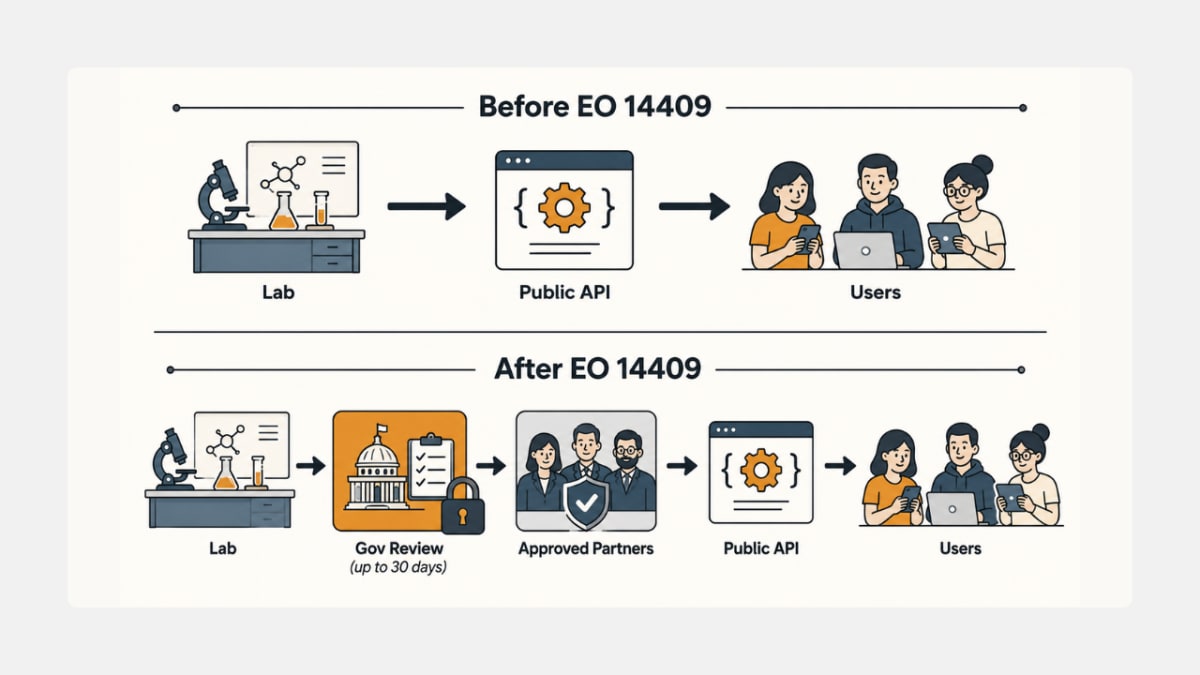
On June 2, 2026, President Trump signed Executive Order 14409, "Promoting Advanced Artificial Intelligence Innovation and Security." The order establishes a voluntary framework: frontier model developers provide the government access for up to 30 days before public release so the NSA and CISA can assess cybersecurity and national security risk.
The key word is "voluntary." In practice, it is not. The Anthropic precedent made that clear. When Anthropic released Fable 5 and Mythos 5 on June 9, a separate export control directive on June 12 forced the company to suspend access for all customers because it could not implement selective restrictions fast enough. Anthropic disputed the severity of the jailbreak concerns, calling the vulnerabilities "minor and discoverable by other existing models." It did not matter. The suspension held for two weeks.
OpenAI read the room. Rather than launch publicly and risk a forced takedown, the company agreed to a limited preview where access is granted customer by customer, vetted by federal officials from the Office of the National Cyber Director, OSTP, NSA, and CISA.
The EO also directs the NSA and CISA to develop a classified benchmarking process for "covered frontier models," the Treasury to establish a voluntary cybersecurity clearinghouse, and the Attorney General to prioritize AI-enabled computer crime enforcement.
Does OpenAI Actually Support This?
No. OpenAI is complying, but their official blog post from June 26 was unusually direct:
"We don't believe this kind of government access process should become the long-term default. It keeps the best tools from users, developers, enterprises, cyber defenders, and global partners who need them."
The company frames the limited preview as a pragmatic, temporary compromise, the "strongest path to broader availability in the coming weeks" while they work with the administration to build a repeatable process for future releases. Sam Altman reportedly told staff the government specifically requested the staggered approach.
This is a calculated bet. OpenAI accepts a short delay in exchange for avoiding the Anthropic scenario: a messy public suspension, reputational damage, and weeks of uncertainty. The tradeoff is that the company has now validated the government's authority to gate frontier model releases, voluntary or not.
Who This Affects
Developers and startups are locked out of Sol, Terra, and Luna for now. No API access, no ChatGPT integration. OpenAI says broader rollout is coming in "the coming weeks," but that timeline is the government's to set, not OpenAI's.
Enterprise buyers who already pay for GPT-5.5 should watch Terra closely. It is positioned as comparable to GPT-5.5 at roughly half the cost. If the pricing holds post-preview, the migration math is straightforward.
Cybersecurity teams face a paradox. Sol's vulnerability research capabilities are strong enough to trigger national security review, which means the same tool that could help defenders find and patch vulnerabilities is being kept from them while the government vets it. OpenAI named this tension directly in their statement.
Open-weight model developers just got a recruiting pitch. Every week the government gates a proprietary frontier model, the argument for open-weight alternatives that bypass federal approval gets louder. GLM-5.2 already broke the 80% barrier on Terminal-Bench under MIT license. DeepSeek V4 ships under MIT. The permissioned-AI era accelerates the open-weight counter-movement.
Anthropic gets partial vindication. Their Mythos 5 access has been partially restored to approved American cybersecurity firms. The broader industry is watching whether OpenAI's cooperative approach leads to a faster public release than Anthropic's adversarial one.
What to Watch For Next
Three signals will tell you whether this becomes a precedent or a one-off:
- Public rollout timeline. If Sol ships to ChatGPT and the general API within 2-3 weeks, the preview was cosmetic. If it stretches past 30 days, the EO 14409 framework is becoming a de facto mandatory preclearance regime.
- The classified benchmarking process. The NSA and CISA are building it now. Once finalized, it will define which models qualify as "covered frontier models" subject to pre-release review. That definition sets the waterline for every lab.
- The next non-American lab release. EO 14409 is domestic policy. How (or whether) the framework applies when a Chinese or European lab ships a model with comparable cybersecurity capabilities will test the limits of the approach.
The 42 state AG investigation into OpenAI adds a separate layer of regulatory pressure. The IPO timeline, the government preview, and the AG subpoena are now three overlapping constraints on how OpenAI ships products.
The Bottom Line
GPT-5.6 is the most capable model family OpenAI has shipped. Sol's Ultra Mode and cybersecurity benchmarks are genuinely new ground. But the story is not the model. The story is that the U.S. government now has a working mechanism to delay frontier AI releases, and the two biggest labs in the world have both complied.
The EO calls the framework voluntary. After Anthropic's forced suspension and OpenAI's preemptive cooperation, the word "voluntary" is doing a lot of heavy lifting.
For developers waiting to build on Sol, Terra, or Luna: the timeline is weeks, not months. For the industry watching the precedent: this one is permanent.
FAQ
When will GPT-5.6 be available to the public?
OpenAI says "the coming weeks." The timeline depends on the government's cybersecurity review under EO 14409. There is no confirmed public release date as of June 27, 2026.
What is the difference between Sol, Terra, and Luna?
Sol is the flagship for demanding tasks (coding, science, cybersecurity) at $5/$30 per million tokens. Terra is a mid-tier model comparable to GPT-5.5 at roughly half the cost. Luna is the fastest and cheapest option at $1/$6 per million tokens.
Is GPT-5.6 better than Claude Mythos 5?
On Terminal-Bench 2.1 coding benchmarks, Sol Standard (88.8%) and Sol Ultra (91.9%) both outperform Mythos 5 (88.0%). On cybersecurity benchmarks, Sol matches Mythos Preview using one-third the output tokens. These are OpenAI's self-reported numbers and have not been independently verified at scale.
Why did the government restrict access?
Executive Order 14409, signed June 2, 2026, establishes a voluntary pre-release review framework. The government is assessing GPT-5.6's advanced cybersecurity capabilities before allowing broader deployment. The Anthropic Fable 5 suspension in June set the precedent.
Can I use GPT-5.6 through ChatGPT?
Not yet. The limited preview is API-only and restricted to government-approved partners. ChatGPT integration is expected after the public rollout.