
Google’s Fruit Fly Brain Has Been Sent to Play Doom
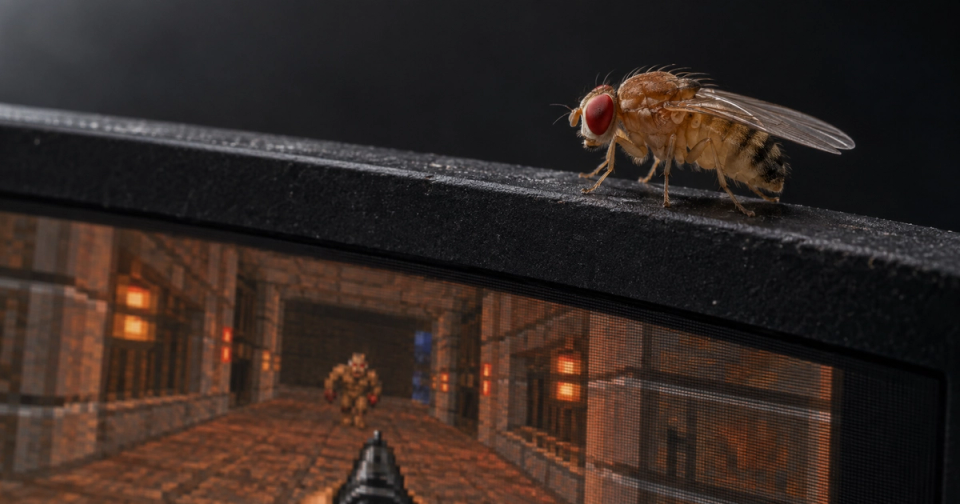
Humanity finally gets a chance to settle its mosquito grudge, and we pick the wrong insect. On September 3, Google Research announced a complete wiring map of an adult male fruit fly’s brain and central nervous system, developed with HHMI Janelia and collaborators. Developers have since connected models based on that map to video games. Google’s announcement identifies the unfortunate species as Drosophila melanogaster.
So, yes, there is an insect-revenge story here, provided we accept that the defendant has been misidentified. Mosquitoes get the blame. A fruit fly gets the controller.
The demos are funny. Their documentation is more interesting: moving a game character, learning to survive, and experiencing the game are separate claims. The evidence supports a much narrower story than “we uploaded a creature and sentenced it to Doom.”
What did Google actually release?
Google and its collaborators released a connectome, a map of neurons and the connections between them. The September announcement describes more than 166,000 neurons and 125 million synaptic connections. It includes the ventral nerve cord, extending the reconstruction into circuitry involved in controlling the body. Google Research
Google used AI to help reconstruct neural shapes from microscope images. Human experts at Janelia checked and annotated the results. The researchers made the resource available for exploration and download, including through the visualization tool Neuroglancer. This was a scientific collaboration, with considerable human verification behind the AI-assisted mapping. Release details
The MaleCNS project website is the starting point for the underlying research resource. For anyone whose mental picture is a tiny brain plugged into a USB port, the download is where that picture needs updating.
The internet assigned it gaming homework
The DOOMFLY project connects a simulation based on MaleCNS to a Doom-engine arena. Game images stimulate modeled sensory neurons. An engineered interface translates neural activity into movement and firing. Its README reports 166,700 retained neurons and 25,582,938 directed connections in the simulation. Those are the simulator’s reported graph counts; use the dataset’s own definitions when comparing them with headline synapse totals. DOOMFLY repository
As checked on September 15, the project’s status says: “live experimental training, not demonstrated learned survival.” Its current v6 candidate failed its visual, conditioning, and survival validation gates. The authors also distinguish biological wiring from their choices about dynamics, sensory inputs, and controls. DOOMFLY’s published limitations
That disclosure deserves to travel with the clip. A developer publishing unsuccessful results gives readers something they can inspect and future contributors something they can improve.
Then there is Fly64, Jessica Paquette’s Super Mario 64 experiment. Its README describes a loop connecting game images, modeled eye cells, the neural network, and controller inputs. It explicitly states that there is no training, reward, or goal to collect stars. Mario can walk into a wall and remain there. Fly64 repository
Humanity has recreated the experience of handing a controller to someone who has never played Mario, except we also invented their eyes and decided which signals mean “jump.”
Does the fly actually know it is playing?
These repositories do not establish that a fly understands a game or experiences its events. Their authors describe software models with engineered interfaces. A character moving on screen demonstrates that the control loop produces actions. Claims about understanding, learning, or subjective experience require evidence beyond that visible movement. DOOMFLY, Fly64
“The fly is being tortured by video games” works as a joke because we supply the experience in our imagination. We picture confusion, frustration, and an urgent desire to return to a banana. The clip itself cannot tell us those things.
There is room for serious discussion about how increasingly detailed simulations should be treated. But declaring this particular software conscious, or declaring that a damage signal proves suffering, would outrun the evidence presented by these projects.
Read the next brain demo with four questions
For builders and AI-curious readers, the useful habit is to inspect where the demonstrated behavior comes from. Before sharing the next “brain learns a game” headline, ask:
- What was measured? Find the dataset and identify whether the project uses reconstructed wiring, recorded activity, or both.
- What did the developer add? Look for the equations governing activity and the rules connecting inputs to actions.
- What improves through experience? A moving character needs a control signal. A learning claim needs a defined task and measured improvement against suitable controls.
- Where are the failures? Look for repeat runs, unsuccessful conditions, and a repository that states its limits.
This is the same reading discipline behind our guide to AI benchmarks and what to test instead: first identify what the test actually measures. A compelling output can leave the important question unanswered.
For developers, the interface deserves particular attention. Our explanation of why AI agents fail even when the model is smart examines how the surrounding system affects results. That engineering question also matters here, even though a connectome simulation and a language-model agent are very different systems.
And when a headline uses “brain data,” check what kind. Our coverage of brain headbands and AI data collection concerns another route to neural data. The shared word does not make the measurements interchangeable.
Let the fly have its bad gaming session
My view: the most valuable follow-up would be a reproducible result showing which biological connections contribute to a behavior, with clear comparisons when those connections change. Another funny clip would be welcome too. It just answers a different question.
Open research gives curious developers material to experiment with, and sometimes the first experiment is wonderfully silly. We can appreciate that without promoting a controller demo into proof of a trapped mind.
The mosquitoes, meanwhile, remain suspiciously absent from the proceedings. They have somehow outsourced humanity’s revenge to a fruit fly.