
Why AI Agents Fail Even When the Model Is Smart
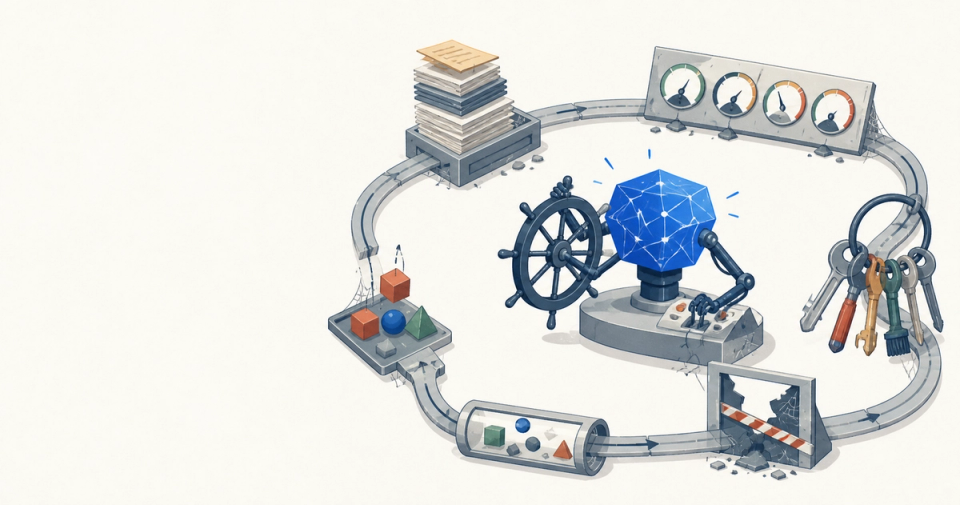
An AI agent is a system in which a language model decides which steps to take, calls tools, observes the results, and continues until it reaches a stopping condition. The model can be excellent at reasoning and the agent can still fail because the surrounding loop gives it bad state, ambiguous authority, weak tests, or no safe way to recover.
The thesis is simple: agent failures usually come from a mismatch between model judgment and system design. Teams keep swapping models when they need to narrow the task, improve the observation returned by a tool, or define what counts as done. The useful unit of analysis is not "how smart is the model?" It is "which part of the loop made the next decision unreliable?"
The thesis: intelligence is only one link in the loop
An agent is not a model with a few API functions attached. It is a control loop: objective, context, decision, action, observation, verification, and stop. A failure at any link can look like bad reasoning in the final transcript.
The ReAct paper made the underlying idea explicit: reasoning can guide actions, while actions provide information that updates the next reasoning step. In its experiments, tool use improved performance on knowledge and interactive tasks, including absolute gains of 34 percentage points on ALFWorld and 10 points on WebShop over the compared baselines. Those results show why agents work. They also expose the risk. Once reasoning and acting are interleaved, a small error in an observation or action can become the input to every later decision. (ReAct paper)
OpenAI's current agent guide describes three core components: model, tools, and instructions. It also recommends evals, layered guardrails, and human intervention for high-risk actions. Anthropic's definition is similar, but its autonomy research adds an important point: autonomy is an emergent property of the deployment, shaped by the model, the user's oversight, and the product design. (OpenAI practical guide, Anthropic autonomy research)
That is why a stronger model can make a weak agent more dangerous. It may take more actions, use more tools, and persist longer inside a flawed control loop.
The quick answer
Why do AI agents fail even when the model is smart?
Because the model only chooses from the state and tools the system gives it. If the goal is ambiguous, context is stale, tools hide important state, permissions are too broad, or completion is poorly tested, a capable model can execute the wrong plan with impressive consistency.
What should teams debug first?
Trace the first wrong state transition. Check the instruction, retrieved context, tool schema, tool result, authorization decision, and stopping rule at that point. Do not begin by changing the model unless the trace shows the model had the right state and still chose poorly.
The non-obvious truth: reliability often improves when an agent gets fewer choices. A small toolset, narrow task boundary, explicit approval step, deterministic validator, and short retry budget give the model a cleaner decision surface than a sprawling "do anything" agent.
What does a smart model actually control?
A model controls the next output token. An agent runtime turns that output into a decision, a tool call, or a final response. The runtime then feeds a new observation back into the model. That boundary matters because the model does not directly see the database, browser, filesystem, or API. It sees a representation produced by your system.
Suppose an agent has to refund an order. The model may correctly infer that the customer qualifies. The tool wrapper may still return only success: true, with no transaction ID, no amount, no currency, and no indication of whether the refund settled or merely entered a queue. The next step is now guesswork. Asking a smarter model to reason over missing state does not solve the problem.
Tool descriptions create the same trap. A function named update_customer may hide five different mutations. A search tool may return the first 20 records but omit that the query was truncated. A browser tool may report that a click succeeded even though the page opened a confirmation dialog. The model's plan can be reasonable while the system's observation is incomplete.
The practical rule is to treat every tool result as an interface contract. Return the state a human operator would need to make the next decision, including partial success, authorization status, side effects, and unknown outcomes.
Why does a good plan still produce a bad result?
A plan is a hypothesis about the world. An agent succeeds only when the world confirms each step. If the system does not verify postconditions, the model can continue from an imagined success. The plan then becomes a story that the tool layer quietly contradicted.
This is common in coding agents. The model edits a file, runs a test command, sees a passing exit code, and reports completion. Yet the test may not cover the changed path. The command may have skipped tests because a dependency was unavailable. The patch may compile while breaking an integration contract. A green command is evidence, not proof.
OpenAI's recent analysis of SWE-bench Verified shows why benchmark scores need careful interpretation. The company reported that performance had risen from 74.9% to 80.9% over six months, then found that at least 59.4% of a sampled set of frequently failed problems had flawed tests that rejected functionally correct submissions. That finding does not prove coding agents are reliable. It proves that the evaluator itself can become part of the failure mode. (OpenAI on SWE-bench Verified)
For an agent, completion needs a postcondition that is independent enough to catch the failure. A refund agent should verify the payment provider state. A deployment agent should check the running version and a health signal. A coding agent should run targeted tests, inspect the diff, and confirm that the intended behavior changed. The check can still be automated. It cannot be the same unexamined assumption that produced the action.

Why does tool access amplify small mistakes?
Tool use turns an incorrect belief into an external side effect. The larger the permission surface and the longer the loop, the more opportunities the agent has to compound a local error before anyone sees it. This is a systems property, not a personality trait of the model.
The security boundary moves when an agent can read private data, change records, send messages, spend money, or call another agent. A read-only search can leak information across tenants. A retry can duplicate a write. A document can contain instructions that compete with the user's request. The model may identify the obvious malicious case and still fail on the ordinary case where two legitimate tools combine into an unauthorized outcome.
OpenAI recommends layering model-based checks with deterministic rules, authentication, authorization, and standard security controls. Its guide also recommends limits on retries and actions, plus human intervention for sensitive or irreversible operations. Anthropic's trustworthy-agents research frames the same problem as a tension between usefulness and autonomy. The short version of its warning is that autonomy "introduces a range of new risks." (OpenAI guardrails guidance, Anthropic trustworthy agents)
The control that matters most is least agency. Give the agent the smallest action that can complete the task. Prefer create_draft over send_message, preview_refund over issue_refund, and propose_patch over deploy_production. Enforce the boundary in code, with a user identity, resource scope, budget, and audit event. A prompt that says "be careful" is not an authorization system.
The AI Agent Safety Checklist Before Tool Access turns that principle into a preflight review for scope, identity, approvals, budgets, logging, and recovery.
Why does context make capable agents look forgetful?
An agent's context is a working set, not a durable memory. It contains instructions, history, tool definitions, tool results, retrieved evidence, and space for the next answer. As the loop grows, old decisions compete with current state. The model can still produce fluent reasoning while acting on stale or badly placed information.
The failure has two forms. The first is simple overflow: the runtime truncates history or leaves too little room for the answer. The second is retrieval failure: the needed fact is technically present but buried, duplicated, contradicted, or summarized without the detail that controls the decision. A one-million-token window does not guarantee that the model will use the right 500 tokens.
This is why context management belongs in the agent design, not in a later optimization pass. Reserve output space before filling the prompt. Store durable state in structured records. Summarize tool traces into facts and unresolved questions. Retrieve evidence for the current step instead of replaying the entire conversation. Test the same fact at different positions and with distractors.
The related Context Windows Explained: The Working Set Is Not Memory covers the working-set model in detail. The decision rule is useful here: use long context when the task depends on relationships across a bounded set of material; use retrieval when the corpus is large, changing, or only partly relevant.
Why do loops fail when every individual step looks reasonable?
Agents fail at the level of trajectories. A tool call can be valid, the next tool call can be valid, and the sequence can still be wrong because the system never tested whether the accumulated state remains aligned with the goal.
The classic symptom is a retry loop. A tool returns an error. The model changes a parameter, retries, receives a slightly different error, and keeps going. Each local move sounds plausible. The agent has no new information, so it is spending tokens to restate uncertainty. A second symptom is plan drift. The model completes an easy subtask, treats that progress as evidence that the broader task is understood, and quietly changes the success criterion.
The fix is not simply "add more reasoning." Add state transitions and budgets. Track the current objective, completed postconditions, unresolved questions, tool attempts, and remaining authority. Set limits on time, calls, spend, tokens, records changed, and delegation depth. Escalate when the agent repeats a failed action, encounters an unknown outcome, or reaches a high-impact step without a verified precondition.
ReAct showed that reasoning traces can help models track plans and handle exceptions. Later work such as ReSpAct argues that interactive agents should ask for clarification when instructions are ambiguous, reporting absolute gains of 6 points on ALFWorld and 4 on WebShop over ReAct in its experiments. The important design lesson is broader than either score: a system that can ask one good question may outperform a system that is allowed to take five more autonomous actions. (ReSpAct paper)
The failure taxonomy to use in a trace review
When an agent fails, label the earliest broken transition rather than the final symptom.
| Failure class | What broke | Useful test |
|---|---|---|
| Goal | The request had multiple plausible interpretations | Give the same request to a human reviewer and compare the chosen success criterion |
| State | The model lacked a fact or received stale context | Replay the trace with the missing fact made explicit |
| Tool | The schema or result hid side effects and limits | Ask whether an operator could make the next decision from the result alone |
| Authority | The agent could act outside the task's scope | Attempt a cross-tenant, high-value, or irreversible action |
| Verification | The system accepted a proxy for success | Change the proxy while keeping the intended outcome constant |
| Control loop | Retries, delegation, or context growth had no budget | Inject a repeated error and inspect whether the agent stops or escalates |
This table is more useful than a single "agent accuracy" number because it tells the team which layer to change. A model upgrade may help a goal or reasoning failure. It will not repair a missing authorization check or a test suite that rejects correct behavior.
The existing AI benchmark guide makes the same distinction for evaluation: a leaderboard is a filter, not a verdict. The benchmark belongs in the test portfolio, alongside traces from your own tools, data, users, and failure costs.
The honest take
The model still matters. Some tasks require planning, abstraction, uncertainty handling, or long-horizon correction that weaker models cannot provide. Better scaffolding cannot turn an incapable model into a dependable one. The systems argument is not an excuse to ignore model quality.
The evidence base is also uneven. ReAct and ReSpAct use controlled benchmarks. Vendor guides summarize deployment experience but do not expose enough raw data to estimate failure rates across teams. The SWE-bench finding shows that evaluation design can distort conclusions, but it does not tell us how every production agent behaves.
The same distinction appears in the OpenAI and Hugging Face sandbox failure analysis: a model's behavior cannot be separated from the environment, permissions, and incentives around the task.
There is a second limit: narrow controls can reduce usefulness. A short retry budget may stop a loop that would have recovered on the next attempt. A human approval step adds latency and operational cost. Least agency is a good default for high-impact tools, not a universal recipe for every low-risk workflow.
The conclusion I trust is narrower. When a smart model fails, inspect the state transition before blaming intelligence. If the model had the right goal, complete context, accurate tool state, valid authority, and a meaningful verifier, then model capability is the likely bottleneck. Most teams have not established those conditions yet.
A practical debugging workflow
Use this sequence after every serious failure:
- Freeze the exact trace, including prompts, retrieved context, tool schemas, tool arguments, tool results, authorization decisions, and timestamps.
- Mark the first point where the next action was no longer justified by the available state.
- Classify the break as goal, state, tool, authority, verification, or control loop.
- Add one targeted test that reproduces the break, including the failure cost and the expected stop or escalation behavior.
- Change the smallest layer that fixes the invariant. Keep the model constant when testing a runtime or tool change, then test the same failure against candidate models.
This workflow separates two questions teams often blend together: could the model solve the task, and did the agent give it a fair, safe chance to solve the task? The first is a capability evaluation. The second is product engineering.
The bottom line
AI agents fail even when the model is smart because an agent is a chain of decisions, observations, permissions, and checks. Intelligence improves one component of that chain. It does not make missing state appear, narrow an over-broad credential, detect an untested side effect, or decide when an unknown result requires a human.
Build the smallest loop that can complete the job. Make each tool return enough state to support the next decision. Verify outcomes outside the model. Budget retries and authority. Then evaluate the model inside that environment. If it still fails with the right information and a real verifier, upgrade the model. Until then, you are probably debugging the system around it.
FAQ
Are AI agents just language models with tools?
They are language-model-driven systems that use tools and a runtime to pursue a task over multiple steps. The runtime supplies context, enforces permissions, records state, checks results, and decides whether the agent may continue. Those controls shape behavior as much as the model does.
Does a bigger model make an agent more reliable?
Sometimes. A stronger model can plan better, resolve ambiguity, and recover from errors. It cannot fix a tool that hides side effects, a context window filled with stale history, or an evaluator that accepts the wrong outcome. Test model capability only after the surrounding loop is giving it valid state.
What is the most common AI agent failure mode?
The most common pattern is a plausible action based on incomplete or stale state, followed by unverified continuation. In practice, that appears as a bad tool result, a missing authorization boundary, a retry loop, or a completion check that measures activity instead of the requested outcome.
Should agents ask for permission before every action?
No. Permission should follow impact and reversibility. Low-risk, read-only actions can run automatically when identity and scope are enforced. Drafts, payments, external messages, destructive changes, and cross-tenant access deserve approval or a stronger policy gate.
How do I evaluate an agent in production?
Record complete traces and score the trajectory, not only the final answer. Measure task completion, postcondition validity, unnecessary actions, retries, latency, cost, permission violations, escalations, and unknown outcomes. Keep a regression set built from real failures and replay it after each material change.
When should I use a workflow instead of an agent?
Use a deterministic workflow when the steps and branching rules are known. Use an agent where the work depends on interpreting unstructured input, choosing among tools, or recovering from varied conditions. A workflow with one model decision is often easier to test than a fully autonomous loop.