
Fish Audio vs ElevenLabs: Open Weights, Closed Decision
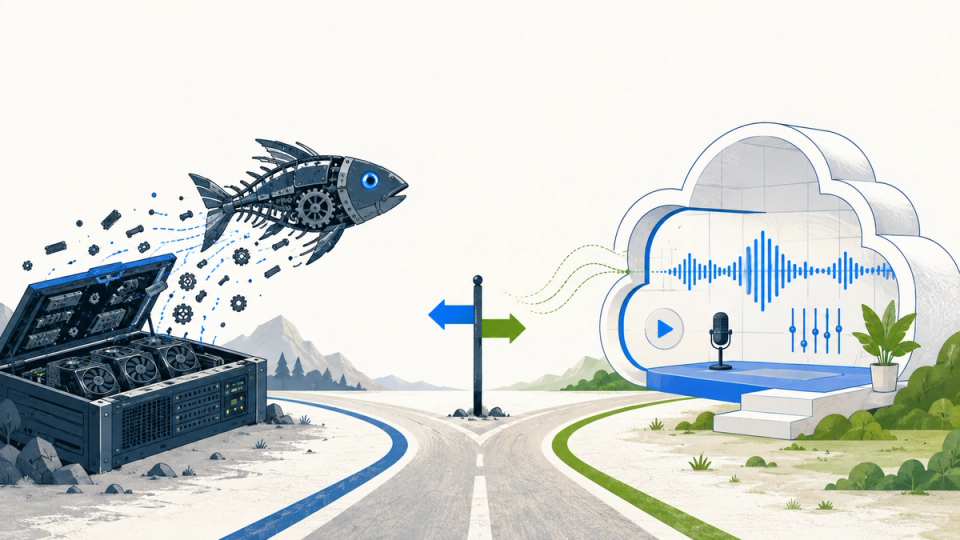
Fish Audio is a voice-generation company whose S2 Pro model ships weights, fine-tuning code, and a streaming inference engine. ElevenLabs is a hosted audio platform built around polished voices, cloning, multilingual text-to-speech, and production APIs.
For researchers, hobbyists, and teams evaluating a self-hosted stack, Fish Audio is now the more interesting model. For a commercial product that needs a simple legal path, dependable operations, and a broad managed audio platform, ElevenLabs remains the safer default. Fish Audio is giving ElevenLabs real competition on model control and price, but “open weights” does not mean “drop it into a paid product.”
That distinction is the story. Fish Audio has made the model layer more accessible. It has not removed the deployment, licensing, GPU, and governance work that a hosted service absorbs for you.
The short answer
For local research and experimentation: Fish Audio S2 Pro.
For a commercial product you need to ship quickly: ElevenLabs.
For fine-grained emotion and prosody control: Fish Audio, if you can run it and clear the license.
For a managed voice stack with support and predictable integration: ElevenLabs.
If you cannot decide: prototype the same script with both, then calculate the cost of a verified, legally usable minute of audio. The raw generation price is only one part of the decision.
Why this comparison matters now
Fish Audio S2’s technical report, published in March 2026, describes an open-sourced text-to-speech system with multi-speaker, multi-turn generation and natural-language control over delivery. The authors report a real-time factor of 0.195 and time-to-first-audio below 100 milliseconds in their production serving setup on a single H200 GPU. The report also says the weights, fine-tuning code, and SGLang inference engine are available publicly.
The freshness caveat matters. These are Fish Audio’s published results, not an independent head-to-head benchmark against the current ElevenLabs models. ElevenLabs publishes its own model and API capabilities, including roughly 75-millisecond latency for Flash/Turbo and roughly 250–300 milliseconds for Multilingual v2/v3. The methodologies are different, so the numbers should establish what to test, not decide the winner for you.
Pricing and license terms checked July 2026.
What is the actual difference between Fish Audio and ElevenLabs?
Fish Audio exposes more of the model stack. ElevenLabs exposes more of the finished product. That is the cleanest distinction.
Fish Audio S2 Pro supports free-form inline instructions such as [whisper], [excited], or [pitch up], plus multi-speaker and multi-turn generation. Its model card lists a 4B slow component and a 400M fast component, and the project documentation recommends at least 24 GB of VRAM for local inference. You get control, but you also inherit hardware, model serving, updates, abuse prevention, and output review.
ElevenLabs gives you hosted APIs, a voice library, voice cloning, multiple TTS models, speech-to-text, dubbing, sound effects, and agent-oriented products behind one account. You give up control over the weights and deployment environment, but you gain a much shorter path from idea to production.
The non-obvious insight is that Fish Audio is not simply “free ElevenLabs.” It is closer to a model foundation plus an engineering project. ElevenLabs is closer to an audio operating layer.
Which is cheaper for a developer?
Fish Audio wins on hosted S2 API list price and can win decisively at scale, but local inference changes the calculation. Fish Audio lists S2.1 Pro and S2 Pro at $15 per million UTF-8 bytes, with one million bytes estimated at about 180,000 English words or 12 hours of speech. ElevenLabs lists Multilingual v2/v3 at $0.10 per 1,000 characters and Flash/Turbo at $0.05 per 1,000 characters. The units are different, so compare your own text corpus rather than multiplying a headline number.
The local Fish option has no per-character API bill after the hardware is running, but a 24 GB-plus GPU, electricity, storage, engineering time, and concurrency management are not free. ElevenLabs’ API price includes managed inference. Its published API page also lists a Creator plan at $11 per month with 220,000 Multilingual v2/v3 characters included, while commercial and enterprise plans add support, limits, and assurance options.
For a small team producing a few hours of narration, ElevenLabs is usually cheaper in calendar time. For a company with sustained volume, in-house GPU capacity, and a valid commercial license, Fish Audio deserves a cost test.
Which one gives builders more control?
Fish Audio wins. S2 Pro’s differentiator is not just that the weights can be downloaded. It is that delivery can be instructed inside the text at fine granularity, and the system can generate multi-speaker dialogue in one pass. That makes it useful for researchers, game developers, and teams building a voice experience where prosody is part of the product rather than decoration.
The catch is reproducibility. A local output depends on model revision, inference settings, reference audio, GPU, quantization, and serving implementation. Fish Audio’s GitHub documentation explicitly recommends a GPU with at least 24 GB of VRAM. A hosted ElevenLabs voice is less hackable, but it is easier to version at the API boundary and hand to a product team.
For an operator who wants to tune the speech system, Fish Audio is the better tool. For an operator who wants to tune the customer experience around speech, ElevenLabs is usually the better tool.
Is Fish Audio really open source?
It is more accurate to call Fish Audio S2 Pro open-weight with public code and a restrictive research license. The model card states that research and non-commercial use are allowed free of charge, while commercial use requires a separate license from Fish Audio. The license definition includes using the model in a paid product, a hosted service, an API, or a company’s internal operations.
That matters more than the marketing shorthand. If you are testing a voice prototype, the released materials can be valuable. If your startup wants to run the model behind a paid application, “the weights are on Hugging Face” is not a sufficient legal review. Ask Fish Audio for commercial terms and keep the answer with the architecture decision.
ElevenLabs has the opposite tradeoff. Its models are not downloadable, but its commercial terms, hosted APIs, enterprise controls, and support model are designed around product use. You still need consent and rights for voice cloning. The hosted model does not remove that responsibility. It does make the enforcement and provenance surface more centralized.
Comparison table
| Dimension | Fish Audio S2 Pro | ElevenLabs |
|---|---|---|
| Deployment | Local or Fish Audio API | Hosted API and platform |
| Model access | Weights, code, and inference engine published | Weights not published |
| Local hardware | Fish documentation recommends at least 24 GB VRAM | No customer GPU required |
| Style control | Inline natural-language tags, prosody, emotion | Model and voice controls through API/product surface |
| Local commercial use | Separate commercial license required | Use governed by ElevenLabs terms and plan |
| Published TTS price | $15 per million UTF-8 bytes for S2 Pro | $0.05 or $0.10 per 1,000 characters, depending on model |
| Reported latency | Below 100 ms TTFA in Fish’s H200 setup | About 75 ms Flash/Turbo, 250–300 ms Multilingual v2/v3 |
| Best default | Research, self-hosting evaluation, controllable speech | Commercial shipping and managed operations |
Where Fish Audio actually wins
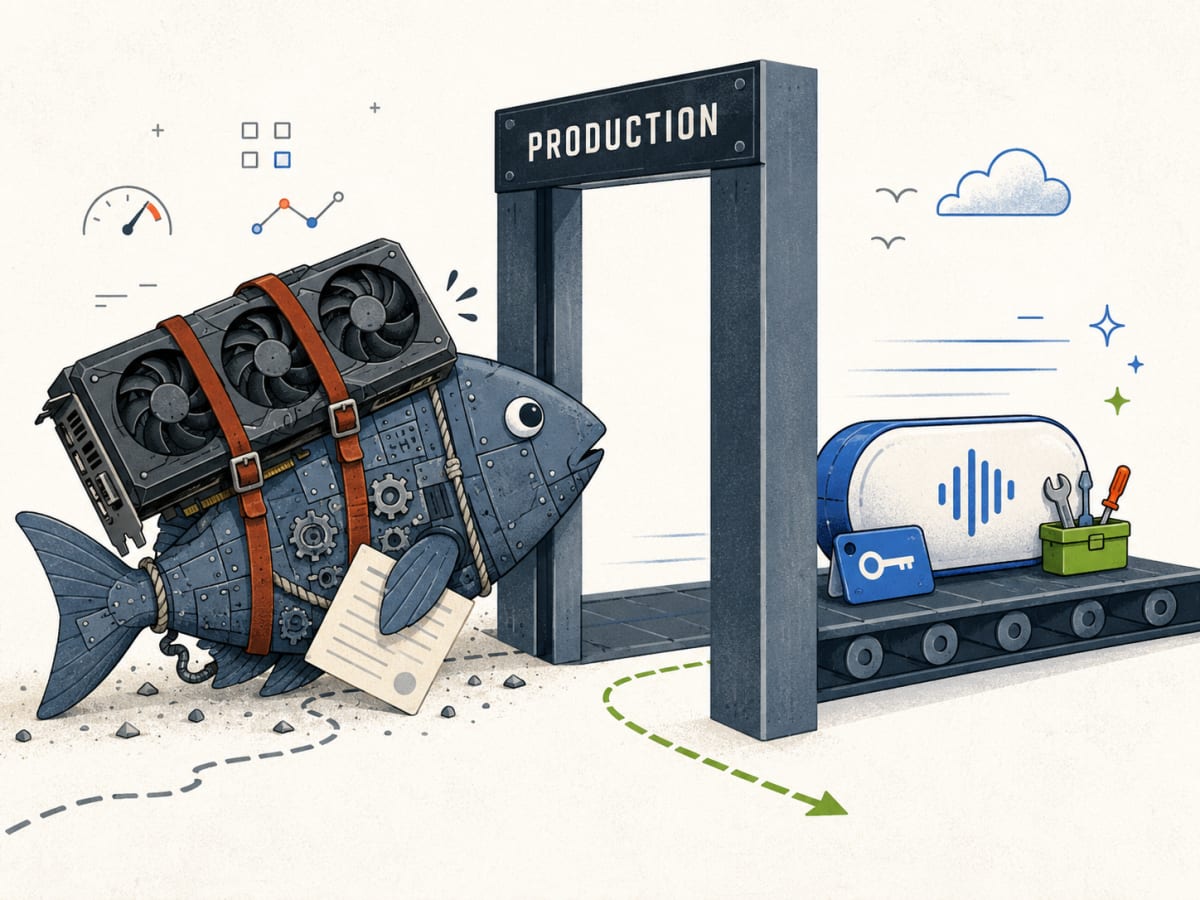
Fish Audio wins when the model itself is the product surface. A research lab can inspect the weights. A developer can change serving behavior. A creative tool can expose expressive tags instead of hiding them behind a small set of sliders. A team with existing GPU infrastructure can test whether local inference reduces marginal cost or data movement.
Its public technical report is also unusually useful because it reports more than a single naturalness claim. It describes multi-speaker generation, long-form synthesis, instruction following, and streaming metrics. On Fish Audio’s own instruction benchmark, S2 reports an overall tag-activation rate of 93.3% and a quality score of 4.51 out of 5, evaluated with Gemini 3 Pro. Those are vendor-reported results, but they point to a testable strength: precise delivery control.
Fish Audio also wins for teams that need to keep sensitive text inside their environment during evaluation or eventual deployment. That advantage disappears if the team uses the hosted API instead of local inference, so architecture matters.
Where Fish Audio loses
The license is the first loss. An open-weight model that requires a separate commercial agreement does not provide the same freedom as an Apache-2.0 or MIT model. It can still be strategically useful, but procurement must happen before launch.
The second loss is operational. The official inference guide recommends 24 GB of VRAM, and the technical report’s strongest latency numbers come from a single H200 setup. Those facts do not tell a small team what latency, cost, or concurrency will look like on its own hardware. The local quality can also diverge from the web demo because reference audio, prompt text, and inference configuration matter.
The third loss is product breadth. Fish Audio’s model is compelling, but ElevenLabs has spent years building the surrounding voice catalog, API surface, dubbing workflow, speech tools, analytics, and enterprise path. If your project needs those pieces, assembling them around a model can erase the apparent savings.
Where ElevenLabs actually wins
ElevenLabs wins when reliability and time-to-market are worth paying for. A team can call a documented API, choose a voice, add usage limits, and ship without operating a GPU service. Its current API catalog spans TTS, speech-to-text, voice changing, isolation, dubbing, music, and sound effects. That breadth makes it a better default for a product team building an audio feature rather than an audio research platform.
It also wins for teams that need a managed path through commercial usage, enterprise support, concurrency, and service-level expectations. ElevenLabs does not publish every enterprise detail on its public pricing page, so buyers still need a sales conversation. But that conversation is part of the product, not an infrastructure gap the buyer must fill alone.
Where ElevenLabs loses
ElevenLabs’ main weakness is lock-in. Your voices, model behavior, and operational assumptions live inside a hosted system. Moving later may require retesting every voice, rebuilding prompts, and revisiting consent and provenance workflows.
The second weakness is cost at sustained volume. The API is convenient, but convenience compounds into a meaningful operating line item. If audio generation becomes core infrastructure, a team should benchmark hosted cost against a properly licensed local or private deployment instead of assuming the first API bill is the long-term architecture.
The third weakness is less control over failure modes. You can tune requests and choose among available models, but you cannot inspect or patch the model when a particular accent, pronunciation, or prosody pattern matters to your product.
The decision rule
Run a 100-sample bake-off using your actual text, voices, languages, and failure cases. Score pronunciation accuracy, speaker similarity, controllability, long-form consistency, time to first audio, total cost, and human correction time. Then add two non-audio fields: commercial rights and operational ownership.
Choose Fish Audio if it wins enough quality or control points to justify GPU operations and you can secure the license. Choose ElevenLabs if the value is in shipping a dependable feature quickly. Do not choose Fish Audio only because the weights are downloadable. Do not choose ElevenLabs only because its demo sounds polished.
For voice-agent work, the model is one layer of the stack. The handoff, moderation, consent, observability, and recovery behavior matter just as much. For a broader platform view, see ElevenLabs vs Vapi vs Retell for lead capture. The Spotify ElevenLabs infrastructure story shows why hosted voice is becoming a platform decision, while why Studio by Spotify Labs points toward local audio covers the local deployment angle.
FAQ
Can I use Fish Audio S2 Pro in a commercial app?
Not under the default research license. The S2 Pro model card says commercial use, including use in a paid product, hosted service, API, or business operation, requires a separate written license from Fish Audio. Treat commercial permission as an unresolved dependency until you have that agreement.
Does Fish Audio sound better than ElevenLabs?
There is no reliable universal winner from the public evidence. Fish Audio reports strong controllability and benchmark results, while ElevenLabs offers polished hosted models and a broad production platform. Evaluate your own scripts, voices, languages, and long-form samples. A model that wins a benchmark can still lose on your pronunciation or style requirements.
What GPU do I need to run Fish Audio S2 Pro locally?
Fish Audio’s inference documentation recommends at least 24 GB of VRAM. That is a starting point, not a production capacity guarantee. Measure memory, latency, concurrency, quantization effects, and long-form stability on the hardware you intend to operate.
Is Fish Audio cheaper than ElevenLabs?
Its published API price is lower on some workloads, and local inference may reduce marginal cost after hardware and licensing are accounted for. ElevenLabs may be cheaper for a small team because it avoids GPU operations. Compare total cost per approved minute, including engineering, infrastructure, review, and failed generations.
Should a startup switch from ElevenLabs to Fish Audio now?
Only if the startup has a concrete reason to own the model layer, such as privacy, controllability, sustained volume, or deployment flexibility. Run a parallel bake-off and request commercial terms first. If the benefit is merely a lower API bill, test Fish Audio’s hosted API before taking on local infrastructure.