
Biohub's Protein World Model Is Zuckerberg's Real AI Bet
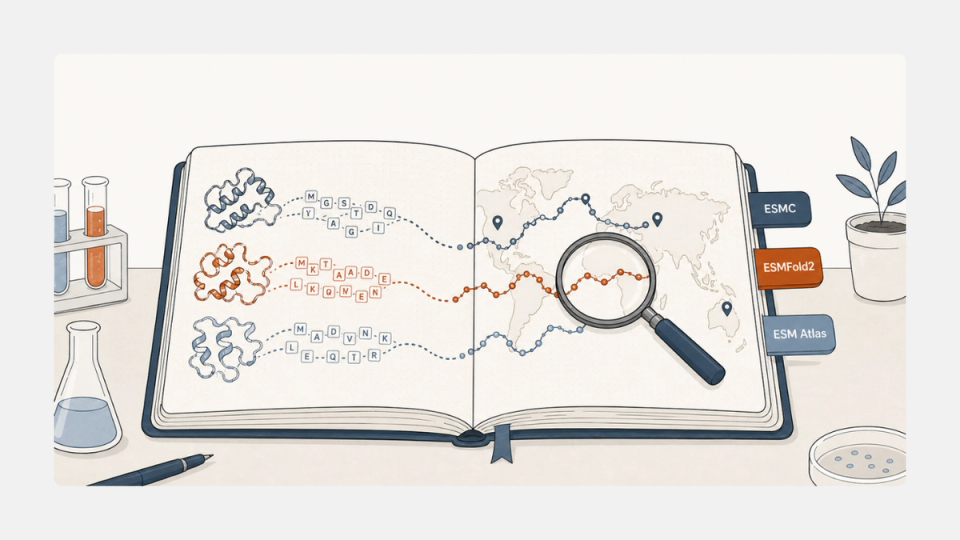
Biohub's protein world model is an open AI system for mapping, folding, and designing proteins across the tree of life. On May 27, 2026, the Mark Zuckerberg and Priscilla Chan-backed research organization released three connected artifacts: ESMC, ESMFold2, and ESM Atlas, positioning them as a shared engine for protein prediction, design, and discovery.
The important part is not the phrase "world model." That label has been stretched across robotics, video, games, and now biology until it almost means "a model we are very excited about." The important part is what Biohub claims the system can now do: learn from billions of protein sequences, predict atomic-resolution structures, and design binders that worked in laboratory experiments against cancer and immunology targets.
If that holds up outside Biohub's own benchmark suite, Zuckerberg's most consequential AI bet may not be Meta's consumer assistant or the robot thesis behind Meta's $145B Spend Only Makes Sense If You Believe in Robots. It may be a quieter attempt to make biology searchable, simulatable, and eventually programmable.
The Quick Answer
What did Biohub release?
Biohub released an open protein-biology stack built around ESMC, ESMFold2, and ESM Atlas. ESMC is the protein language model. ESMFold2 turns model representations into 3D structures and binder designs. ESM Atlas lets researchers search 6.8 billion protein sequences and 1.1 billion predicted structures.
Why does it matter?
Protein discovery is still slow because researchers often have to move from idea to wet-lab experiment before they know whether a design has any chance. Biohub is trying to move more of that search into computation, where thousands or millions of hypotheses can be ranked before anyone touches a pipette.
The non-obvious truth: this is less like ChatGPT for proteins and more like a biological search engine with a design loop attached. The release matters because it connects representation learning, structure prediction, and experimental binder validation in one open workflow.
What is a protein world model, really?
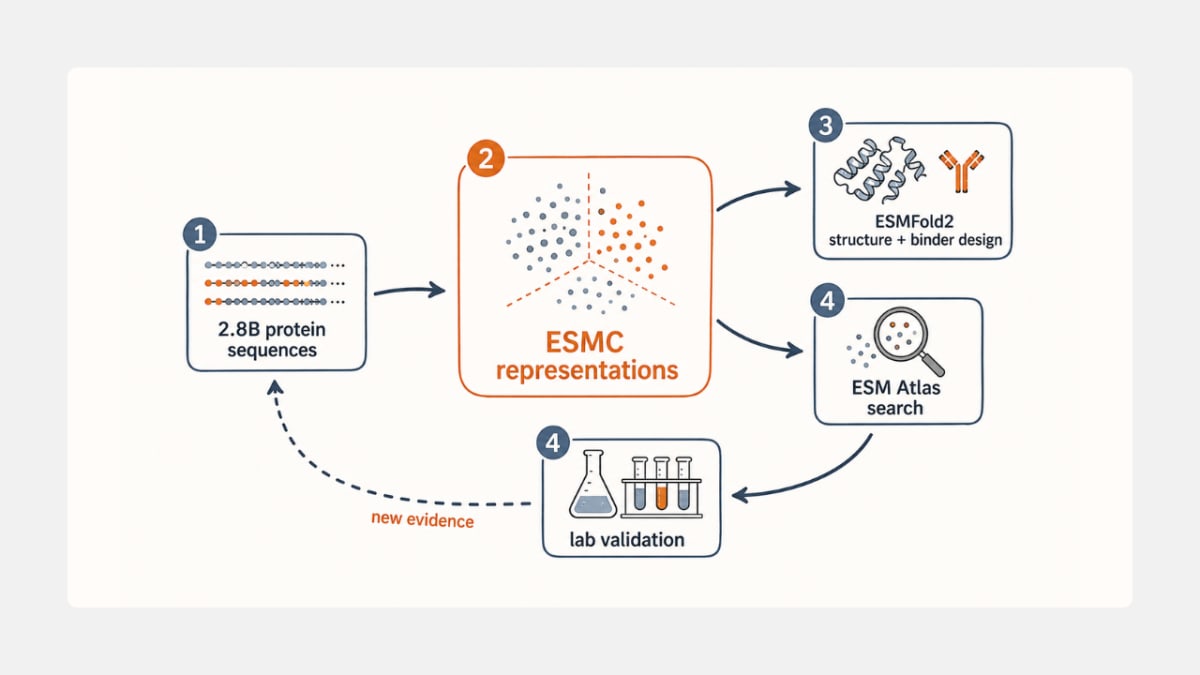
A protein world model is a learned representation of the rules that govern how protein sequences fold, interact, and function. Biohub's core hypothesis is that training on protein sequences from across life forces a model to internalize some of the evolutionary constraints that shaped working proteins.
That sounds grand, so strip it down. Proteins are chains of amino acids. Those chains fold into shapes. Those shapes determine interactions. Those interactions drive signaling, immunity, metabolism, disease, and most of the drug targets medicine cares about.
Traditional structure biology gives you a precise answer, but slowly. X-ray crystallography, cryo-EM, and NMR are powerful, expensive, and not always available for the complex you care about. AlphaFold changed the default expectation for single-protein structure prediction. Biohub is trying to push the next boundary: complexes, antibodies, binders, and biological relationships across proteins that have never been annotated.
The system has three pieces:
- ESMC is the language model trained on roughly 2.8 billion protein sequences. It learns representations of protein biology from evolutionary data.
- ESMFold2 predicts all-atom 3D structures directly from amino-acid sequences, with optional multiple sequence alignment input for harder targets.
- ESM Atlas makes billions of protein sequences and predicted structures searchable, including relationships the model infers but existing databases may not yet annotate.
This is why the word "world model" is at least defensible here. Biohub is not just predicting the next amino acid. It is claiming that the hidden states of a scaled protein model encode reusable biological structure: families, functions, interfaces, evolutionary neighborhoods, and design constraints.
The closest AI analogy is not a chatbot. It is a multimodal model whose internal representation becomes the product. The same pattern showed up in vision with natively multimodal systems like Muse Spark's Real Superpower Isn't Reasoning. It's Seeing. In both cases, the model is useful because its learned representation becomes a map of a domain, not merely because it can emit a plausible output.
What did Biohub actually prove in the lab?
Biohub's strongest claim is not that ESMFold2 predicts structures. It is that the model helped design binders against five disease-relevant targets, and those designs showed measurable binding in laboratory experiments. That moves the story from benchmark theater into early experimental biology.
The targets were EGFR, PDGFR-beta, PD-L1, CTLA-4, and CD45. Biohub says these sit at the center of cancer and immunology research: EGFR and PDGFR-beta are tied to tumor growth, PD-L1 and CTLA-4 are immune checkpoints, and CD45 regulates immune cell signaling.
In its release, Biohub reported hit rates of 36-88% for compact minibinders and 15-29% for antibody-derived formats, with confirmed binding in lab experiments. For PD-L1, it says designed binders restored T-cell signaling in lab tests by blocking the same pathway targeted by approved checkpoint therapies.
Those numbers are the part worth staring at. Early binder discovery normally burns enormous time because most designs fail. Biohub's public framing says a single preclinical binder candidate typically takes three to four years to develop, while ESMFold2 lets researchers produce experimentally testable candidates in days.
Alex Rives, Biohub's head of science, put the claim plainly: the model can help design protein interfaces that "function as predicted." That is the bar that separates a useful biology model from a beautiful hallucination machine.
Still, a binder is not a drug. Binding in vitro does not prove safety, delivery, pharmacokinetics, manufacturability, immune tolerance, or clinical efficacy. The optimistic reading is that Biohub compressed a painful search step. The sober reading is that drug discovery contains many painful steps, and this release mostly attacks the first one.
Why is ESM Atlas the underrated part?
ESM Atlas may matter more than the flashier binder-design demos because it turns uncharacterized biology into something researchers can navigate. Biohub says the Atlas covers 6.8 billion protein sequences and 1.1 billion predicted structures, organized by relationships learned by ESMC.
That scale changes the user interface of biology. If you are studying a disease pathway, a bacterial enzyme, a gene-editing system, or an immune protein with thin annotations, the limiting factor is often not that no biology exists. It is that the relevant biology is buried across evolutionary distance, messy databases, and proteins nobody has characterized.
A searchable atlas does not solve that problem by itself. But it can make strange neighbors visible. Biohub says the Atlas surfaced evolutionary links between gene-editing enzymes across distant branches of life that existing databases had not captured. That is exactly the kind of thing a representation model should be good for: not replacing experimental biology, but proposing connections humans would not have searched for first.
This is the same category shift AI teams keep chasing elsewhere. The model starts as a predictor, then becomes an interface. In consumer AI, that is why How Gemini Omni Actually Works Under the Hood matters: a single representation across modalities changes what the product can be. In biology, a shared representation across sequence, structure, function, and evolutionary relationships could change how researchers ask questions.
The sparse autoencoder work is also worth noting. Biohub says it trained SAEs on ESMC representations to decompose internal states into roughly 16,000 interpretable features, with natural-language descriptions generated by an agentic pipeline. That does not make the model transparent in the full scientific sense. But it is a serious attempt to turn "the model learned something" into inspectable biological hypotheses.
Why did Zuckerberg and Chan put this inside Biohub?
This release is part of a larger institutional bet. In November 2025, Zuckerberg and Chan announced a Biohub push combining frontier AI and frontier biology, and the EvolutionaryScale team behind ESM joined Biohub. In April 2026, Biohub followed with a five-year, $500 million Virtual Biology Initiative: $100 million for coordinated global data generation and $400 million for data at scale plus technologies for measuring, imaging, and engineering biology.
That matters because foundation models for biology are not just model problems. They are data problems, measurement problems, validation problems, wet-lab automation problems, and governance problems. A protein model trained on public sequences can go far. A virtual-cell model that predicts disease mechanisms across contexts needs a different order of data quality.
This is where Zuckerberg's biology strategy diverges from the AI product race. Meta can ship a consumer assistant and watch usage. Biohub has to build an instrumented scientific loop: generate data, train models, propose interventions, validate in the lab, feed the results back, and make the tools available enough that outside researchers stress-test them.
There is also a reputational reason to keep the work in Biohub rather than Meta. Researchers will argue about licenses, safety, and open access, but a nonprofit biomedical research organization is a more plausible home for disease-focused open science than a social-platform company. That does not remove governance concerns. It gives the project a structure where open release is not obviously in conflict with advertising incentives.
Where does the hype break?
The hype breaks at clinical translation. ESMFold2 can help propose binders. It cannot tell you whether a molecule will become a safe therapy in humans. It cannot remove the need for experimental validation. Biohub's own Hugging Face model card says generated outputs should be treated as hypotheses requiring validation, not established biological facts.
The hype also breaks at data coverage. ESMFold2 is trained on PDB and AlphaFold DB-derived data. Those resources are extraordinary, but they are not a complete measurement of living biology. The model card names familiar limitations: overrepresented protein families, missing conformations, post-translational modifications, disordered regions, and performance variation on underrepresented types.
The safety question is real too. Protein design is dual-use. Biohub says it conducted risk assessments for this release and uses guardrails on the platform to restrict controlled pathogen and toxin-related use. That is necessary, but not magic. Open code and weights are powerful precisely because they travel beyond the original host's interface.
The final limit is semantic. Calling this a world model can invite the wrong mental picture. It is not a complete simulator of a cell, an organism, or disease. It is a protein-centered representation system with impressive evidence that evolution-trained models can predict and design useful molecular interactions. That is enough to be important. It does not need to be mythologized into a digital twin of life.
The Honest Take
Biohub's release is important because it collapses three pieces of the protein-discovery workflow into one open stack: learned representation, structure prediction, and experimental design. The leap is not that AI can draw a protein shape. The leap is that the same representation can organize the protein universe, guide design, and produce lab-testable binders.
But the honest version is narrower than the headline. This is not "AI cures disease." It is "AI may reduce the search cost of early protein biology." That is still a big deal. Drug discovery is full of compounding attrition, and shaving years off the wrong early step does not guarantee a cure. But shaving years off a recurring early step across many labs is how a field's tempo changes.
The open release is also strategically meaningful. If Biohub had kept ESMFold2 and Atlas behind a closed interface, the story would be another rich lab showing a demo. By releasing code, weights, platform access, and an atlas, Biohub is inviting the scientific community to find the failure modes. That is uncomfortable. It is also how useful infrastructure becomes trustworthy.
The thing to watch next is not another benchmark chart. Watch independent binder-design replications, weird edge cases in underrepresented proteins, safety-response norms around open protein design, and whether the Atlas becomes a daily research surface rather than a launch-week curiosity.
The Bottom Line
Biohub's protein world model is Zuckerberg and Chan's clearest answer to what AI-powered biology is supposed to mean in practice. It is not a chatbot for scientists. It is a compute-native protein discovery loop: map the space, predict the structure, design the interaction, test the result, and feed the evidence back.
The release should make AI builders pay attention because it shows what frontier models look like outside language and media. The prize is not content generation. It is a domain where better representations can change the cost curve of discovery.
The cautious conclusion is the right one: this is not a cure machine. It is a new kind of scientific instrument. If independent labs can reproduce the binder-design results and turn the Atlas into real biological discoveries, Biohub may have built one of the first genuinely useful world models in AI: not because it dreams about the world, but because it helps scientists search the parts of life they could not see before.