
The Best Local AI Assistant in 2026: Gemma, Llama, Qwen, or Mistral?
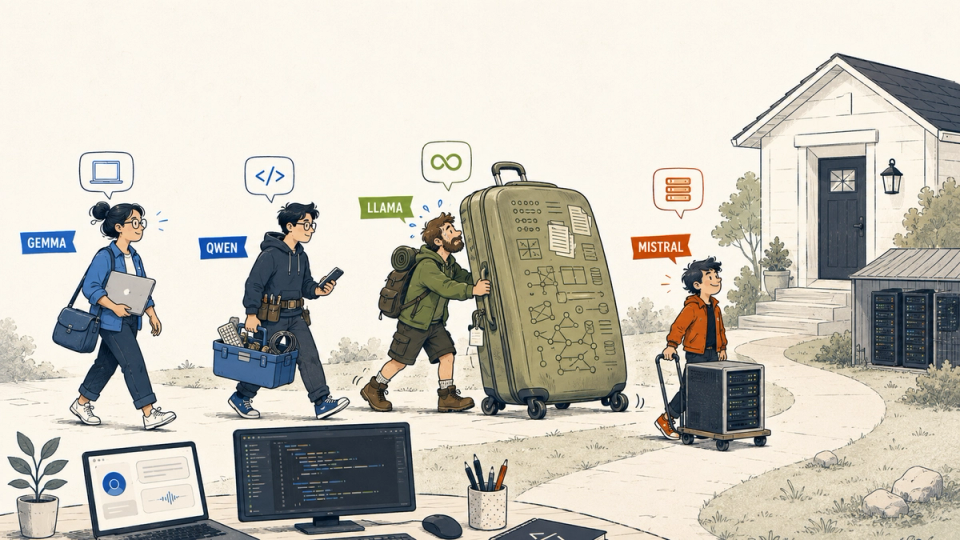
Gemma 4 is Google's open-weight multimodal model family, Llama 4 is Meta's natively multimodal MoE family, Qwen is Alibaba's open-weight model line with thinking and non-thinking modes, and Mistral Small 4 is Mistral's hybrid instruct, reasoning, and coding model. All four can be run locally, but they are not interchangeable downloads.
For most people with a modern laptop or a single consumer GPU, Gemma 4 is the best local AI assistant in 2026 because it offers the most usable range of small-to-medium checkpoints, strong multimodal support, and a clear path from edge hardware to a desktop. Qwen is the better choice when coding and experimentation matter more than simplicity. Llama 4 wins on ecosystem and long-context ambition, but its flagship local experience assumes substantially more hardware. Mistral Small 4 wins on a properly provisioned local server, not on an ordinary laptop.
The surprise is that “best model” is the wrong first question. The useful question is: which model reaches acceptable quality on the hardware you already own, with a runtime and license you can actually operate? Last updated July 2026.
The short answer
For a laptop assistant: Gemma 4 E4B or 12B. Choose E4B when responsiveness matters; choose 12B when you have the memory.
For local coding and tool use: Qwen3.6-35B-A3B if your machine can run it comfortably; otherwise Gemma 4 12B or 26B A4B.
For multimodal experiments and the broadest community ecosystem: Llama 4 Scout, provided you have serious GPU memory and accept Meta's usage terms.
For a self-hosted workstation or small server: Mistral Small 4, if you can dedicate roughly H100-class memory at useful precision. It is powerful, but it is not a lightweight desktop assistant.
If you cannot decide: start with Gemma 4 E4B in your preferred local runtime, then test the same 20 prompts against Qwen. A model that runs every day beats a larger model that makes you manage its infrastructure.
Why this comparison matters now
The local-model market changed in 2026 because “local” stopped meaning “text-only 7B chatbot.” Google's Gemma 4 now spans E2B, E4B, 12B, 26B A4B, and 31B variants, with multimodal inputs, native system prompts, function calling, and context windows up to 256K. Meta's Llama 4 Scout advertises a 10-million-token context window, while Mistral Small 4 combines instruct, reasoning, and coding in one 119B-parameter MoE model. Qwen's current open-weight line keeps pushing the useful middle: sparse models that aim for much of a larger model's quality without activating every parameter on every token.
That creates a practical problem. Model cards increasingly describe what a model can do in a lab, while local users care about four less glamorous constraints: download size, quantization quality, runtime compatibility, and sustained memory use. The headline context window is also not the same as a comfortable local context window. A model can accept a long prompt and still be too slow, too memory-hungry, or too unreliable for daily work.
The facts below were checked in July 2026 against the Gemma 4 model overview, Meta's Llama 4 release, the Qwen3 release post, the Qwen3.6-35B-A3B announcement, and Mistral's model documentation. Published benchmark results are vendor-reported unless stated otherwise.
The core comparison
Which model is best for an ordinary laptop?
Gemma 4 wins because Google explicitly offers small variants designed for mobile and laptop deployment: E2B, E4B, and 12B. Llama 4 Scout may be described as fitting on a single H100 with Int4 quantization, but that is a server GPU, not a normal laptop. Qwen has smaller options, while Mistral Small 4 is dramatically outside ordinary laptop memory budgets.
Gemma's advantage is not just parameter count. Its official distribution includes quantization-aware checkpoints and mobile-optimized variants, and Google recommends the 26B A4B model as a starting point when hardware allows. That gives users a sensible ladder: start small, keep the same family, and move up only when the workload justifies it.
On a 16GB laptop, do not begin by chasing a model's maximum context. Start with a 4B–12B quantized model, cap the context at the length your workflow actually needs, and measure tokens per second while the machine is warm. The best local assistant is the one that remains responsive while your browser, editor, and notes are open.
Which is better for coding and tool use?
Qwen is the best first experiment for developers who want strong coding, controllable thinking, and broad local-runtime support. Gemma 4 is the better default when you also need image input, audio on supported variants, or a more straightforward deployment ladder. Llama 4 can be excellent, but its hardware and licensing overhead make it a less forgiving starting point.
Qwen3 introduced a unified thinking and non-thinking mode: spend more compute on a hard debugging task, then switch to a faster mode for routine edits. The Qwen team framed the release in four words—“Think Deeper, Act Faster”—and that captures its practical appeal. The model family is built for users who will tune prompts, swap runtimes, test quantizations, and wire tools themselves.
Qwen's newer Qwen3.6-35B-A3B offers open weights, 35B total parameters with 3B activated parameters, and a 131,072-token context in the provider configuration documented by Qwen. That does not make it a free lunch: total weights, KV cache, quantization format, and runtime kernels still determine whether it feels local on your machine. But it is a strong fit for codebase Q&A, structured edits, and terminal workflows when you have enough memory.
Gemma 4 is more attractive for a mixed assistant: read a screenshot, summarize a PDF, call a function, then answer in text. Its official overview lists multimodal input, native system-role support, and function-calling capabilities across the family. For code-only work, Qwen often gives you more knobs; for a general assistant, Gemma asks for fewer compromises.
Is Llama 4's context window useful locally?
Yes, but only for a narrow class of users. Meta lists Llama 4 Scout at 10M context and Maverick at 1M, but the model family is not a lightweight local download in the way the marketing phrase “open-weight” may suggest. Meta's own repository says full-precision Llama 4 inference requires multiple GPUs, and even Int4 Scout examples assume an 80GB GPU.
That makes Llama 4's context window most useful for a server, a well-equipped workstation, or a hosted endpoint that happens to use open weights. It is less useful as a personal laptop assistant. Long context also consumes memory through the KV cache; loading the weights is only the first bill. If your real task is a 300-page document or a medium-sized repository, retrieval plus a smaller model can be faster and cheaper than trying to keep millions of tokens resident.
Llama 4 still has a meaningful advantage: ecosystem gravity. Meta's models are supported by a wide range of serving stacks, adapters, evaluation tools, and community examples. If you are building a product that must be portable across vendors, Llama is a safer ecosystem bet than a model with fewer integrations. If you are choosing a private daily assistant, that advantage may never pay back the hardware cost.
Is Mistral Small 4 actually small enough for local use?
No—not in the consumer-laptop sense. Mistral calls Small 4 a hybrid model, but its official offline-model guidance says the 119B MoE model needs significantly more VRAM and recommends at least an H100 80GB at FP8 for holding the weights. Its 256K context makes it useful for a self-hosted server, yet the deployment profile is closer to “private inference service” than “install it on your MacBook.”
The name creates the trap. “Small” is a product tier, not a promise that the model is small enough for a laptop. Mistral Small 4 is a compelling choice when the requirement is to keep a capable model inside your network, expose it through an internal API, and serve several users from dedicated hardware. It is a poor choice if your requirement is instant setup, low power draw, or a battery-friendly personal assistant.
Mistral's licensing also deserves a deliberate review. Mistral says most open models use Apache 2.0, while some models use a modified MIT license with a commercial-revenue condition. Check the individual model card and license before shipping a commercial product; “open weights” does not mean every model has identical commercial terms.
The comparison table
| Decision dimension | Gemma 4 | Llama 4 | Qwen | Mistral Small 4 |
|---|---|---|---|---|
| Best local starting point | E4B or 12B | Scout only with serious hardware | Qwen3.6-35B-A3B or smaller Qwen variant | Dedicated server |
| Model shape | Dense + MoE + unified variants | MoE | Dense and MoE families | 119B MoE |
| Context headline | 128K small; up to 256K medium | 10M Scout; 1M Maverick | 131K in Qwen3.6 provider config | 256K |
| Multimodal input | Text/image; audio on E2B, E4B, 12B | Native text/image, with video-frame support | Depends on the checkpoint | Model-dependent multimodal support |
| Local hardware fit | Mobile to workstation | Workstation/server | Small-to-large range | H100-class server recommended |
| License posture | Gemma 4 Apache 2.0 | Meta Llama license and use policy | Check the exact checkpoint | Apache 2.0 or modified MIT by model |
| Best reason to choose it | Balanced daily assistant | Ecosystem and long context | Coding control and experimentation | Private high-capability serving |
Where each model actually wins
Gemma 4 wins for the default personal assistant
Choose Gemma 4 when “local assistant” means a private tool that runs beside your normal work. The family gives you a clear progression from edge devices to laptops, desktops, and servers. E4B is the sensible responsiveness pick; 12B is the quality pick for a stronger laptop or desktop; 26B A4B and 31B are for users with dedicated GPU memory.
Gemma also wins when one assistant must handle more than code. Its multimodal inputs, supported audio variants, function calling, and long context make it a better general-purpose base than a model optimized mainly for text and code. The tradeoff is that Gemma is a Google model with its own terms and safety behavior, not a blank canvas.
If you want a practical setup walkthrough, start with how to build a local AI assistant with Gemma 4, then benchmark your own prompts rather than copying a leaderboard verdict.
Llama 4 wins for ecosystem-first builders
Choose Llama 4 if you are building an application whose life depends on community tooling, vendor support, and portability. Meta's open-weight release is widely packaged, and Scout's context design is genuinely unusual. It is the model family to investigate when your workload involves large multimodal corpora and you have infrastructure to match.
Llama is also a good strategic choice when the model itself is one component in a bigger stack. You may not run it on a laptop, but you can deploy it behind an internal endpoint and use the same family across experiments and production. That is a different definition of local: your data stays inside infrastructure you control, even if the assistant is not on your desk.
Qwen wins for hands-on developers
Choose Qwen if you want to tinker. Qwen's thinking toggle, dense and MoE range, coding focus, and support across Ollama, LM Studio, llama.cpp, Transformers, and other runtimes make it a strong developer's model family. It is particularly appealing when you want to compare quantizations, change inference settings, and build tool loops rather than install a single polished assistant.
Qwen's weakness is choice overload. “Qwen” is not one behavior. The exact checkpoint, instruct tuning, thinking mode, quantization, tokenizer, and runtime all matter. Save the model ID and quantization in your notes; otherwise a later upgrade can quietly change the assistant you thought you were evaluating.
Mistral Small 4 wins for controlled private serving
Choose Mistral Small 4 when you have a real reason to operate a capable model inside your own environment: sensitive documents, internal coding infrastructure, predictable latency, or an API shared by a small team. Its hybrid design is attractive because one model can cover instruction following, reasoning, and coding workloads.
It loses when the user is one person on a laptop. The hardware requirement, operational surface, and license review are all too heavy for casual use. In that situation, a smaller Mistral model may be a better fit than Small 4 itself.
Where each model actually loses
Gemma 4 loses when you want the broadest possible community fine-tuning culture or when a particular tool only supports Llama-family prompt formats. It also has multiple variants with different modality and deployment properties, so “Gemma 4” is not precise enough for a reproducible benchmark.
Llama 4 loses on friction. Its open-weight status can make it feel accessible, but the local memory requirements are closer to a serious workstation or server than a typical personal computer. The context headline is impressive; it does not remove the cost of storing and processing that context.
Qwen loses on operational consistency. The ecosystem moves quickly, and the name can hide substantial differences between releases. It is powerful for someone willing to test; it is less ideal for a non-technical user who wants updates to be boring.
Mistral Small 4 loses on the word “small.” It is a serious model for serious hardware. If your goal is a quiet, low-power, offline assistant, this is the wrong tier even if the quality is attractive.
The non-obvious insight: runtime is part of the model
The biggest mistake in local AI comparisons is treating the model file as the product. The actual product is the tuple of checkpoint, quantization, runtime, context limit, hardware, prompt template, and tool wrapper.
That is why two people can report opposite experiences with “the same model.” One is using a Q4 quant on a fast GPU with a 16K context; the other is using a different quant on CPU with a 128K context and a tool loop that adds thousands of tokens per turn. The second setup may be slower, less coherent, and more likely to hit memory pressure even though the model name is identical.
Use this three-stage test before choosing a winner:
- Capability: Run 20 representative prompts: five factual, five coding, five structured-output, and five multimodal or private-document tasks.
- Operation: Repeat them after 30 minutes of normal computer use. Record latency, memory pressure, crashes, and whether the runtime remains usable.
- Workflow: Add your real tools, files, and context. A model that answers well in a blank chat but fails function calls or loses structure in your editor is not the better assistant.
This is also why hardware comparisons matter. NVIDIA RTX Spark vs Apple M5 is useful context for the battery-versus-CUDA tradeoff, while Google's on-device AI work shows why the local-versus-cloud boundary is becoming a product decision rather than just a model decision.
The bottom line
Gemma 4 is the best local AI assistant for most people in 2026. Its family is broad enough to fit real personal hardware, capable enough to handle text, images, and tools, and structured enough that you can scale from E4B to larger variants without changing your entire workflow.
Pick Qwen when you are a developer who values coding performance and control more than a polished default. Pick Llama 4 when ecosystem portability and very long multimodal context justify serious hardware. Pick Mistral Small 4 when “local” means a private internal service, not a laptop app.
Your next step is simple: choose the smallest checkpoint that fits comfortably, run the same 20-task test for a week, and only then move up. Local AI rewards fit more than hype.
FAQ
Is Gemma 4 better than Llama 4 for local use?
For most laptops and single-GPU desktops, yes. Gemma 4 has smaller official variants and a deployment path aimed at mobile, edge, and laptop hardware. Llama 4 is more attractive for multimodal workloads, ecosystem breadth, and very long context, but its flagship local requirements are much higher.
Which local model is best for coding in 2026?
Qwen is the best first test for developers who want thinking controls, coding strength, and runtime flexibility. Gemma 4 is the better general assistant if coding is only one part of the workload. Test the exact checkpoint and quantization on your own repository; family-level labels are too broad to settle coding quality.
Can I run Llama 4 Scout on a laptop?
Not as a comfortable default. Meta describes Scout as fitting on a single H100 with Int4 quantization, and its advertised context window is 10M tokens. A consumer laptop has far less memory and much weaker sustained throughput. A smaller Llama checkpoint or another model family is usually the better laptop choice.
Is Mistral Small 4 a small local model?
It is small relative to Mistral's largest models, not relative to consumer hardware. Mistral's offline guidance recommends at least an H100 80GB at FP8 for holding the weights. Treat Small 4 as a private server model unless your workstation has unusually large GPU memory.
Does a larger context window make a local assistant better?
Only when your workload benefits from it and your hardware can sustain it. Context increases memory use and can reduce speed. For many personal workflows, retrieval over the relevant files plus a smaller context produces a faster and more reliable assistant than keeping an entire repository or document archive in memory.