
Anthropic’s Claude Watermark System Explained
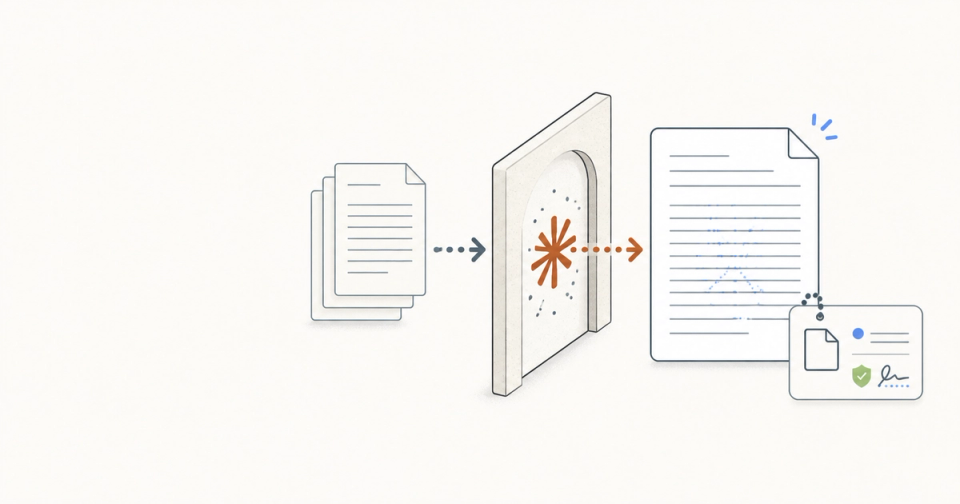
Anthropic started adding machine-readable marks to content produced by Claude models launched in the European Union on or after August 2, 2026. The system works in two ways: an imperceptible statistical watermark woven into generated text, and digital signatures in metadata attached to files Claude creates or processes. Anthropic says the marking operates wherever Claude is offered, not only inside the EU.
That matters because the mark is about model involvement, not a legal finding about authorship. If Claude edits, translates, summarizes, or formats a human-written document, the result may still carry a Claude mark. The practical shift is simple: teams can no longer treat “I wrote the source material” as the same thing as “the final artifact has no machine provenance.”
What happened
Anthropic’s official explanation of how Claude marks AI-generated content says supported models mark text at generation time. The watermark is designed to be invisible to readers, but detectable by a machine that knows how to look for it. Anthropic has not published a general-purpose public detector or described the secret parameters that would let anyone independently verify a result.
For files, Anthropic uses metadata-based marking. A generated or processed file can carry a digital signature that indicates Claude handled it. This is a different mechanism from text watermarking: it travels through file metadata rather than through the token choices that form a paragraph.
The timing is regulatory. Article 50 of the EU AI Act’s transparency regime became applicable on August 2, 2026, and requires providers to make synthetic or manipulated content identifiable in specified circumstances. Anthropic says models launched on or after that date support marking at launch, while older models have until December 2 to be brought into compliance.
Anthropic’s public description also includes caveats. A mark can be harder to detect when text is heavily rewritten, mixed with other writing, translated, or too short. File metadata can be lost when a file is converted, screenshotted, or otherwise stripped of its original properties. A positive detection is therefore evidence that Claude may have handled the content—not proof that Claude was the sole author.
The distinction is already visible in the way the news has been reported. Axios described the change as a system that can mark content “wherever Claude is offered, worldwide,” while noting that Anthropic’s own examples include proofreading, formatting, and translation. That is a bigger product-policy change than a small compliance label: the model’s participation can become part of the artifact’s lifecycle.
For context, this arrives after Anthropic has steadily pushed Claude from a chat model toward a work surface. Our earlier coverage of Claude Opus 4.8 and Claude Code as a platform update looked at that shift from model calls to agent infrastructure. Watermarking extends the same model-level control into the outputs those workflows leave behind.
Does Anthropic’s watermark prove that Claude wrote the document?
No. The mark is better understood as provenance evidence that Claude generated or transformed some of the content. Anthropic explicitly warns that Claude may not be the original author when it edits, translates, summarizes, or formats material. A detector should not be used as a binary authorship verdict.
That limitation is not a footnote. It changes how schools, publishers, employers, and compliance teams should interpret a future “Claude detected” result. The right question is not “Did a human write this?” in the abstract. It is “What did Claude do, which version handled it, and what human review happened afterward?”
This is also why watermarking should not be confused with today’s generic AI detectors. A detector that guesses from style or token statistics is making an inference about likely machine writing. A watermark detector is looking for a signal deliberately inserted by the model provider. The second can be stronger when the signal survives, but it is still bounded by coverage, access to the detector, and the amount of text available.
Research on text watermark reliability points in the same direction. A study of large-language-model watermarks found that after strong human paraphrasing, a mark could still be detectable after roughly 800 tokens on average under its tested false-positive setting—but that result belongs to the study’s system and assumptions, not Anthropic’s undisclosed implementation. The useful takeaway is not that rewriting always defeats a watermark or that every mark survives. It is that detectability is statistical, not magical.
Will the watermark affect people who only use Claude for editing?
Potentially, yes. Anthropic says content can carry a mark when Claude is used to proofread, translate, summarize, or convert human-originated material. That makes the mark a record of AI assistance rather than a reliable measure of how much original thinking came from a model. Editorial and communications workflows should document the intervention instead of treating the mark as a misconduct signal.
The operational impact is largest for work that changes hands. A comms team may draft a release in Google Docs, ask Claude to tighten it, export it to a CMS, and send it to legal. A publisher may translate a human-written article. A developer may ask Claude Code to refactor a human-written source file. In each case, the organization needs an audit trail that explains the transformation, because the final artifact may carry a machine-readable signal that the original did not.
The mark also creates a provenance asymmetry. Claude can mark content, but Anthropic has not yet promised a universally available way for ordinary recipients to inspect the mark. That means the first phase may produce artifacts that are technically labeled but practically unverifiable by the people asked to make decisions about them.
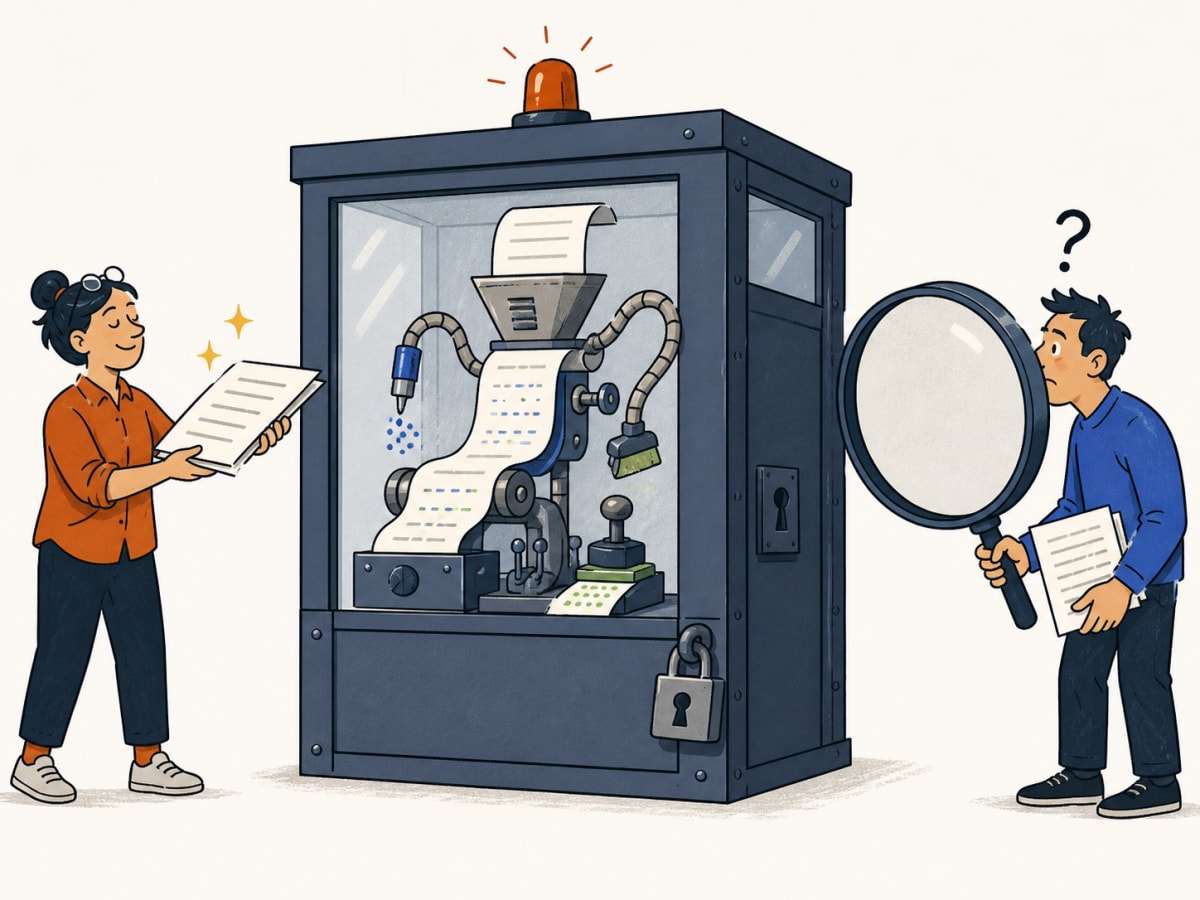
This is the non-obvious part of the rollout: it is not primarily an anti-cheating feature. It is a chain-of-custody feature arriving before the industry has agreed on who gets to read the chain. Until Anthropic publishes detector access, confidence semantics, and retention behavior, a mark should support a review process—not replace one.
The distinction matters for agent workflows too. Our guide to how to use Claude Fable 5 focuses on giving the model bounded work and checking what it does when it takes initiative. Watermarking adds another check: record which model touched the output, what transformation it performed, and whether the final artifact should be disclosed as AI-assisted.
What should teams change in their workflow now?
Teams using Claude for publishing, customer communication, translation, or code should treat provenance as a field in the workflow, not a last-minute label. Record the source artifact, model identifier, operation type, timestamp, reviewer, and destination. The goal is not to ban AI assistance. It is to make the assistance explainable when a downstream reader or regulator asks.
For text, preserve the original and the Claude-transformed version. For files, preserve metadata before conversion and record every export that could strip it. For agentic coding, keep the diff, tests, review decision, and model identity together. A watermark can tell you that a model touched something; it cannot tell you whether the change was correct, authorized, or safe.
That last point is consistent with our earlier MCP production checklist for authentication, permissions, logging, and recovery: a system needs identity, policy, evidence, and recovery as separate controls. Content marking belongs in the evidence layer. It is not permission, approval, or quality assurance.
What happens before December 2?
The next 30 days should answer three practical questions. First, will Anthropic ship a detector that customers, platforms, and researchers can use without special access? Second, will the detector report confidence and scope—for example, whether it found a full-document mark or only a short fragment? Third, will Anthropic publish enough technical detail for independent testing without making evasion trivial?
The December 2 deadline is the next visible checkpoint for older models. Watch whether Anthropic backfills marking consistently across Claude.ai, the API, Claude Code, and file-producing products, or whether behavior differs by surface. Also watch other providers. Google already has SynthID for text in Gemini experiences, and the EU’s code is likely to push providers toward different versions of the same provenance problem.
The signal that would change my read is not another announcement claiming “invisible” marking. It is evidence about false positives, short-text behavior, multilingual performance, detector access, and how marks survive ordinary document pipelines. Those details determine whether the system becomes useful provenance infrastructure or merely another opaque signal that organizations overinterpret.
The bottom line
Anthropic’s new watermark system makes Claude assistance part of an output’s technical provenance, even when a human supplied the original ideas or words. That is useful for transparency, but it is not an authorship verdict and it is not yet a complete accountability system.
If your team uses Claude in a workflow that ends in publication, customer communication, regulated records, or production code, start recording model involvement now. Keep originals, transformed versions, metadata, diffs, and human approvals. When detection arrives, you will have the context to interpret a mark instead of asking the mark to explain the entire history of the work.
What does Anthropic’s watermark mark?
It marks content generated or transformed by supported Claude models. Anthropic says text can contain an imperceptible statistical signal, while files can carry digital signatures in metadata.
Can Claude watermark human-written text?
Yes, if Claude processes it. Anthropic says proofreading, translation, summarization, formatting, and conversion can result in marked output even when the underlying ideas or words came from a person.
Can a watermark be removed?
Anthropic says detection may become harder after heavy editing, translation, mixing with other text, or when a passage is too short. File metadata can also be lost during conversion or screenshots. That does not make every mark removable, and it does not make an undetected mark proof that Claude was not involved.
Is there a public Claude watermark detector?
Anthropic says it is working to enable users and other entities to detect marks and metadata provenance. As of this article’s publication, the company’s public explanation does not describe a generally available detector with published confidence and false-positive characteristics.